10 Must-Visit Ancient Telescope Observatories Globally

As you stand on the shoulders of ancient astronomers, gazing into the night sky through their monumental creations, you’re not just looking at stars—you’re peering into humanity’s relentless quest for discovery.
These ancient telescope observatories, from the intricate mechanisms of the Jantar Mantar in India to the enigmatic alignments of Stonehenge, are not merely stone and metal; they are the legacy of human ingenuity and curiosity. They beckon you to journey across continents and epochs, to witness firsthand how our ancestors revealed the secrets of the cosmos.
Yet, this is merely the beginning. Imagine what secrets and stories lie untold, waiting for you to uncover them in these ancient astronomical theaters.
Key Takeaways
- Ancient observatories demonstrate advanced early astronomical knowledge and celestial navigation skills.
- These sites are architectural and design marvels, integrating astronomical functions with aesthetic appeal.
- They played a crucial role in the development of calendars, celestial mapping, and understanding cosmic movements.
- Preserving these observatories is vital for appreciating humanity’s long-standing fascination with the cosmos.
Origins of Astronomical Observations
Since ancient times, civilizations have meticulously charted the cosmos, utilizing rudimentary yet ingenious tools such as the astrolabe and sundials to decipher the mysteries of the stars and planets.
Among these early astronomers, the Sumerians and Babylonians stand out for their foundational contributions. Their observations, critical for agriculture, timekeeping, navigation, and religious rites, laid the groundwork for the intricate relationship between humanity and the heavens.
One notable example of these early astronomical endeavors is found within the boundaries of Chaco Culture National Historical Park. Here, ancient stone circles, not merely architectural feats but sophisticated celestial observatories, underscore the ingenuity of prehistoric peoples. These constructions weren’t random or purely aesthetic; they were meticulously aligned with celestial events, serving both as calendars and as tools for astronomical observation.
This detailed exploration into the origins of astronomical observations reveals a fascinating tapestry of human innovation. The use of simple yet effective tools like astrolabes and the construction of stone circles at sites like Chaco Culture National Historical Park are signs of humanity’s enduring quest to understand the cosmos. These early steps in astronomy paved the way for the advanced observatories and astronomical theories we benefit from today.
Architectural Marvels and Design
Throughout history, ancient observatories haven’t only served as platforms for celestial observation but also as architectural marvels, revealing the sophisticated design techniques of their creators without the aid of modern technology.
Take, for instance, the Beijing Ancient Observatory and Ulugh Beg Observatory, which integrate early astronomy technology and Islamic astronomical heritage into their structures. These sites exemplify how ancient builders merged functionality with aesthetic appeal, creating iconic landmarks that have withstood the test of time.
Similarly, El Caracol in Chichen Itza and the Radkan Tower in Iran exemplify the ingenuity of ancient civilizations in incorporating astronomical designs into their architecture. These structures weren’t solely for observation; they were significant archaeological sites that communicated a deep understanding of celestial movements through their very design.
The Goseck Circle in Germany, a Neolithic celestial calendar, and Zorats Karer in Armenia, known as the Armenian Stonehenge, further demonstrate the architectural ingenuity of ancient cultures. These ancient observatories employed precise alignments and stone placements to track celestial events, showcasing an advanced knowledge of astronomy long before the advent of modern tools.
Lastly, the Callanish Stones in Scotland and Chaco Culture National Historical Park in New Mexico stand as proofs to the exceptional architectural achievements of their builders, attracting visitors with their mysterious designs and astronomical precision.
Cultural and Scientific Contributions

Exploring these ancient observatories, you’ll uncover significant historical insights and observe the strides made in astronomy by early civilizations. Each site reflects the advanced understanding and meticulous observation of celestial bodies and phenomena, marking pivotal contributions to the scientific field.
Through your visit, you’ll appreciate how these ancient astronomers laid the groundwork for modern astronomical studies with their innovative approaches and precise calculations.
Historical Insights Gained
Delving into the annals of ancient observatories like the Beijing Ancient Observatory and Ulugh Beg Observatory reveals their pivotal roles in enhancing our understanding of early astronomical technologies and Islamic astronomical innovations, marking significant cultural and scientific contributions to the history of astronomy.
- Cultural Significance: Observatories such as Chaco Culture National Historical Park and El Caracol underscore the deep astronomical knowledge and cultural importance of celestial observations in ancient societies.
- Unique Perspectives: Radkan Tower, Zorats Karer, and the Callanish Stones offer insights into the diverse cultural beliefs and astronomical interpretations across different regions.
- Practical Applications: Goseck Circle and Kokino Observatory demonstrate the practical uses of celestial tracking for ancient civilizations, showing scientific ingenuity without modern technology.
- Rich Tapestry: Together, these ancient sites weave a complex narrative of humanity’s quest to understand the cosmos, highlighting the intertwined nature of cultural heritage and scientific discovery.
Advances in Astronomy
Building on the historical insights provided by ancient observatories, we now examine their cultural and scientific contributions to advancements in astronomy.
Observatories like the Beijing Ancient Observatory and Ulugh Beg Observatory weren’t merely architectural marvels; they were epicenters of early astronomy technology. Sites such as Chaco Culture National Historical Park in New Mexico and the Armenian Stonehenge, Zorats Karer, underscore the depth of astronomical knowledge these ancient civilizations possessed.
They meticulously observed celestial movements, laying the groundwork for our understanding of the cosmos. The precision with which these observatories were constructed to study sun and moon movements greatly contributed to the development of early calendars, showcasing a remarkable blend of science, culture, and architecture that continues to influence modern astronomy today.
Stargazing Through the Ages
As you explore ancient telescope observatories, you’ll uncover the evolution of astronomy from its rudimentary beginnings to the sophisticated practices observed today.
These sites reveal not only the technological advancements but also the cultural significance that stargazing held across civilizations, shaping rituals and calendars.
Additionally, understanding the origins of modern observatories through this historical lens highlights the continuum of human curiosity and our quest to comprehend the cosmos.
Ancient Astronomy Evolution
From basic observations of the night sky to the construction of sophisticated observatories, ancient civilizations greatly advanced the field of astronomy. You’ll find that the journey from mere stargazing to the establishment of astronomical observatories isn’t only fascinating but also indicative of the intellectual leaps made by early societies, particularly in the Middle East. Here’s how:
- Early Observations: Civilizations like the Egyptians and Babylonians cataloged stars, planets, and celestial events, laying the foundation for systematic study.
- Greek Contributions: The Greeks developed models of celestial movements, enhancing understanding to a great extent.
- Construction of Observatories: These structures enabled precise tracking of solstices, equinoxes, and planetary motions, showcasing advanced engineering and astronomical skills.
- Intellectual Advancements: The evolution reflects significant progress in mathematical, observational, and theoretical aspects of astronomy, pushing the boundaries of ancient science.
Stargazing Cultural Significance
Having explored the intellectual leaps achieved through ancient observatories, it’s now pertinent to examine how stargazing has woven itself into the fabric of various cultures throughout history.
This cultural practice, spanning millennia, reflects humanity’s deep fascination with the night sky. Ancient civilizations often integrated celestial events into their religious rituals and agricultural calendars, underscoring the importance of these observations.
Historical sites and stone circles around the globe serve as tangible evidence of ancient stargazing practices. Moreover, monasteries and spiritual locations, with their remote and serene settings, have historically been prime sites for observing the heavens.
Observatories located in natural environments like national parks provide unobstructed views of the sky, connecting visitors to the origins of humanity and highlighting the enduring significance of stargazing in human culture.
Modern Observatories Origins
The evolution of modern observatories traces back to ancient structures, demonstrating how early astronomy technology laid the groundwork for current celestial studies. These age-old observatories, some of the world’s oldest, have influenced the scientific methods used in modern astronomy. Here’s how:
- Beijing Ancient Observatory and Ulugh Beg Observatory: Pioneers in utilizing early astronomy technology, showcasing centuries-old dedication to celestial observation.
- El Caracol and Radkan Tower: These sites illustrate the historical evolution of astronomical observation methods, with unique architectural designs focused on tracking celestial bodies.
- Chaco Culture National Historical Park: Represents a network of ancient observatories within a single complex, highlighting the astronomical knowledge of indigenous peoples.
- Zorats Karer: Often compared to Stonehenge, this prehistoric site underscores the global reach and diversity of early stargazing practices.
This lineage of ancient observatories continues to inspire and inform the field of modern astronomy research and exploration.
Preserving Astronomical Heritage
Efforts to preserve astronomical heritage often involve meticulously protecting ancient observatories, such as the Beijing Ancient Observatory and Ulugh Beg Observatory, to make certain their stories and scientific contributions aren’t lost to time.
These sites, along with others like El Caracol, have provided insights into celestial events for thousands of years. Their structures, designed to track phenomena such as the winter solstice, showcase the advanced understanding of astronomy possessed by ancient civilizations.
Protecting unique structures like the Radkan Tower in Iran and Zorats Karer in Armenia is critical. These observatories serve as tangible links to how our ancestors interpreted the cosmos, emphasizing the necessity of their preservation for future generations.
Conservation efforts at locations such as Chaco Culture National Historical Park and Gobekli Tepe are essential in maintaining their astronomical relevance and historical value.
Initiatives to safeguard ancient observatories worldwide, including the Callanish Stones in Scotland and Goseck Circle in Germany, are crucial in preserving our cultural astronomy heritage. Recognizing and promoting the importance of sites like the Kokino Observatory in North Macedonia ensures the continuation of their astronomical legacy, allowing us to appreciate the depth of human curiosity and innovation throughout history.
Navigational Landmarks in Astronomy

As you explore ancient observatories, you’ll find that celestial navigation principles and the mapping of stars were fundamental to these sites’ construction and usage.
These landmarks served as pivotal tools for understanding the cosmos, employing sophisticated methods to chart the heavens without modern technology.
Their precise locations, often aligned with specific celestial events, underscore the advanced astronomical knowledge and navigational skills of ancient civilizations.
Mapping the Stars
Exploring the night sky, ancient astronomers used observatories as essential landmarks to chart the stars, revealing the universe’s vast mysteries. These early sky watchers at places like Chichen Itza and Gobekli Tepe demonstrated an advanced understanding of celestial movements before the telescope was even invented.
Here’s how they did it:
- Chichen Itza: Mayan astronomers used the El Caracol observatory to track Venus’s movements, which was vital for their calendar and rituals.
- Gobekli Tepe: This site challenges old theories with its megaliths, possibly marking solstices and equinoxes, predating settled agricultural societies.
- Beijing Ancient Observatory: Showcases intricate bronze instruments for celestial observation, highlighting early technological sophistication in astronomy.
- Ulugh Beg Observatory: Emphasizes the precision in star mapping, greatly contributing to the medieval Islamic world’s astronomical knowledge.
Celestial Navigation Principles
Building on our understanding of ancient observatories, it’s now time to examine how celestial navigation principles, using stars and planets as navigational landmarks, played a pivotal role in the advancement of early global exploration.
Ancient civilizations, such as the Greeks and Polynesians, mastered celestial navigation, relying on stars like Polaris, which maintains a nearly fixed position, to guide their long-distance sea voyages. This practice was grounded in a detailed understanding of celestial bodies’ motions relative to Earth, a knowledge base refined and passed down through generations.
Even today, these ancient techniques continue to inform navigation in aviation and maritime activities. The astronomical observatory, a cornerstone of ancient science, was instrumental in developing these navigational methods, demonstrating the enduring legacy of celestial navigation principles in human exploration.
Expanding the Frontiers of Science
The study of ancient observatories reveals how early civilizations pushed the boundaries of scientific understanding by meticulously observing celestial phenomena. You’ll find that these ancient sites weren’t only about marking time but also about expanding our grasp of the universe. Here’s how they did it:
- Innovative Design and Technology: Ancient observatories like the Beijing Ancient Observatory utilized the advanced technology of their time, showcasing early astronomy’s sophistication. Instruments were crafted with precision, allowing for detailed celestial observations without modern technology.
- Islamic Astronomical Advancements: The Ulugh Beg Observatory represents a pinnacle in Islamic astronomy, where scholars made significant contributions to the field, refining the positions of stars and understanding celestial movements with remarkable accuracy.
- Understanding Celestial Events: Sites such as the Callanish Stones and Goseck Circle reflect an early human fascination with the sun and moon, even older than previously thought. These observatories were engineered to mark significant celestial events, enhancing early societies’ agricultural and religious practices.
- Creating Calendars: The Kokino Observatory highlights the use of ancient markers to study sun and moon movements meticulously. This allowed for the creation of lunar calendars, essential for planning agricultural activities and religious ceremonies.
These observatories weren’t just about tracking time; they were laboratories where ancient astronomers expanded the frontiers of science, laying the groundwork for future discoveries.
Ancient Observatories Unveiled

Delving into ancient observatories reveals a world where early astronomers meticulously crafted structures to decipher the cosmos, marking significant advancements in our understanding of celestial phenomena. Each enigmatic site, spanning years of history, stands as proof of humanity’s enduring quest to grasp the vast unknown.
- At the Beijing Ancient Observatory, you’ll find an impressive collection of early astronomy technology. This site, lying at coordinates 39.9079, 116.4323, showcases China’s rich heritage in celestial observation, untouched by modern telescopes.
- Venture into Uzbekistan, where the Ulugh Beg Observatory, at coordinates 39.6750, 67.0050, lets light cascade into its ruins. This ancient Islamic observatory remains a pivotal site, echoing the sophisticated methodologies crafted by astronomers centuries ago.
- In New Mexico, the Chaco Culture National Historical Park, located at 36.0305, -107.9104, offers a glimpse into North America’s most complete ancient ruins. Its pueblos are monumental, hinting at a complex understanding of the stars.
- El Caracol, nestled in Chichen Itza at coordinates 20.6802, -88.5707, operates without telescopes, representing one of the oldest observatories. It underscores the ingenious ways early civilizations engaged with the sky.
- The Radkan Tower in Iran, built by Nasir al-Din Tusi at coordinates 36.7762, 59.0311, epitomizes the blend of architecture and astronomy, reflecting years of scholarly dedication to unraveling the cosmos’ mysteries.
The Art of Celestial Measurement
Exploring these ancient observatories further, it’s evident that their construction wasn’t only about marking celestial bodies but also about precisely measuring their movements through sophisticated instruments and methodologies. The remains of an observatory often reveal a deep understanding of the night sky, a proof of the ingenuity of ancient astronomers.
Here’s how they mastered the art of celestial measurement:
- Intricate Astronomical Instruments: These observatories housed specialized tools designed for tracking celestial events with remarkable accuracy, enabling the measurement of planetary movements and the timing of eclipses.
- Structural Alignments: Buildings and markers were aligned with specific celestial bodies or events, such as solstices and equinoxes, showcasing an advanced grasp of astronomical cycles.
- Mathematical Precision: The layout and design of these sites often incorporated complex mathematical formulas, reflecting an understanding of geometry and its application to celestial observations.
- Observational Records: Ancient astronomers meticulously recorded their observations, creating a valuable historical record that offers insights into their knowledge of celestial mechanics.
This analytical approach to studying the night sky highlights the advanced scientific understanding and technical capabilities of ancient societies in the field of astronomy.
Legacy of the Star Gazers
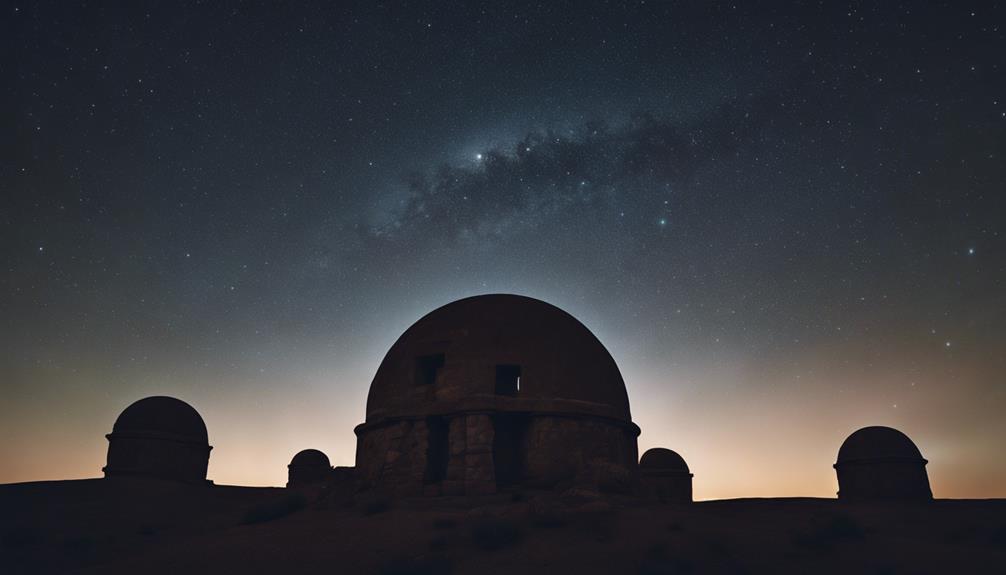
Ancient observatories, such as Gobekli Tepe, revolutionize our understanding of early astronomers’ legacies, challenging us to reconsider their depth of celestial knowledge. These sites, with their complex symbols and structures, suggest a sophistication that predates known historical timelines for astronomical advancements.
Gobekli Tepe, in particular, serves as a cornerstone for this discussion, offering a glimpse into an era where observing the stars wasn’t just science but was intertwined with daily life and spiritual beliefs.
| Observatories Around | Significance |
|---|---|
| Gobekli Tepe | Challenges conventional theories with its pre-agricultural and pre-religious origins, suggesting advanced astronomical practices. |
| T-shaped Pillars | Feature intricate carvings of animal motifs and complex symbols, hinting at a coded language to track celestial events. |
| Archaeological Speculations | Suggest the site may have functioned as an astronomical observatory, indicating a high level of scientific knowledge. |
| Ongoing Excavations | Aim to uncover the true intentions behind these unique structures, potentially rewriting parts of human history. |
| Controversies | Persist, fueling debates on the site’s astronomical significance and its role in understanding the cosmos. |
These elements combine to make sense of the legacy left by ancient stargazers, urging a deeper appreciation for the observatories around and their contributions to the tapestry of human knowledge.
Frequently Asked Questions
Where Are the Best Telescopes in the World Located?
You’re looking for the best telescopes worldwide, focusing on modern observatory technology and the evolution of telescope design. These advanced instruments are at the forefront of astronomical research, offering unparalleled insights into the universe.
What Are the Oldest Astronomical Observatories in the World?
You’ll find the oldest astronomical observatories showcase ancient observatory construction techniques, reflecting their cultural significance. These sites, from El Caracol to Zorats Karer, offer deep insights into early astronomy’s precision and societal importance.
Where Is the World’s Highest Telescope Observatory?
Looking for the world’s highest telescope observatory? It’s perched atop Mauna Kea in Hawaii, overcoming construction challenges at an altitude of 13,796 feet. This location offers unparalleled astronomical clarity, thanks to its high altitude effects.
What Is the Famous Prehistoric Astronomical Observatory?
You’re delving into Stonehenge, a famous prehistoric astronomical observatory. Its alignments with celestial bodies highlight its cultural significance, offering insights into ancient cosmology and engineering. Analyzing these aspects reveals Stonehenge’s technical and detailed construction marvels.
Conclusion
You might think ancient observatories are merely relics, but they’re proof of humanity’s enduring quest to decode the cosmos.
These architectural marvels not only showcase early scientific ingenuity but also highlight the cultural significance of stargazing through ages.
By preserving these sites, we honor our ancestors’ legacy and continue expanding scientific frontiers. Exploring these observatories offers a unique lens into the art of celestial measurement, making them essential visits for anyone fascinated by the intersection of history, culture, and astronomy.
