3 Big Space Telescope Advances Shaping Our View of the Cosmos
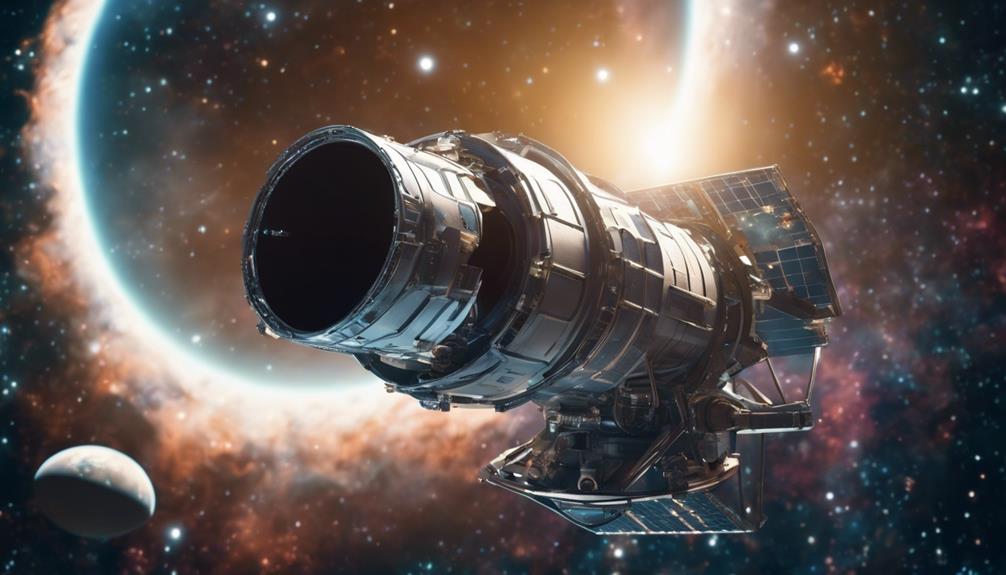
As we’ve gently nudged the boundaries of our cosmic backyard, three monumental advances in space telescope technology have quietly revolutionized your understanding of the universe.
You’ve witnessed the power of advanced adaptive optics clearing the blur between us and the stars, spectroscopic breakthroughs unraveling the chemical DNA of distant worlds, and innovative exoplanet discovery techniques revealing neighbors previously hidden in the vast cosmic sea.
These tools have not only expanded what you see but also how you perceive the very fabric of space.
Imagine what lies just beyond the horizon of our current knowledge, waiting for you to uncover it.
Key Takeaways
- Advanced adaptive optics counteract atmospheric distortions, enhancing clarity in cosmic observations.
- Spectroscopic breakthroughs reveal the chemical compositions of distant exoplanets, hinting at their habitability.
- Various exoplanet discovery techniques, including the transit method and direct imaging, expand our knowledge of the universe.
- Technological advancements in space telescopes promise unprecedented discoveries in astronomy and cosmic evolution.
Advanced Adaptive Optics
Harnessing the power of Advanced Adaptive Optics, telescopes now counteract Earth’s atmospheric distortions, delivering unparalleled clarity in observing distant cosmic phenomena. This technology leverages sophisticated deformable mirrors and sensors to adjust for atmospheric turbulence in real-time.
By doing so, it guarantees the blurring and distortion effects that Earth’s atmosphere imposes on astronomical images. Through these corrections, telescopes achieve near-diffraction-limited imaging, allowing astronomers to capture sharper and more detailed views of celestial objects than ever before.
Advanced Adaptive Optics systems are pivotal in ground-based astronomy, overcoming the limitations that atmospheric turbulence has traditionally imposed. By continuously adjusting the shape of deformable mirrors to counteract the ever-changing distortions, these systems guarantee that the collected astronomical data is of the highest quality.
This real-time correction enables the acquisition of images with a clarity that rivals, and in some aspects surpasses, those taken by telescopes located in space, free from atmospheric interference.
The implementation of Adaptive Optics has revolutionized the field, providing astronomers with unprecedented views of distant galaxies, stars, and planetary surfaces. It marks a significant leap forward in our ability to explore and understand the universe from ground-based observatories.
Spectroscopic Breakthroughs
Building on the foundation of advanced optical technologies, the Webb Space Telescope’s spectroscopic breakthroughs offer a detailed window into the chemical makeup of distant exoplanet atmospheres.
You’re now at the forefront of discovering the mysteries of the cosmos, thanks to Webb’s advanced spectrographs. These instruments are pivotal in detecting specific molecules, such as water vapor and carbon dioxide, which are essential markers in understanding the habitability of these distant worlds.
| Capability | Impact | Key Molecules Detected |
|---|---|---|
| Exoplanet Atmospheres | Reveals potential habitability | Water Vapor, Carbon Dioxide |
| Evolution of Galaxies | Offers insights into galaxy formation | – |
| Stars Properties | Details physical and chemical properties | – |
| Origins of the Universe | Helps decipher the universe’s beginnings | – |
| Cosmic Structures | Aids in understanding cosmic evolution | – |
This table encapsulates how Webb’s spectroscopic observations are revolutionizing our understanding of not just exoplanet atmospheres but also the evolution of galaxies, the properties of stars, and the very origins of the universe. By dissecting the light from these cosmic entities, you’re gaining unparalleled insights into their composition, behavior, and role in the grand tapestry of the cosmos.
This analytical approach not only sharpens our knowledge of the universe’s current state but also its past, opening new avenues for deciphering the fundamental processes shaping cosmic structures.
Exoplanet Discovery Techniques
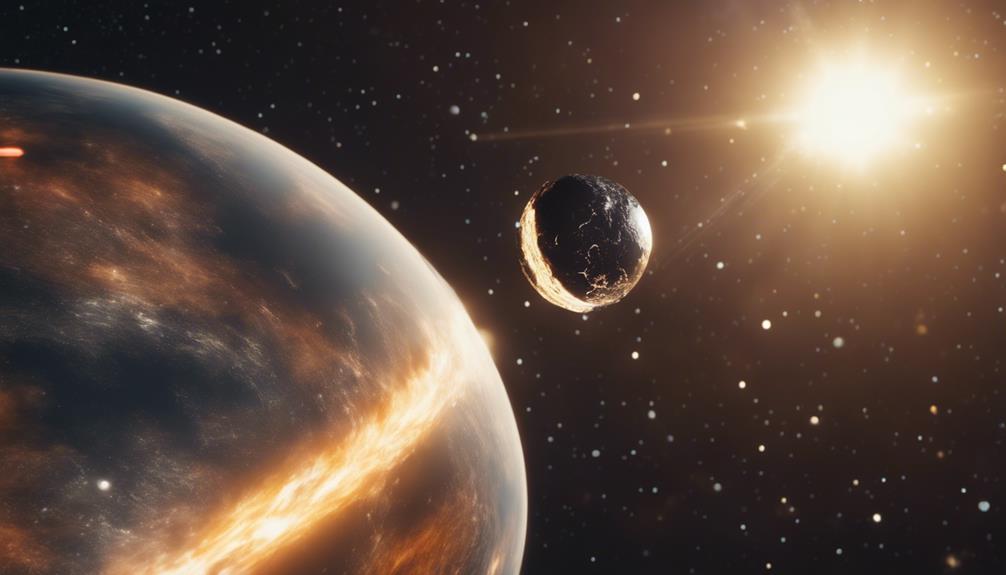
Exploring the vast universe, scientists employ a variety of exoplanet discovery techniques, such as the transit method, radial velocity approach, direct imaging, microlensing, and astrometry, to expose the mysteries of distant worlds orbiting other stars.
These methods each have their own unique advantages and challenges, contributing to a thorough understanding of exoplanets.
- Transit Method: It’s all about timing and dimming. You look for the slight dip in a star’s brightness when a planet passes in front of it. This method not only confirms the presence of an exoplanet but can also provide information about its size.
- Radial Velocity Method: This technique measures the star’s wobble caused by the gravitational pull of an orbiting planet. It’s like detecting a gentle sway in the star’s movement, revealing the planet’s mass and sometimes its orbital shape.
- Direct Imaging: Probably the most visually enchanting, this method takes actual pictures of planets by using a coronagraph to block out the star’s blinding light. It’s akin to taking a photo of a firefly flitting around a lighthouse beam from miles away.
Microlensing and astrometry, while less commonly used, further enrich the toolkit for exoplanet discovery, analyzing light bending around a planet and the minuscule shifts in a star’s position, respectively. Together, these techniques are revolutionizing our understanding of the cosmos.
Frequently Asked Questions
How Have Telescopes Changed Our View of the Universe?
Telescopes have revolutionized your understanding by uncovering dark matter, analyzing exoplanet atmospheres, and detailing the cosmic microwave background. You’ve gained insights into star formation, galaxy shapes, interstellar mediums, quasar traits, supernova remnants, and imaged black holes.
Why Are Space Telescopes So Important to Our Understanding of the Universe?
Space telescopes are your windows into the universe’s soul, revealing dark matter, exoplanet atmospheres, and the cosmic microwave background. They offer insights into star formation, galaxy evolution and estimate the universe’s age with unparalleled precision.
How Will the James Webb Space Telescope Increase Our Knowledge of the Universe?
The James Webb Space Telescope’s infrared capabilities will unravel exoplanet atmospheres, illuminate star formation, and map dark matter. You’ll witness the early universe, explore the cosmic web, and analyze galaxy evolution through detailed spectroscopic analysis and gravitational lensing.
How Has the Hubble Space Telescope Expanded Our Knowledge of the Universe?
How’s your universe expanding? Hubble’s research sheds light on galaxy classification, stellar evolution, and dark matter evidence. It’s pinpointed cosmic distances, discovered exoplanets, explored nebula studies, imaged black holes, observed supernovae, and uncovered gravitational lensing, revealing intergalactic connectivity.
Conclusion
In sum, you’re witnessing a transformative era in cosmic exploration, where advanced adaptive optics, spectroscopic breakthroughs, and exoplanet discovery techniques are the linchpins.
This trio not only sharpens our cosmic perspective but also uncovers the universe’s secrets in unprecedented detail.
It’s as if we’ve been given a new lens, revealing the cosmos’ intricate tapestry with clarity never seen before.
These advancements aren’t just expanding our knowledge; they’re reshaping our understanding of the universe’s very fabric.
