5 Must-Visit Observatories for Stellar Views

In the domain of celestial exploration, few places offer the awe-inspiring clarity of the night sky quite like the observatories dotting our planet.
As you set off on a journey to uncover the mysteries of the cosmos, Lowell Observatory in Flagstaff, Arizona, serves as a prime starting point. Known for its pivotal role in the discovery of Pluto and designated as an International Dark Sky City, this observatory isn’t just a window to the stars—it’s a gateway to understanding the universe.
But why stop there? The road less traveled by amateur astronomers leads to other global giants, each with its own unique contributions to science and mesmerizing views of the heavens.
Let’s explore what makes these observatories must-visit destinations for anyone looking to connect with the vastness of our universe.
Key Takeaways
- Mauna Kea Observatories in Hawaii offer the world’s largest astronomical observatory with 13 facilities.
- Kitt Peak National Observatory in Tucson features 24 optical and two radio telescopes for diverse astronomical studies.
- Paranal Observatory in Chile provides exceptional stargazing quality with clear skies and guided tours.
- Mount Lemmon SkyCenter in Tucson offers educational tours and stargazing programs, ideal for both enthusiasts and families.
Pioneering the Cosmos
Exploring the cosmos has led to groundbreaking discoveries, and observatories like Lowell Observatory in Flagstaff, Arizona, have been at the forefront, where the theory of the expanding universe was first developed.
This pivotal development in astronomy underscores the critical role observatories play in our understanding of the cosmos. Observatories such as Kitt Peak National Observatory in Tucson, Arizona, with its 24 optical and two radio telescopes, offer unparalleled opportunities for research and public viewing, further enhancing our grasp of stellar phenomena.
The Mount Graham International Observatory, situated at an impressive altitude of 10,400 feet above sea level in Safford, Arizona, exemplifies the lengths to which astronomers go to obtain clearer views of the cosmos, free from atmospheric interference. Similarly, the Fred Lawrence Whipple Observatory in Amado, Arizona, is renowned for its advanced research in gamma-ray astronomy, pushing the boundaries of what we understand about the most energetic forms of light.
Lastly, the Mount Lemmon SkyCenter, also in Tucson, combines educational tours with professional stargazing programs, making the wonders of the universe accessible to both the public and the scientific community.
Each of these observatories contributes to a deeper, more detailed understanding of the cosmos, offering stellar views that aren’t just visually stunning but scientifically significant.
Charting the Heavens
Amid the quest for understanding the cosmos, the Mauna Kea Observatories in Hawaii stand out, hosting 13 astronomical observatories that offer unparalleled views and insights into the night sky. You’re not just looking at stars; you’re diving deep into the fabric of the universe, guided by some of the most advanced telescopes on Earth.
To make this exploration even more enchanting, consider these key points:
- Diverse Telescope Array: From the W.M. Keck Observatory’s twin telescopes in Hawaii to the 27 radio telescopes forming the Very Large Array in New Mexico, you’ve got a wide range of instruments. Each is uniquely tailored for different aspects of celestial observation, from optical to radio wavelengths.
- Public Engagement: Observatories like Kitt Peak and McDonald offer robust public programs. You can engage in Nightly Observing sessions, live sun viewings, or star parties, making the science accessible and exciting.
- Historical and Cutting-Edge Technology: Witness the blend of history and innovation with Griffith Observatory’s historic Zeiss telescope and the cutting-edge Hobby-Eberly Telescope in Texas.
- Celestial Observations: These facilities aren’t just for show. They’re instrumental in discovering and studying celestial objects across the universe, from planets in our solar system to distant galaxies.
Global Giants
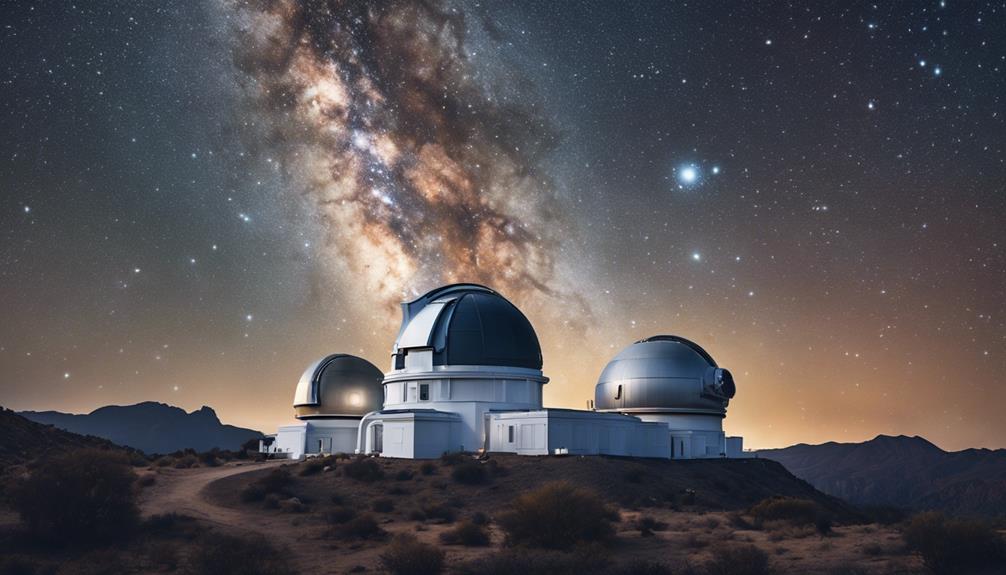
Venture to the world’s distinguished observatories, where their strategic locations and advanced technologies reveal unparalleled vistas of the cosmos. The Mauna Kea Observatories, perched atop Hawaii’s highest peak, leverage high altitude to peer into the universe’s depths with minimal atmospheric interference.
Similarly, the Atacama Desert offers stargazing experiences unmatched globally, thanks to its arid climate and high elevation, which reduce cloud cover and light pollution.
| Location | Unique Attributes |
|---|---|
| Mauna Kea Observatory | The world’s largest astronomical observatory, high elevation for crystal-clear views. |
| Atacama Desert | Minimal cloud cover, virtually no light pollution, renowned for the best stargazing spots. |
| Grand Canyon | Clear skies, a magnificent backdrop, and opportunities for amateur astronomers. |
The Grand Canyon, with its vast open skies, provides a dramatic setting for stargazing. Its North Rim, less frequented by tourists, offers serene darkness. Further south, the Mt. John Observatory, nestled in a Dark Sky Reserve, offers observatory tours that enlighten both amateur astronomers and curious minds.
Australia’s Warrumbungles National Park, home to the Siding Spring Observatory, enables public viewing in a pristine Dark Sky Park setting, offering exceptional stargazing quality.
The Eyes of Science
Diving into the heart of astronomical research, observatories like Lowell in Flagstaff became pivotal platforms where theories such as the expanding universe weren’t merely proposed but meticulously developed.
These facilities aren’t just about stargazing; they’re the eyes of science, peering into the cosmos to unravel its mysteries.
- Lowell Observatory: Positioned in Flagstaff, this iconic site is where the concept of an expanding universe took shape, marking a cornerstone in modern astronomy.
- Mount Graham International Observatory: Elevated at 10,400 feet, its high altitude offers clearer skies, enhancing the capabilities of its telescopes for more detailed astronomical research.
- Kitt Peak National Observatory: Home to 24 optical and two radio telescopes, it stands as a beacon for both public engagement and cutting-edge astronomical research in Tucson.
- Fred Lawrence Whipple Observatory: Specializing in gamma-ray astronomy, it showcases the diverse scientific pursuits within the field, extending beyond traditional optical observations.
Each of these observatories offers tours and public viewing sessions, led by professional astronomers. They serve as educational hubs where the public can engage with astronomy on a deeper level, all under the watchful eyes of the telescopes that continue to push the boundaries of our cosmic understanding.
Listening to the Stars
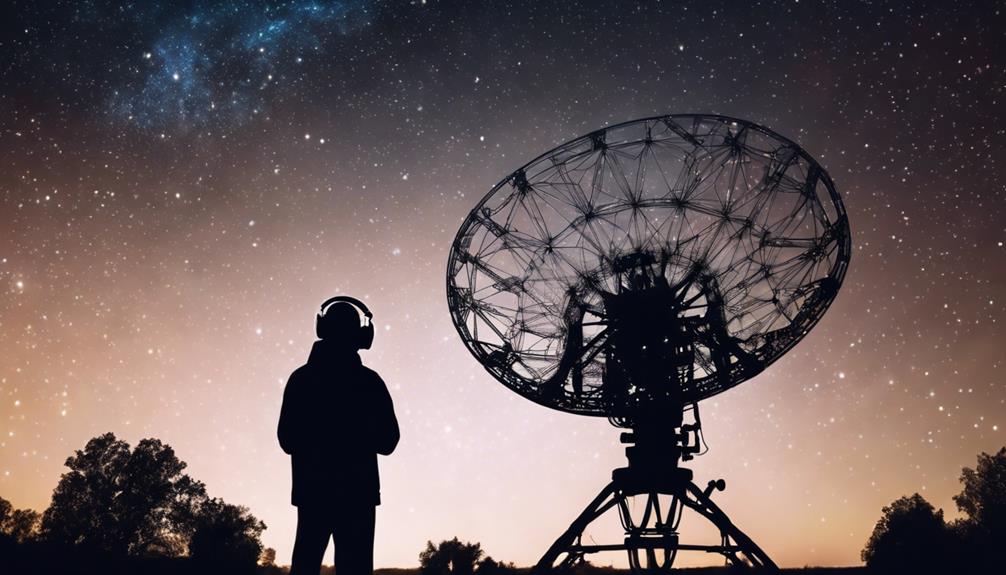
Radio telescopes, such as those at the Karl G. Jansky Very Large Array in Socorro, New Mexico, transform the art of stargazing by capturing radio waves emitted by stars and galaxies, offering a unique perspective on the universe’s complexities.
Operated by the National Radio Astronomy Observatory, these radio telescopes are pivotal in dissecting the intricacies of celestial objects and cosmic phenomena that are invisible to the naked eye or even optical telescopes.
By meticulously analyzing radio signals, scientists investigate the heart of pulsars, expose the mysteries surrounding black holes, and decode the cosmic microwave background radiation—each element is an essential piece in the puzzle of the universe’s structure.
This approach allows for an unparalleled mapping of celestial events and an in-depth understanding of the dynamics driving the universe’s evolution.
The study of radio astronomy, therefore, lays bare the composition of the universe, providing a foundation for theories on the dynamics and evolution of the cosmos.
Through these observations, the National Radio Astronomy Observatory’s radio telescopes offer not just a window, but a thorough lens into the ongoing narrative of the universe, marking a significant leap in our quest to understand the vast expanse beyond our planet.
Frequently Asked Questions
What Has an Observatory and Is One of the Best Observation Sites on Earth?
Mauna Kea’s observatory, a prime observation site, benefits from dark skies, mitigating light pollution’s effects. Its advanced telescopes and architecture enhance astronomical photography and stargazing, integrating indigenous astronomy with modern celestial navigation and astro-tourism growth.
Where Is the Best Place on Earth to See the Stars?
You’re on a celestial quest, where stars aren’t just lights in the sky but jewels in the universe’s crown. The best place? It’s where Dark Sky Reserves meet minimal light pollution, guided by stargazing apps.
What Is the Best Observatory to Visit in California?
For the best observatory visit in California, Griffith Park’s Observatory stands out. It hosts star parties, offers night photography opportunities, and has public telescopes. Its astronomy talks, sunset views, and educational programs enhance the experience.
Where Is the Most Famous Observatory?
The most renowned observatory, Griffith Observatory, leads in design innovations and technology trends. It’s pivotal in dark sky preservation, offers extensive public access for stargazing events, and champions educational programs on celestial observations.
Conclusion
As you’ve set sail on this celestial journey, remember, the universe is a grand tapestry, and observatories are its finest needles, threading through the cosmos to unravel its mysteries.
Each visit offers a unique lens to peer through the fabric of space, merging science with the sublime.
Whether charting unknown galaxies or whispering with the stars, these observatories stand as sentinels, guiding us in our quest to comprehend the vast, star-studded skies.
Embrace this expedition, for through the eyes of science, the universe unfolds.
