7 Smart Steps to Pick Your Ideal Planet-Watching Telescope

When Galileo first pointed his telescope toward the heavens over 400 years ago, he couldn’t have imagined the advancements we’d see today in our quest to observe distant planets.
As you start on your own celestial journey, you’ll find that picking the right telescope isn’t just about magnification or the biggest aperture you can afford. It’s a nuanced decision where factors like portability, the type of mount, and even the telescope’s ability to withstand your local atmospheric conditions play pivotal roles.
If you’re curious about how these elements come together to enhance your planet-watching experience, you’ll want to contemplate the following steps carefully.
Key Takeaways
- Choose a telescope with a large aperture and long focal length for detailed planetary observations.
- Opt for an equatorial mount for precise tracking and easier observation of planets.
- Consider the telescope’s portability and ease of setup to enjoy planet-watching from various locations.
- Regular maintenance and proper care ensure your telescope remains in prime condition for clear, detailed astronomical viewing.
Understanding Telescope Varieties
Why should you care about the variety of telescopes available? Different types offer distinct advantages, depending on your astronomical interests and goals. Delving into the technicalities, the aperture and focal length are critical in determining a telescope’s capability. A larger aperture allows more light to enter, enhancing the brightness and detail of celestial objects. The focal length, on the other hand, influences the magnification and field of view.
Reflectors, utilizing mirrors for image formation, present a cost-effective choice with the potential for larger apertures. Among reflectors, Newtonian telescopes stand out for their affordability and exceptional light-gathering prowess, making them ideal for deep-sky observations. However, their design may require more frequent adjustments compared to other types.
On the flip side, catadioptric telescopes, which blend lenses and mirrors, offer compact and versatile solutions. Schmidt-Cassegrain models, a subset of catadioptric telescopes, are particularly noted for their balance between portability and performance.
Their adaptability to various mounts, such as the German Equatorial, enhances their appeal to both beginners and seasoned astronomers seeking a thorough astronomical experience.
Assessing Aperture Significance
Having explored the variety of telescopes and their features, it’s imperative to focus on the importance of aperture size and its role in elevating your planet-watching experience. The aperture, being the diameter of the telescope’s primary lens or mirror, is critical for capturing light and enhancing the brightness of celestial bodies.
A larger aperture telescope doesn’t just gather more light; it greatly improves the resolution and detail of the planets you’re observing, making it a critical factor in your choice of a planet-watching telescope.
Consider these points when evaluating aperture importance:
- Larger aperture sizes allow for a greater ability to gather light, directly impacting the clarity and detail of the planetary views.
- Enhanced brightness is achieved through larger apertures, making dim objects more visible and detailed.
- Resolution detail is markedly improved, allowing you to see finer details on planets, which smaller apertures might miss.
- The primary lens or mirror diameter is the defining measure of a telescope’s aperture size, guiding you towards better performance in planet watching.
Prioritizing aperture size in your selection process will undeniably optimize your viewing experience, ensuring you enjoy the marvels of the night sky with unparalleled clarity and detail.
Focusing on Focal Length
In addition to considering aperture size, it’s vital to focus on the focal length of your telescope for ideal planetary observation.
A long focal length, around 4 meters (4000mm), greatly enhances detail visibility, making it important for observing the fine details of planets in the night sky. Brands like Celestron and Meade offer telescopes with long focal lengths, ideal for this purpose.
The high spatial resolution achieved with a longer focal length is key to capturing the intricate features of planets. This clarity is what allows you to distinguish between the subtle bands on Jupiter and the rings of Saturn with precision.
To further boost your planetary observation capabilities, consider using Barlow lenses. These accessories can effectively double or triple your telescope’s focal length, enhancing detail visibility without the need for a larger, more cumbersome instrument.
Below is a comparison of features related to focal length and their impact on planetary observation:
| Feature | Impact on Planetary Observation |
|---|---|
| Long Focal Length | Enhances detail visibility |
| High Spatial Resolution | Captures fine planetary details |
| Barlow Lenses | Increases clarity and detail |
| Brands (Celestron, Meade) | Offer suitable long focal lengths |
| Telescope Size | Improved clarity in the night sky |
Focusing on these aspects will make sure you choose a telescope that brings the wonders of the universe into sharp relief.
Comparing Mount Types
After examining the importance of focal length for planetary observation, let’s now explore how different mount types can affect your stargazing experience. The mount you choose plays a pivotal role in tracking celestial objects and can have a major impact on your observation or astrophotography pursuits.
- Equatorial Mounts: These are designed for serious stargazers and astrophotographers. Equatorial mounts compensate for Earth’s rotation, enabling precise tracking of celestial objects. They’re indispensable for astrophotography, allowing for long exposure times without star trails.
- Alt-azimuth Mounts: Ideal for beginners, these mounts move vertically (altitude) and horizontally (azimuth). They’re straightforward for manual tracking but require frequent adjustments to keep objects in view, making them less suited for long exposure astrophotography.
- Dobsonian Mounts: Known for their simplicity and stability, Dobsonian mounts are excellent for visual observation, especially for beginners. However, they generally lack the automatic tracking features of more advanced mounts.
- Mount Selection: Your choice should align with your observing goals. For visual observation, a Dobsonian or alt-azimuth mount might suffice. Conversely, equatorial mounts are essential for serious astrophotography efforts due to their tracking precision.
Choosing the right mount is important for enhancing your planet-watching experience, whether you’re observing visually or capturing the night sky through astrophotography.
Considering Portability and Setup
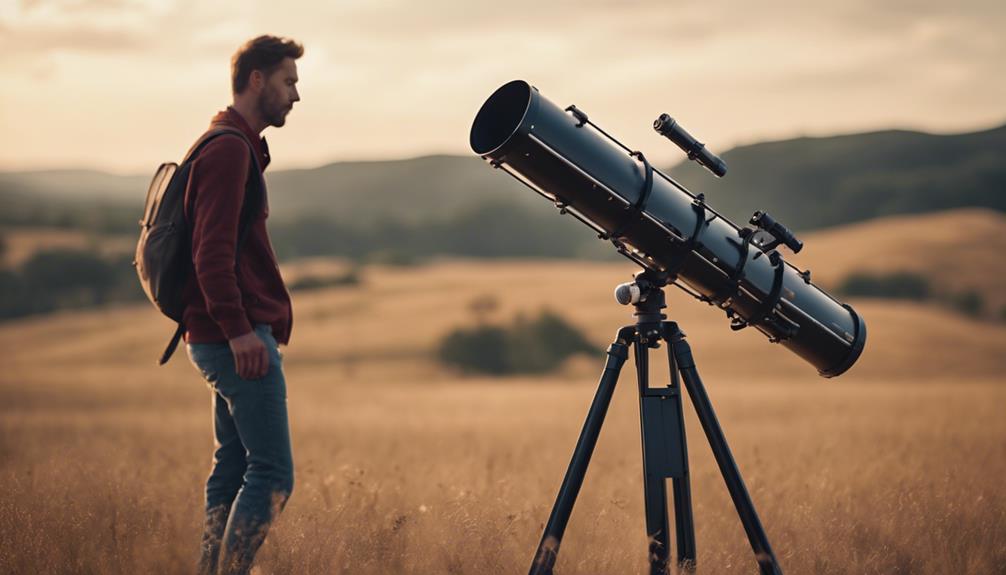
When considering a telescope for planet-watching, it is crucial to evaluate its portability and how easily it can be set up. Portability isn’t just about the ease of carrying your telescope; it’s about the freedom that allows you to explore various celestial wonders from different locations.
For avid planet observers, the perfect telescope combines lightweight design with hassle-free assembly, enabling quick setups for impromptu observation sessions.
| Feature | Importance | Impact on Planet Observation |
|---|---|---|
| Weight | High | Eases transport, allowing observations from various locations |
| Size | High | Compact designs facilitate storage and mobility |
| Foldable Design | Medium | Simplifies assembly/disassembly for frequent movement |
| Sturdy Mounts | Critical | Ensures stable, clear views of celestial bodies |
Choosing a telescope that emphasizes setup ease, such as tabletop models, can enhance your planet-watching experience, especially for beginners.
Compact telescopes, like Maksutov-Cassegrains, offer an excellent balance between portability and robust viewing capabilities. They are crafted to be light and easy to handle, making them perfect for on-the-go stargazing.
Additionally, selecting a telescope with a sturdy mount is non-negotiable; it is the foundation of a steady, enjoyable planet observation session, ensuring that your celestial views remain undisturbed by vibrations or movements.
Accessorizing Your Telescope
Having considered the importance of portability and setup for your telescope, let’s now focus on enhancing your planet-watching experience with the right accessories. These not only elevate the functionality of your telescope but also guarantee a more detailed and documented observation process.
- Smartphone Adapters: These ingenious devices allow you to affix your smartphone to the telescope. This setup enables the capture of breathtaking images of planets and other celestial objects, making your observations not just scientific but also visually memorable. It’s a step towards astrophotography without the need for expensive, professional equipment.
- Bluetooth Remotes: For those seeking precision in celestial tracking, Bluetooth remotes are indispensable. They offer you the convenience to adjust your telescope’s orientation remotely, ensuring that your viewing experience isn’t hampered by manual adjustments. This is particularly useful for maintaining precise viewing angles on your astronomical subjects.
- Astronomy Software: Certain telescopes come bundled with specialized software packages designed to enhance your astronomical journey. This software can provide detailed charts, object databases, and even guided tours of the night sky, enriching your understanding and experience.
- Lab Notebook: Keeping a meticulous record of your observations, including dates, times, viewing conditions, and details of celestial objects observed, is important. A lab notebook serves as a personal astronomy log, enabling you to track your progress, note discoveries, and refine your observation techniques over time.
Incorporating these accessories into your planet-watching endeavors not only augments the quality of your observations but also contributes significantly to the documentation and analysis of celestial phenomena.
Long-Term Care and Maintenance
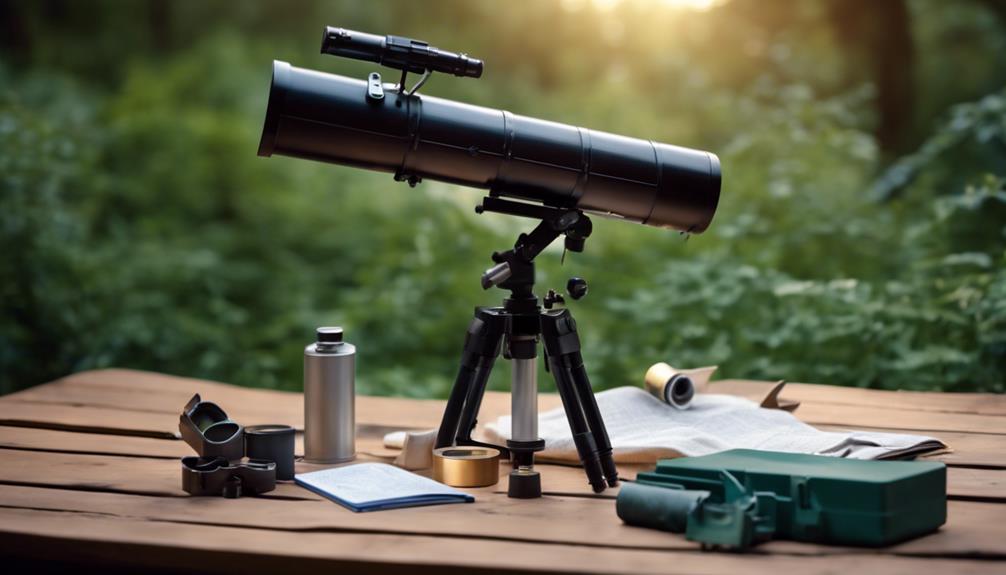
To guarantee your telescope remains in prime condition for years of planet-watching, it’s essential you adopt a regimen of regular cleaning, proper storage, and annual maintenance checks.
You’ll need to meticulously clean the optics with a soft brush or compressed air, and store your device in a dry, dust-free space to shield it from damage.
Additionally, aligning your telescope accurately and checking its components annually can prevent tracking issues and sustain clear viewing, enhancing your astronomical observations.
Regular Cleaning Procedures
Maintaining your telescope’s peak performance requires regularly cleaning its optics with a soft brush or compressed air to remove any dust and debris. This step is essential in preventing dirt buildup that could compromise your viewing quality.
Here are essential points to make sure your telescope delivers sharp images consistently:
- Regular cleaning procedures are important to keep the telescope in a dust-free condition.
- Periodically check for alignment and collimation to guarantee peak performance.
- Store your telescope in a dry, dust-free environment to prevent potential damage.
- Avoid touching the lenses or mirrors with bare hands to maintain optical clarity.
Following these guidelines meticulously will prolong the lifespan of your telescope and guarantee that your celestial observations remain clear and precise, enhancing your planet-watching experiences.
Storage and Protection Tips
Proper storage conditions, including a dry, dust-free environment, are essential for preserving your telescope’s optics and components over the long term.
To guarantee peak performance and longevity, adhere to meticulous cleaning routines for lenses and mirrors using specialized tools. This step not only maintains clarity but also prevents abrasive damage.
Avoid direct contact with optical surfaces; fingerprints can degrade viewing quality through smudges and scratches. Regularly assess and adjust alignment to make sure precise observations. These protection tips and maintenance practices safeguard the intricate workings of your telescope, ensuring consistent, high-quality celestial experiences.
Annual Maintenance Checks
Beyond the day-to-day care, setting aside time each year for thorough maintenance checks guarantees your telescope remains in prime condition for observing the cosmos.
- Collimation: Regularly check your telescope’s collimation to make sure the alignment is perfect. Misalignment can greatly blur your views of the planets, making this check important for clear, crisp images.
- Stability Inspection: Examine the mount and tripod for stability. Adjustments may be necessary to maintain smooth tracking and prevent wobbling during use.
- Optics Cleaning: Gently clean the optics with a soft brush or compressed air to remove dust and debris. This step is essential for preserving the quality of your observations.
- Lubrication and Storage: Lubricate moving parts as needed to ensure smooth operation. Additionally, store your telescope in a protective case to protect it from dust, moisture, and damage.
Annual checks focusing on these aspects of telescope maintenance—collimation, stability, optics cleaning, lubrication, and storage—guarantee your equipment’s longevity and performance.
Frequently Asked Questions
How Do You Choose the Perfect Telescope?
To choose the perfect telescope, consider your budget, location, portability, optical design, maintenance ease, brand reliability, accessory options, and upgrade potential. Analyzing these factors guarantees you’ll find a telescope that meets your specific needs.
How Good of a Telescope Do I Need to See Planets?
To see planets clearly, you’ll need a telescope with high magnification limits, great light gathering, stable mount, superior optical quality, carefully chosen eyepieces, large aperture size, considering viewing conditions for capturing those crisp planetary details.
What Is the Best Telescope for Viewing Planets for Beginners?
For beginners, the best telescope balances aperture importance, mount stability, and budget considerations. Opt for a reliable brand, robust optical design, suitable eyepiece selection, mindful of light pollution and magnification limits to enhance planetary viewing.
How Do I Choose an Astronomy Telescope?
To choose an astronomy telescope, assess optical quality and mount type for stability. Consider aperture size for clarity, focal length for detail, and portability. Plan your budget, factor in accessories essentials, and account for light pollution.
Conclusion
To sum up, selecting your ideal planet-watching telescope is akin to choosing the best spaceship for your celestial journey.
You’ve learned the importance of balancing aperture size with focal length, the nuances of mount types, and the significance of portability.
With the right accessories and a commitment to maintenance, you’re set to explore the universe’s wonders.
Remember, it’s not just about the specs—it’s about how your telescope serves your stargazing quest.
Now, set off on your astronomical adventure with confidence.


