A Look Back: The Evolution of Telescopes Through Time

Isn’t it a coincidence that you’re looking up at the night sky just as we’re about to initiate a journey through the evolution of telescopes? You’ve likely marveled at the stars, but have you considered how our ability to observe them has transformed over centuries?
From Galileo’s modest lens to the James Webb Space Telescope, each leap in technology has peeled back a layer of the universe’s mysteries. Let’s explore this progression together, and you might just find yourself seeing the night sky in a whole new light, enthusiastic to uncover what lies beyond each discovery.
Key Takeaways
- The invention of the refracting telescope in 1608 marked the beginning of astronomical breakthroughs.
- Advances like adaptive optics and space telescopes have drastically improved observation quality.
- Radio and infrared telescopes have unveiled previously hidden cosmic phenomena.
- The evolution of telescopes has expanded our understanding beyond the visible spectrum.
The Dawn of Astronomy: Refracting Telescopes
The advent of refracting telescopes in the early 17th century marked a pivotal moment in astronomy, as innovators like Hans Lippershey and Galileo Galilei harnessed lenses to reveal the mysteries of the cosmos.
This period witnessed the evolution from rudimentary optical aids to sophisticated instruments capable of magnifying distant celestial bodies. Led by figures such as Galileo, the refracting telescope became a powerful tool, revolutionizing our understanding of the universe.
Galileo’s application of refracting telescopes revealed unprecedented views of the Moon’s craters, Jupiter’s moons, and Venus’s phases, challenging prevailing cosmological models. However, these early telescopes weren’t without their flaws. Chromatic aberration, a distortion resulting from lenses refracting different colors of light to varying degrees, marred the clarity of celestial observations.
This limitation spurred further scientific inquiry into lens design, pushing the boundaries of material science and optical engineering.
Despite the inherent drawbacks, the contributions of Lippershey, Galileo, and their contemporaries can’t be overstated. Their pioneering work laid the foundational principles of modern astronomical observation, demonstrating that even the sky wasn’t the limit for human curiosity and ingenuity.
The Reflecting Revolution: Introduction of the Mirror
In 1668, Sir Isaac Newton’s invention of the reflecting telescope, utilizing mirrors to bypass refraction issues, marked a pivotal shift in astronomical observation.
This innovation, replacing lenses with mirrors to reflect light, eliminated the distortion caused by refraction, allowing for clearer, more precise images. Newton’s design laid the groundwork for the concept of using greater reflecting power to observe the cosmos, fundamentally altering the course of astronomical research.
The introduction of the reflecting telescope didn’t just improve image quality; it allowed for the construction of telescopes with much larger apertures. This increase in size was instrumental in enhancing the reflecting power of telescopes, enabling astronomers to capture fainter, more distant objects.
This capability was critical in the development and validation of the concept of extragalactic studies, expanding our understanding of the universe.
Advancements in materials like Pyrex, Cer-Vit, and Zerodur further revolutionized reflecting telescopes in the 20th century, improving their durability and performance. These materials reduced the deformation of mirrors under varying temperatures, ensuring that telescopes retained their precise reflecting power over time. Reflecting telescopes, with their enhanced capabilities, have become the cornerstone of modern astronomical research, pushing the boundaries of our cosmic knowledge.
Breaking the Sound Barrier: Radio Telescopes
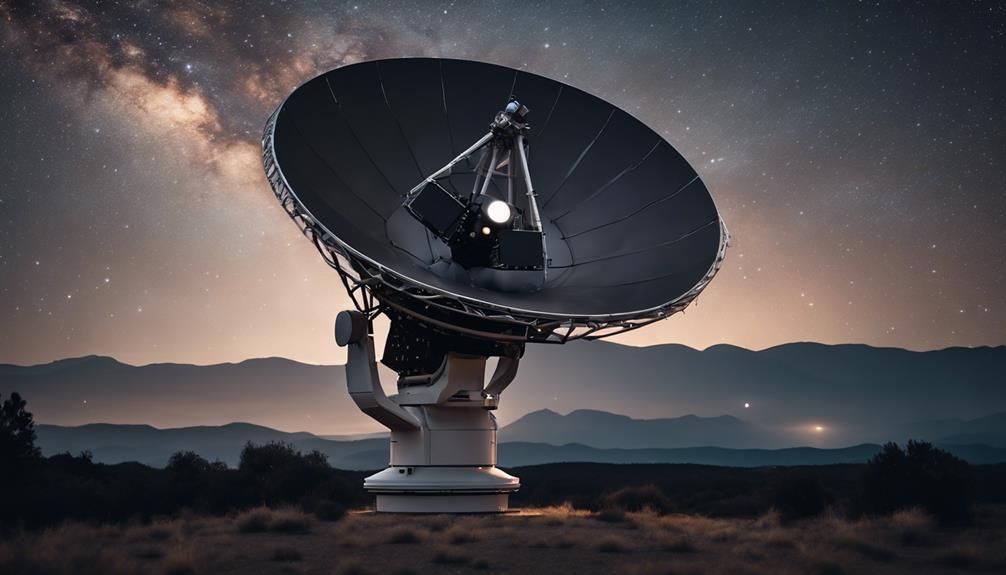
You’ve witnessed how the advent of radio telescopes, initiated by Karl Jansky’s groundbreaking construction in 1931, revolutionized our understanding of the cosmos by detecting radio waves from celestial bodies.
This leap enabled astronomers to explore the universe’s hidden phenomena, including pulsars and cosmic microwave background radiation, which are invisible to optical telescopes.
Techniques like interferometry have magnified the impact of radio telescopes on astronomy by enhancing resolution and enabling the observation of distant cosmic events in unprecedented detail.
Radio Telescope Origins
Pioneering the exploration of the cosmos beyond visible light, Karl Jansky’s construction of the first radio telescope in 1931 marked a monumental shift in astronomical studies.
This remarkable invention allowed scientists to detect and study radio waves emanating from the Milky Way, revealing a previously hidden aspect of the universe. Soon after, in 1937, Grote Reber built the first parabolic radio telescope in his backyard, further advancing the field of radio astronomy.
The origins of radio telescopes have dramatically expanded our cosmic understanding:
- Revelation: Uncovering celestial phenomena invisible in optical light.
- Innovation: The leap from Jansky’s discovery to Reber’s hands-on application.
- Expansion: Laying the groundwork for groundbreaking discoveries like quasars and cosmic microwave background radiation.
These milestones underscore the transformative role of radio telescopes in astronomy.
Impact on Astronomy
Radio telescopes have revolutionized our understanding of the universe, breaking through the limitations of optical observation to reveal a cosmos teeming with unseen phenomena.
They’ve laid the observational groundwork for a deeper comprehension of celestial objects, from the galaxies outside the Milky Way to the very edges of the observable universe.
| Evolution of Telescopes | Impact on Astronomy |
|---|---|
| First radio telescope in 1931 | Unearthed cosmic radio waves |
| Radio interferometry | Enhanced resolution in telescopic observations |
| Mapping cosmic microwave background | Supported the Big Bang theory |
| ALMA in Chile | Offers views of star formation regions |
| Increasingly larger arrays | Allow detailed studies of distant galaxies |
This leap in technology underscores the continuous, evolutionary march of telescopes, opening new vistas in our quest to understand the universe.
Beyond Earth’s Atmosphere: The Era of Space Telescopes
As humanity sought to transcend the limitations imposed by Earth’s atmosphere, the launch of the Hubble Space Telescope in 1990 marked a pivotal shift towards the era of space telescopes, offering unprecedented clarity and depth in astronomical observations.
Floating 350 miles above Earth’s surface, Hubble sidestepped atmospheric distortions, granting astronomers a clear window into the cosmos. This monumental leap was first proposed in the 1940s by Lyman Spitzer, who envisioned a telescope in space to bypass Earth-based limitations.
The introduction of the James Webb Space Telescope in 2021 further revolutionized space observation. With enhanced sensitivity and a broader wavelength coverage, it built on Hubble’s foundation, pushing the boundaries of our cosmic understanding. Operating beyond Earth’s atmospheric disturbances, these space telescopes have notably improved the quality and accuracy of astronomical observations.
Consider these transformative impacts:
- Unparalleled Clarity: Free from atmospheric blurring, images captured by Hubble and James Webb are in a league of their own.
- Revolutionary Discoveries: The data collected has reshaped our understanding of the universe, from black holes to distant galaxies.
- Technological Marvels: Both telescopes showcase human ingenuity, overcoming vast technical challenges to explore the cosmos from space.
Infrared Astronomy: Seeing the Invisible
You’ll find that infrared detection technology has been a pivotal advancement in astronomy, enabling scientists to explore the coldest regions of the cosmos with unprecedented detail. This method allows the observation of phenomena such as dust-enshrouded star nurseries and planet-forming disks, which remain obscured in the visible spectrum.
Comparing ground-based observatories with those stationed in space reveals significant differences in the quality and scope of data collected, highlighting the unique contributions each makes to our understanding of the universe’s intricate mechanisms.
Infrared Detection Technology
Infrared detection technology in telescopes has revolutionized our ability to observe and understand phenomena beyond the limits of the visible light spectrum.
Through infrared astronomy, you’re able to see what was once hidden: cool objects like cosmic dust clouds and distant galaxies emitting infrared radiation that tell stories of the early universe. Instruments such as the James Webb Space Telescope have the power to reveal these dust clouds, exposing hidden stars and planetary systems.
- Discovery: You’re witnessing the revealing of celestial secrets, from the birth of stars to the formation of galaxies.
- Insight: You gain profound insights into the early universe, offering a glimpse into its origins and evolution.
- Understanding: You’re enhancing your comprehension of the composition and dynamics of cosmic structures, pushing the boundaries of our cosmic knowledge.
Unveiling Cosmic Cold Regions
Peering beyond the veil of visible light, infrared astronomy uncovers the universe’s coldest regions, revealing celestial phenomena otherwise obscured to our eyes. By observing objects emitting infrared radiation, this branch of astronomy explores the cosmos’s cooler components.
Infrared telescopes, equipped to detect wavelengths longer than visible light, are pivotal in exposing hidden celestial objects. They expose cold dust clouds, bustling star-forming regions, and distant galaxies invisible to the naked eye or traditional optical telescopes.
The James Webb Space Telescope, a marvel in infrared astronomy, excels at studying these cosmic phenomena at low temperatures. It provides invaluable insights, complementing observations in visible light and enriching our understanding of the universe’s vast, cold expanses.
Through infrared astronomy, we grasp the fuller spectrum of cosmic beauty, piecing together the puzzle of the cosmos bit by bit.
Ground Vs Space Observatories
When comparing ground-based observatories to their space-based counterparts, the latter’s capability to bypass atmospheric interference greatly enhances the clarity and precision of infrared astronomical observations.
Space observatories like the Hubble Space Telescope and the James Webb Space Telescope have revolutionized our understanding by offering clearer imaging, free from the distortions of Earth’s atmosphere. This is vital in infrared astronomy, a field dedicated to studying celestial objects emitting invisible infrared radiation.
- Reveal: Space telescopes reveal the universe’s hidden stories.
- Precision: They pierce through the cosmic fog with unmatched accuracy.
- Innovation: Each leap into space marks a new chapter in our cosmic journey.
Shifting to space observatories has fundamentally changed astronomical research, allowing scientists to observe the universe in ways once thought impossible.
Ultraviolet Observations: Beyond the Visible Spectrum
Ultraviolet telescopes reveal a hidden chapter in the cosmic narrative, observing wavelengths shorter than visible light to expose the universe’s unique features.
Unlike Galileo Galilei, who peered through his telescope to investigate visible celestial phenomena, today’s astronomers use ultraviolet telescopes to uncover the mysteries of hot young stars, active galactic nuclei, and the intricate dance of interstellar medium interactions.
Instruments like NASA’s GALEX have been pivotal in mapping the ultraviolet sky, revealing phenomena that remain invisible to the naked eye or even through traditional telescopes.
| Feature | Impact | Example |
|---|---|---|
| Hot, Young Stars | Study of star formation | GALEX observations |
| Active Galactic Nuclei | Insights into galaxy evolution | Ultraviolet imaging |
| Interstellar Medium | Understanding high-energy processes | Spectral analysis |
| Galaxy Evolution | Uncovering hidden phenomena | Ultraviolet sky mapping |
| Complementary Studies | Enhancing visible light observations | Integrated research |
Ultraviolet observations have revolutionized our understanding, providing a more nuanced view of the cosmos.
By capturing the universe’s ultraviolet portrait, astronomers can probe into the processes of star formation, galaxy evolution, and the impacts of high-energy phenomena, enhancing our grasp on the cosmos’s vast complexity.
The Digital Age: Adaptive Optics and Interferometry
The advent of adaptive optics and interferometry marks a transformative era in astronomy, dramatically enhancing our capacity to observe the cosmos with unparalleled clarity and detail.
By adjusting for atmospheric distortions in real-time, adaptive optics technology sharpens the images captured by modern telescopes. Central to this system are deformable mirrors that can change shape to counteract atmospheric turbulence, thereby delivering crisper astronomical images.
Meanwhile, interferometry has revolutionized our approach to celestial observation by combining signals from multiple telescopes. This technique creates a virtual telescope of unprecedented resolution, equivalent to a single telescope whose diameter is as vast as the distance between the individual telescopes involved.
Consider the emotional impact of these advancements:
- Awe at the sheer ingenuity of using deformable mirrors to outsmart the Earth’s atmospheric distortions.
- Wonder at the collaboration between multiple telescopes spanning vast distances, working together as one.
- Excitement for the future discoveries made possible by these groundbreaking techniques.
Indeed, adaptive optics and interferometry signify a monumental leap in observational astronomy, offering clearer and more detailed glimpses of the universe than ever before.
The Future: Telescope Technology on the Horizon

Building on the achievements of adaptive optics and interferometry, we now set our sights on the horizon of telescope technology, where innovations like the James Webb Space Telescope are ushering in a new era of astronomical discovery.
Launched in 2021, the James Webb Space Telescope represents a monumental leap forward, offering enhanced sensitivity and broader wavelength coverage. This allows for unprecedented astronomical observations that promise to deepen our understanding of the universe.
The ongoing evolution of telescope technology, as demonstrated by the Hubble and James Webb Space Telescopes, is pivotal in advancing our comprehension of cosmic phenomena. These tools have been instrumental in uncovering cosmic mysteries, thanks to their improved imaging capabilities.
Looking ahead, anticipated advancements in this field suggest even more promising prospects for scientific discoveries. Researchers are poised to explore deeper into the mysteries of the cosmos, armed with increasingly sophisticated apparatus.
Astronomy enthusiasts, too, stand on the brink of exciting new opportunities. Engaging with the latest in telescope technology, they’ve got at their fingertips the means for unparalleled celestial exploration. The future of telescope technology, it seems, holds boundless possibilities for expanding our scientific horizons.
Frequently Asked Questions
How Have Telescopes Evolved Over Time?
Telescopes have evolved with mirror advancements, adaptive optics, and digital imaging, enhancing observation. Space telescopes and interferometry techniques have furthered our cosmic insights, pushing beyond Earth’s atmospheric limits for clearer, more detailed celestial observations.
How Does a Telescope Look Back in Time?
A telescope is your time machine, capturing light that’s journeyed across the cosmos. Through cosmic observation, it deciphers the universe’s age, utilizing light travel time for deep space imaging and advancing observational astronomy.
What Is the Brief History of the Telescope?
The telescope’s history began with Galileo’s discoveries, evolving through lens technology improvements and reflecting telescopes. Advances in radio astronomy expanded our universe view, leading to space-based observatories that revolutionized our cosmic understanding.
What Is the Summary of the Telescope?
Telescopes, built on optical principles, have evolved drastically. Mirror advancements and technology integration have enhanced their capabilities. Space telescopes have expanded our cosmic view, while amateur astronomy has become more accessible, thanks to these innovations.
Conclusion
As you’ve journeyed through the evolution of telescopes, it’s clear that each advancement, like links in a chain, has strengthened our grasp on the universe’s mysteries.
From Galileo’s simple lens to the James Webb Space Telescope’s intricate mirrors, we’ve pushed the boundaries of space exploration. The future promises even more, with technologies brewing on the horizon that’ll refine our cosmic perception as sharply as a scalpel’s edge.
This ongoing innovation isn’t just about seeing further; it’s about understanding deeper.
