A Tour of the World's Largest Telescope Observatories

As gateways to the cosmos, the world’s largest telescope observatories invite you to step beyond the boundaries of Earth and venture into the vastness of space.
You’ll find yourself on a path where history, technology, and the pursuit of knowledge converge, offering a unique glimpse into the universe’s most profound mysteries.
From the architectural marvels that house these colossal eyes on the sky to the groundbreaking discoveries they facilitate, each observatory has a story to tell. But what secrets do they hold, and how do they shape our understanding of the cosmos? Join this exploration to uncover the answers and ignite your curiosity about what lies beyond the stars.
Key Takeaways
- The European Extremely Large Telescope in Chile will be the largest optical telescope globally, with a 39-meter primary mirror.
- Mauna Kea Observatories host the world’s largest optical and infrared telescopes with mirrors 10 meters in diameter.
- Gran Telescopio Canarias sets a standard with its 34.1-foot diameter, employing advanced adaptive optics for clear, high-resolution observations.
- The Giant Magellan Telescope aims to produce images 10 times clearer than Hubble, showcasing significant advancements in optical design and engineering.
Global Astronomy Landmarks
Among the world’s astronomy landmarks, Mauna Kea stands out as a titan, hosting an unparalleled array of major telescopes that benefit from its superior observing conditions. At its heart, the Keck Observatory exemplifies the summit’s astronomical prowess.
The observatory operates two of the largest optical and infrared telescopes in the world, each mirror spanning an impressive 10 meters in diameter. This technical marvel allows astronomers to explore the cosmos with unprecedented clarity and detail, from studying the faintest galaxies to scrutinizing the composition of distant celestial bodies.
The Keck Observatory’s location on Mauna Kea is no coincidence. Situated above 40% of Earth’s atmosphere, the summit offers an exceptionally clear window to the stars, minimizing the atmospheric disturbances that can blur celestial observations.
This, combined with the site’s dry, stable climate, maximizes the observatory’s operational efficiency, enabling it to capture images and data of remarkable quality. The meticulous management and stewardship of the land by the University of Hawaii guarantee that Mauna Kea remains a bastion for cutting-edge astronomical research, cementing its status as a global landmark in the field.

Gran Telescopio Canarias
You’ll find that the Gran Telescopio Canarias (GTC) stands out due to its unparalleled viewing power, anchored by its impressive 34.1-foot diameter, which is instrumental for high-resolution observations of the cosmos.
Its suite of advanced technology features, including cutting-edge adaptive optics, greatly enhances its capability to study distant galaxies and cosmic phenomena with unmatched clarity.
Moreover, its unique location atop La Palma offers exceptional observing conditions, leveraging atmospheric stability to push the boundaries of astronomical research.
Unparalleled Viewing Power
The Gran Telescopio Canarias, with its 34.1-foot diameter, sets a new standard for astronomical observation by discovering the most densely populated galaxy cluster. This telescope not only revolutionizes how humans comprehend the universe but also highlights the incredible potential of modern astronomical instruments.
- Location: Nestled in La Palma, Spain, offering pristine observing conditions.
- Consortium Operation: Managed by an international team, ensuring diverse scientific input and expertise.
- Adaptive Optics: Employs cutting-edge technology for crystal-clear images of celestial phenomena.
- Instrumentation: Equipped with advanced tools for groundbreaking research in astronomy and astrophysics.
- Discovery: Its significant finding underscores the telescope’s pivotal role in expanding our cosmic knowledge.
This unparalleled viewing power grants astronomers the ability to peer deeper into space than ever before, opening new frontiers in the quest to comprehend our universe.
Advanced Technology Features
Building on its unparalleled viewing power, let’s examine the Gran Telescopio Canarias’s advanced technological features that set it apart in the domain of astronomical observation.
With a primary mirror diameter of 34.1 feet (10.4 meters), the GTC stands as a significant optical telescope, known not just for its size but for its scientifically productive capabilities. It was this telescope that discovered the most densely populated galaxy cluster, showcasing its ability to contribute significantly to our understanding of the universe.
The GTC’s cutting-edge capabilities stem from a blend of sophisticated optical technologies and digital instrumentation, making it a cornerstone of astronomical research and observations. These advanced features enable the GTC to play a critical role, pushing the boundaries of our cosmic knowledge further than ever before.
Unique Location Benefits
Nestled atop the pristine peaks of La Palma, Spain, the Gran Telescopio Canarias benefits immensely from its unique location, offering unparalleled clarity and minimal light pollution for astronomical observations.
- Elevated Site: Positioned at high altitude, it’s beyond much of Earth’s atmospheric disturbances.
- Minimum Light Pollution: Its remote location ensures dark skies, critical for deep-space observations.
- Stable Airflows: The surrounding ocean moderates the air temperature, reducing atmospheric turbulence.
- Advanced Capabilities: With a 34.1-foot diameter, it captures faint celestial light with exceptional detail.
- National Astronomical Observatory Collaboration: This strategic placement enhances its role in global astronomical research, leveraging Spain’s commitment to leading scientific discovery.
In this technical sanctuary, the GTC stands as a cornerstone of astronomical excellence, pushing the boundaries of our cosmic understanding.
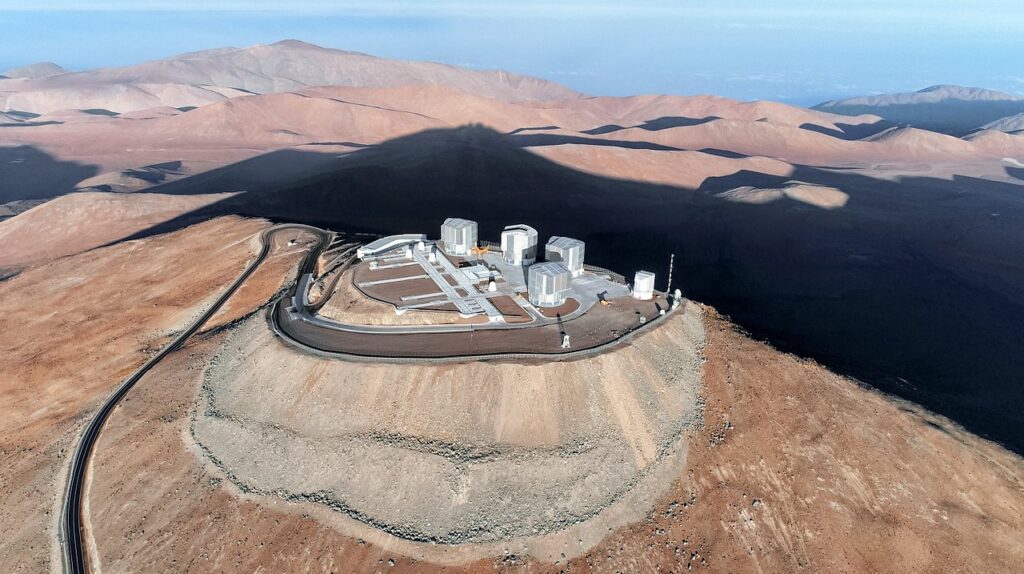
Revolutionary Paranal Observatory
You’ll find the Paranal Observatory’s achievements stem from its advanced optical instruments, which include the Very Large Telescope’s quartet of 8.2-meter units and adaptive optics system. This setup not only offers exceptional sky clarity but also enables groundbreaking research in imaging exoplanets and probing distant galaxies.
Its location in the Atacama Desert further enhances its capability for innovative research contributions by providing one of the clearest skies on Earth.
Advanced Optical Instruments
At the heart of Chile’s revolutionary Paranal Observatory, the Very Large Telescope (VLT) array stands as a sign of advanced optical instrumentation, incorporating adaptive optics technology to deliver unparalleled image clarity.
- VLT Interferometer: Harnesses the power of multiple telescopes, combining their observations to achieve the resolution of a much larger telescope.
- Four 8.2-meter Telescopes: Each equipped with state-of-the-art optics, contribute to a broad observational capability.
- Adaptive Optics: Correct atmospheric disturbances in real-time, ensuring sharp images.
- Four Movable 1.8-meter Auxiliary Telescopes: Enhance the flexibility and precision of the VLT Interferometer.
- Wide Wavelength Coverage: Instruments at Paranal capture data from visible to mid-infrared, supporting a diverse range of astronomical research.
Exceptional Sky Clarity
Building upon the advanced optical instruments of the Very Large Telescope array, the exceptional sky clarity at Paranal Observatory greatly enhances the precision of astronomical observations. Nestled in the Atacama Desert’s heights, at an altitude of 2,635 meters, this observatory benefits from a uniquely dry and stable atmosphere.
Such conditions are paramount for minimizing atmospheric distortions that typically hinder ground-based telescopes’ effectiveness. The VLT’s adaptive optics system plays a critical role, dynamically adjusting to correct these distortions, thereby achieving an unparalleled level of detail in observing celestial objects.
The combination of Paranal’s remote location and cutting-edge technology ensures that the telescopes housed here are among the most potent tools in the quest to unravel the universe’s mysteries.
Innovative Research Contributions
Regularly pushing the boundaries of space exploration, the VLT at Paranal Observatory has made significant contributions to our understanding of phenomena such as exoplanets and black holes through its advanced observational capabilities.
- The VLT’s location in the Atacama Desert guarantees unparalleled clear skies, enhancing image quality dramatically.
- Four 8.2-meter telescopes working in unison provide unmatched resolution, critical for detailed astrophysical studies.
- Auxiliary telescopes add to the VLT’s power, enabling high-precision interferometry that sharpens the view of the cosmos.
- Advanced instruments facilitate groundbreaking research, from the detection of distant exoplanets to probing the mysteries of the early universe.
- Managed by ESO, the observatory stands as a beacon of technological innovation, setting new standards for image quality and astronomical research.
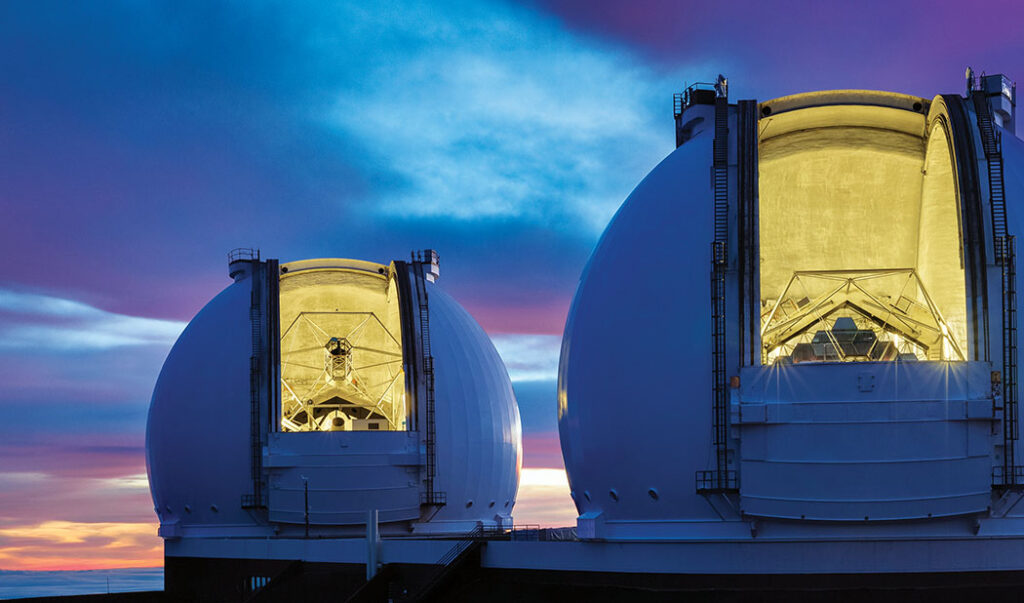
Keck Observatory Twins
Nestled atop Maunakea in Hawaii, the Keck Observatory Twins boast an impressive diameter of 32.8 feet each, enabling unparalleled exploration into the depths of space. Stationed on one of the most revered astronomical sites globally, these twins stand as monumental achievements in optical and infrared astronomy.
Their location on Mauna Kea offers exceptional observing conditions, largely due to the mountain’s high elevation and the stable atmospheric conditions it provides. This unique advantage allows the Keck telescopes to achieve clarity and detail in observations that few other ground-based observatories can match.
Each telescope’s mirror, spanning 10 meters, is among the largest optical/infrared reflectors in operational use today. This substantial size grants the Keck Observatory Twins the power to see farther into space with greater detail than the Hubble Space Telescope.
Such capability is critical for conducting detailed astronomical studies, encompassing the examination of celestial bodies, the investigation of cosmological phenomena, and the search for exoplanets. The data they gather contributes significantly to our understanding of the universe, reinforcing the Keck Observatory Twins’ status within the elite circle of the Maunakea Observatories.
Mauna Kea Observatories
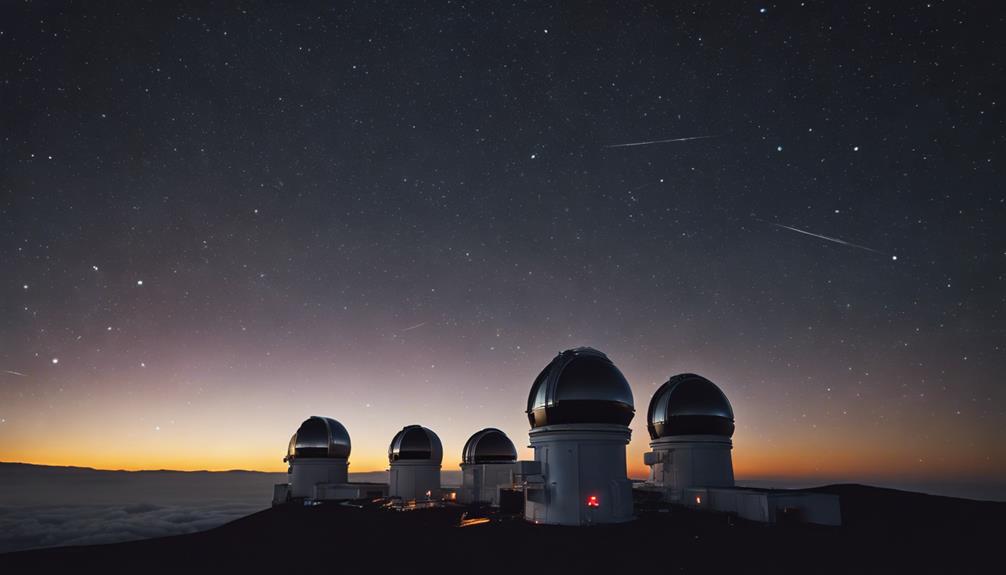
Often heralded as the premier location for astronomical observation, Mauna Kea’s summit plays host to an unparalleled assembly of telescopes, capitalizing on its unique atmospheric and geographical advantages.
Situated atop a dormant volcano in Hawaii, this site rises majestically from the ocean floor, reaching an altitude of 4,205 meters above sea level. Managed by the University of Hawaii, Mauna Kea Observatory stands as a proof of humanity’s quest to unravel the mysteries of the cosmos.
The observatory’s distinctive features include:
- Exceptional Viewing Conditions: Its summit is above 40% of Earth’s atmosphere, offering clearer views of space.
- Dry and Cloud-Free Atmosphere: Guarantees minimal atmospheric interference, essential for precision in astronomical observations.
- Diverse Telescope Array: Hosts a wide range of instruments for optical, infrared, and millimeter measurements.
- Unique Landscape: The cinder cones and lava plateau provide a stable foundation for these astronomical giants.
- Global Recognition: Known for having more major telescopes than any other peak worldwide, it’s a hub for groundbreaking astronomical research.
At Mauna Kea Observatories, you’re not just witnessing the stars; you’re stepping closer to understanding the universe’s profound mysteries.
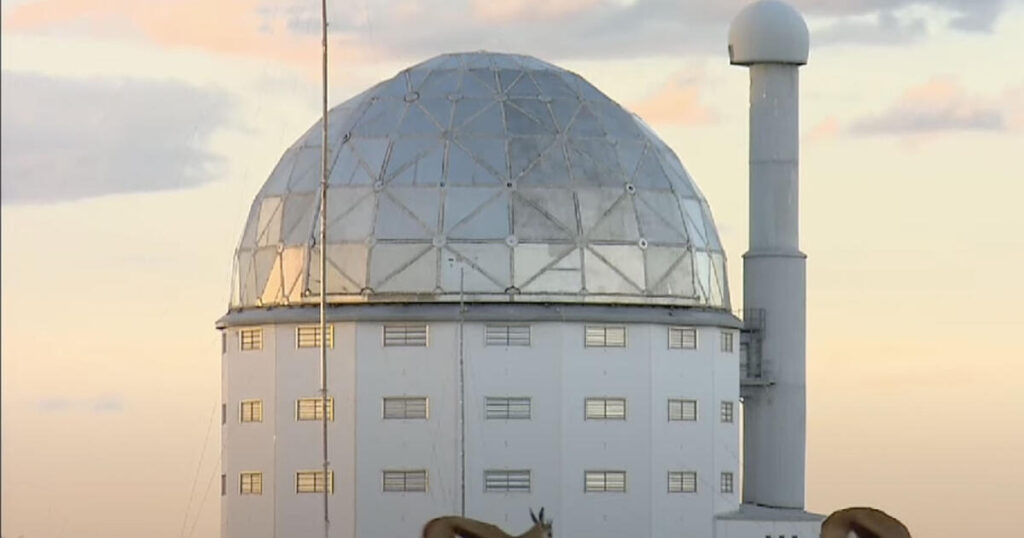
South African Large Telescope
The South African Large Telescope (SALT), the largest single optical telescope in the Southern Hemisphere, stands in Sutherland, South Africa, representing a pinnacle of international collaboration and engineering prowess. At the heart of SALT’s observational capabilities is its ingeniously designed primary mirror. Comprised of a hexagonal array, this mirror spans an impressive total diameter of 11 meters, a feature that not only distinguishes it but also notably enhances its light-gathering power.
This primary mirror is central to SALT’s ability to conduct observations across a broad spectrum of wavelengths, thereby facilitating a diverse range of astronomical studies. From the detailed examination of celestial bodies within our own galaxy to the exploration of distant galaxies, SALT’s versatile design is instrumental in advancing our understanding of the universe.
Managed by an international consortium that includes countries like South Africa, the United States, Germany, Poland, and New Zealand, SALT exemplifies global cooperation in the pursuit of scientific knowledge.
Its cutting-edge technology and strategic location in Sutherland—a site chosen for its exceptionally clear skies—combine to position it as a critical tool in the ongoing quest to unravel the mysteries of the cosmos.
European Extremely Large Telescope
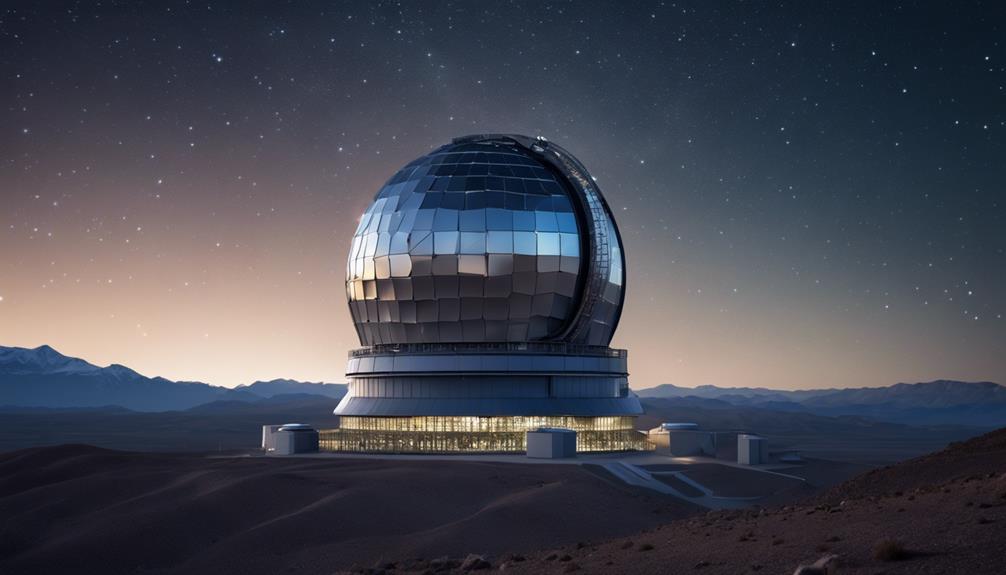
As we turn our gaze toward the ambitious European Extremely Large Telescope, it’s clear that its unprecedented 39-meter primary mirror sets a new standard for optical astronomy, promising to redefine our exploration of the cosmos. Nestled atop Cerro Armazones in Chile, this titan of technology is poised to usher in a new era of discoveries.
- Location and Scale: Perched on Cerro Armazones, the ELT’s 128-foot (39 meters) primary mirror will be the largest of its kind, dwarfing its predecessors in the quest for celestial clarity.
- Light Collection Capacity: Designed to collect 100,000,000 times more light than the human eye, it represents a quantum leap in observational power.
- Exoplanet Exploration: With its unparalleled capabilities, the ELT is uniquely equipped to discover Earth-like planets, offering a tantalizing possibility of detecting signs of life beyond our Solar System.
- Revolutionary Imaging: Set to revolutionize our understanding of the universe, its exceptional imaging capabilities are eagerly anticipated by the astronomical community.
- Completion Timeline: With a scheduled completion date in 2027, the anticipation for the European Extremely Large Telescope’s operational commencement is palpable among scientists and astronomers worldwide.
This behemoth promises not just to observe the cosmos but to reveal secrets that have eluded humanity for millennia.
Observatory Visiting Tips
Exploring the European Extremely Large Telescope and its groundbreaking capabilities naturally leads to the consideration of how best to experience such monumental observatories firsthand. Visiting astronomical observatories offers a unique insight into the universe’s vastness and the intricate science behind it.
To ensure a fulfilling visit, it’s important to prepare adequately and understand what to expect.
| Tip | Why It Matters |
|---|---|
| Arrive Early | Maximizes your time to explore the facilities and absorb the rich history and achievements of the observatory. |
| Wear Warm Clothing | Observing sessions, especially at night, can be chilly due to dome temperatures being kept low to match outside conditions and prevent thermal currents that could distort observations. |
| Follow Rules and Regulations | Guarantees a safe and respectful environment for all visitors and staff, preserving the integrity of the observatory’s operations and research. |
| Engage with Staff | Enhances your understanding by providing a deeper insight into the observatory’s operations, current research, and the technological marvels at play. |
Taking advantage of behind-the-scenes tours offers an unparalleled perspective, revealing the technical and operational complexities of running such advanced astronomical observatories. Engaging with the knowledgeable staff and asking questions can greatly enrich your visit, turning a simple tour into an educational journey through the cosmos.
Optical Technology Impact

Observatory advancements and optical technology have revolutionized our understanding of the universe, enabling telescopes like the Keck, Gran Telescopio Canarias, and the forthcoming
Extremely Large Telescope to capture unprecedented celestial details. You’re witnessing a new era where the boundaries of space are pushed further than ever before, thanks to the sophisticated optical technology integrated into these monumental instruments.
Let’s explore the specifics:
- The Keck Telescopes, with their 32.8-foot mirrors, surpass the Hubble Space Telescope in seeing farther, a proof of ground-based optical technology’s potential.
- Gran Telescopio Canarias’ discovery of the most densely populated galaxy cluster was made possible by its 34.1-foot diameter, showcasing how size correlates with discovery potential.
- The Giant Magellan Telescope’s promise of images 10 times clearer than Hubble is a direct outcome of its massive 80-foot diameter, illustrating the leap in optical design and engineering.
- With a diameter of 128 feet, the Extremely Large Telescope is set to be the world’s largest optical telescope, promising a future filled with unparalleled astronomical discoveries.
- The Hobby Eberly Telescope’s discovery of distant quasar light exemplifies how even telescopes with a 32-foot diameter can contribute significantly to our knowledge, thanks to advanced optical technology.
This peek into the impact of optical technology vividly illustrates its critical role in expanding our cosmic frontiers.
Innovation in Astronomy
Innovation in astronomy, driven by groundbreaking telescopes like the Thirty Meter Telescope and the Extremely Large Telescope, is reshaping our understanding of the cosmos.
These monumental projects not only push the boundaries of human knowledge but also showcase the collaborative spirit of the global astronomical community, including pivotal contributions from the Astronomical Observatory of Japan.
| Telescope | Location | Key Capabilities |
|---|---|---|
| Thirty Meter Telescope (TMT) | Maunakea, Hawaii | Analyzing black holes in the Milky Way |
| Extremely Large Telescope | Cerro Armazones, Chile | Expected to be the largest optical telescope globally |
| Keck Telescopes | Maunakea, Hawaii | Producing clear images in visible light and infrared |
| Gran Telescopio Canarias | La Palma, Spain | Discovered the most densely populated galaxy cluster |
| Giant Magellan Telescope | Atacama Desert, Chile | Projected to produce images 10 times clearer than Hubble |
These advancements represent a leap forward in our ability to observe the universe. The telescopes’ sophisticated technology and strategic locations enable astronomers to explore deeper into space mysteries, offering clearer images and new data that challenge our current understanding.
The Astronomical Observatory of Japan plays an important role in this global effort, contributing to the development of technologies and methodologies that further our exploration of the cosmos.
Frequently Asked Questions
Which Observatory Has the Largest Telescope in the World?
You’re diving into the domain of Observatory Giants, seeking the largest telescope. Today, it’s the Keck Observatory leading with its optical behemoths. Yet, the upcoming ELT in Chile will snatch that title with its unparalleled size.
Can You Visit the Very Large Telescope?
Yes, you can visit the Very Large Telescope. It offers public tours, promoting public engagement with its advanced optical technology. Each of its four telescopes boasts an 8.2-meter mirror, showcasing remarkable achievements in astronomy.
How Long Is the Yerkes Observatory Tour?
The Yerkes Observatory tour typically spans 1.5 to 2 hours. This duration allows you to delve into its architectural marvels, explore telescopes, and roam the grounds while learning about its astronomical significance and history.
Why Was Overwhelmingly Large Telescope Cancelled?
The Overwhelmingly Large Telescope was canceled due to funding challenges. High costs, estimated between €1.5 and €1.8 billion, and feasibility concerns made it unviable, leading to the pivot towards the European Extremely Large Telescope project.
Conclusion
Embarking on this celestial journey, you’ve traversed the globe’s stargazing titans, from Gran Telescopio Canarias’ majestic gaze to the pioneering spirits of Paranal and Mauna Kea.
Like ancient mariners voyaging vast oceans guided by the stars, you’ve witnessed modern explorers charting the cosmos’ unseen frontiers with optic alchemy and innovation’s fervor.
This journey underscores not just humanity’s quest for knowledge but the transformative power of peering deep into the universe’s heart, forever altering our understanding of the cosmic sea that surrounds us.
