5 Best Apps for Stargazing and Planet Identification

Looking for the best stargazing apps? Here’s a quick guide to the top 5 picks for 2025. Whether you’re a beginner or an expert, these apps help you identify stars, planets, and celestial events with ease. From AR navigation to astrophotography tools, there’s something for everyone.
- SkySafari 7 Pro: Advanced features like telescope control, event tracking, and a vast database of 100M+ stars. ($29.99/year Premium)
- Stellarium Mobile Plus: Realistic visuals and offline functionality for immersive stargazing. ($13.99 iOS, $9.99 Android)
- Star Walk 2: Beginner-friendly AR interface with cultural constellation art and event tracking. (Free or $2.99 Premium)
- PhotoPills: Perfect for astrophotographers with tools like Milky Way tracking and exposure calculators. ($10.99)
- Night Sky: Broad features including satellite tracking, 3D solar system views, and light pollution maps. ($4.99/month Premium)
Quick Comparison Table:
| Feature | SkySafari 7 Pro | Stellarium Mobile Plus | Star Walk 2 | PhotoPills | Night Sky |
|---|---|---|---|---|---|
| AR Navigation | Advanced | Limited | Full | Photo AR | Full |
| Telescope Integration | Yes | Yes | No | No | Yes |
| Offline Access | Full | Yes (Premium) | Yes | Yes | Partial |
| Price | $29.99/year | $13.99/$9.99 | Free/$2.99 | $10.99 | $4.99/month |
Whether you want to explore the cosmos casually or dive into astrophotography, these apps cover it all. Read on for detailed reviews of each app.
10 FREE Stargazing Apps Compared and Tested
1. SkySafari 7 Pro
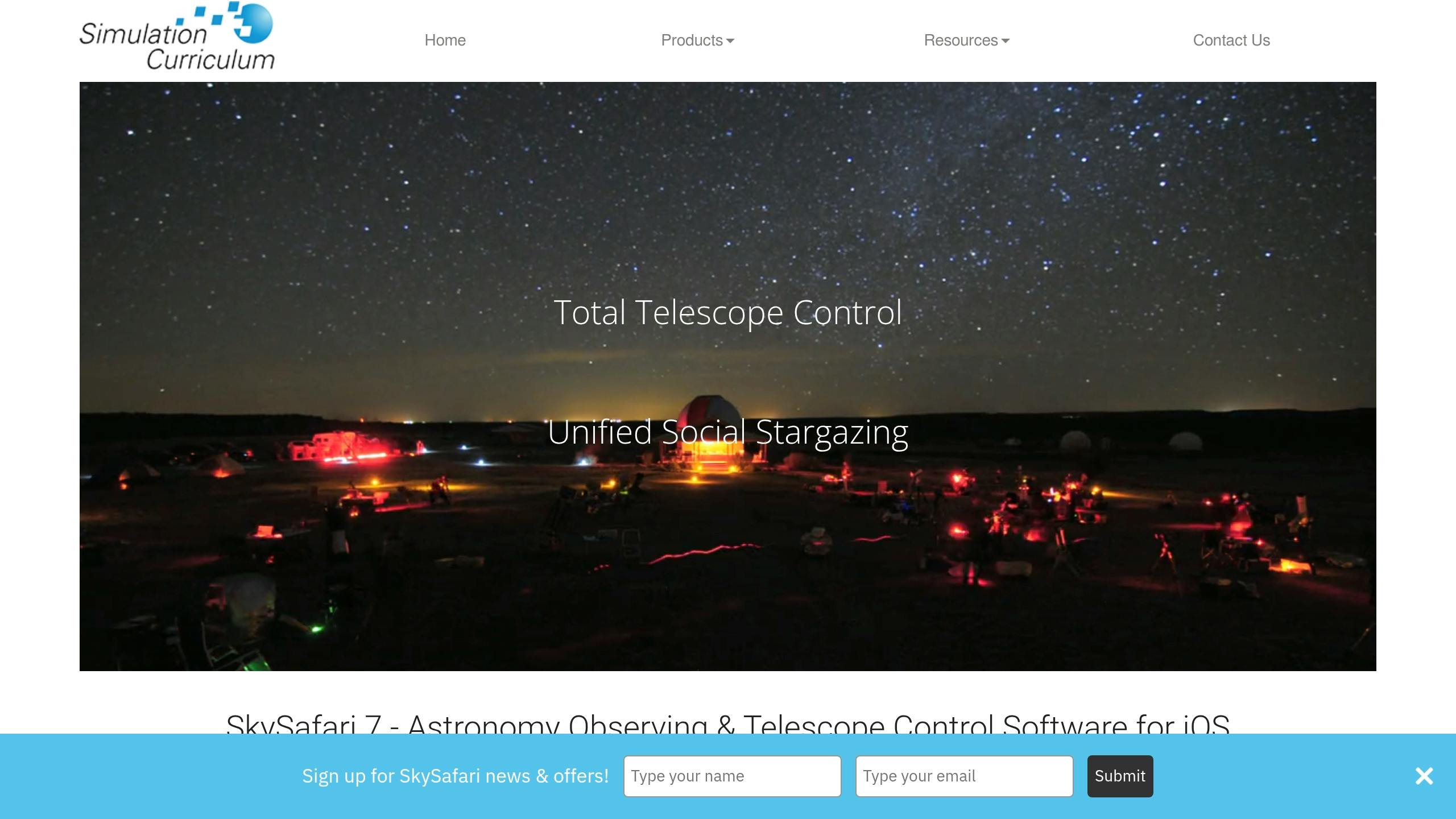
SkySafari 7 Pro is a top-tier stargazing app designed for both casual enthusiasts and serious astronomers. It boasts an extensive astronomical database with over 100 million stars and 3 million galaxies, including details down to the 18th magnitude . This makes it a go-to tool for anyone looking to explore the night sky in depth.
The app includes features like augmented reality (AR) mode, which enhances your stargazing experience, and a Night Vision mode, perfect for preserving your eyesight in dark conditions . It also supports advanced telescope control, working seamlessly with networked devices via standard industry protocols. Plus, its integration with LiveSky.com allows for automated observations .
One standout feature is the Events Finder, which acts as your personal astronomy planner. It helps you track:
- Lunar eclipse visibility
- Meteor showers, including radiants and peak times
- Planetary conjunctions and transits
- The movement of Jupiter’s Great Red Spot
Astrophotographers will appreciate the app’s planning tools. By entering your camera specifications, you can calculate precise field-of-view overlays for deep-sky objects . Additionally, the app connects with AstroBin, enabling users to upload observation logs alongside captured images .
For those who want even more, the Premium subscription ($29.99/year) offers extras like cloud syncing across devices, tools for analyzing variable stars, and expanded social sharing options within astronomy-focused communities .
The app also features time simulation, allowing users to visualize celestial movements over long periods – ideal for planning future observations. With its rich database and advanced tools, SkySafari 7 Pro is a fantastic choice for anyone passionate about exploring the cosmos.
2. Stellarium Mobile Plus
Stellarium Mobile Plus is perfect for those who value visual precision over having an enormous database. With a catalog featuring over 1.4 million stars and 600,000 celestial objects , it’s a great choice for educators and casual stargazers who want visuals that feel like a planetarium.
What sets this app apart? Its incredibly realistic sky visuals , including:
- Atmospheric effects that mimic actual conditions
- Landscape views tailored to your specific location
The app also works offline, making it a reliable companion for stargazing in remote areas without cell service . While SkySafari leans toward event planning, Stellarium shines with its time manipulation feature, allowing users to explore past astronomical events. This is especially handy for studying eclipses or creating engaging classroom demos, as you can simulate celestial configurations from any date or time .
The app is priced at $13.99 for iOS and $9.99 for Android , with strong ratings: 4.7/5 on the App Store and 4.5/5 on the Play Store, based on over 10,000 reviews . However, some users have noted occasional performance hiccups on certain devices .
Its precision search helps locate celestial objects quickly, and the tablet-optimized landscape mode enhances the overall viewing experience. Whether you’re a beginner or an expert, Stellarium Mobile Plus delivers a polished and user-friendly stargazing tool .
3. Star Walk 2
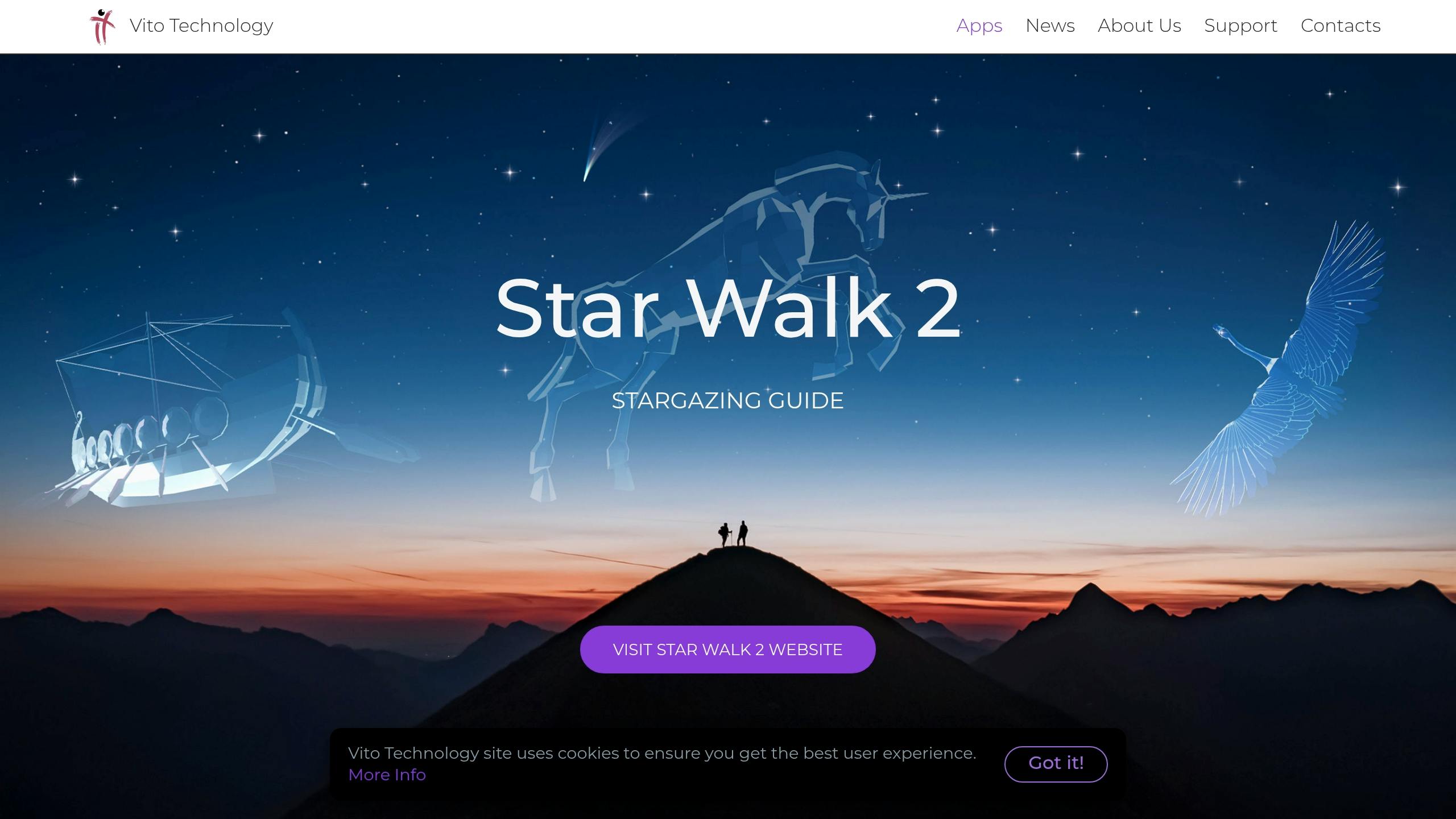
Star Walk 2 is a user-friendly stargazing app with an intuitive AR setup, making it a great choice for beginners. Unlike Stellarium, which leans heavily on historical accuracy, Star Walk 2 adds a layer of cultural depth with its time-travel features .
For those new to astronomy, the app simplifies complex terms and concepts. Point your device at Jupiter, for example, and it will show its current brightness and orbital position relative to Earth. Plus, it works offline once downloaded, making it convenient for outdoor use.
The app’s curated database helps users focus on key celestial sights. Its ‘Tonight’s Visibility’ feature highlights bright objects like the ISS, while the compass-aligned sky map includes adjustable filters to reduce the impact of light pollution .
One standout feature is the "Time Machine" , which offers a deeper look at the sky by:
- Showing past and future star alignments
- Tracking upcoming celestial events
- Showcasing historical constellation art from various cultures
Star Walk 2 is also budget-friendly, offering flexible pricing options:
- Free version with ads
- One-time premium purchase for $2.99
- Monthly subscription at $3
With an impressive 4.7/5 rating on the App Store from over 158,000 reviews , users frequently commend its ease of use and educational features.
The app also includes a "Sky Live" section, which tracks moon phases, daylight hours, and planet visibility . A red-light night mode ensures your eyes stay adjusted to the dark, making it perfect for family stargazing or educational settings.
sbb-itb-9161f90
4. PhotoPills
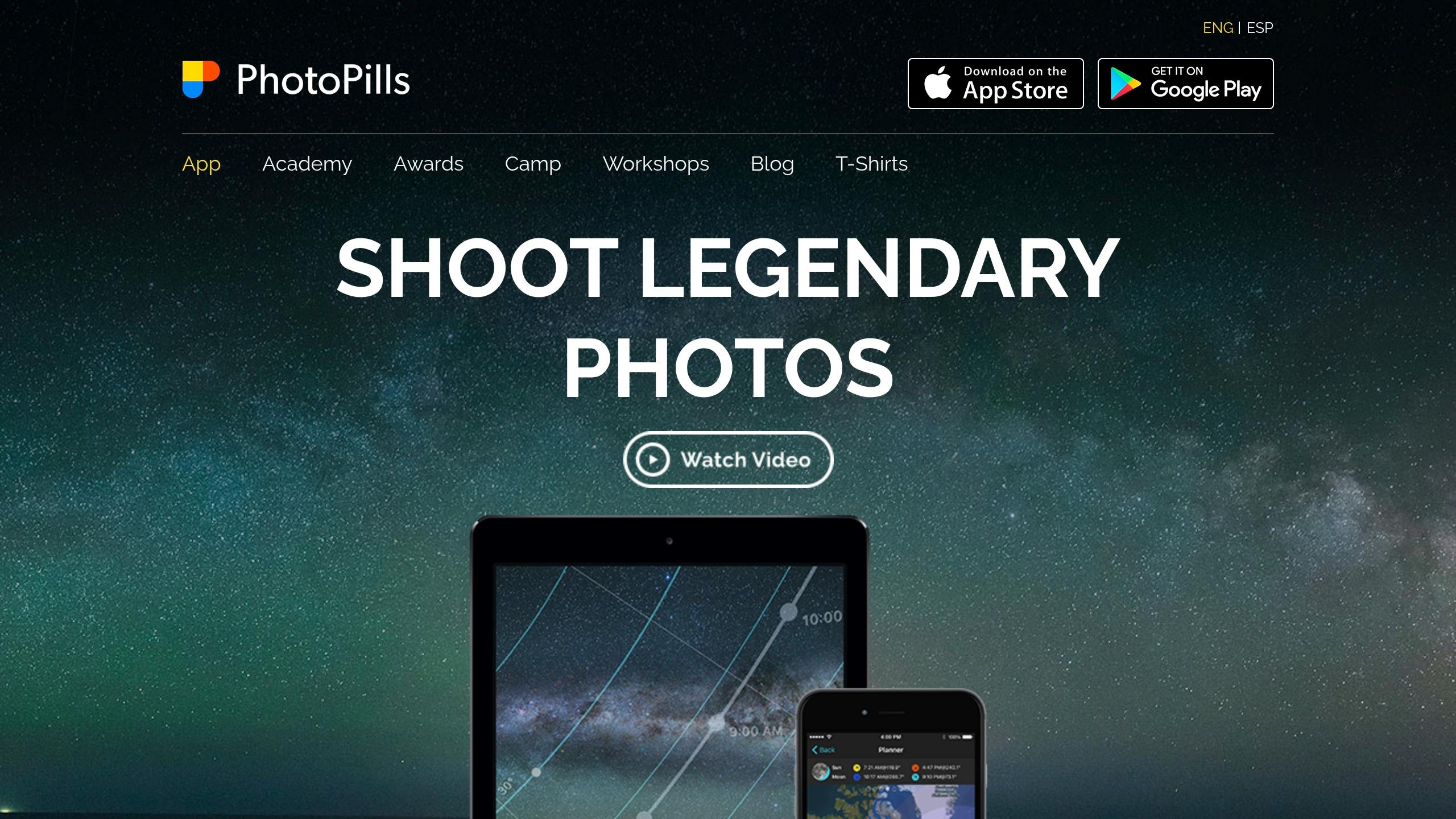
PhotoPills is a go-to app for photographers who combine celestial observation with artistic photography.
Unlike general stargazing apps like Star Walk 2, which leans on cultural elements, PhotoPills focuses on delivering precise tools tailored for capturing celestial events. While it’s primarily designed for astrophotography, its object-tracking features also make it a reliable choice for dedicated stargazers.
With an impressive 4.8/5 rating on the App Store from over 4,000 reviews , the app has clearly struck a chord with its users.
At its core, PhotoPills excels in planning. Whether you’re aligning the Milky Way with a mountain peak or capturing a lunar eclipse, its real-time visualization tools help you nail the perfect composition.
Here are some key features that make PhotoPills stand out:
| Feature | Purpose |
|---|---|
| Position Tracker | Provides real-time celestial coordinates |
| Milky Way Calendar | Highlights the best viewing times |
| Spot Stars Calculator | Calculates maximum exposure times to avoid star trails |
For $10.99, the app offers tools like a Milky Way visibility calendar and an exposure calculator that considers moon phases – critical for achieving sharp, trail-free star images . Its advanced planner calculates sun and moon positions, helping users pick the ideal time and place for their astrophotography sessions .
What truly sets PhotoPills apart is its attention to detail. The exposure calculator takes moon phases into account, while the focus assist ensures your stars are sharp. Together, these features cater to both casual stargazers and seasoned photographers.
To make things easier for beginners, the app includes tutorials in 11 languages and real-time event visualizations. It can even calculate celestial positions for any date – past or future – making it a powerful tool for planning rare celestial events or intricate photo shoots .
With its blend of photography tools and astronomical precision, PhotoPills is a must-have for anyone looking to capture or study the wonders of the night sky.
5. Night Sky
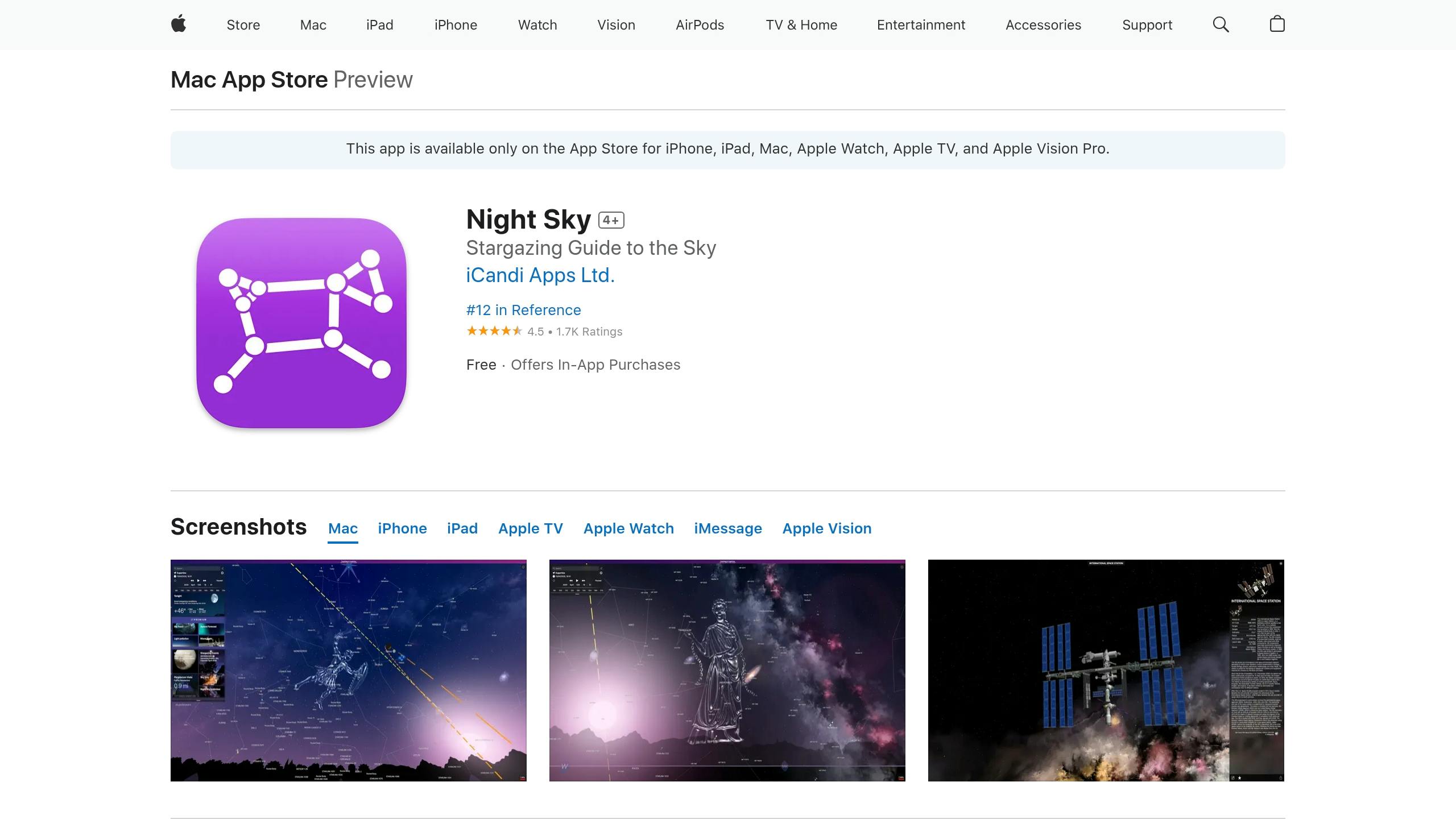
While PhotoPills focuses on astrophotography, Night Sky caters to a broader audience with tools designed for both observation and collaboration. Its advanced positioning system pinpoints planetary locations with an impressive accuracy of 0.01 arcseconds .
The app includes a massive database featuring 1.7 million stars and 8,000 deep-sky objects . Its real-time tracking goes beyond stars and planets, covering satellites and even details like Jupiter’s Great Red Spot .
To make extended observation sessions easier, Night Sky automatically adjusts brightness to protect your night vision .
Much like SkySafari’s Events Finder, Night Sky’s premium features are tailored for practical use:
| Feature | Purpose |
|---|---|
| Light Spectrum Vision | Explore objects in different wavelengths |
| Sky Tags | Share virtual notes with others |
| Meteor Shower Tracker | Monitor meteor activity in real time |
| Grand Orrery (3D solar system model) | View planetary movements in 3D |
For astrophotographers, Night Sky integrates smoothly with professional equipment. It supports ZWO cameras, making it ideal for creating detailed timelapses . This dual focus on visual observation and photography makes the app versatile for astronomy enthusiasts.
The premium subscription ($4.99/month) unlocks additional tools like light pollution maps and historical sky simulations spanning 5000 BCE to 5000 CE .
Night Sky isn’t just for identifying stars. Its "Tonight’s Highlights" feature curates a list of visible celestial objects for easy exploration . Advanced users can also apply filters to track phenomena like quasars and pulsars, even down to magnitude 14 .
The app’s AI-powered meteor path prediction, which earned it the 2023 Space Innovation Award, showcases its cutting-edge tools for astronomy .
App Features at a Glance
Here’s a side-by-side look at how these apps stack up in terms of features and capabilities:
Core Features Comparison
| Feature | SkySafari 7 Pro | Stellarium Mobile Plus | Star Walk 2 | PhotoPills | Night Sky |
|---|---|---|---|---|---|
| AR Navigation | Advanced with overlay | Limited | Full AR support | AR for photo planning | Full AR support |
| Offline Use | Complete access | Premium only | Yes | Yes | Partial |
| Platform Support | iOS, Android, macOS | iOS, Android | iOS, Android | iOS, Android | iOS, iPadOS |
Specialized Capabilities
Each app shines in its own way, offering tools tailored to different needs:
- SkySafari 7 Pro: Ideal for equipment integration, it supports ASCOM/INDI protocols and features OneSky for real-time observer tracking, plus SkyCast for sharing guided tours .
- Stellarium Mobile Plus: Known for its scientific precision, it uses JPL ephemeris calculations and offers INDI telescope control . While its AR features are more limited, it excels in accurate star mapping and astronomical calculations.
- PhotoPills: A favorite for astrophotographers, it includes tools like exposure calculators, Milky Way positioning, moon phase tracking, and advanced exposure planning.
- Night Sky: Focused on social and accessibility features, its premium version adds light pollution maps and historical sky simulations spanning 5000 BCE to 5000 CE .
Performance Ratings
Each app has its niche: SkySafari 7 Pro stands out for precision and equipment integration, PhotoPills is perfect for photographers, and Star Walk 2 offers user-friendly accessibility.
How to Pick the Right App
With five options reviewed, focus on these key factors to make the best choice:
Experience Level Considerations
Beginners should go for apps with simple interfaces and helpful guidance. For example, SkySafari 7 Pro’s "Tonight" panel helps users identify visible celestial objects without overwhelming them with technical jargon .
Intermediate users may want apps that allow for observation logging and support learning over time. Features like SkySafari’s AstroBin integration let you track discoveries and build a personal viewing history .
Advanced observers need more complex tools to enhance their experience:
| Experience Level | Must-Have Features |
|---|---|
| Beginner | AR Navigation, Guided Tours |
| Intermediate | Observation Logging, 3D Views |
| Advanced | Telescope Control, Large Databases |
Specialized Use Cases
If you’re observing in urban areas, look for apps that include real-time light pollution maps to find the best spots. Astrophotographers will benefit from apps with planning tools specifically designed for capturing celestial events.
Cost vs. Features
Here are a few practical tips to weigh cost against features:
- Start with free versions to test the app.
- Compare the features offered in different pricing tiers.
- Check how often the app is updated to ensure long-term support.
Device Compatibility
Keep in mind that iOS and Android apps may differ in features. For example, Android users should confirm AR compatibility, while iOS users can take advantage of features like Live Activities widgets .
Offline Functionality
For remote locations, offline access is a must. SkySafari 7 Pro, for instance, offers a locally stored database of 100 million stars, ensuring the app works even without an internet connection .
FAQs
What is the best astronomy software?
If you’re trying to decide on the right astronomy app, here’s a quick guide tailored to different needs:
One of the top choices for all-around use is Stellarium Mobile Plus. Its clean design makes it easy and enjoyable to navigate the night sky, whether you’re an adult or a child .
For more specific needs, here are some standout options based on user testing:
| User Type | Recommended App | Key Feature |
|---|---|---|
| Serious Astronomers | SkySafari 7 Pro | Large database, precise accuracy |
| Beginners | Star Walk 2 | Simple AR interface |
| Astrophotographers | SkySafari 7 Pro | Powerful planning tools |
When comparing apps, focus on these important factors:
- Database size and coverage: Check the specs of each app to see which fits your needs.
- Offline usability: Essential for stargazing in remote areas.
- Regular updates: Keep an eye out for apps that frequently add new features and data.
Choose an app that matches your skill level and goals. Whether you go with Stellarium’s scientific tools or Star Walk 2’s beginner-friendly design, there’s an option out there for every stargazer.
