Astounding Finds From the World's Best Telescopes
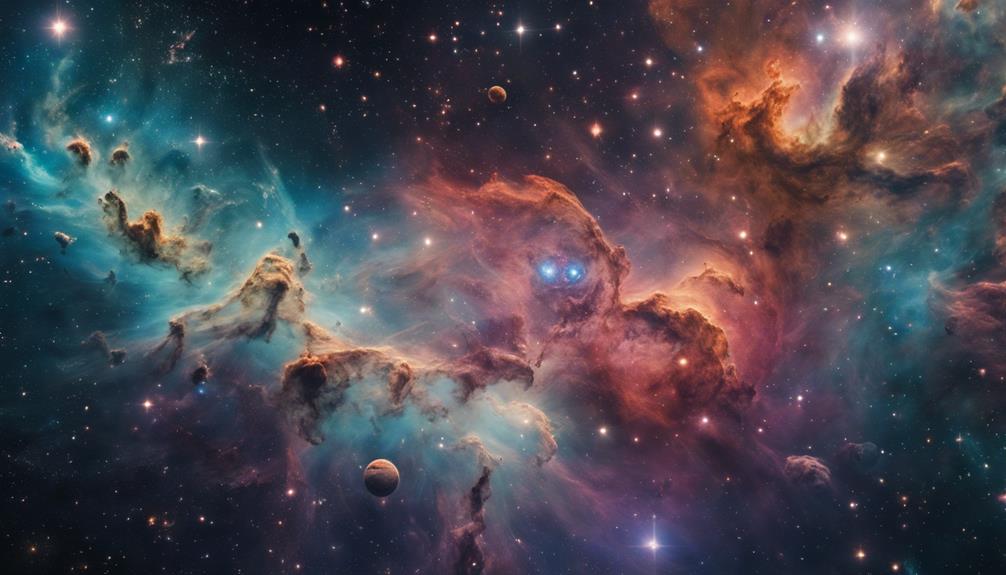
You might think that the universe's grandeur was fully mapped out with the invention of the backyard telescope, but the world's best observatories, like the James Webb Space Telescope, have been quietly outdoing themselves.
They've not only peered back into the cosmic dark ages but also thrown light on thousands of previously unknown galaxies and intriguing exoplanets with weather forecasts that make Earth's hurricanes seem like a gentle breeze.
These celestial detectives have revealed cosmic phenomena that challenge our understanding of the universe. If you've ever wondered about the secrets hidden in the vast expanse above us, now's the time to lean in closer and explore the frontiers that these technological marvels are discovering.
Key Takeaways
- Hubble Space Telescope's images have revolutionized our understanding of galaxies and supermassive black holes.
- Galileo's telescopic discoveries laid the groundwork for modern observational astronomy.
- Radio astronomy has unveiled cosmic phenomena like pulsars and quasars, hidden from optical telescopes.
- Exoplanet exploration by telescopes like Webb offers insights into the atmospheres and habitability of distant worlds.
Gazing Into the Cosmos: Hubble's Legacy
Since its launch in 1990, the Hubble Space Telescope has opened your eyes to the universe's wonders, forever changing our understanding of the cosmos. Perched above Earth's distorting atmosphere, Hubble has acted as humanity's eye in the sky, peering into the far reaches of space.
You've marveled at its detailed images of distant galaxies, which not only confirmed the existence of supermassive black holes but also pushed the boundaries of what was thought to be observable.
Through Hubble's lens, you've witnessed the birth and death of stars, contributing to a deeper understanding of these celestial phenomena. It's not just about the stars, though. Hubble's contributions extend to unraveling the mysteries of exoplanet atmospheres and offering glimpses that have paved the way for future explorations. Its findings have inspired next-generation telescopes like Webb, promising to delve even deeper into the universe's secrets.
Hubble's legacy is a confirmation to human curiosity and ingenuity. It's ensured that telescopes like Hubble continue to ignite your imagination, encouraging you to look up and ponder your place among the stars. As you gaze into the cosmos through Hubble's eye, you're reminded that the universe's story is far from over—it's just beginning.
Galileo's Gaze: The Dawn of Modern Astronomy
You stepped into the dawn of modern astronomy when Galileo turned his telescope towards the heavens, challenging the very fabric of contemporary celestial understanding. His groundbreaking observations laid the groundwork for what you now explore with marvels like the Hubble Space Telescope. Galileo didn't just gaze up; he saw a universe filled with wonders, forever altering the course of astronomy.
Discovering the moons of Jupiter, Galileo provided irrefutable support for the heliocentric model, a universe where planets revolved around the sun, not Earth. This was a bold stance, shaking the foundations of the then-accepted geocentric model. Observing the phases of Venus, he offered more proof that Earth wasn't the center of everything. His meticulous notes on sunspots challenged the age-old belief in an unblemished, unchanging celestial sphere.
Galileo's telescope became his key to opening the secrets of the universe, shifting the focus from theoretical speculation to observational astronomy. His legacy is a proof to the power of looking closer, questioning further, and never settling for the accepted explanation. In the vast expanse of the universe, Galileo taught you to observe, learn, and wonder.
The Invisible Universe: Breakthroughs in Radio Astronomy
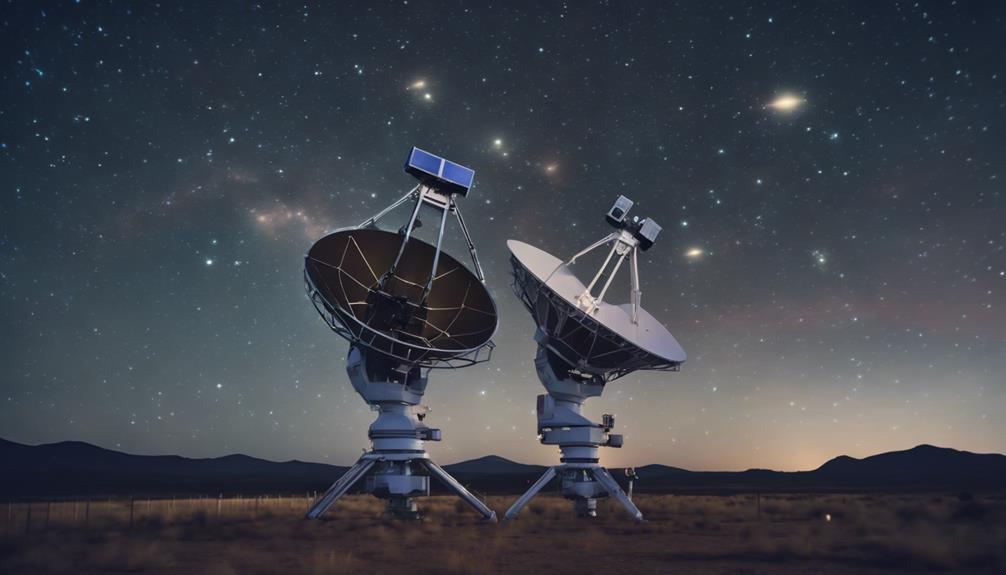
Building on Galileo's legacy, radio astronomy takes your journey of discovery beyond the visible, revealing a universe teeming with hidden cosmic wonders. When you tune into the universe with radio astronomy, you're tapping into the symphony of celestial objects, pulsing and humming with radio waves. This adventure has exposed pulsars, spinning neutron stars that serve as cosmic lighthouses, and quasars, the brilliantly bright centers of distant galaxies, all contributing to our expanding understanding of the cosmos.
Interestingly, radio astronomy has also brought the cosmic microwave background radiation to light, offering a glimpse into the universe's infancy. This discovery alone has reshaped our cosmic perspective, illustrating the significance of radio waves in understanding the universe's evolution.
| Key Discoveries | Instrumentation |
|---|---|
| Pulsars | VLA |
| Quasars | ALMA |
| Cosmic Microwave Background Radiation | VLA & ALMA |
| Interstellar Gas Composition | ALMA |
| Origins of Cosmic Rays | VLA |
Radio telescopes like the Very Large Array (VLA) and the Atacama Large Millimeter/submillimeter Array (ALMA) are at the forefront, peering into the depths of space to study star formation, the dynamics within galaxies, and the activities surrounding black holes. They're our eyes on the invisible, revealing secrets of interstellar gas, galactic magnetic fields, and the enigmatic origins of cosmic rays.
Beyond Our Solar System: Exoplanet Discoveries
Venturing beyond our solar system, we encounter the fascinating domain of exoplanet discoveries, where recent observations have uncovered worlds with atmospheres strikingly different from our own. The Webb Space Telescope, a marvel in astronomical instrumentation, has been pivotal in this new era. It directly imaged exoplanet HIP 65426 b, marking a significant milestone in our quest to understand the universe.
Webb's data doesn't stop there. It has peeled back the atmospheric layers of WASP-39b, revealing an intricate tapestry of gases, including unexpected cloud formations that challenge our understanding of planetary weather. On K2-18 b, Webb detected both methane and CO2, crucial clues in the puzzle of habitability and the search for Earth-like conditions elsewhere in the cosmos.
These exoplanet discoveries aren't just about adding numbers to a catalog. They're about deepening our comprehension of planetary compositions and the delicate balance that makes a planet habitable. Each observation, each data point from Webb, contributes to a richer narrative of our place in the universe, underscoring the diversity and complexity of worlds beyond our own solar system.
Echoes of the Big Bang: Uncovering the Cosmic Microwave Background
Peeling back the layers of cosmic history, the Cosmic Microwave Background (CMB) offers a window into the universe's infancy, echoing the Big Bang's monumental event. Discovered by Arno Penzias and Robert Wilson in 1965, this relic radiation blankets the cosmos, providing a snapshot of the universe just moments after its explosive birth. The CMB radiation is a proof to the universe's primordial moments, its uniform glow punctuated by slight temperature fluctuations that map the early cosmos's structure.
These minute differences in temperature are more than mere anomalies; they're the earliest seeds from which galaxies and vast cosmic structures sprang. Studying the CMB has revolutionized our understanding of the universe's evolution, shedding light on dark matter, galaxy formation, and the universe's overall structure. It's as if the cosmos has handed us a treasure map, with the CMB guiding us through the dark, revealing the universe's age, composition, and expansion.
The insights gained from the CMB radiation aren't just about understanding where we come from but also about piecing together how the universe will evolve. It's a profound reminder that in the cosmic microwave background, we're looking at the echoes of creation itself.
Frequently Asked Questions
What Were the Biggest Findings From the James Webb Telescope?
You've discovered that the James Webb Telescope has revealed mysteries of galactic formation, star birth, and exoplanet atmospheres. It's brought us closer to understanding cosmic dust, dark matter, and the universe's expansion through stunning nebulae images.
What Has James Webb Actually Discovered?
James Webb's discoveries, from exposing exoplanet atmospheres to probing the early universe, bridge cosmic webs and star birth. It's peered into the infrared universe, offering dark matter insights and illuminating interstellar objects' secrets.
What Is the Best Telescope Ever Made?
You're witnessing telescope evolution at its peak with the James Webb Space Telescope. It's an optical marvel, overcoming engineering challenges to redefine space observation. Future designs will build on this technology breakthrough, marking new scientific milestones.
What Are the Latest Findings of the James Webb Telescope?
You've ventured beyond, uncovering cosmic mysteries through the James Webb Telescope's latest finds. From exoplanet atmospheres to the dark corners where galaxies form, you're peering into stellar nurseries and mapping the unseen, igniting quasar illumination.
Conclusion
You've journeyed through the vast expanses of the universe, from Galileo's first peek to the James Webb Space Telescope's latest revelations. Here's a thought to carry with you: over 4,000 exoplanets have been discovered, each holding the potential for new worlds, life forms, and mysteries untold.
This statistic isn't just a number; it's a gateway to infinite possibilities, challenging us to keep looking up, dreaming big, and exploring further. The universe is vast, and our curiosity, boundless. Let's continue the adventure together.
