Beginner's Guide to Picking the Perfect Telescope
Starting your stargazing journey brings a bevy of baffling choices, particularly when picking the perfect telescope. You’re faced with decisions about aperture sizes, mounts, and whether a refractor or reflector better suits your celestial cravings.
However, it’s not just about the specs. Understanding the nuances of each type and how they align with your astronomical aspirations is vital. As you stand at this crossroads, wondering which path will lead you to breathtaking views of nebulae or the craggy craters of the moon, remember, the right choice can elevate your night sky adventures from mundane to magical.
Let’s explore the essentials to make sure your selection not only meets but exceeds your stargazing expectations.
Key Takeaways
- Consider the aperture size for a balance between portability and viewing capability.
- Choose between a refractor, reflector, or compound based on your preferred celestial objects.
- Prioritize telescopes with user-friendly mounts and durable construction for ease of use.
- Regular maintenance ensures long-term performance and the quality of observations.
Understanding Telescope Basics
To effectively select the right telescope for your astronomical pursuits, it’s important to grasp the basics of how telescopes, through their use of lenses or mirrors, gather and focus light to magnify celestial objects.
Understanding the key components and their roles in the optical design of telescopes is vital. Each type, be it refractor, reflector, or catadioptric, employs a distinct method to achieve this goal, influencing your viewing experience and the type of celestial objects you’ll observe with clarity.
Refractors rely on lenses to bend light, offering a straightforward optical design that’s excellent for viewing planets and the moon. Reflectors, on the other hand, use mirrors to collect and bounce light, making them ideal for deep-sky observations like galaxies and nebulae due to their ability to gather more light. Catadioptric telescopes combine both lenses and mirrors in a compact design, offering versatility and power for a broad range of celestial viewing.
Selecting the right telescope involves analyzing these optical designs alongside your observational interests. Each has its advantages and specific applications, necessitating a technical and detailed approach to fully understand their capabilities.
Refractor Telescopes: A Popular Choice
As you explore refractor telescopes, understanding their optics is critical; These devices harness lenses to focus light, providing clear, high-contrast images.
Selecting the appropriate aperture is essential—it determines both the telescope’s portability and its ability to capture light, influencing the clarity and detail of celestial observations.
Additionally, regular maintenance guarantees your refractor remains in top condition, extending its lifespan while ensuring consistent observational quality.
Understanding Refractor Optics
Refractor telescopes, utilizing lenses to gather and focus light, offer sharp and clear views of celestial objects, making them a favored choice for amateur astronomers seeking both reliability and quality in their stargazing endeavors.
They’re particularly versatile, ideal for both terrestrial and astronomical observations. APO refractors are a standout, reducing chromatic aberration and ensuring high-quality views.
| Feature | Benefit |
|---|---|
| Lenses | Provide sharp, clear images |
| Low maintenance | Easy setup and use for beginners |
| Less distortion | More accurate astronomical observations |
| APO refractors | Minimize chromatic aberration for clearer views |
| Versatility | Suitable for both terrestrial and space viewing |
With these advantages, refractor telescopes are a solid, reliable option for anyone starting their journey into astronomy.
Choosing the Right Aperture
Understanding the significance of aperture size in refractor telescopes will guide you in selecting a model that best fits your astronomical exploration needs. The aperture, pivotal in determining a telescope’s light-gathering ability, directly influences how well you can resolve celestial objects.
Popular refractor telescopes, with apertures ranging from 70mm to 120mm, strike a delicate balance between portability and performance, catering to both beginners and seasoned stargazers.
Larger apertures, exceeding 120mm, enhance your views of planets, the Moon, and select deep-sky objects by improving light-gathering capacity, crucial for observing faint galaxies and nebulae.
Additionally, lens quality in refractor telescopes is indispensable, as it greatly affects the resolution and sharpness of the images you’ll capture, ensuring detailed and clear observations of the cosmos.
Maintenance and Care Tips
To maintain your refractor telescope and make sure it continues to provide the best celestial views, it’s crucial to adhere to a routine maintenance and care regimen. Proper telescope maintenance not only prolongs the life of your instrument but also guarantees top performance during observation sessions.
Here are key practices to follow:
- Regularly clean lenses and optical surfaces with a soft brush or compressed air to remove dust and debris, protecting against dust buildup and preventing damage.
- Check and adjust collimation to ensure proper alignment, providing clear and sharp images.
- Store your telescope properly in a dry, dust-free environment to prevent damage from extreme conditions and maintain the integrity of lenses and internal components.
Reflector Telescopes: The Power of Mirrors
Harnessing the reflective capabilities of mirrors, reflector telescopes offer an efficient and cost-effective means for beginners to explore the cosmos. Unlike their refractive counterparts, reflectors use a primary mirror to gather light, greatly enhancing light collection.
This design is particularly beneficial for observing faint deep-sky objects, where larger apertures capture more elusive celestial wonders.
Reflectors stand out for their superior reduction of chromatic aberration. This means you’ll enjoy sharper images without the color fringing that can detract from your viewing experience. However, to maintain these crisp views, occasional collimation is necessary. Aligning the mirrors guarantees peak performance and the best possible image quality.
Among the various reflector designs, Newtonian reflectors and Dobsonian telescopes are especially popular. They marry simplicity with effectiveness, offering a straightforward path to observing the cosmos. Dobsonians, in particular, are known for their robust yet simple mounting, making them a favorite for their ease of use and stability.
| Feature | Benefit | Ideal For |
|---|---|---|
| Mirrors | Reduces chromatic aberration | Sharp, color-accurate images |
| Light Collection | Larger apertures for faint objects | Deep-sky observation |
| Collimation | Maintains alignment for clarity | Peak performance |
| Newtonian | Classic design, cost-effective | Beginners & enthusiasts |
| Dobsonian | Easy to use, stable | First-time telescope users |
Reflectors offer a gateway to the stars that’s both accessible and rewarding, guiding you to explore the universe with sharp, detailed views.
Compound Telescopes: The Best of Both Worlds
As you explore the domain of compound telescopes, you’ll find their hybrid design merges the best features of refractor and reflector models, offering unparalleled optical clarity and efficient light capture.
Deciding on your compound telescope involves understanding the nuances between Schmidt-Cassegrain and Maksutov-Cassegrain configurations, each known for their specific advantages in image fidelity and portability.
Analyzing these aspects critically will make certain you select a telescope that aligns with your observational preferences and mobility requirements, maximizing your stargazing experience.
Advantages of Compound Telescopes
Compound telescopes, merging the best features of lenses and mirrors, offer a compact and versatile solution for astronomers at all levels. They embody the strengths of both refractor and reflector designs, providing a streamlined experience. Here’s why they’re an exceptional choice:
- High Magnification and Compact Design: Compound telescopes, particularly Schmidt-Cassegrain models, deliver powerful magnification capabilities within a remarkably compact frame. This makes them ideal for detailed celestial observations without the bulkiness associated with traditional designs.
- Versatile and user-friendly: Their versatility extends from the backyard astronomer to the serious hobbyist, accommodating a wide range of celestial pursuits with ease of use.
- Reduced Chromatic Aberration: These telescopes notably reduce chromatic aberration, a common issue in refractors, resulting in clearer and more precise images.
Choosing Your Compound Telescope
Selecting the right compound telescope involves analyzing factors such as optical performance, portability, and the specific celestial phenomena you’re keen to observe.
Compound telescopes, or catadioptric telescopes, merge the best features of refractor and reflector models. Their compact size enhances portability, making them a top choice for stargazers who value convenience without sacrificing high-quality images. These telescopes minimize chromatic aberration, ensuring sharp, clear views of the cosmos.
Among the popular variants, Schmidt-Cassegrain and Maksutov-Cassegrain telescopes stand out for their versatility and superior performance.
Whether you’re a beginner or an advanced user, these compound telescopes offer an ideal balance between ease of use, image quality, and the ability to observe a wide range of celestial phenomena with remarkable clarity.
Aperture and Focal Length Explained
Understanding the concepts of aperture and focal length is essential for anyone looking to explore into astronomy, as they’re key factors in determining a telescope’s performance and observational capabilities.
Aperture, the diameter of your telescope’s primary lens or mirror, directly impacts its light-gathering ability. A larger aperture allows your telescope to capture more light, resulting in brighter and more detailed images of celestial objects. This is critical for seeing faint objects and discerning fine details on planets and deep-sky objects.
Focal length, on the other hand, determines the magnification potential of your telescope. A longer focal length provides higher magnification, allowing you to zoom in on distant celestial bodies. However, it’s the relationship between aperture and focal length that truly defines your telescope’s resolving power—the ability to see fine details and separate closely spaced objects.
When selecting a telescope, consider these points:
- Aperture size impacts the light-gathering capacity and detail resolution.
- Focal length influences magnification and field of view.
- Observing preferences should guide your choice, balancing between detailed views of planets or wider views for deep-sky exploration.
Understanding these elements will help you choose a telescope that fits your observing preferences and maximizes your stargazing experience.
Choosing the Right Mount
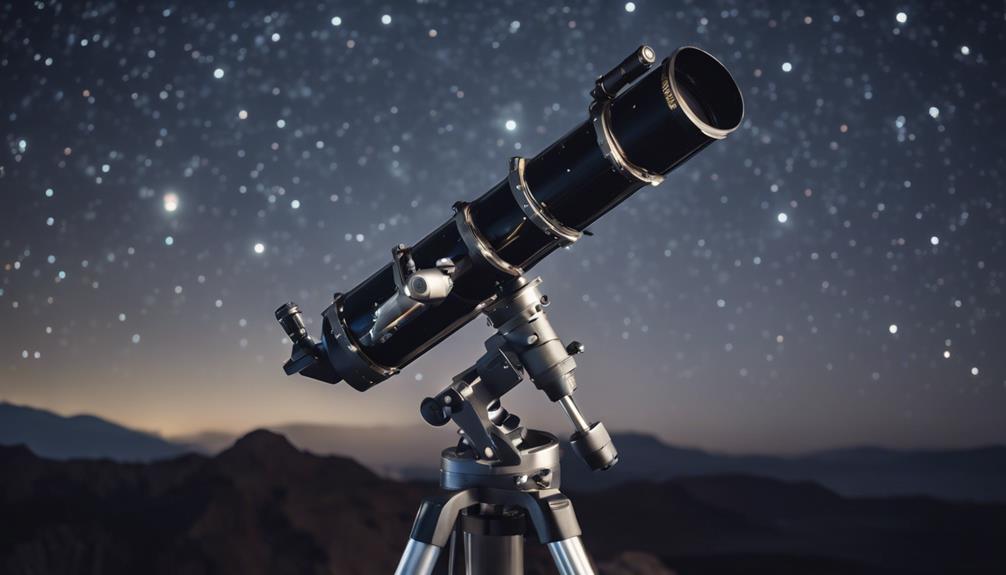
After considering aperture and focal length, the next important decision you’ll face is choosing the appropriate mount, as it greatly impacts your telescope’s functionality and ease of use. Understanding the differences between mount types is key for a rewarding stargazing experience.
| Mount Type | Key Feature | Best For |
|---|---|---|
| Equatorial Mount | Compensates night sky rotation | Precise tracking of celestial objects |
| Altitude-Azimuth Mount | Simpler, manual tracking | Beginners, casual observations |
| Computerized Mount | Automated object location | Advanced users seeking convenience |
Equatorial mounts, while offering unparalleled stability and tracking accuracy, require a bit of a learning curve. They necessitate alignment with the celestial pole to effectively track celestial objects across the night sky. This makes them a bit challenging for beginners but invaluable for serious astronomers.
Altitude-azimuth mounts are more user-friendly, making them ideal for beginners. Their straightforward design allows for easy operation, although they lack the automatic tracking capabilities of their equatorial counterparts.
Computerized mounts, despite their complexity in setup, provide an effortless way to locate and track celestial bodies with minimal manual intervention. This feature, however, comes with a steeper learning curve and might overwhelm beginners.
Choosing the right mount involves balancing your need for stability, ease of tracking, and the level of involvement you desire in the observation process.
Considerations for Ease of Use
When selecting a telescope, it’s important to prioritize ease of use, focusing on features such as user-friendly design, straightforward setup, and stable mount systems for seamless operation. A telescope that’s a hassle to use can quickly diminish your enthusiasm for astronomy.
To help guide you in your selection, consider the following key points:
- User-Friendly Design and Intuitive Controls: Opt for a telescope that boasts a design simple enough for beginners, yet equipped with intuitive controls. This guarantees that you spend less time fumbling with settings and more time enjoying the night sky.
- Simple Setup and Clear Instructions: A telescope with a simple setup process and clear instructions can significantly reduce initial frustration. This aspect is important for beginners who may not be familiar with the intricacies of telescope assembly and calibration.
- Stable Mounts and Durable Construction: Choose a telescope with stable mounts to facilitate smooth tracking of celestial objects. Additionally, durable construction and quality components are essential for long-term usability and enjoyment, making sure that your telescope withstands the test of time and frequent use.
Frequently Asked Questions
How Do You Choose the Perfect Telescope?
To choose the perfect telescope, consider mount stability, aperture size, optical design, budget, brand reliability, maintenance ease, portability, accessory compatibility, viewing location, and user reviews. Analyze these factors carefully for an informed decision.
What Should I Look for in a Beginners Telescope?
When diving into stargazing, remember that all that glitters isn’t gold. Look for a telescope with a large aperture, stable mount, and high optical quality, considering budget, portability, and light pollution. Brands and communities matter too.
What Is the Best Magnification for a Beginner Telescope?
For a beginner’s telescope, aim for 20x to 100x magnification, ensuring optical quality, ample aperture size for light gathering, and mount stability. Consider eyepiece compatibility, refractor benefits, reflector advantages, ease of use, portability, and budget.
What Strength Telescope Do I Need to See Planets?
To see planets, you’ll need a telescope that aligns with the stars in quality. Prioritize aperture size for clarity, stable mounts, quality eyepieces, and optical coatings to navigate through light pollution and celestial events.
Conclusion
To summarize, selecting the perfect telescope is a fine balance between technical specifications and personal aspirations.
Remarkably, 90% of amateur astronomers report enhanced satisfaction with their stargazing experiences after investing in telescopes with higher aperture sizes. This statistic underscores the critical importance of prioritizing aperture and optical quality over fancy features.
By focusing on essential elements like aperture, focal length, and a stable mount, you’re on your path to revealing the mysteries of the cosmos with unparalleled clarity and precision.


