Best Celestron Telescope: Discover Top Celestron Models For Every Stargazer

-
Beginner-Friendly:
- Celestron AstroMaster 114EQ ($279.95): Ideal for planets and deep-sky objects with a 114mm aperture and equatorial mount.
- Celestron Travel Scope 70 ($25.00): Lightweight and portable, great for beginners on the go.
-
Intermediate Choices:
- Celestron NexStar 6SE ($785.00): A 6-inch Schmidt-Cassegrain telescope with GoTo technology for automated tracking.
- Celestron Astro Fi 102 ($699.99): Wireless control via SkyPortal app with a 102mm Maksutov-Cassegrain design.
-
Advanced Options:
- Celestron NexStar 8SE ($1,699.99): An 8-inch aperture for detailed views of planets and galaxies, perfect for enthusiasts.
- Celestron Advanced VX 8 EdgeHD ($2,799.00): Designed for astrophotography with advanced optics and a sturdy equatorial mount.
-
Professional-Level:
- Celestron CPC 1100 XLT ($3,999.00): 11-inch aperture, dual-fork mount, and GPS alignment for serious astronomers.
Quick Comparison
| Model | Aperture | Focal Length | Mount Type | Weight | Price | Best For |
|---|---|---|---|---|---|---|
| AstroMaster 114EQ | 4.5" | 1,000mm | Equatorial | 13.3 lbs | $279.95 | Beginners, planets & deep-sky |
| Travel Scope 70 | 2.75" | 400mm | Alt-azimuth | 3.3 lbs | $25.00 | Beginners, portability |
| NexStar 6SE | 6" | 1,500mm | Alt-azimuth (GoTo) | 30 lbs | $785.00 | Intermediate, automated use |
| Astro Fi 102 | 4" | 1,325mm | Computerized (WiFi) | 16 lbs | $699.99 | Intermediate, wireless control |
| NexStar 8SE | 8" | 2,032mm | Alt-azimuth (GoTo) | 33 lbs | $1,699.99 | Advanced, deep-sky observing |
| Advanced VX 8 EdgeHD | 8" | 2,032mm | Equatorial | 14 lbs | $2,799.00 | Astrophotography |
| CPC 1100 XLT | 11" | 2,800mm | Dual Fork Arm (GoTo) | 92 lbs | $3,999.00 | Professionals, detailed views |
This guide covers everything from budget-friendly beginner telescopes to high-end options for professionals. Whether you’re observing the Moon, planets, or deep-sky objects – or diving into astrophotography – there’s a Celestron telescope for you. Let’s explore the details of each model!
Best Celestron Telescope For Beginners
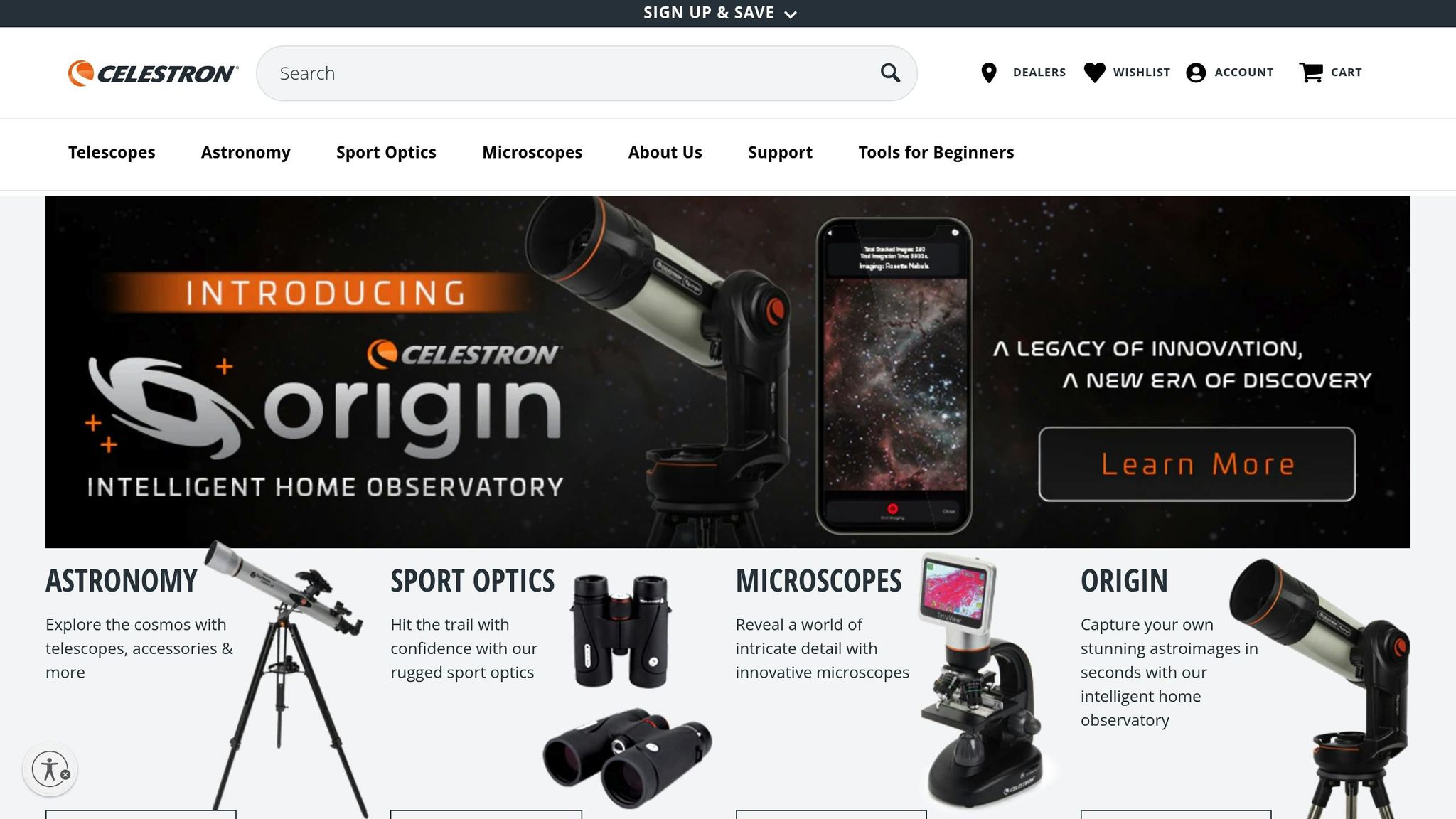
1. Celestron NexStar 4SE Specs
The NexStar 4SE combines advanced features with high-quality optics in a compact package. Its 4.02-inch (102mm) Maksutov-Cassegrain design collects 212 times more light than the human eye. With a focal length of 1,325mm and an f/13 focal ratio, it’s perfect for capturing planetary and lunar details. The StarBright XLT coatings improve contrast and sharpness for clear celestial views.
The telescope’s computerized mount system is designed for performance and ease of use, featuring a single-fork arm:
| Mount Features | Specifications |
|---|---|
| Tracking Modes | Alt-Az, EQ North, EQ South |
| Slew Speeds | 9 speeds (up to 3°/second) |
| Database | 38,181 celestial objects |
| Power Source | 8 AA batteries or 12V DC adapter |
| Weight Capacity | 10 lbs (4.54 kg) |
Weighing only 23 pounds (10.4 kg) and with a tube length of 13.5 inches (343mm), the NexStar 4SE is highly portable – great for taking on the go.
Key visual performance stats include:
- Maximum useful magnification: 241x
- Limiting stellar magnitude: 12.5
- Resolution (Rayleigh): 1.37 arc seconds
- A 25mm eyepiece providing 53x magnification
The mount offers multiple alignment options, such as SkyAlign, Auto 2-Star Align, and Solar System Align. The NexStar+ hand control includes a backlit LCD and 19 fiber optic buttons, making it easy to operate in low-light conditions.
Priced at $679.00, the NexStar 4SE is a solid choice for beginners and intermediate stargazers. It also comes with Celestron’s Starry Night Special Edition Software and works with the SkyPortal App for added functionality.
2. Celestron AstroMaster 114EQ Details
The AstroMaster 114EQ Newtonian reflector is a solid choice for observing planets and deep-sky objects. With a 4.48-inch (114mm) aperture and a 1,000mm focal length (f/8.77), it’s well-suited for viewing the Moon and planets in detail.
Its optical system uses aluminum-coated glass mirrors with SiO₂ protection, ensuring durability and good light transmission. The telescope gathers 265 times more light than the human eye, making it possible to observe celestial objects as faint as magnitude 12.8.
| Optical Specifications | Details |
|---|---|
| Maximum Magnification | 269x |
| Minimum Magnification | 16x |
| Resolution (Rayleigh) | 1.22 arc seconds |
| Resolution (Dawes) | 1.02 arc seconds |
| Secondary Obstruction | 38% diameter, 14% area |
The telescope includes two eyepieces:
- 20mm eyepiece with a built-in erect image corrector (50x magnification)
- 10mm eyepiece for higher magnification (100x)
The CG-2 German equatorial mount provides accurate tracking with dual-axis slow-motion controls, making it easier to follow objects as they move across the sky. The mount is paired with a sturdy steel tripod, adjustable from 32 inches to 51 inches (812.8mm to 1295.4mm), offering both stability and flexibility.
"You’ll be ready to observe in minutes thanks to the quick and easy no-tool setup. The 114EQ provides bright, clear images of the Moon, planets, star clusters, and more for great nighttime viewing." – Celestron
For locating objects, the StarPointer™ red dot finderscope is especially helpful for beginners. The entire setup weighs only 13.3 lbs (6.03 kg), making it easy to transport while maintaining stability.
Additionally, the included Starry Night Basic Software offers access to 36,000 celestial objects and printable sky maps. At $279.95, the AstroMaster 114EQ is a practical option for beginners and intermediate stargazers eager to explore the night sky.
Next, we’ll take a look at other Celestron models that offer even more stargazing opportunities.
3. Celestron Travel Scope 70 Overview
The Celestron Travel Scope 70 is built with a 70mm achromatic lens and a 400mm focal length, making it compact and lightweight – perfect for travelers and beginners.
| Specification | Rating |
|---|---|
| Optics | 4/5 |
| Moon & Planets | 3/5 |
| Rich Field | 3/5 |
| Focuser | 3/5 |
| Mount | 1/5 |
| Portability | 5/5 |
| Value | 2/5 |
The optics perform well for terrestrial viewing during the day, but the included accessories leave room for improvement. The standard 45-degree erecting prism reduces image clarity, causing blurriness and some color distortion.
To enhance its performance for stargazing, consider swapping the 45-degree prism for a 90-degree mirror diagonal. Using a sturdier tripod and upgrading to a red dot finder instead of the stock optical finderscope will also make a big difference.
The telescope is easy to carry, thanks to a custom backpack included in the package. However, the tripod’s instability can make observing the night sky frustrating.
In summary, the Travel Scope 70 offers a mix of portability and basic performance. While its optics are decent, achieving better results often means investing in upgraded accessories. It also includes basic astronomy software, which provides access to celestial object databases and sky maps – helpful for beginners despite the telescope’s hardware limitations.
This balance between portability and performance provides a good starting point for those looking to explore more advanced Celestron models in future sections.
4. Celestron NexStar 6SE Features
The NexStar 6SE is built around a 6-inch Schmidt-Cassegrain optical system that collects 459 times more light than the human eye can. This telescope combines quality optics with automated functionality, making it suitable for enthusiasts of varying experience levels.
| Key Specifications | Details |
|---|---|
| Optical Design | Schmidt-Cassegrain |
| Aperture | 6 inches (150 mm) |
| Focal Length | 59 inches (1,500 mm) |
| Focal Ratio | f/10 |
| Max Magnification | 354x |
| Weight Capacity | 12 lbs (5.44 kg) |
| Slew Speed | Up to 5° per second |
The NexStar+ mount is preloaded with a database of 40,000 celestial objects and allows for up to 200 custom entries. This automated system simplifies tracking and observation, making it a reliable choice for various viewing needs.
"Once the telescope is aligned, you can choose from lists of deep-sky objects, the planets, and double stars to point it at, which it’ll slew to automatically with high accuracy, assuming you’ve aligned it properly." – TelescopicWatch
According to TelescopicWatch, the mount earned a 4 out of 5 rating, with reviewers highlighting its user-friendly design and precise GoTo functionality. Aligning the telescope takes about 10 minutes, aided by the included StarPointer red dot finderscope.
The NexStar 6SE is also well-suited for astrophotography. It supports NexImage for capturing planetary details and can be adapted for wide-field deep-sky imaging. The telescope’s tracking system offers multiple rates – sidereal, solar, and lunar – ensuring smooth and precise object tracking.
For advanced users, the NexStar 6SE is compatible with accessories like SkySync GPS and StarSense AutoAlign, which enhance its capabilities. Additionally, the package includes Celestron Starry Night Special Edition Software and the SkyPortal App, providing helpful tools for planning and executing observation sessions.
The mount, weighing 12 lbs, can handle an 8-lb optical tube and up to 4 lbs of additional accessories. To maintain accuracy, periodic re-syncing of the system is recommended.
5. Celestron Inspire 100AZ Analysis
The Celestron Inspire 100AZ is a 4-inch (100 mm) refractor telescope designed for beginners and hobbyists. It delivers crisp views of the Moon and planets, making it a solid choice for those starting their stargazing journey. Here’s a quick look at its key specifications:
| Specification | Detail |
|---|---|
| Optical Design | Refractor |
| Aperture | 3.94 inches (100 mm) |
| Focal Length | 25.98 inches (660 mm) |
| Focal Ratio | f/6.5 |
| Total Weight | 20 lbs (9.07 kg) |
| Light Gathering | 212× the human eye |
| Included Eyepieces | 20 mm (33×) and 10 mm (66×) Kellner |
The telescope features a built-in red light that helps preserve night vision when swapping eyepieces. Its StarPointer Pro red-dot finder makes it easier to locate celestial objects.
"Aimed at beginners and those looking to upgrade, this 4-inch refractor is at its best with the moon and planets and comes with a lens cap that doubles as a novel smartphone holder for convenient astrophotography. It’s also got a built-in red light that makes swapping-out eyepieces easy in the dark." – Space.com
Performance and Reviews
TelescopicWatch rated the Inspire 100AZ highly in its evaluation:
- Optics: 4/5
- Ease of Use: 4/5
- Portability: 4/5
- Overall Value: 3/5
The telescope’s alt-azimuth mount includes a panhandle control, allowing for smooth and precise tracking. Among refractor telescopes priced around $350, it ranks #4 out of fourteen.
"It’s not perfect and, like most refractors, it does its best work with the moon and planets, but the Celestron Inspire 100AZ has more to get excited about than many of its cut-price rivals." – Space.com
Observational Highlights
While minor chromatic aberration is noticeable on bright objects, it doesn’t significantly impact the viewing experience. The Inspire 100AZ excels in observing:
- Detailed lunar features
- Planetary details
- Star clusters
- Terrestrial subjects (with an erect image diagonal)
However, it’s important to note that this telescope is not compatible with solar filters.
Additional Features
The package includes Starry Night Software and the SkyPortal app, which help users plan their observations and identify celestial objects. These tools, combined with its solid performance, make the Inspire 100AZ a strong contender for those focused on lunar and planetary exploration. It also pairs well with other models discussed in this guide.
sbb-itb-9161f90
6. Celestron Astro Fi 102 Review
The Celestron Astro Fi 102 combines smart features with reliable optical performance, making it a solid choice for observing both the night sky and terrestrial landscapes.
Technical Specifications
| Feature | Specification |
|---|---|
| Optical Design | Maksutov-Cassegrain |
| Aperture | 4.02" (102mm) |
| Focal Length | 52.17" (1,325mm) |
| Focal Ratio | f/13 |
| Maximum Magnification | 241x |
| Weight | 16 lbs (7.25 kg) |
| Mount Type | Computerized Alt-Azimuth |
| Light Gathering Power | 212x human eye |
Smart Features and Connectivity
The Astro Fi 102 takes advantage of modern technology by offering wireless control through the SkyPortal app. This app provides a database of celestial objects, real-time updates, automatic tracking, and guided sky tours, making it easier to explore the universe.
Optical Performance
This telescope delivers bright and sharp images with minimal color distortion, thanks to its Maksutov-Cassegrain design. It comes with two eyepieces:
- 25mm eyepiece: Offers approximately 53x magnification
- 10mm eyepiece: Provides approximately 132x magnification
These eyepieces are excellent for viewing the moon’s surface, planetary details, bright deep-sky objects, and even terrestrial scenes.
Features That Stand Out
The Astro Fi 102 includes thoughtful features to improve usability:
- StarPointer™ red dot finderscope: Simplifies locating your target
- Built-in smartphone adapter: Perfect for astrophotography
- Rubberized accessory tray: Includes a holder for smartphones or tablets
- Two auxiliary ports: For connecting optional accessories
- Multiple tracking rates: Choose from Sidereal, Solar, or Lunar tracking modes
Setup and Alignment
Setting up the Astro Fi 102 is straightforward with Celestron’s SkyAlign technology. The mount supports three alignment methods: SkyAlign, 3-Star Align, and Solar System Align. Keep in mind that the telescope may require some time to reach thermal equilibrium after setup. This combination of ease-of-use and performance makes the Astro Fi 102 a solid addition to any stargazer’s toolkit.
7. Celestron NexStar 8SE Guide
The Celestron NexStar 8SE is a computerized telescope designed for ease of use and equipped with advanced optics. Here’s a closer look at its key features and capabilities.
Technical Specifications
| Feature | Specification |
|---|---|
| Optical Design | Schmidt-Cassegrain |
| Aperture | 8" (203 mm) |
| Focal Length | 80" (2,032 mm) |
| Focal Ratio | f/10 |
| Mount Type | Computerized Alt-Azimuth |
| Total Weight | 24 lbs (12.5 lbs tube + 10 lbs tripod) |
| Eyepiece Connection | 1.25" Nosepiece |
| Power Source | AC adapter or 8 AA batteries |
Optical Performance
With its 8-inch aperture and StarBright XLT coatings, the NexStar 8SE delivers sharp, detailed views.
"The NexStar 8SE is the largest model in the NexStar series, with an 8″ aperture telescope capable of crisp, high-magnification views."
This telescope is excellent for observing intricate details in celestial objects, such as:
- Saturn’s rings, including the Cassini Division
- Spiral arms in the Whirlpool Galaxy
- Surface details of the Moon
- Clear views of planets and bright nebulae
Smart Features
The NexStar+ hand controller enhances usability with advanced features:
- A database of over 40,000 celestial objects
- SkyAlign technology for quick three-star alignment
- Mini-USB port for firmware updates
- Compatibility with NexImage cameras for planetary imaging
Essential Accessories
| Accessory | Purpose |
|---|---|
| 12V DC Power Supply | For extended observing sessions |
| Wide-field Eyepiece | Simplifies star alignment |
| High-mag Eyepiece | Ideal for detailed planetary viewing (10mm or lower) |
| Dew Shield | Protects optics from moisture |
Using these accessories can enhance the telescope’s performance and ensure stable operation.
Setup Considerations
Be aware that the fork mount base might wobble slightly due to the system’s weight. However, the telescope’s modular design makes it easy to disassemble for transport or storage. The package also includes Starry Night software and comes with a 2-year warranty, adding extra value.
8. Celestron Advanced VX 8 EdgeHD Specs
The Celestron Advanced VX 8 EdgeHD combines high-quality optics with a German equatorial mount, making it a strong option for both stargazing and astrophotography.
Technical Specifications
| Feature | Specification |
|---|---|
| Optical Design | EdgeHD (Enhanced Schmidt-Cassegrain) |
| Aperture | 8" (203.2mm) |
| Focal Length | 80" (2,032mm) |
| Focal Ratio | f/10 |
| Mount Type | Advanced VX German Equatorial |
| Payload Capacity | 30 lbs (13.6 kg) |
| Highest Magnification | 480x |
| Light Gathering Power | 843x (compared to the human eye) |
| Resolution (Rayleigh) | 0.69 arc seconds |
Advanced Optical System
The EdgeHD optics provide outstanding image clarity, thanks to features like:
- StarBright XLT coatings, which improve light transmission.
- A built-in mirror lock system to minimize image shift during focusing.
- A flat, aberration-free field that delivers sharp stars all the way to the edges.
- Support for imaging setups at f/2, f/7, and f/10.
These features ensure crisp visuals and smooth imaging performance.
Mount Capabilities
The Advanced VX mount is designed for precise tracking and ease of use:
- All-Star Polar Alignment for accurate alignment with the pole.
- Programmable Periodic Error Correction (PPEC) for consistent tracking.
- A dual saddle plate compatible with CG-5 and CGE-style dovetails.
- Usable across a wide range of latitudes (7° to 77°).
Imaging Performance
This telescope supports various imaging configurations to suit different needs:
| Configuration | F-Stop | Best For |
|---|---|---|
| Native | f/10 | Planetary imaging |
| Focal Reducer | f/7 | Deep-sky objects |
| Hyperstar | f/2 | Fast wide-field imaging |
Key Features
The Advanced VX 8 EdgeHD includes several useful connectivity options and tools:
- Ports for hand control, autoguider, and accessories (two AUX ports).
- CPWI telescope control software for seamless operation.
- A database of over 40,000 celestial objects for exploration.
With its 14-pound optical tube assembly, the telescope is portable yet sturdy. The tripod, featuring 2-inch steel legs, provides the stability needed for long-exposure imaging.
9. Celestron CPC 1100 XLT Features
The CPC 1100 XLT takes performance up a notch with its 11-inch aperture, offering outstanding light-gathering ability for both visual observation and astrophotography.
Technical Specifications
| Feature | Specification |
|---|---|
| Aperture | 11 inches (279.4 mm) |
| Focal Length | 2,800 mm |
| Focal Ratio | f/10 |
| Mount Type | Alt-Azimuth, Dual Fork Arm |
| Light Gathering Power | 1,600× (compared to the human eye) |
| Limiting Magnitude | 14.7 |
| Object Database | 40,000+ celestial objects |
| Total Weight | 92 lbs |
Advanced Optical System
The Schmidt-Cassegrain design, paired with StarBright XLT coatings, ensures a 97.4% light transmission rate. This enhances brightness and detail, making it easier to observe faint celestial objects.
Mount and Tracking Features
The dual fork arm mount is engineered for stability and includes:
- 5.625-inch hard-anodized gears on both axes
- Precision brass worm gears for smooth and accurate tracking
- A built-in GPS alignment system
- SkyAlign technology for quick and easy three-star alignment
Imaging Capabilities
High Point Scientific describes this telescope as:
"Offering great versatility, impressive performance, and an excellent user experience, this Celestron CPC 1100 is a perfect system for any astronomy enthusiast!"
Real-World Performance
In January 2020, Andrew S., an amateur astronomer, shared his experience:
"The Celestron CPC 1100 provided some of the best views I had experienced in 25 years of stargazing. The tracking was accurate, and the OTA delivered sharp, easy-to-focus views."
Included Accessories
The telescope comes with the following:
- 40mm eyepiece
- 1.25-inch star diagonal
- 8×50 finderscope
- NexStar+ hand controller
- Heavy-duty stainless steel tripod
- Astronomy software package
For enhanced usability, consider adding these optional accessories:
- Dew shield to prevent moisture buildup
- WiFi module for remote operation
- T-adapter for astrophotography
With its powerful features and durable design, the CPC 1100 XLT is a great choice for dedicated astronomers. It delivers precise tracking and impressive light-gathering capabilities, perfect for exploring deep-sky objects, planets, and lunar landscapes. This section sets the stage for the upcoming comparison chart.
Model Comparison Chart
Here’s a detailed look at the specifications and features of various Celestron models.
Core Specifications Comparison
| Model | Aperture | Focal Length | Mount Type | Weight | Price Range |
|---|---|---|---|---|---|
| NexStar 4SE | 4" (102mm) | 1,325mm | Alt-azimuth | 21 lbs | $250.00 |
| AstroMaster 114EQ | 4.5" (114mm) | 1,000mm | Equatorial | 17 lbs | $134.99 |
| Travel Scope 70 | 2.75" (70mm) | 400mm | Alt-azimuth | 3.3 lbs | $25.00 |
| NexStar 6SE | 6" (150mm) | 1,500mm | Alt-azimuth | 30 lbs | $785.00 |
| Astro Fi 102 | 4" (102mm) | 1,325mm | Alt-azimuth | 14 lbs | $699.99 |
| NexStar 8SE | 8" (203mm) | 2,032mm | Alt-azimuth | 33 lbs | $1,699.99 |
*Prices are as of April 2025.
Next, let’s break down the special features and connectivity options for each model.
Feature Comparison Matrix
| Model | GoTo Capability | StarBright XLT | WiFi Compatible | Object Database |
|---|---|---|---|---|
| NexStar 4SE | Yes | Yes | Optional | 40,000+ |
| AstroMaster 114EQ | No | No | No | N/A |
| Travel Scope 70 | No | No | No | N/A |
| NexStar 6SE | Yes | Yes | Optional | 40,000+ |
| Astro Fi 102 | Yes | Yes | Built-in | 40,000+ |
| NexStar 8SE | Yes | Yes | Optional | 40,000+ |
Now, let’s match each model to its ideal user based on experience level and purpose.
Best Use Cases
| Experience Level | Recommended Model | Key Advantage |
|---|---|---|
| Beginner / Portable | Travel Scope 70 | Lightweight and highly affordable |
| Intermediate | NexStar 6SE | Balanced features with excellent performance |
| Advanced | NexStar 8SE | Outstanding light collection and GoTo tech |
"The Celestron NexStar 8SE strikes a perfect balance between ease of use and advanced features. It’s a fantastic choice for anyone looking to dive deep into astronomy without feeling overwhelmed."
Additionally, StarBright XLT coatings improve clarity and enhance deep-sky viewing.
Buying Guide Summary
This guide helps you choose the right Celestron telescope based on your experience and needs, making it easier to find the perfect match for your stargazing goals.
Entry-Level Options ($400–$700)
For beginners who value simplicity and portability, the StarSense Explorer series is a great choice. These telescopes work with smartphone apps to make locating celestial objects easier. Popular models include:
- StarSense Explorer DX 102AZ: $469.95
- StarSense Explorer DX 130AZ: $479.95
Intermediate Choices ($700–$1,500)
If you’re ready to take your hobby to the next level, consider the NexStar SE series. These telescopes feature advanced optics and GoTo technology for automated object tracking. Notable options include:
- NexStar 5SE: $939.00
- NexStar 6SE: $1,099.00
Another excellent choice is the StarSense Explorer 10" Dobsonian, priced at $1,099.95. Its large aperture and user-friendly design make it ideal for both casual and serious observers.
Advanced Systems ($2,000+)
For professionals or dedicated enthusiasts, these high-end telescopes deliver exceptional performance:
| Model | Best For | Price | Key Feature |
|---|---|---|---|
| Advanced VX 8" EdgeHD | Astrophotography | $2,799.00 | Astrograph-quality imaging |
| Advanced VX 9.25" SCT | Deep-sky viewing | $2,949.00 | Superior light gathering |
| CPC 1100 GPS (XLT) | Professional use | $3,999.00 | Research-grade optics |
The Advanced VX series (priced between $1,329.00 and $3,699.00) caters to both visual and astrophotography needs. For those focused on deep-sky imaging, the EdgeHD optical systems and RASA designs are excellent choices. Meanwhile, the CPC 1100 XLT stands out with its professional-grade optics, perfect for serious research or advanced stargazing.
Use the comparison chart above to review technical details and find the best fit for your astronomy goals.
Related posts
- Best Children’s Telescope: Fun, Easy Stargazing For Young Explorers
- Best Telescope For Adults: Expert-recommended Models For Serious Stargazing
- Best Refractor Telescope: Crisp, Clear Views With Top Refractor Picks
- Best Computerized Telescope: Smart Telescopes That Automatically Locate And Track Planets
