Best Computerized Telescope: Smart Telescopes That Automatically Locate And Track Planets

If you’re looking for a telescope that does the hard work for you, computerized telescopes (also called GOTO telescopes) are a game-changer. They automatically locate and track planets, stars, and deep-sky objects, making astronomy accessible for beginners and powerful for experienced stargazers. Here’s what you need to know:
Key Features to Look For:
- Automated Tracking: Locates celestial objects for you.
- Database of Celestial Objects: Access thousands of stars, planets, and galaxies.
- Ease of Use: Smartphone apps, auto-alignment, and minimal setup time.
- Astrophotography Support: Capture high-quality images with features like image stacking and light pollution reduction.
Top Models in 2025:
-
Unistellar eQuinox 2 ($2,499):
- 6.2 MP resolution, 450mm focal length, 11-hour battery life.
- Ideal for deep-sky imaging and solar observation.
- Includes Smart Light Pollution Reduction and Enhanced View mode.
-
Vaonis Vespera II ($1,690):
- Compact and lightweight, with 8.3 MP resolution (boosted to 24 MP).
- Excellent for deep-sky and lunar observations with CovalENS technology.
-
Celestron Astro Fi 5 ($750):
- Affordable Schmidt-Cassegrain telescope with a 125mm aperture.
- Perfect for planetary viewing and beginners, with WiFi and SkyAlign technology.
-
Stellina Observation Station ($3,999):
- High-end automated telescope with 6.4 MP resolution.
- Excels in group stargazing and deep-sky astrophotography.
Quick Comparison Table
| Feature | Unistellar eQuinox 2 | Vaonis Vespera II | Celestron Astro Fi 5 | Stellina Observation Station |
|---|---|---|---|---|
| Price | $2,499 | $1,690 | $750 | $3,999 |
| Resolution | 6.2 MP | 8.3 MP (24 MP) | N/A | 6.4 MP |
| Aperture | 4.5" (114mm) | 2" (50mm) | 4.92" (125mm) | 3.15" (80mm) |
| Focal Length | 450mm | 200mm | 1,250mm | 400mm |
| Weight | 15.5 lbs | 11 lbs | 16.8 lbs | 24.7 lbs |
| Battery Life | 11 hours | N/A | N/A | 5 hours |
| Best For | Deep-sky imaging | Lunar and deep-sky | Planetary viewing | Group astrophotography |
Which Telescope Should You Choose?
- Beginners: Celestron Astro Fi 5 ($750) for affordability and ease of use.
- Casual Stargazers: Vaonis Vespera II ($1,690) for portability and image quality.
- Serious Astrophotographers: Unistellar eQuinox 2 ($2,499) for advanced features.
- Group Viewing: Stellina ($3,999) for automated, multi-user sessions.
These telescopes simplify stargazing, whether you’re a novice or a seasoned astronomer. Choose one that fits your budget and observation goals.
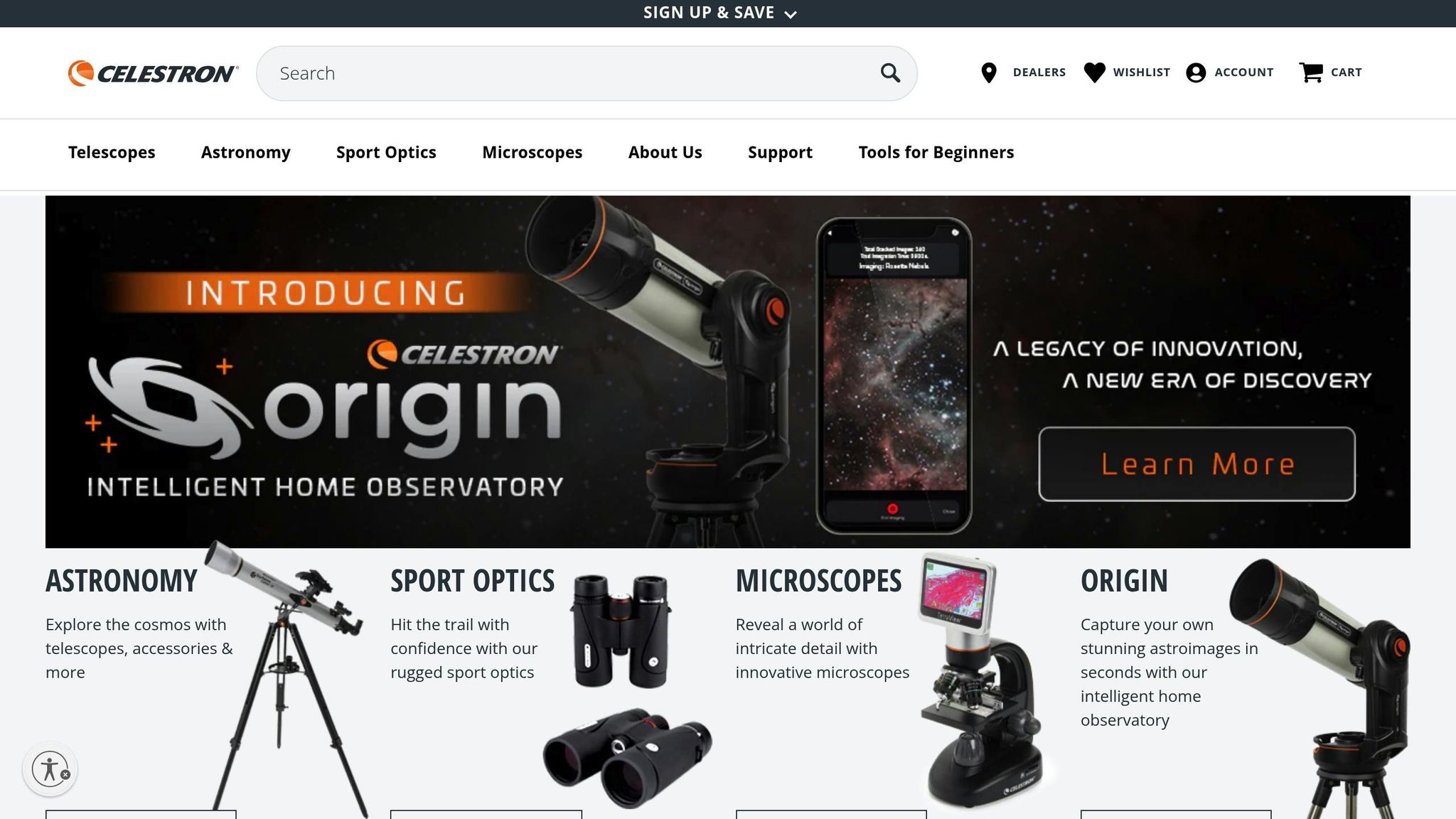
The Celestron ORIGIN: An In Depth Review – Is it Worth your …
1. Unistellar eQuinox 2 Features
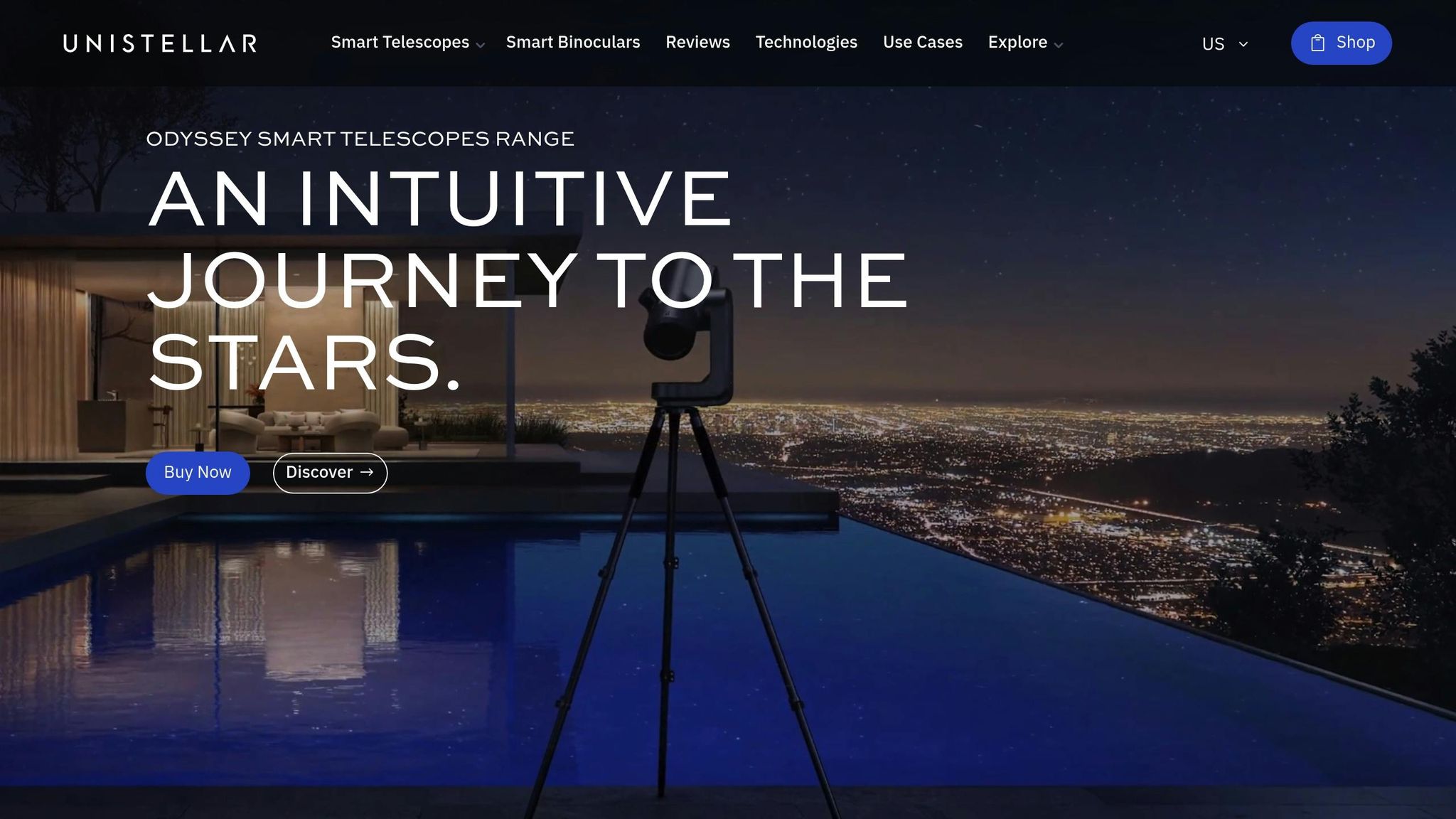
The Unistellar eQuinox 2 is a motorized smart telescope with automated tracking, priced at $2,499. It’s designed for all levels of stargazers, offering a simple yet powerful experience through its companion app. The app provides access to a vast database of over 5,000 celestial objects and 37 million stars. Thanks to its Autonomous Field Detection system, users can quickly and accurately locate celestial bodies using their smartphones.
This telescope is equipped with a 6.2 MP sensor and a 450mm focal length, delivering a 34 x 47 arc-minute field of view. Features like the Enhanced View mode, which stacks images to highlight deep-sky details, and Smart Light Pollution Reduction, which reduces interference from urban lighting, make it a versatile tool for observing the night sky.
| Technical Specifications | Details |
|---|---|
| Image Resolution | 6.2 MP |
| Focal Length | 450mm |
| Field of View | 34 x 47 arc minutes |
| Limiting Magnitude | 18.2 |
| Battery Life | 11 hours |
| Weight | 15.5 lbs |
During October 2023 tests at Great Basin National Park, the telescope demonstrated its strengths and a few weaknesses. With the optional Smart Solar Filter ($249), it easily located the sun and displayed clear views of sunspots, even through thin clouds. However, some challenges arose, such as occasional focusing delays and orientation issues during twilight.
"Once orientated using Unistellar’s Autonomous Field Detection feature the eQuinox 2 happily jumps from one object to another and within just a few minutes we were imaging nebulas, galaxies, star clusters and the moon without ever having to concern ourselves with looking up their position in the night sky." – Jase Parnell-Brookes, Managing Editor, Space and Live Science
For astrophotography enthusiasts, the eQuinox 2 offers automated tracking and Enhanced View mode, ensuring stable, detailed images that can be easily shared through the app.
2. Vaonis Vespera II Specifications
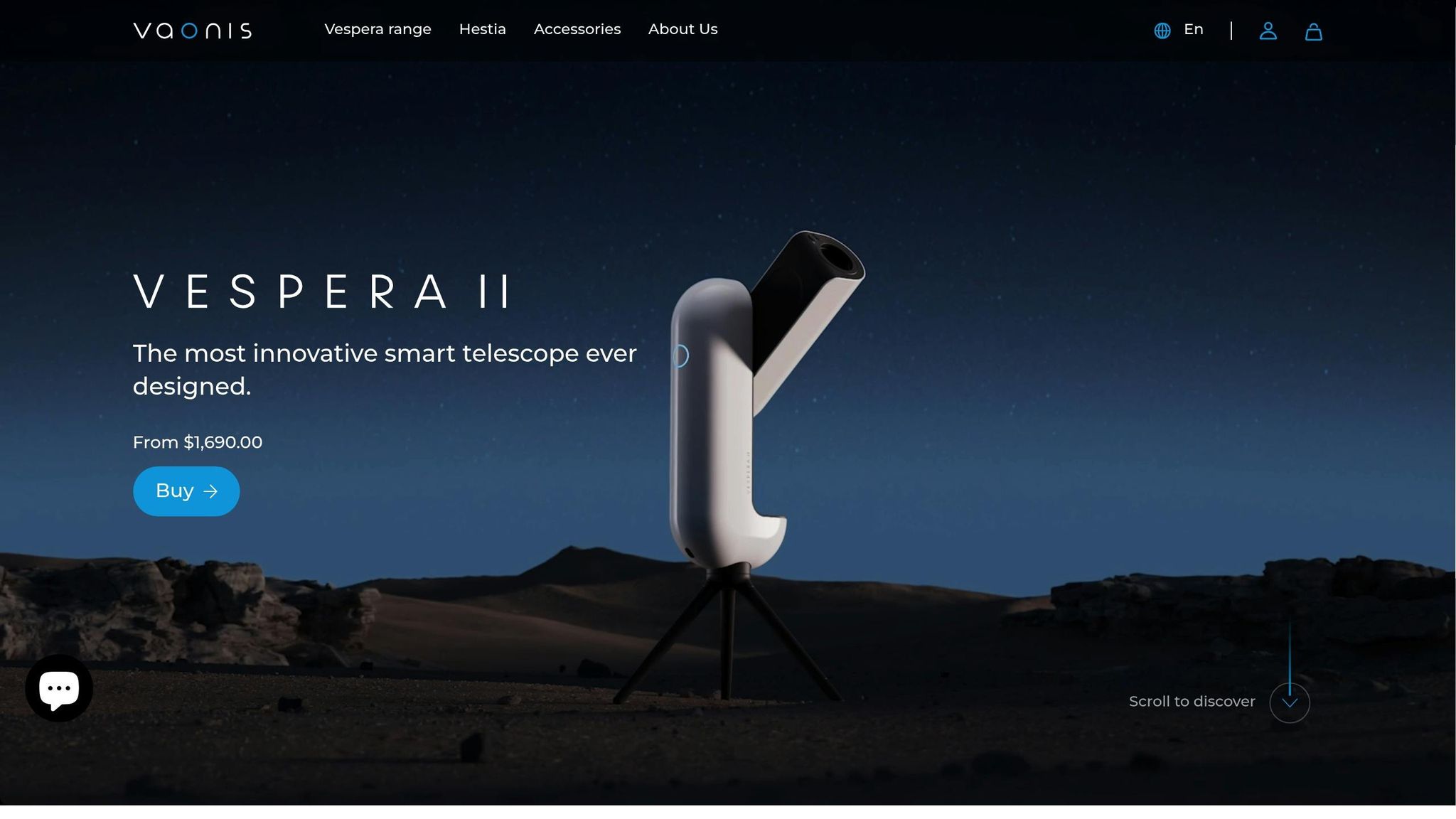
The Vaonis Vespera II, priced at $1,690.00, merges camera and telescope technologies for effortless stargazing. Weighing 11 lbs and measuring 18.9 x 7.9 x 3.5 inches, it’s compact yet powerful.
At its core is a Sony IMX 585 color sensor, delivering an 8.3MP resolution that can be boosted to 24MP using CovalENS technology. This feature not only enhances image quality but also expands the field of view, making it adaptable for various celestial observations.
| Technical Specifications | Details |
|---|---|
| Sensor Type | Sony IMX 585 (Color) |
| Resolution | 8.3 MP (Native) / 24 MP (with CovalENS) |
| Field of View | 2.5° x 1.4° (Native) |
| Extended Field of View | 4.33° x 2.43° (with CovalENS) |
| Detail Resolution | 2.39 arcsec/pixel |
| Operating Temperature | Down to 32°F |
| Database Objects | 4,300+ |
The Vespera II uses advanced star-pattern detection to automatically align itself, making setup a breeze. Paired with the Singularity mobile app, users can explore a database of over 4,300 celestial objects, all trackable with automated precision.
For image quality, the telescope features real-time autofocus and frame stacking, ensuring sharp and detailed visuals by combining the best frames. Its durable aluminum-copper alloy construction is designed to handle harsh conditions, including rain and snow, making it a reliable companion for all-weather observations.
sbb-itb-9161f90
3. Celestron Astro Fi 5 Analysis
The Celestron Astro Fi 5 Schmidt-Cassegrain telescope, priced at about $750, offers a mix of advanced tracking features and straightforward operation. With a 4.92-inch (125 mm) aperture and a 1,250 mm focal length, it provides sharp and detailed views, especially for planetary observation. Its combination of smart technology and ease of use makes it a standout option for amateur astronomers.
This telescope features built-in WiFi, which connects seamlessly to the free Celestron SkyPortal app. With this setup, you can locate and track celestial objects directly from your smartphone or tablet. Its computerized Alt-Azimuth mount gives access to a database of over 40,000 celestial targets, offering a wide range of observing opportunities.
| Key Specifications | Details |
|---|---|
| Aperture | 4.92" (125 mm) |
| Focal Length | 49.2" (1,250 mm) |
| Focal Ratio | f/10 |
| Maximum Magnification | 295x |
| Minimum Magnification | 18x |
| Total Weight | 16.8 lbs |
| Height Range | 34" – 54" |
The Astro Fi 5 is equipped with StarBright XLT coated optics, which improve light transmission for crisp, detailed views of planets and deep-sky objects. With light-gathering power 329 times greater than the human eye, it excels in planetary observation. It also supports sidereal, solar, and lunar tracking rates for reliable performance across different types of celestial events.
Setting up the telescope is straightforward, thanks to its SkyAlign technology. You can choose from three alignment methods: SkyAlign, 3-Star Align, or Solar System Align. The package includes a StarPointer finderscope and two Kellner eyepieces (25 mm and 10 mm), providing versatility for observing various objects.
An accessory tray is built into the design to hold your smartphone or tablet securely. The telescope’s sturdy construction and adjustable height (34"–54") make it both stable and portable, whether you’re using it in your backyard or taking it on a trip. With its precise tracking and solid aperture size, the Astro Fi 5 is particularly well-suited for observing planets in detail.
4. Stellina Observation Station Review
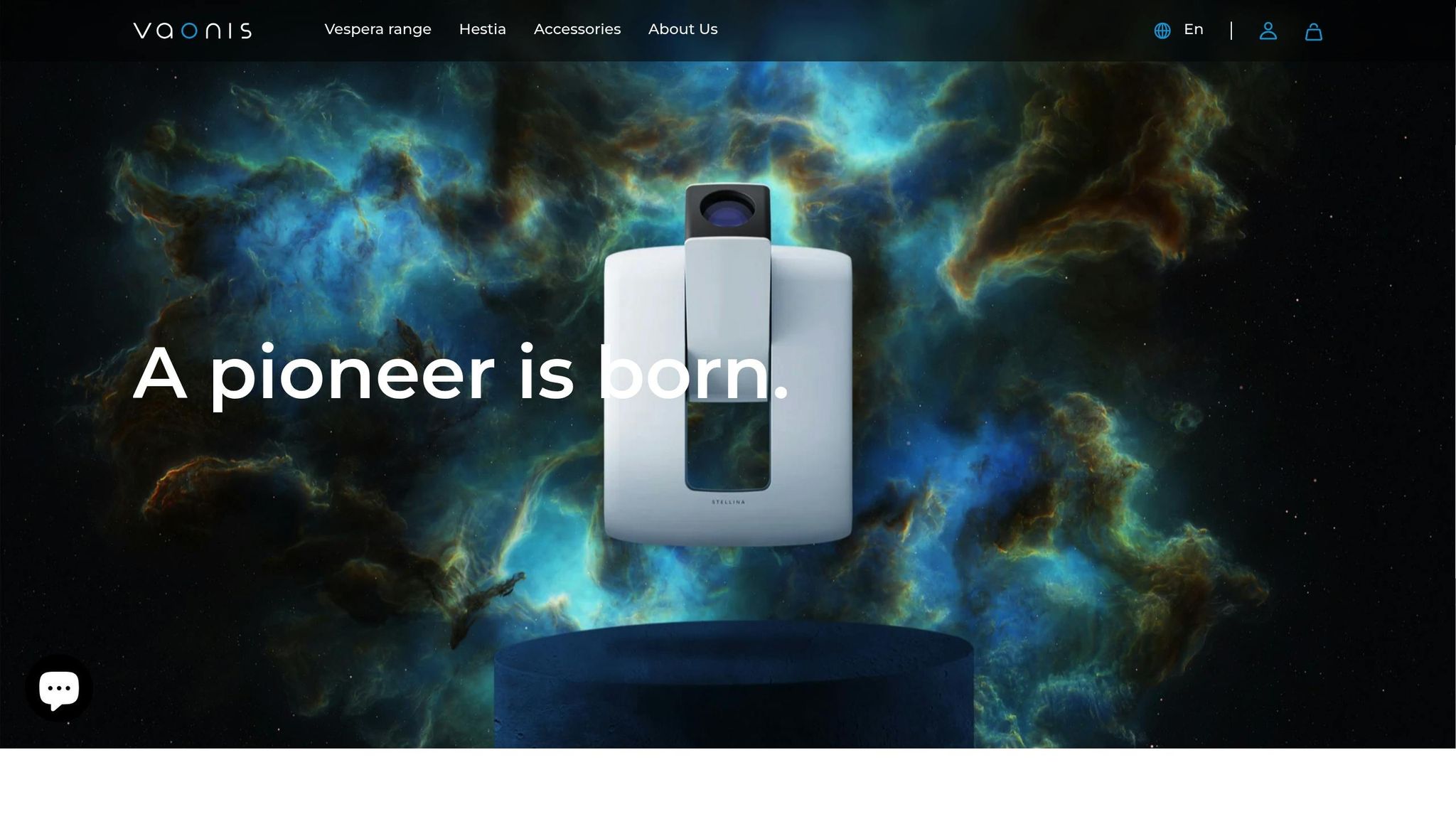
The Stellina Observation Station, priced at $3,999, offers a high-end solution for automated stargazing and astrophotography. Here’s a closer look at its optical capabilities and automation features.
Stellina is equipped with an 80mm apochromatic ED doublet lens, offering a 400mm focal length (f/5). It uses a Sony IMX 178 CMOS sensor with a resolution of 6.4 million pixels (3096 x 2080), delivering detailed celestial images with a field of view measuring 1° x 0.7°.
| Technical Specifications | Details |
|---|---|
| Aperture | 3.15" (80mm) |
| Focal Length | 15.75" (400mm) |
| Focal Ratio | f/5 |
| Sensor Resolution | 6.4MP (3096 x 2080) |
| Weight | 24.7 lbs |
| Dimensions | 19" x 15" x 4.7" |
| Battery Life | 5 hours |
Key Features
Stellina simplifies the astronomy experience through its Singularity app, which automates key functions like initialization and target acquisition. The telescope also includes:
- Automatic tracking with a built-in field derotator
- Light suppression for better image clarity
- Real-time image stacking and processing
- Rain sensor with automatic lens protection
- An automatic focusing system paired with a dew heater
One of its standout features is the group observation mode, enabling up to 20 users to connect simultaneously through the app. This makes it a great choice for educational use or group stargazing events. At just 24.7 lbs and with compact dimensions, Stellina is also easy to transport.
Performance Insights
While Stellina excels in automation, it does have a few limitations. Wind can impact its performance, and extended image stacking may sometimes result in overly bright stars. However, these issues are minor compared to its overall capabilities.
The telescope’s tripod provides stability for long observation sessions, and its 5-hour battery life supports both short backyard sessions and longer trips to remote locations. For planetary viewing, Stellina can reveal Saturn’s rings and Jupiter’s cloud bands, but its true strength lies in capturing deep-sky objects. The automated tracking eliminates the need for manual polar alignment, making it accessible for beginners while still offering advanced features for experienced users.
Feature Comparison Chart
Here’s a side-by-side look at the main features of some leading computerized telescopes:
| Feature | Unistellar eQuinox 2 | Vaonis Vespera II | DWARF II | Seestar |
|---|---|---|---|---|
| Optical Specifications | ||||
| Aperture | 4.5" (114mm) | 2" (50mm) | 0.9" (24mm) | 2" (50mm) |
| Focal Length | 17.7" (450mm) | 7.9" (200mm) | 3.9" (100mm) | 9.8" (250mm) |
| Focal Ratio | f/4 | f/4 | f/2.4 | f/4.9 |
| Field of View | 3° | 0.78° x 0.57° | Up to 3.2° x 1.8° | 1.29° x 0.73° |
| Image Quality | ||||
| Sensor Resolution | 7.7MP | 2MP (8MP with CovalENS) | 2MP wide, 8MP telephoto | 2MP |
| Sensor Type | IMX347 | IMX462 | IMX415 Starvis | IMX462 |
| Practical Considerations | ||||
| Weight | 19.8 lbs | 11 lbs | 2.6 lbs | 6.6 lbs |
| Price | $4,899.00 | $1,499.00 | $459.00 | $499.00 |
The table covers the technical specs, but let’s dive into what makes each telescope stand out.
Performance Highlights
Each telescope brings something different to the table, making it easier to explore the night sky:
- Deep-Sky Objects: The Vaonis Vespera II stands out for capturing deep-sky images with excellent detail and minimal noise.
- Planetary Viewing: Thanks to its larger aperture and longer focal length, the Unistellar eQuinox 2 is a strong choice for observing planets.
- Lunar Photography: The Vespera II offers impressive detail for mapping the moon’s surface.
- Solar Observation: The eQuinox 2 excels at revealing intricate solar details, with the Vespera II following closely behind.
Buying Guide Summary
Choose a computerized telescope that suits your specific needs:
-
For Beginners ($400–$700):
The Celestron NexStar 4SE ($679) is a great starting point. It features a 4-inch aperture and access to over 40,000 celestial objects. Its SkyAlign technology makes setup quick and straightforward. -
For Visual Observation ($1,500–$2,500):
The Vaonis Vespera II stands out for its compact design and high-quality optics. Its CovalENS technology allows for detailed mosaic imaging, making it a solid choice for lunar and deep-sky observations. -
For Serious Astrophotography:
The Unistellar eQuinox 2 offers a larger aperture and advanced imaging capabilities, perfect for capturing detailed planetary and deep-sky photos. Its sturdy build is ideal for long imaging sessions.
Key Factors to Consider
- Location and Portability: If you need mobility in urban areas, go for a lightweight option. For dedicated viewing spots, a sturdier design might be better.
- Primary Viewing Targets: Telescopes with longer focal lengths are better for detailed planetary views, while wider fields of view are ideal for observing deep-sky objects.
- Budget vs. Features: Align your budget with features like mosaic imaging or citizen science capabilities to achieve your goals.
This guide simplifies the process of matching your budget and needs with the features discussed in the detailed comparisons above.
"Celestron’s signature orange-tube telescope combines advanced features and excellent optics in one easy-to-use system, the NexStar 4SE. It’s the perfect choice for your first serious telescope, offering striking views at an economical price." – Celestron
Related posts
- Best Smart Telescope: Discover Automated, High-tech Telescopes For Effortless Viewing
- Best Telescope For Adults: Expert-recommended Models For Serious Stargazing
- Best Telescope For Deep Space: Unlock The Universe With Telescopes Designed For Deep Space Viewing
- Best Refractor Telescope: Crisp, Clear Views With Top Refractor Picks
