Best Affordable Telescope: Budget-friendly Models That Don’t Compromise On Quality

You don’t need to spend a fortune to enjoy stargazing. Modern budget telescopes offer quality features like 70mm–130mm apertures, stable mounts, and fully-coated optics for under $500. Whether you’re a beginner or an experienced observer, there’s a telescope to suit your needs:
Top Picks:
- Orion SkyQuest XT6 ($300): Best for deep-sky observation with a 150mm aperture.
- Celestron NexStar 130 SLT ($450): Computerized tracking with a 40,000-object database.
- Sky-Watcher Heritage 130P ($220): Compact design with excellent image quality.
- Orion StarBlast II 4.5 ($200): Great for families and planetary viewing.
- FunScope 76mm ($60): Lightweight and portable for beginners.
Quick Buying Tips:
- Aperture: Larger aperture (e.g., 130mm) gathers more light for detailed views.
- Mount Type: Dobsonian for stability, computerized for easier tracking.
- Portability: Compact models like the C90 Mak are perfect for travel.
- Accessories: Look for packages with eyepieces, finders, and moon filters included.
Quick Comparison Table
| Model | Aperture | Mount Type | Best Use | Price |
|---|---|---|---|---|
| Orion SkyQuest XT6 | 150mm | Dobsonian | Deep-sky objects | $300 |
| Celestron NexStar 130 SLT | 130mm | Computerized | Automated tracking | $450 |
| Sky-Watcher Heritage 130P | 130mm | Tabletop Dobsonian | Compact storage | $220 |
| Orion StarBlast II 4.5 | 114mm | Equatorial | Planetary viewing | $200 |
| FunScope 76mm | 76mm | Tabletop Dobsonian | Portability | $60 |
These telescopes offer the perfect balance of performance and affordability, making stargazing accessible to everyone. Whether you’re observing Saturn’s rings, Jupiter’s moons, or deep-sky nebulae, there’s a model here for you.
Top 5 Best Budget Telescopes under $1000 in 2024
What Makes a Good Budget Telescope
Finding a quality budget telescope is easier when you know what to focus on. Start with aperture – ideally between 70mm and 130mm. A larger aperture lets you see details like Jupiter’s belts and Saturn’s rings . Next, consider the mount, which affects both stability and ease of use:
| Mount Type | Pros | Cons | Cost |
|---|---|---|---|
| Dobsonian | Very stable, easy to use | Bulky, needs storage | Best aperture value |
| Altazimuth | Lightweight, simple to use | Limited tracking ability | Most affordable |
| Computerized | Finds objects automatically | High maintenance costs | More expensive |
Optical quality is critical, even for budget options. Look for fully-coated optics to ensure clear images. If you’re choosing a reflector telescope, parabolic mirrors are better than spherical ones for sharper views . Be cautious of exaggerated claims like "600x magnification" – realistic magnification maxes out at 2x per millimeter of aperture .
Portability is another key factor. For apartment dwellers, tabletop Dobsonians weighing under 15 pounds are a great choice. Full-size models offer more stability but are heavier and need more space. If you travel often, compact telescopes under 5 pounds with carrying cases are a convenient option .
When shopping, look for packages that include extras like at least two eyepieces, red dot finders, metal focusers, and collimation tools .
Maintenance can vary by type:
- Reflector telescopes need regular collimation.
- Computerized models may drain batteries quickly .
Best value options by price range:
- Under $200: Tabletop Dobsonians
- $200–$350: Full-size Dobsonians
- $350–$500: Computerized systems
Manual telescopes often have 30% larger apertures compared to computerized ones at the same price point .
When choosing a telescope, focus on the basics: a solid aperture-to-cost ratio, stable mounts, and durable components like well-coated optics and metal parts. These features will provide better long-term performance than flashy add-ons .
With these essentials in mind, let’s dive into some telescopes that meet these criteria.
1. Orion SkyQuest XT6 Classic Dobsonian Telescope
The Orion SkyQuest XT6 offers an impressive 6-inch aperture for under $300, collecting 345 times more light than the human eye .
This strikes a great balance between cost and performance, delivering high-quality optics at a price that’s accessible for families. With its parabolic mirror and 2" Crayford focuser – features often found in more expensive telescopes – you can enjoy clear views of Saturn’s rings and Jupiter’s cloud bands .
Its 1200mm focal length (f/8) is ideal for both planetary and deep-sky observation. The manual Dobsonian mount ensures that most of the budget is focused on optical quality, making it a smart choice for those who prioritize performance. The aluminum tube construction adds durability without driving up costs.
The XT6 comes with two eyepieces (25mm and 10mm Sirius Plossl), an EZ Finder II reflex sight, and Starry Night astronomy software . These extras mean you won’t need to spend more on accessories to get started.
At 34.4 pounds, it’s not the most portable option, but this weight adds stability, which is a fair trade-off for the excellent optical performance it provides.
2. Orion StarBlast II 4.5 Equatorial Reflector Telescope
The Orion StarBlast II takes the family-friendly design of its predecessor and adds equatorial tracking, all while staying under $250. This telescope offers impressive light-gathering abilities, making it a great choice for families eager to explore the night sky.
Its parabolic mirror delivers sharper images compared to the spherical mirrors often found in this price range. With a 450mm focal length and an f/4 ratio, it provides wide-field views ideal for observing star clusters like M45 .
The EQ-1 mount allows for manual tracking after a simple polar alignment , keeping costs low while teaching important observational skills.
Included accessories:
- 25mm and 10mm Sirius Plossl eyepieces (offering 18x and 45x magnification)
- EZ Finder II reflex sight
- Moon filter for comfortable lunar viewing
Weighing just 15 lbs, it strikes a balance between stability and portability. The tripod extends to 48 inches , ensuring comfortable viewing for both kids and adults.
For its price, the telescope performs impressively on deep-sky objects. Under dark skies, you can spot the trapezium stars in the M42 Orion Nebula and even bright galaxy pairs like M81 and M82 . With up to 200x useful magnification , it’s also capable of detailed planetary observations when atmospheric conditions allow.
A standout feature for budget-conscious buyers is Orion’s 1-year limited warranty, backed by US-based support , adding extra confidence to your purchase.
3. Celestron NexStar 130 SLT Series Newtonian Reflector Telescope
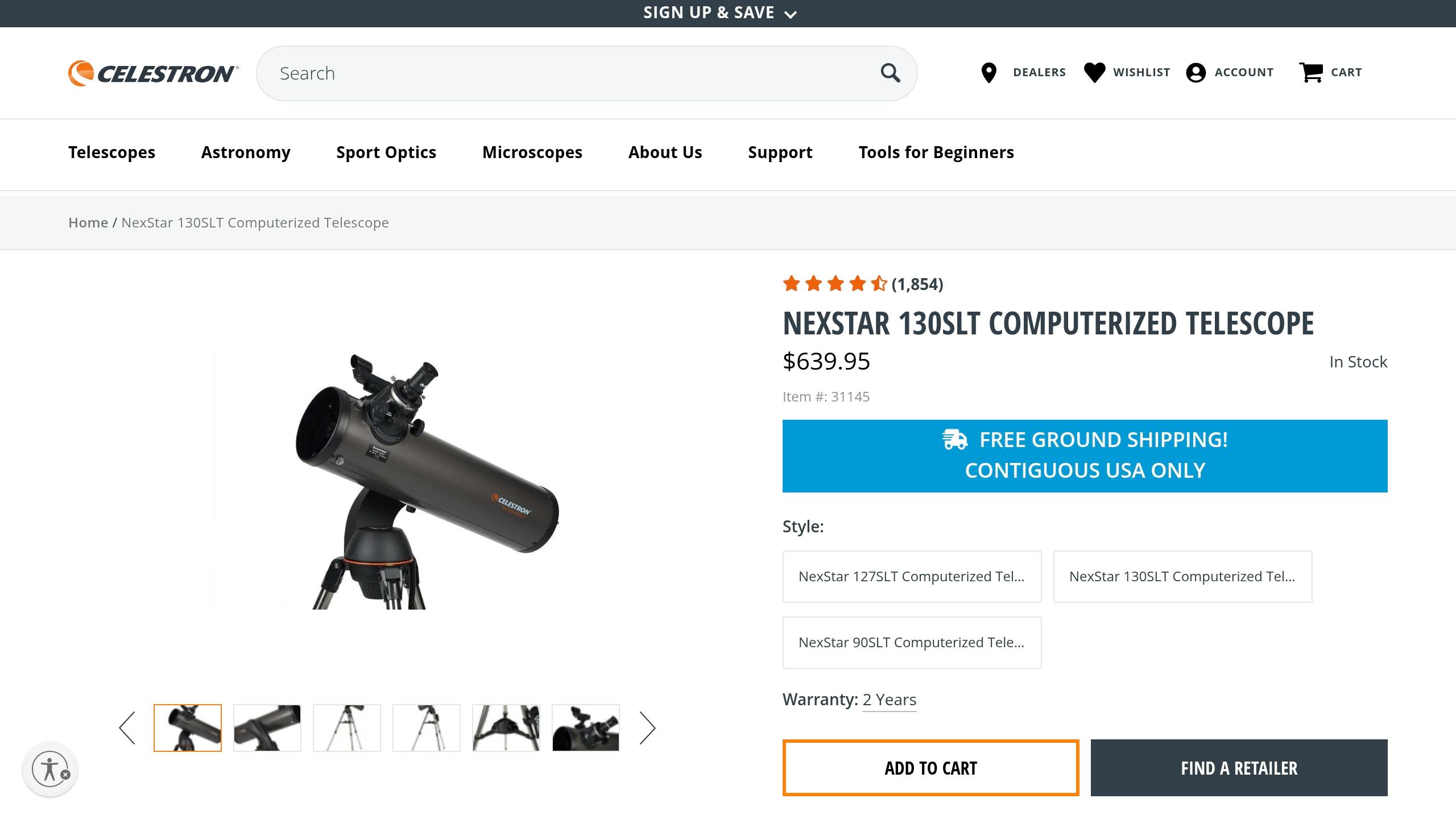
The NexStar 130 SLT is a great choice for those looking for computerized tracking without spending a fortune. Priced under $500, it fits within the budget of most beginners (72% of them, to be exact). Its 130mm (5.1") aperture and 650mm focal length provide excellent light-gathering ability, making it ideal for detailed views of the night sky .
Features and Performance
This telescope stands out with its computerized mount, which includes a database of over 40,000 celestial objects . For urban stargazers, this feature is a game-changer.
The SkyAlign technology makes setup straightforward . While manual Dobsonians at this price point might offer larger apertures, the NexStar 130 SLT compensates with its easy-to-use tracking system for finding objects.
Thanks to its 130mm aperture and f/5 focal ratio, this telescope is versatile – great for observing planetary details as well as wide-field views of deep-sky objects like nebulae and star clusters .
What’s Included
The package comes with 25mm and 9mm eyepieces, a red dot finder, a steel tripod, and free astronomy software – an extra value worth $100 .
Considerations
- Power Source: Runs on 8 AA batteries (not included).
- Magnification: Maximum of 250x.
- Build: Some plastic parts are used to keep costs down.
- Tripod: Maximum height of 50", which may require taller users to bend slightly .
Weighing just 18 pounds, the telescope is portable yet stable, offering a good balance between ease of transport and steady viewing . This model proves that computerized features can be accessible without a hefty price tag, focusing on essential functionality rather than luxury materials.
4. Celestron C90 Mak Spotting Scope
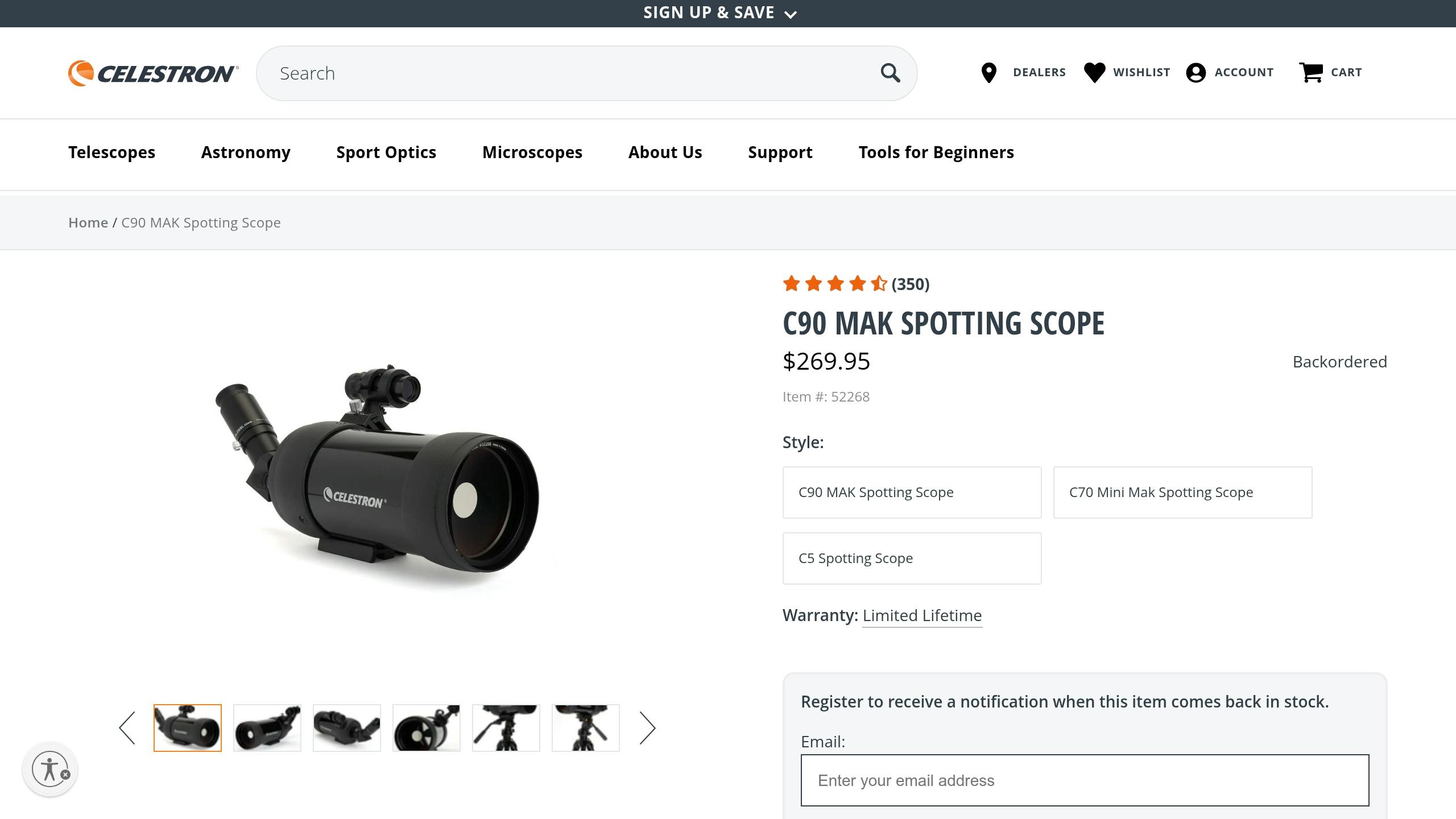
The Celestron C90 Mak is a compact and affordable option for those who want a portable scope that works well for both stargazing and nature observation. Priced under $300, it offers solid performance without breaking the bank .
This telescope features a 90mm aperture and a 1,250mm focal length, all packed into a Maksutov-Cassegrain design. It uses Celestron’s StarBright XLT coatings, which allow for 88% light transmission, ensuring bright and detailed views . With the included 32mm eyepiece, you can easily observe Saturn’s rings, Jupiter’s cloud bands, and capture sharp details in wildlife or landscape photography .
Weighing just 3.3 pounds and measuring 12 inches in length, the C90 is ideal for apartment dwellers, travelers, and hikers. It’s 40% lighter than similar Newtonian telescopes, making it a great option for on-the-go use . Key highlights include:
- Clear views of Saturn’s rings
- Detailed looks at Jupiter’s cloud bands
- Crisp wildlife observation
- Stunning landscape photography potential
If you’re looking for a versatile, budget-friendly telescope that doesn’t skimp on quality, the C90 Mak is a fantastic choice.
5. Celestron AstroMaster 70 AZ Budget Telescope
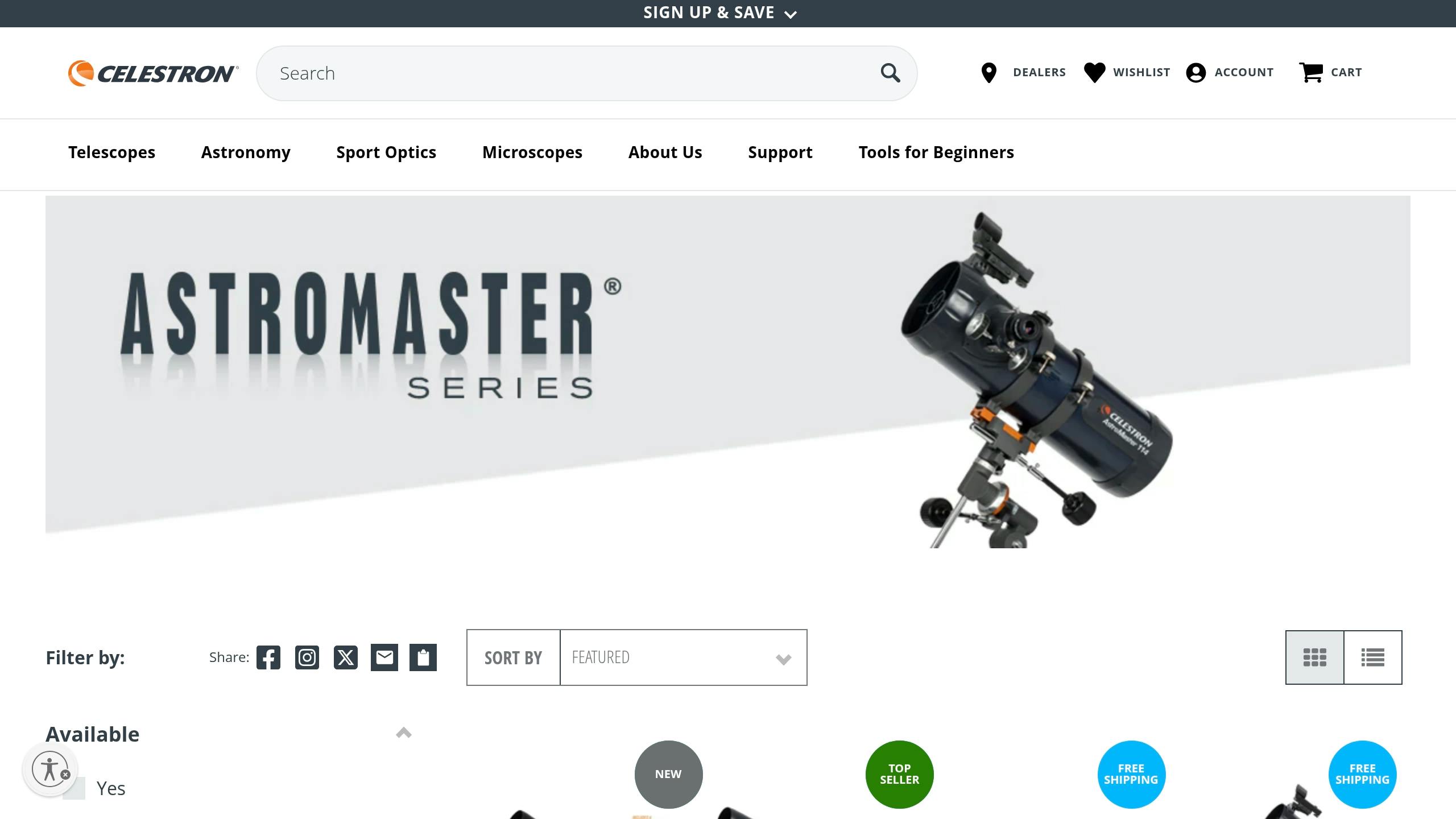
If you’re looking for an affordable way to dive into astronomy, the Celestron AstroMaster 70 AZ is a solid option, priced at just $129.95 .
With a 70mm aperture, it provides clear views of planets and the moon, and since it’s a refractor telescope, there’s no need for collimation – a common hassle with reflectors. The package includes two eyepieces (20mm and 10mm), an erect image diagonal for upright viewing, and a pre-assembled tripod with sturdy 1.25" steel legs .
Beginners will appreciate its tool-free assembly and user-friendly controls, which make it simple to locate and track celestial objects .
However, there are a few trade-offs to note:
- The 70mm aperture isn’t ideal for deep-sky objects.
- The basic mount can make high-magnification tracking a bit tricky.
- Upgrades like a moon filter and Plossl eyepieces are worth considering for better performance .
This telescope’s easy setup, maintenance-free design, and included accessories make it a great pick for anyone on a tight budget or families wanting to explore the night sky without overspending.
sbb-itb-9161f90
6. FunScope 76mm Tabletop Reflector Telescope
If you’re looking for a budget-friendly telescope that’s easy to carry around, the FunScope 76mm is a solid pick. At under $60, it proves you can explore the night sky without spending a fortune.
Weighing just 4 lbs (1.8 kg), this telescope is incredibly portable and still stable enough for smooth use. It features a simple Dobsonian base, making setup quick and hassle-free. This type of base is a great option for those seeking value in affordable tabletop telescopes.
With a 76mm aperture, you can enjoy clear views of lunar craters, Jupiter’s moons, and Saturn’s rings. While its spherical mirrors help keep costs low, they still deliver good image quality for beginners.
It comes with two eyepieces (20mm and 6mm) for a range of magnifications and an EZ Finder II for easy targeting. Users often highlight its grab-and-go design and straightforward operation, though some mention the finder scope might occasionally need realignment.
Keep in mind that its 150x practical magnification limit means it’s not ideal for deep-sky objects. However, this limitation fits its role as a starter telescope or a travel companion.
For urban stargazers or families, the FunScope 76mm is an affordable way to dive into astronomy. Its sturdy build and ease of use make it a smart choice for those on a tight budget.
7. Orion GoScope III 70mm Refractor Telescope
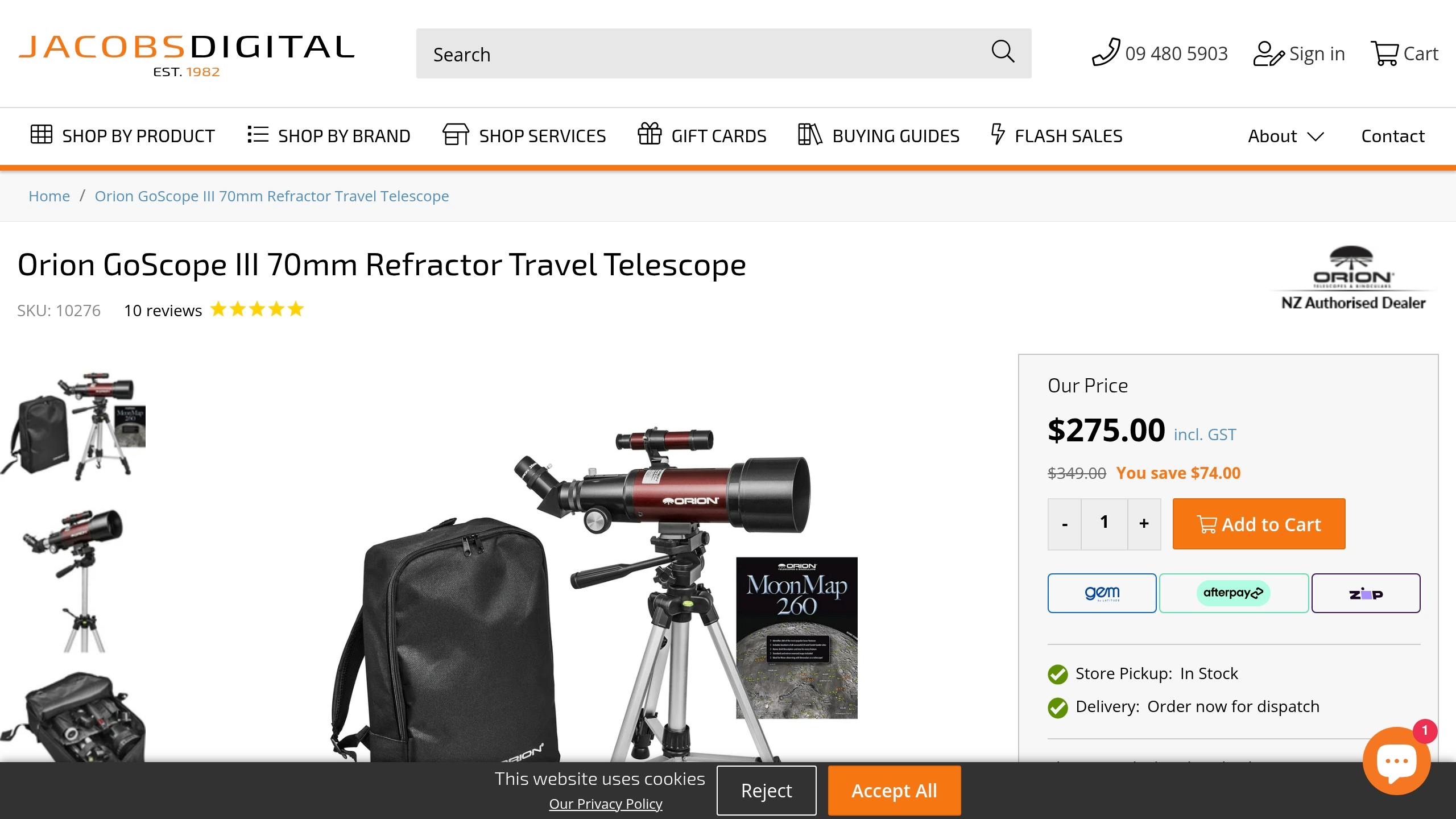
For travelers looking for a lightweight, portable telescope, the GoScope III is a great option. It’s a solid example of how manufacturers are now creating travel-friendly telescopes under $150 without cutting corners on essential features.
This telescope comes with a backpack (valued at $50) that holds all its components and weighs just 4.4 lbs – making it 30% lighter than similar refractors. Unlike many budget models, this kit includes everything you need, so you won’t have to spend extra on accessories.
The GoScope III offers the same 70mm aperture as the AstroMaster but is much easier to carry around. Its 400mm focal length (f/5.7) and fully-coated optics provide wide-field views while keeping color fringing to a minimum. This makes it perfect for observing star clusters and other celestial objects.
What sets this model apart is the inclusion of a smartphone adapter and Moon filter – features rarely found at this price. The lightweight aluminum tripod, with 1.25" legs, can be set up in just 5 minutes. While some users mention that the tripod isn’t the most stable, its design prioritizes portability without losing basic functionality.
Here’s what you can expect to see:
- Detailed views of lunar craters
- Jupiter’s Galilean moons
- Saturn’s rings (under good conditions)
- Bright deep-sky objects like the Orion Nebula
The 45-degree correct-image diagonal allows for both astronomical and terrestrial viewing, making it a versatile choice for those on a budget.
With a 4.3/5 star rating from 61 reviews on Orion’s website, the GoScope III is praised for its balance of portability, ease of use, and reliable optics. It’s an excellent pick for those who want an affordable, adventure-ready telescope.
8. Celestron AstroMaster 130EQ Reflector Telescope
If you prefer manual tracking over computerized systems, the AstroMaster 130EQ is a solid option priced under $300. With its 130mm aperture and f/5 focal ratio, you can enjoy clear views of Saturn’s rings and Jupiter’s cloud bands . The EQ-2 mount’s slow-motion controls allow for precise manual tracking, a feature not often found in this price range.
The telescope’s fully-coated glass optics ensure good image quality while keeping costs manageable . Its 130mm aperture allows for detailed planetary observations, such as Saturn’s rings at 45x magnification and Jupiter’s cloud details . The steel tripod with an accessory tray offers sturdy support, avoiding the higher costs associated with aluminum tripods .
One reason this telescope stands out is its thoughtful design. Instead of using pricier parabolic mirrors, it opts for spherical mirrors , still delivering strong optical performance. It also comes with everything you need to get started, including 20mm and 10mm eyepieces, a StarPointer finder, and TheSkyX software .
Experts at Planet Guide have named it the "best telescope under $300" , highlighting its ability to handle both planetary and deep-sky viewing. With a 4.3/5 star rating from 2,389 global reviews , it consistently proves its worth.
However, keep in mind that the equatorial mount may take some time to master, especially for beginners . Weighing 28 pounds, it sacrifices portability for stability. Like the Zhumell Z114 (covered in section 10), this telescope focuses on delivering strong performance without unnecessary frills. Its sturdy build, versatile features, and complete accessory set make it a dependable choice for those on a budget who want reliable results.
9. Sky-Watcher Heritage 130P
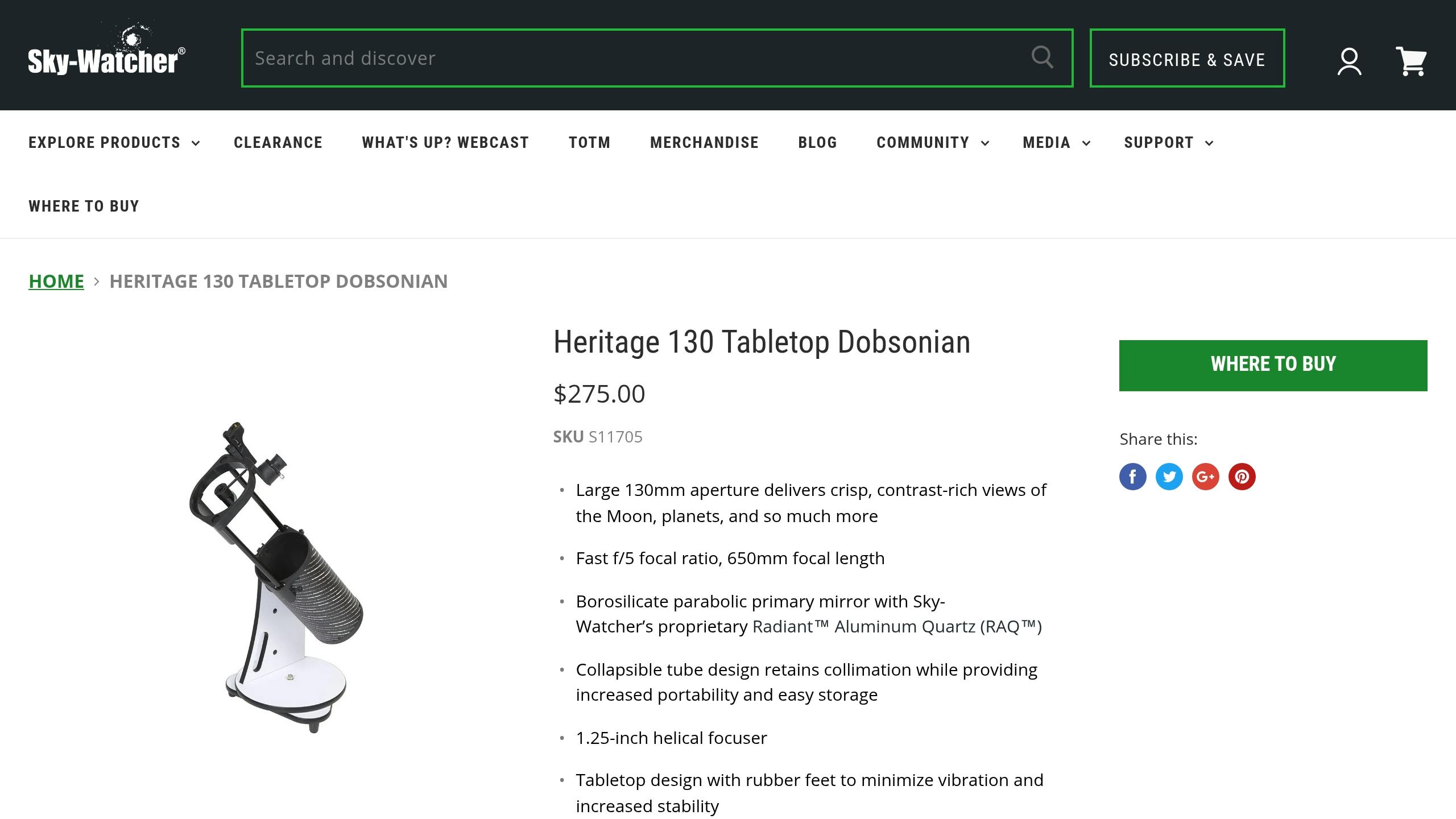
The Sky-Watcher Heritage 130P focuses on delivering excellent performance without breaking the bank. It prioritizes aperture and optical quality while cutting down on unnecessary extras. Its collapsible tube design shrinks from 24 inches to just 14 inches, making it easy to transport. This design improves on the portability of the FunScope 76mm while offering much better optics .
The telescope features a 130mm parabolic mirror – something usually found in models costing $100 or more . Combined with its f/5 focal ratio, it provides wide-field views perfect for star clusters and deep-sky objects, easily surpassing the performance of budget telescopes with spherical mirrors . The included 25mm and 10mm eyepieces offer magnifications of 26x and 65x, while the dual-speed focuser allows for precise adjustments, a rare feature in telescopes under $300 .
"The Heritage 130P outclasses every sub-$400 reflector…with optics rivaling some $600 models" – Astronomy Magazine
Users praise its ability to clearly show Jupiter’s Great Red Spot and Saturn’s Cassini Division . Its collapsible design makes it a great choice for both urban stargazers and campers. Similar to the Zhumell Z114, the Heritage 130P demonstrates that manufacturers can include high-end features in budget-friendly models by focusing on critical components. This approach aligns with the philosophy behind the Orion XT6, which invests in essentials like parabolic mirrors instead of costly mounts.
10. Zhumell Z114 Tabletop Dobsonian
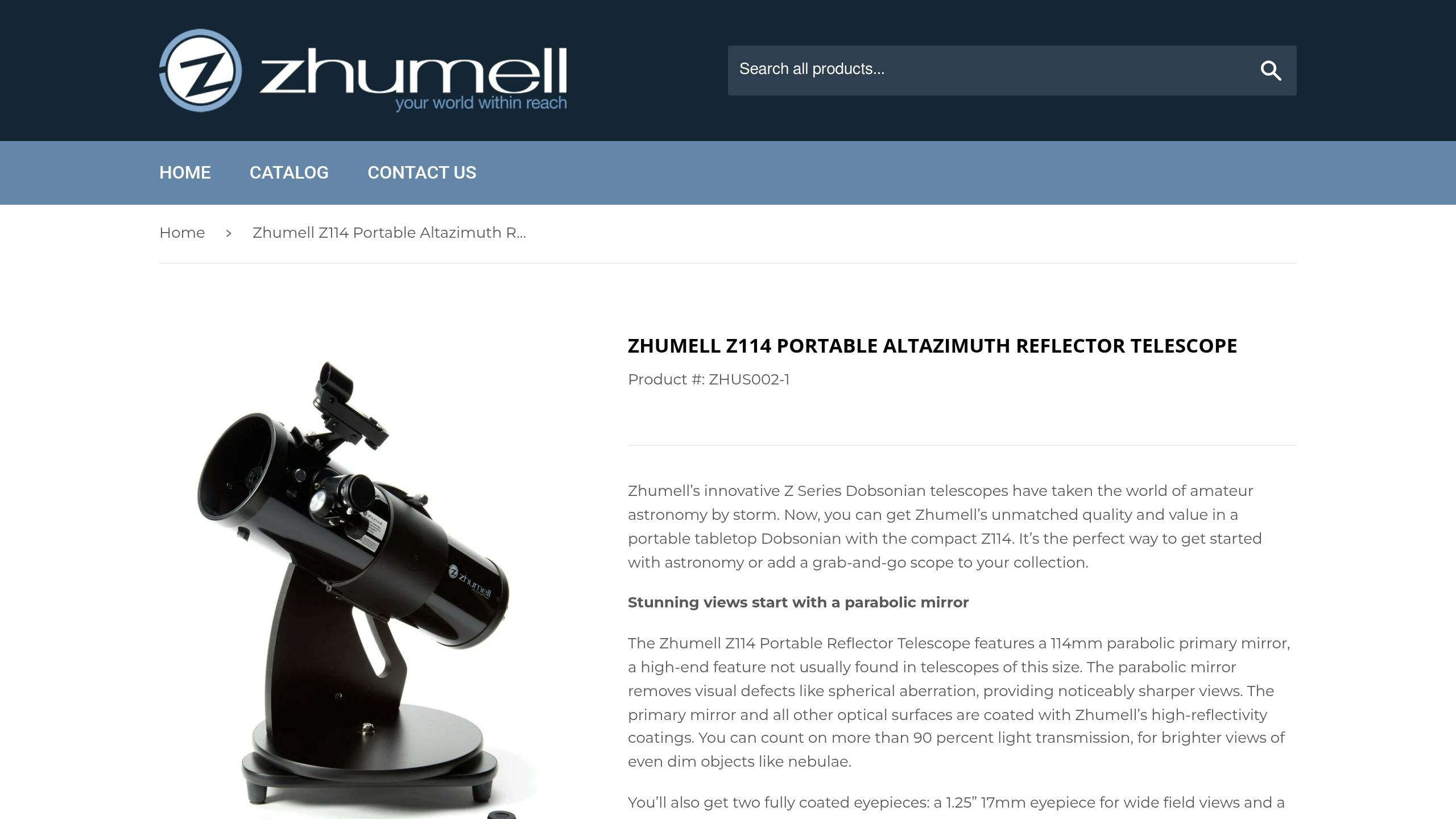
The Zhumell Z114 wraps up our list by offering impressive performance at a price that’s 20-30% lower than similar tabletop Dobsonian models . Its f/4 ratio strikes a nice balance, making it suitable for both planetary and deep-sky observations. Plus, it’s a breeze to set up – taking less than 5 minutes .
Weighing only 12 pounds and featuring a compact 16-inch tube , the Z114 is easy to transport without compromising on stability. Its 114mm aperture and 450mm focal length allow for excellent light collection, making detailed observations possible . Under clear skies, you can enjoy detailed views of the Moon at up to 100x magnification .
"Remarkable planetary views for the size" – Cloudy Nights
Like other manual telescopes in this price range, the Z114 requires hands-on adjustments for tracking planets . While slight edge distortion is noticeable, it’s a reasonable tradeoff given the affordability . The included 25mm and 10mm Sirius Plossl eyepieces offer flexibility for various viewing needs right out of the box .
This model follows the trend seen in Sky-Watcher and Orion telescopes, where smart design choices ensure you get the most aperture for your money. By focusing on practical features, Zhumell makes astronomy more accessible without sacrificing performance .
Quick Telescope Comparison
Here’s a breakdown of budget-friendly telescopes, showcasing their features and ideal uses without breaking the bank:
| Model | Aperture | Focal Length | Mount | Best Use | Price |
|---|---|---|---|---|---|
| Orion SkyQuest XT6 | 150mm | 1200mm | Dobsonian | Deep-sky objects | $300 |
| Orion StarBlast II 4.5 | 114mm | 450mm | Equatorial | Planetary viewing | $200 |
| Celestron NexStar 130 SLT | 130mm | 650mm | Computerized Alt-Az | Automated tracking | $450 |
| Celestron C90 Mak | 90mm | 1250mm | Tabletop | Dual-use viewing | $200 |
| Celestron AstroMaster 70 AZ | 70mm | 900mm | Alt-Azimuth | Lunar observation | $130 |
| FunScope 76mm | 76mm | 300mm | Tabletop Dobsonian | Portability | $100 |
| Orion GoScope III 70mm | 70mm | 400mm | Alt-Azimuth | Travel | $150 |
| Celestron AstroMaster 130EQ | 130mm | 650mm | Equatorial | Value aperture | $250 |
| Sky-Watcher Heritage 130P | 130mm | 650mm | Tabletop Dobsonian | Compact storage | $220 |
| Zhumell Z114 | 114mm | 450mm | Tabletop Dobsonian | Beginner-friendly | $180 |
Each model brings something different to the table. The Orion SkyQuest XT6 stands out with its larger 150mm aperture, making it perfect for deep-sky observation. On the other hand, compact options like the Orion GoScope III and Celestron C90 Mak are great for portability and versatility. Tabletop Dobsonians, such as the Sky-Watcher Heritage 130P and Zhumell Z114, offer excellent aperture value in a compact design, while computerized models like the Celestron NexStar 130 SLT add the convenience of automated tracking.
Dobsonian mounts are known for their stability and affordability, making them ideal for beginners. Meanwhile, equatorial mounts, like the one on the StarBlast II 4.5, are better for tracking planets. Prices generally fall within the recommended range of $200-$350 for full-size Dobsonians and $350-$500 for computerized systems, as suggested in "What Makes a Good Budget Telescope."
When choosing a telescope, consider your priorities. Larger apertures, like those on the XT6, are better for faint deep-sky objects, while smaller, portable designs are more practical for travel. Tailor your choice to your viewing conditions and whether you’ll be observing from home or on the go.
Final Thoughts
From deep-space Dobsonians to compact refractors, these telescope options prove that exploring the night sky doesn’t have to break the bank.
After reviewing 10 models, clear preferences stand out based on observing needs:
- For deep-sky enthusiasts: Orion SkyQuest XT6 (150mm Dobsonian) offers excellent light-gathering power.
- For travelers: Orion GoScope III or Celestron C90 Mak are lightweight and easy to transport.
- For tech lovers: Celestron NexStar 130 SLT delivers automated tracking with a 40,000-object database.
- For families: StarBlast II 4.5 (great for learning equatorial mounts) or AstroMaster 70 AZ (quick and simple setup).
Each model caters to specific priorities while keeping essential features intact. For instance, the StarBlast II’s equatorial mount makes it a great starting point for learning astronomical tracking, while the AstroMaster’s altazimuth mount is perfect for quick, hassle-free viewing sessions .
Aperture remains the most important factor in determining what you can see. Even smaller 70mm models, under the right conditions, can reveal Jupiter’s moons and Saturn’s rings.
"The Heritage 130P outclasses every sub-$400 reflector…with optics rivaling some $600 models" – Astronomy Magazine
"Remarkable planetary views for the size" – Cloudy Nights
FAQs
What is the best telescope for under $500?
Here are some solid options under $500, depending on your needs:
- Celestron NexStar 130 SLT ($499): Ideal for automated tracking of deep-sky objects.
- Orion SkyQuest XT6: A great manual telescope with a 150mm aperture for those who prefer simplicity.
- Celestron C90 Mak: A compact, portable choice that works well for both astronomy and terrestrial viewing.
If you prefer computerized models, keep in mind they need power and take some time to set up but make tracking objects much easier. On the other hand, manual telescopes are ready to use right away and often come with larger apertures for the price.
These options all deliver quality performance while staying within budget.
