Best Smart Telescope: Discover Automated, High-tech Telescopes For Effortless Viewing

Smart telescopes in 2025 make stargazing simple and accessible, blending advanced technology with user-friendly features. They automatically locate and track celestial objects, connect to your smartphone, and even tackle light pollution. Whether you’re a beginner or an enthusiast, these devices offer options for effortless astrophotography and group observations.
Top Picks for 2025:
- Unistellar eVscope 2 ($4,899): Advanced automation, 7.7 MP resolution, and dynamic light amplification for deep-sky imaging.
- Vaonis Vespera II ($1,690): Compact, wide-field imaging with 8.3 MP Sony sensor and collaborative app features.
- Celestron StarSense Explorer DX 130AZ ($479.95): Affordable Newtonian reflector with smartphone-guided navigation.
- ZWO Seestar S50 ($549): Lightweight, portable, and beginner-friendly with built-in light pollution filters.
Quick Comparison:
| Feature | eVscope 2 | Vespera II | StarSense DX 130AZ | Seestar S50 |
|---|---|---|---|---|
| Price | $4,899 | $1,690 | $479.95 | $549 |
| Weight | 19.8 lbs | 11 lbs | 18 lbs | 5.5 lbs |
| Sensor Resolution | 7.7 MP | 8.3 MP | N/A | 2 MP |
| Automation | Advanced AI | Auto-alignment | Smartphone-guided | Auto-tracking |
| Best For | Enthusiasts | Deep-sky | Beginners | Beginners |
These telescopes simplify astronomy for all skill levels, offering features like real-time tracking, image processing, and virtual sky maps. Choose based on your needs and budget to explore the universe effortlessly.
The Ultimate Smart Telescope Comparison – Design & Specs
1. Unistellar eVscope 2
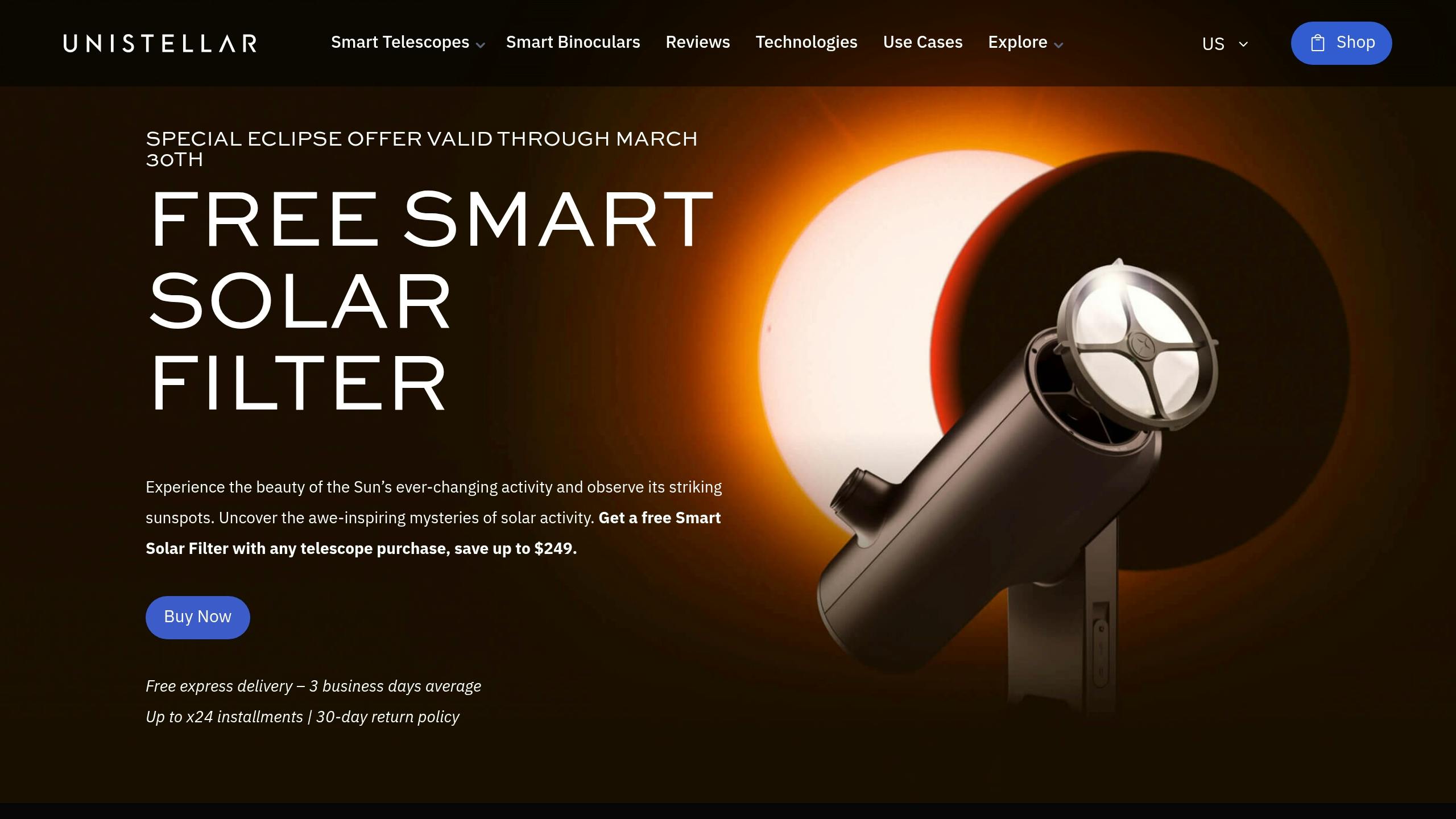
The Unistellar eVscope 2 stands out in the world of smart telescopes, combining advanced digital capabilities with an easy-to-use design. Priced at $4,899, this telescope gained popularity after a Kickstarter campaign that raised an impressive $2.2 million.
With a 7.7 MP image sensor, a field of view measuring 34.2 × 45.6 arcminutes, and a limiting magnitude of 18.2, the eVscope 2 is packed with features.
| Feature | Specification |
|---|---|
| Object Catalog | 4,800 celestial objects |
| Detailed Info | 120 astronomical objects |
| Image Resolution | 7.7 MP |
| Star Database | 37 million stars |
| Alignment Time | 10 seconds |
The eVscope 2 makes stargazing easier and more enjoyable with cutting-edge technologies. It includes dynamic signal amplification, filters to reduce light pollution, Nikon Eyepiece Technology for sharper views, and a smart star finder that automatically locks onto celestial objects.
Its automation features are especially impressive. The Autonomous Field Detection system aligns the telescope in just 10 seconds, while Automated Celestial Tracking with Feedback ensures objects stay perfectly centered. As one user, Fred W, shared:
Even through larger apertures most deep sky objects appear as faint fuzzies, but a few minutes with the EVSCOPE 2 reveals so much more! – Fred W
The eVscope 2 isn’t just for personal use – it’s also contributing to scientific discoveries. In late 2022, over 30 users observed asteroid Dimorphos after NASA’s DART planetary defense mission. Their data was so valuable that it earned them co-authorship in a Nature journal article published in March 2023.
With real-time light amplification and an integrated smartphone app, the eVscope 2 offers clear views – even in urban areas – and a smooth, enjoyable stargazing experience.
2. Vaonis Vespera II
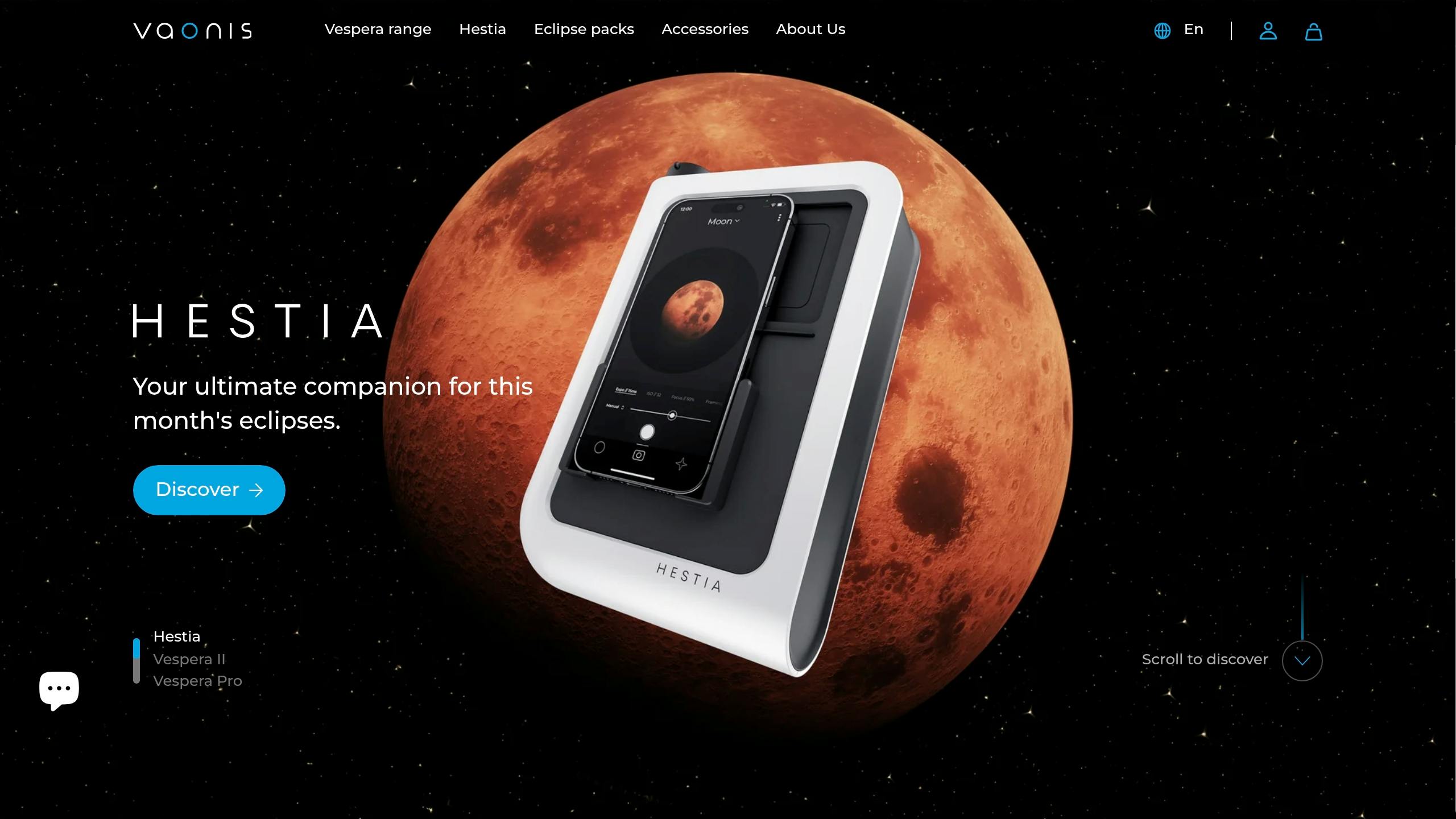
The Vaonis Vespera II combines telescope and camera capabilities in one sleek package, priced at $1,690.00. Designed with an 8.3MP ultra-sensitive Sony IMX585 sensor (2.9 µm pixels), it delivers impressive image quality, even in light-polluted areas.
| Technical Specifications | Details |
|---|---|
| Field of View | 2.5° x 1.4° native |
| Resolution | Up to 24MP with CovalENS |
| Detail Resolution | 2.39 arc seconds |
| Storage | 25 GB internal |
| Battery Life | 4 hours |
| Weight | 11 lbs |
| Dimensions | 18.9 x 7.9 x 3.5 inches |
With a one-button design, the Vespera II is controlled entirely through the Singularity mobile app. This app, rated 4.2 out of 5 on the App Store, gives users access to over 4,300 celestial objects and allows up to five devices to connect at once.
Users have praised its simplicity and performance. Clint J. shared:
"I bought this scope to have a simple way of capturing deep sky objects, and it is totally worth the investment! I cannot believe how simple and quick it is to set up. The software works flawlessly and provides a live view within minutes."
The Vespera II stands out for its automated features, including:
- Auto-initialization and alignment
- Live autofocus for sharp star images
- Real-time image stacking for enhanced visuals
- CovalENS technology to widen the field of view
- Automatic celestial tracking
It can reveal space colors in just 10 seconds, a feature educators love. Leah L., a teacher, commented:
"This telescope is AMAZING! My students and I are enjoying our exploration of the skies. The app, Singularity, that runs the telescope is so easy to use and helpful for learning. The set up through the app was so easy!"
For the best experience, consider pairing it with the Vespera adjustable tripod. Its compact size (18.9 x 7.9 x 3.5 inches) makes it easy to transport without sacrificing professional performance. Jase Parnell-Brookes, Managing Editor of Space and Live Science, summed it up:
"It’s a purpose-built, automatic, night sky-hunting machine. It’s fast and simple to set up, with no prior knowledge required."
sbb-itb-9161f90
3. Celestron StarSense Explorer DX 130AZ
The Celestron StarSense Explorer DX 130AZ combines classic telescope design with modern smartphone technology, offering a user-friendly stargazing experience. At $479.95, this 5.11-inch Newtonian reflector integrates advanced sky recognition software to simplify celestial navigation.
| Technical Specifications | Details |
|---|---|
| Aperture | 5.11" (130mm) |
| Focal Length | 25.59" (650mm) |
| Focal Ratio | f/5 |
| Weight | 18 lbs (8.16 kg) |
| Max Magnification | 307x |
| Light Gathering Power | 345x human eye |
| Included Eyepieces | 25mm (26x) and 10mm (65x) |
The telescope’s standout feature is the StarSense Explorer app, which uses your smartphone for real-time star pattern analysis through plate-solving technology. This essentially turns your phone into a celestial guide. As Newsweek puts it:
"It’s an irresistible proposition from amateur astronomers and other stargazers: Get the capabilities of a professional observatory in a telescope that costs less than $500".
The app, which has earned recognition like the Edison Award, makes stargazing straightforward and engaging, even for beginners. Paired with the manual alt-azimuth mount’s slow-motion controls, users can enjoy smooth and precise tracking. Space.com highlights this in their review:
"The StarSense Explorer DX 130AZ is a great choice for a first telescope or for those just starting out. Its great user-friendliness and capable StarSense App make this telescope an impressively powerful tool that will offer many hours of observing pleasure."
What Can You See?
This telescope offers clear views of:
- Lunar mountains and craters
- Planetary details, including Saturn’s rings and Venus’ phases
- Deep-sky objects under dark skies
- Basic astrophotography opportunities
Smart Features That Stand Out
The Celestron StarSense Explorer DX 130AZ includes several practical features to enhance usability:
- Smartphone dock with X-Y adjustment knobs for precise alignment
- Integrated shade to block stray light for clearer images
- StarPointer red dot finderscope for backup navigation
- Compatibility with most smartphones running iOS (iPhone 6+) or Android 7.1.2+
Astronomy.com also praised its accuracy during hands-on testing:
"I came away really impressed with the StarSense Explorer 130AZ. Images were very good and the push-to accuracy was always spot on. I had expected it would get the scope close to a target but require some hunting to actually center it in view. But no – of the dozens of objects I examined, each was within the low-power field every time."
At just 18 pounds, the telescope is easy to transport, making it a great option for use in both urban and remote dark-sky locations.
4. ZWO Seestar S50
The ZWO Seestar S50 is a compact and user-friendly smart telescope priced at $549.00. Weighing just 5.5 pounds (2.5 kg), it combines a telescope, electric focuser, astronomical camera, and mount into one portable package.
| Technical Specifications | Details |
|---|---|
| Aperture | 1.97" (50 mm) |
| Focal Length | 9.84" (250 mm) |
| Sensor Resolution | 1920 x 1080 |
| Battery Life | 6 hours |
| Storage | 64 GB |
| Weight | 5.5 lbs (2.5 kg) |
| Slew Rate | 1X – 1440X |
The Seestar S50 uses platesolving technology to automatically detect and track celestial objects. It also features built-in filters to improve image quality, including:
- UV/IR Cut filter
- Dark filter
- Dual-band anti-light pollution filter optimized for Ha and Oiii signals
These features simplify stargazing by automating detection and enhancing image clarity.
Astronomy expert Jörg Kraberg shares:
"The Seestar S50 is an impressive device that provides a quick and effortless entry into astronomy… its intuitive app control makes operation seamless, even for beginners."
Smart Features That Make It Shine
The Seestar S50 pairs with a dedicated app for wireless control and access to real-time astronomical data. The app offers weather updates, lunar phases, rise and set times, and personalized viewing suggestions based on your location. For beginners, the "Tonight’s Best" feature highlights the top celestial targets to observe.
Automated features include live image stacking, auto GoTo and tracking, wireless connectivity, electric focusing, and a built-in dew heater.
Performance and Usability
Powered by a 6000 mAh battery, the telescope runs for up to 6 hours. It supports multiple viewing modes, such as Stargaze for deep-sky exploration, Lunar for detailed moon observations, Solar (with the included filter), and Scenery for terrestrial views. With a 4.86/5 rating from 469 reviews, users often highlight its portability and ease of use. The package also includes a carbon fiber tripod, carrying case, and solar filter, making it a well-rounded option for both beginners and experienced astronomy enthusiasts.
Features Comparison
Here’s a breakdown of the key features and automation capabilities of these telescopes:
| Feature | Unistellar eVscope 2 | Vaonis Vespera II | ZWO Seestar S50 |
|---|---|---|---|
| Price | $4,899 | $1,590 | $499 |
| Weight | 19.8 lbs (9 kg) | 11 lbs (5 kg) | 6.6 lbs (3 kg) |
| Dimensions | 30.3 x 13 x 10.2 inches | 18.9 x 7.9 x 3.5 inches | 5.5 x 5.1 x 10.2 inches |
| App Features | • Target recommendations • Object information • Global community access • Dynamic Signal Amplification | • Weather forecasts • Astronomical events • CovaLENS panorama • Collaborative viewing | • Moon phase data • Weather updates • Virtual sky atlas • Special viewing modes |
| Image Quality | Great planetary detail | Sharp deep-sky results | Clear lunar imaging |
| Sensor | Advanced Sony sensor | 12.5 MP Sony Starvis 2 | 2 MP Sony IMX462 |
| Field of View | Medium | Wide | 0.7° x 1.3° |
Now, let’s dive into what makes each model stand out and where they might fall short.
The Unistellar eVscope 2 excels in planetary imaging, offering stunning clarity for features like Jupiter’s cloud bands. Its dynamic signal amplification enhances deep-sky observations, but this performance comes with a steep price tag. The Vaonis Vespera II, on the other hand, shines in capturing deep-sky images with minimal noise. Its Singularity app adds a wealth of astronomical insights and even allows collaborative stargazing sessions. Meanwhile, the ZWO Seestar S50, though limited by its narrower field of view, delivers sharp images and offers solid automation at a much lower price.
When it comes to automation, each telescope brings something different to the table. The Vespera II features a smooth automatic slew and autofocus system for hassle-free use. The eVscope 2 steps up with AI-powered automation through its Deep Dark Technology, aimed at enhancing image clarity and tracking.
App functionality also highlights their unique strengths. Unistellar’s app focuses on guided exploration, Vaonis’s app emphasizes detailed data and collaborative tools, and Seestar’s app strikes a balance between simplicity and useful features.
These telescopes showcase how advanced automation and smart design make stargazing easier and more enjoyable for users at every price point.
Recommendations
Based on our detailed reviews, here’s a breakdown to help you choose the right telescope depending on your experience level and budget:
For Beginners ($300–$500): The Seestar S30 ($349) is perfect for those just starting out, offering an easy, automated setup. If you’re ready for a bit more functionality without added complexity, consider the Seestar S50 or Dwarf 3 (both $499).
For Enthusiasts ($1,500–$2,500): The Vaonis Vespera II ($1,590) excels at wide-field imaging, while the Unistellar Odyssey ($2,299) strikes a great balance between portability and performance.
For Advanced Users ($2,800–$4,900): If you’re into astrophotography, the Vaonis Vespera Pro ($2,799) offers manual camera controls, RAW file capture, advanced calibration options, and tools for detailed observation planning. For those wanting top-tier features, the Unistellar EVscope 2 ($4,899) provides enhanced magnification and automated tracking.
"This is one of the best investments I’ve made in a long time. The quality of the telescope and its imaging capabilities are out of this world!" – Jonathan S.
Special Considerations: Looking for flexibility? Check out the Celestron Origin ($3,999). It includes a built-in filter drawer compatible with 1.25″ and 2″ astronomical filters, making it suitable for various observing conditions. Its larger aperture and wide field of view make it ideal for both deep-sky and planetary observations.
All these models are equipped with Sony STARVIS IMX sensors, ensuring excellent performance in low-light conditions. These picks combine cutting-edge tech with user-friendly designs.
Related Blog Posts
- Best Children’s Telescope: Fun, Easy Stargazing For Young Explorers
- Best Small Telescope: Compact Telescopes That Pack A Powerful Punch
- Best Telescope For Adults: Expert-recommended Models For Serious Stargazing
- Best Telescope For Deep Space: Unlock The Universe With Telescopes Designed For Deep Space Viewing
