Dobsonian vs Refractor Telescopes: Which to Choose?
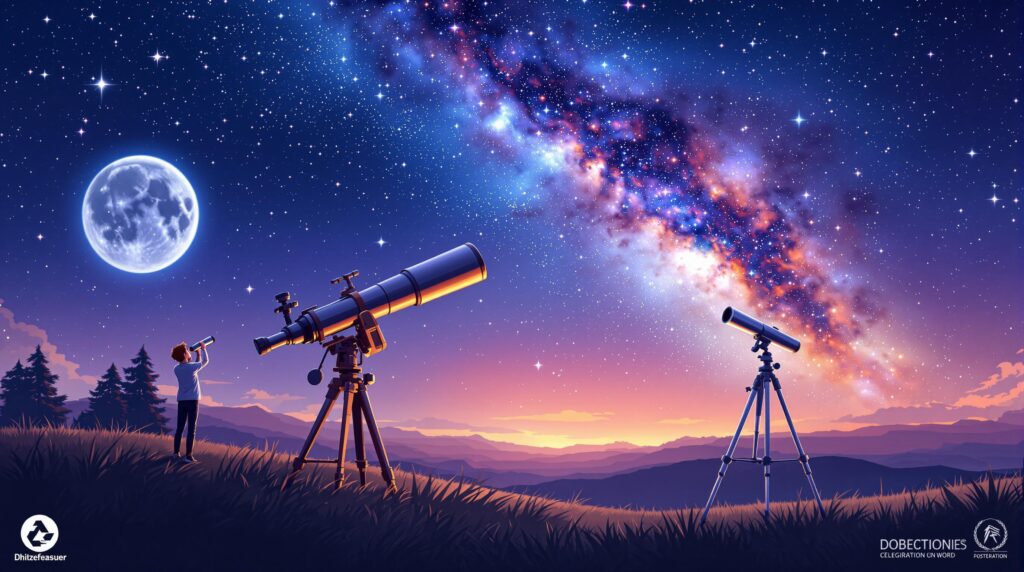
When choosing between Dobsonian and refractor telescopes, it boils down to your stargazing goals, environment, and budget. Here’s a quick breakdown to help you decide:
- Dobsonian Telescopes: Best for deep-sky viewing (e.g., galaxies, nebulae) due to their large apertures and affordability. They require more maintenance (e.g., collimation) and are less portable.
- Refractor Telescopes: Ideal for planetary and lunar observation with sharper contrast and minimal upkeep. They are more portable but costlier, especially at larger sizes.
Quick Comparison
| Feature | Dobsonian (8") | Refractor (4") |
|---|---|---|
| Best For | Deep-sky objects | Planets & Moon |
| Aperture | 203mm | 102mm |
| Maintenance | Regular collimation | Minimal |
| Portability | Bulky | Compact |
| Price Range | $500-$800 | $1,200-$3,000 |
| Astrophotography | Limited | Excellent |
For beginners, an 8" Dobsonian offers the best value for deep-sky exploration, while a 4" refractor is great for urban planetary viewing or astrophotography. Both have their strengths – your choice depends on what you want to see and how much effort you’re willing to put into setup and maintenance.
Refractor vs Reflector telescope explained for beginners
Design and Construction
Dobsonian and refractor telescopes differ in design, which influences their performance, upkeep, and cost. Let’s break down their main components and construction styles.
Dobsonian Design: How It Works
Dobsonian telescopes rely on a straightforward mirror-based system. They feature a parabolic primary mirror and a flat secondary mirror within an open tube. These mirrors work together to collect and focus light . However, the secondary mirror blocks about 20-30% of the incoming light .
Refractor Design: Key Features
Refractors use a sealed tube with an objective lens at the front. They are available in two main types: achromatic, which uses basic crown and flint glass, and apochromatic, which uses more advanced materials .
Unlike Dobsonians, refractors have a fixed optical alignment and allow light to pass through unobstructed.
Comparing Design Specifications
Here’s a side-by-side look at common specs for popular sizes of each type:
| Feature | 8" Dobsonian | 4" Refractor |
|---|---|---|
| Aperture | 203mm | 102mm |
| Focal Ratio | f/6 | f/7-f/10 |
| Tube Length | 1200mm | 700-1000mm |
| Weight | 15-20kg | 5-8kg |
| Mount Type | Alt-Azimuth Rocker | Equatorial |
| Typical Cost | $500-$800 | $1,200-$3,000 |
These differences impact how each type performs in practice. For example, refractors don’t require regular collimation, unlike Dobsonians, which need periodic alignment .
This fixed alignment makes refractors particularly appealing for users who want minimal maintenance. As we’ll see next, these designs shine in different observational settings.
Viewing Performance
Dobsonian and refractor telescopes offer different strengths when it comes to observing various astronomical targets. Each type is better suited for specific purposes, depending on what you want to observe.
Planet and Moon Viewing
Refractors are particularly well-suited for observing planets and the Moon due to their clear, unobstructed light path. One standout feature is their ability to provide excellent contrast.
For example, high-quality refractors can display Jupiter’s Great Red Spot with more vivid color distinctions compared to similarly sized reflectors . However, many refractors tend to produce purple halos around bright objects like Venus .
Deep Space Objects
While refractors shine in planetary observation, Dobsonians are the go-to choice for deep-space targets. Their larger apertures allow them to gather much more light. For instance, an 8" Dobsonian collects 78% more light than a 4" refractor . This makes a noticeable difference when observing faint objects:
"A 12" Dobsonian reveals intricate filamentary details in the Veil Nebula that a 130mm refractor cannot, while also resolving 50% more stars in M13 ."
Under light-polluted skies, refractors maintain about 30% better contrast. However, Dobsonians truly shine under dark skies, where their larger apertures can fully showcase their capabilities .
Viewing Results Chart
| Target Type | 8" Dobsonian | 4" Refractor |
|---|---|---|
| Planets | Good detail, moderate contrast | Excellent contrast, sharp detail |
| Moon | High resolution, some contrast loss | Superior crater definition |
| Bright DSOs (M42, M31) | Excellent brightness, good detail | Good overall view, limited brightness |
| Faint DSOs (M51, M101) | Clear spiral structure visible | Challenging to observe |
| Star Clusters | Resolves many stars, wider field | Pinpoint stars, limited resolution |
| Light Pollution Performance | Moderate | Better contrast retention |
Dobsonians do have a drawback: their secondary mirrors reduce contrast. For example, Jupiter’s cloud belt contrast drops by 18%, and lunar highlands lose about 12% contrast .
This reduction is due to the light obstruction caused by the secondary mirror . As a result, refractors tend to perform better for high-magnification planetary viewing, even though Dobsonians have the advantage of larger apertures.
Setup, Transport, and Care
Practical handling is just as important as optical performance when it comes to using a telescope effectively.
Setup Time and Steps
Dobsonian and refractor telescopes differ quite a bit in how they are set up. Refractors are typically easier to get going, needing very little adjustment before use.
Dobsonians, though simple in design, need more preparation. For example, an 8" Dobsonian that’s been properly collimated can stay aligned for several sessions .
| Setup Aspect | Dobsonian | Refractor |
|---|---|---|
| Cool-down Time | 30-45 minutes | 15-20 minutes |
| Regular Adjustments | Monthly collimation + mount checks | None needed |
These differences mean refractors can get you observing faster after setup.
Transport and Storage
Transporting and storing these telescopes also highlights their differences. A 4" refractor fits easily in a car trunk, while an 8" Dobsonian often needs to be taken apart. Truss-tube models, however, make Dobsonians a bit more portable .
When it comes to storage, both types benefit from stable environmental conditions:
| Storage Consideration | Dobsonian (8") | Refractor (4") |
|---|---|---|
| Required Floor Space | 2′ x 2′ minimum | 1′ x 1′ minimum |
| Height Needed | 4′ typical | 3′ typical |
| Temperature Range | 50-77°F optimal | 50-77°F optimal |
For those frequently on the move, refractors are often the better choice due to their compact size.
Regular Upkeep
Maintenance needs also vary between the two designs. Dobsonians, with their open structure, require more attention. Refractors, on the other hand, are known for their durability and low-maintenance design .
| Maintenance Task | Dobsonian | Refractor |
|---|---|---|
| Optics Care | Mirror cleaning + collimation | Rarely needed |
| Mount Lubrication | Every 3-6 months | Annually |
Refractors’ sealed design keeps maintenance costs lower over time. Dobsonians may also need mirror recoating every 5-7 years, adding to their upkeep requirements .
sbb-itb-9161f90
Price Range Analysis
When comparing Dobsonian and refractor telescopes, understanding their price differences is crucial for making a smart purchase. Each type has its own pricing structure and offers distinct benefits.
Dobsonian Price Points
Dobsonians are often praised for their affordability when it comes to aperture size. For instance, a beginner-friendly 6" Dobsonian like the Orion SkyQuest typically costs between $300-$400, while upgrading to an 8" model might set you back $450-$650 . As aperture size increases, prices rise steadily but remain reasonable.
For those seeking portability, premium Dobsonians offer options like the Explore Scientific 12", which can be disassembled for easier transport and costs $1,999 .
Refractor Price Points
Refractors, on the other hand, follow a sharper pricing curve as aperture size grows.
Entry-level 70mm achromatic refractors are available for $200-$400, but better optics come with a steep price increase . A high-quality 4" ED doublet refractor typically starts at $800 or more.
Premium refractors are significantly more expensive due to their advanced materials and optical performance. For example, the Takahashi TSA-120, featuring fluorite lenses for exceptional correction, is priced at $6,495 . Larger apertures in refractors drive up lens costs quickly .
Price Range Chart
Below is a comparison of typical price ranges for Dobsonian and refractor telescopes across various aperture sizes:
| Aperture Size | Dobsonian Example | Price | Refractor Example | Price |
|---|---|---|---|---|
| 4"-5" | Zhumell Z114 | $299 | William Optics GT81 | $1,299 |
| 6"-8" | Apertura AD8 | $649 | Sky-Watcher ProED 120 | $899 |
| 10"-12" | Explore Scientific 12" | $1,999 | Takahashi FSQ-106 | $4,000+ |
These price differences highlight accessibility: Dobsonians offer large apertures at lower costs, making them appealing for casual observers. Refractors, however, require a higher investment for their superior optical precision.
Keep in mind that refractors may also need $500-$1,000 in additional accessories, while Dobsonians might require costly tracking mounts for advanced imaging. This brings us to their photo capabilities…
Photo Capability
The price gap between telescopes becomes even more apparent when you factor in the gear needed for astrophotography.
Refractor Photo Setup
Refractors are a favorite for astrophotography thanks to their clear optics and stable alignment, which are ideal for long exposures . Their high contrast, which also benefits planetary viewing, minimizes diffraction artifacts in extended imaging sessions .
To set up a refractor for astrophotography, you’ll need some essential gear:
| Component Type | Required Equipment | Typical Cost |
|---|---|---|
| Mount | SkyWatcher HEQ5 or similar | $1,500 |
| Guiding System | Guide Scope & Camera | $400+ |
| Imaging Device | Astronomy Camera | $300-2,000 |
A solid example is the SkyWatcher Evostar 72ED, known for capturing award-winning Orion Nebula images at f/4.9 using long exposures . However, achromatic refractors might need special filters to handle color fringing .
Dobsonian Photo Limits
Dobsonians, on the other hand, have limitations when it comes to astrophotography. Their mount design makes them best suited for planetary and lunar photography, which requires shorter exposure times .
When comparing costs, a basic astrophotography setup for refractors typically runs around $3,500, while for Dobsonians, it’s closer to $2,200. However, the capabilities differ significantly.
For beginners diving into astrophotography, refractors offer a gentler learning curve . Their better color correction and contrast make them ideal for capturing both planetary details and deep-sky objects .
This focus on photography aligns well with the earlier discussion of each telescope type’s observational strengths.
Buyer’s Guide by User Type
New User Options
For beginners, it’s all about finding the right mix of capability and simplicity. If you’re just starting out and want something easy to use, refractors are a great option – they provide sharp lunar views and don’t require collimation adjustments .
If you’re looking for more power and value, the 6" or 8" Dobsonian is a solid pick for serious beginners .
| Experience Level | Recommended Model |
|---|---|
| Complete Beginner | Zhumell Z114 Dob |
| Budget-Conscious | Orion AstroView 90mm |
| Serious Beginner | 8" Classic Dobsonian |
Deep Space Viewing
For deep-space enthusiasts, aperture size is key. A larger aperture makes faint objects, like the M81 galaxy, much easier to spot . While high-end refractors have their perks, the price difference often pushes most deep-space observers toward Dobsonians.
They consistently deliver the best performance for faint objects, as shown in deep-sky object comparisons.
Mixed Use Setup
Combining visual observation with imaging? You’ll need to carefully plan your setup – especially with Dobsonians, as their tracking limitations cap exposures at around 30 seconds .
If you’re trying to balance the detailed planetary views of refractors with the light-gathering power of Dobsonians, the mount becomes a critical consideration. Many beginners underestimate how important a sturdy mount is. A weak mount can ruin the performance of even the best refractor.
Start by investing in a good mount. Mid-sized refractors (100-130mm) paired with proper tracking systems are a great choice for flexibility . Plan to spend at least $800 on a quality tracking mount before thinking about optics .
Here are some key specs to keep in mind:
- Dobsonians: Check the mirror obstruction size (previously discussed).
- Refractors: Pay attention to the focal ratio – f/5 gives a wider field, while f/8 is more focused.
- Mounts: Ensure the mount can handle the combined weight of your telescope and any attached cameras.
Summary and Recommendations
When deciding between Dobsonian and refractor telescopes, your choice should align with your specific goals, environment, and budget. Here’s what to keep in mind:
Dobsonians are an excellent option for those working with a budget under $800. As highlighted in the Viewing Performance section, an 8" Dobsonian offers far superior light-gathering ability compared to similarly priced refractors, making it ideal for deep-sky observation .
Refractors, on the other hand, shine in urban settings where light pollution limits deep-sky viewing. Their better contrast and portability make them a go-to for planetary observation .
| Usage Scenario | Recommended Choice |
|---|---|
| Urban/Suburban/Planetary | 4-5" ED Refractor |
| Dark Sky Sites | 8-10" Dobsonian |
| Mixed Use | 6" Dobsonian + 80mm Refractor |
For astrophotography, it’s worth noting that basic Dobsonians are limited to exposure times of 30 seconds . Adding a tracking platform (costing $300-$500) can extend this, but advanced imaging typically requires a dedicated system.
Maintenance is another factor to consider. While refractors demand less frequent adjustments, they still require occasional upkeep.
If you’re looking for versatility, starting with an 8" Dobsonian (around $500) for visual observation and later investing in an 80mm ED refractor (approximately $800) for imaging can provide a balanced approach for both deep-sky viewing and astrophotography .
FAQs
Can a Dobsonian telescope be used for astrophotography?
Yes, but it comes with some limitations. Dobsonian telescopes are suitable for certain types of astrophotography, though they are better suited to different targets compared to refractors.
Dobsonians are ideal for planetary and lunar imaging using video stacking techniques. However, their alt-azimuth mounts make them less effective for long-exposure deep-sky photography. The larger apertures of Dobsonians allow for sharp and detailed images of planets, but their slower focal ratios can make capturing faint objects more challenging .
For bright targets like Jupiter, Saturn, and the Moon, Dobsonians are a great choice. Their larger apertures – often 8 inches or more – make them particularly effective for capturing fine details on these objects .
This ties back to earlier discussions about the tracking limitations of Dobsonians, making them a good option for those focused on planetary imaging while accepting the challenges of deep-sky photography.
