Easy DIY Telescope Setup for Newbies in 3 Steps

You might think assembling a telescope from scratch is beyond your reach, but it's actually more doable than you'd expect.
In just three simple steps, you'll select your design, gather the necessary materials and tools, and follow a straightforward assembly process.
With the right approach, even beginners can craft a telescope that reveals the secrets of the night sky. This guide will walk you through each step, ensuring you understand the fundamentals of the optical components involved.
Stick with us to reveal the secrets of the cosmos from your backyard.
Key Takeaways
- A Newtonian reflector design is beginner-friendly and effective for first-time telescope makers.
- Gathering the right materials and tools, like a convex glass objective lens and a tripod, is essential for assembly.
- Precise assembly steps, including mirror mount construction and collimation, ensure sharp and clear celestial images.
- Understanding optical components and their adjustments is crucial for a successful DIY telescope setup.
Selecting Your Telescope Design
Choosing the right telescope design is a critical first step in starting on your stargazing journey. When you're diving into the cosmos from your backyard, the Newtonian reflector is a fantastic entry point. It's not just about saving some cash; this design's simplicity makes the vast universe more accessible to beginners. Newtonian telescopes use a primary mirror at the bottom of the telescope tube to collect light, which is then reflected onto a smaller secondary mirror. This setup directs the celestial light straight to your enthusiastic eyes.
Understanding the telescope's focal length, which is the distance between the primary mirror and the point where light rays converge to form a sharp image, is important. It determines how large celestial objects will appear. You'll also get acquainted with the term 'collimation,' which is the alignment of the mirrors. Proper collimation ensures that the light travels correctly through the optical tube, allowing you to see crisp, clear celestial bodies. Adjusting the mirrors might've you moving them back and forth a bit, but achieving that perfect, sharp image of the night sky is definitely worth the effort.
Gathering Materials and Tools
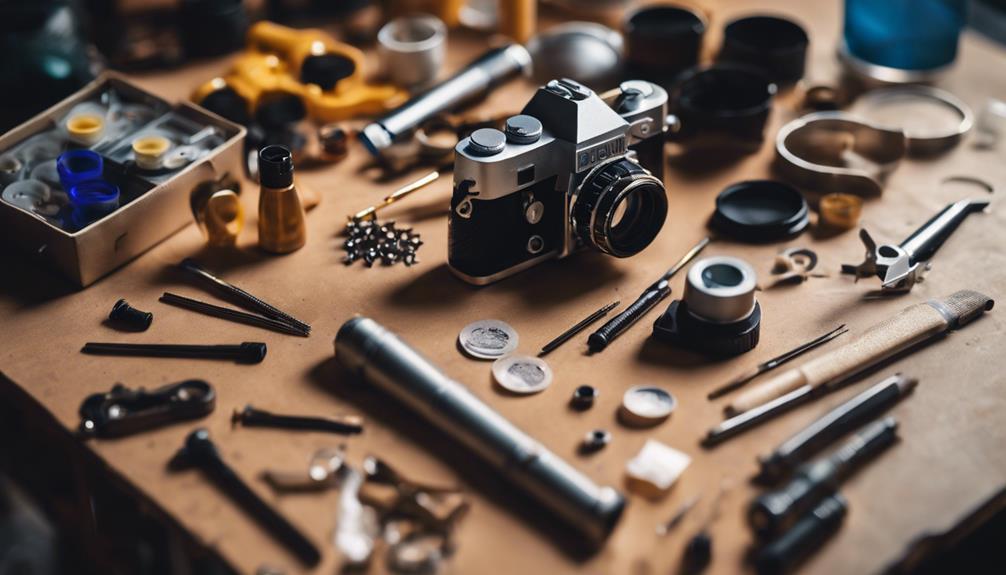
Now that you've settled on a telescope design, it's time to gather the materials and tools you'll need to bring your stargazing dreams to life. With the right focal length and quality lenses, your DIY telescope will reveal the cosmos in stunning detail. Here's a quick guide to make sure you have everything at hand:
| Materials | Tools | Purpose |
|---|---|---|
| Convex glass objective lens | Saw | Cutting materials |
| Eyepieces | Drill | Making holes |
| Tube for telescope | Sandpaper | Smoothing edges |
| Tripod | Screws | Assembly |
| Dew shield | Protecting lenses from moisture |
Salvaging lenses from old binoculars can be a smart way to get high-quality lenses without breaking the bank. Consider using a plastic waste pipe and a piece of timber to craft a sliding focuser, essential for adjusting the distance between the eyepiece and objective lens for the perfect view. Don't forget the dew shield to keep your lenses clear from moisture. With these materials and tools, you're on your way to putting together a telescope that's truly your own.
Step-by-Step Assembly Instructions
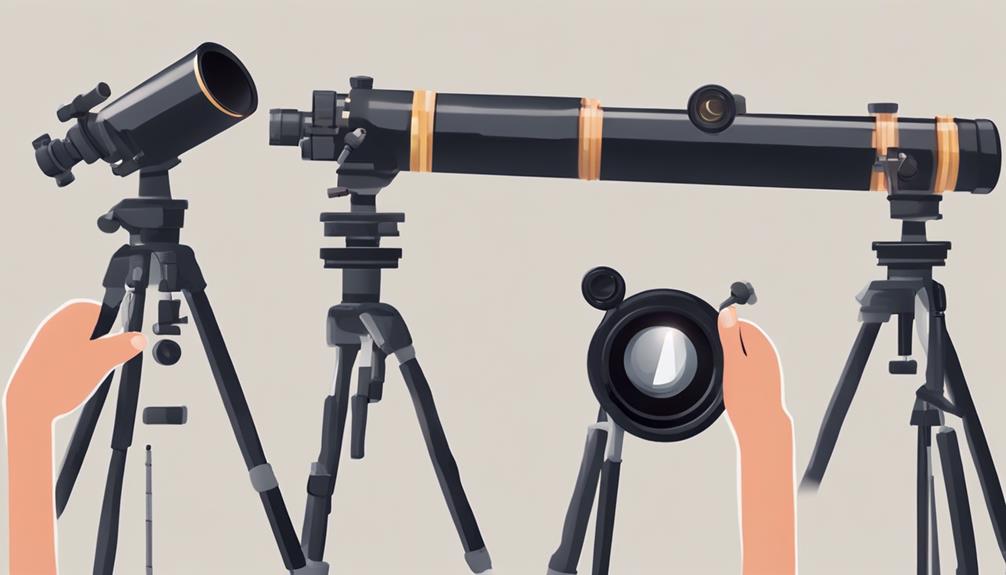
Let's explore the step-by-step assembly of your DIY telescope, starting with the construction of the primary mirror mount. Begin by using adjustable screws and wood discs to assemble the mount, making sure you're testing for alignment as you go. This foundation is important as it holds the heart of your telescope setup – the primary mirror – which determines the focal length and overall viewing capability.
Next, create the secondary mirror by attaching an elliptical mirror to a wooden dowel with epoxy. Center this mirror with precision using threaded rods, essential for the fine-tuning of your Newtonian reflector. This step is essential for centering the light path and achieving clear views of the stars.
The magic happens during collimation. Secure the secondary mirror with screws and adjust its tilt with wing nuts and threaded rods for the best focus. It's a delicate balance, tweaking the alignment until the image is perfectly centered. This process ensures that light is accurately focused, providing crystal clear celestial views.
Frequently Asked Questions
How Do You Set up a Telescope for Beginners?
To set up your telescope, start by choosing a location away from light pollution. Assemble the mount, find Polaris for guidance, select the right eyepiece, focus carefully, and use star maps or smartphone apps for navigation.
How Do You Make a Simple Telescope at Home?
To make a simple telescope at home, focus on lens selection and mirror grinding to optimize light gathering. Use durable building materials for the frame, pick a sturdy mount, and calculate magnification for the best experience.
What Are the First Steps With a Telescope?
First, choose your location wisely, considering light pollution. Check the weather and moon phases, then use star maps or stargazing apps to plan your observation. Finally, pick the perfect night and set up your telescope!
What Should Be My First Telescope?
For your first telescope, prioritize aperture for clearer views, but mind magnification limits. Refractors are user-friendly; reflectors offer deep-sky benefits. Choose a stable mount, select eyepieces wisely, consider your budget, and factor in light pollution for your observing goals.
Conclusion
Congratulations!
You've now ventured into the astronomers' kingdom, armed with nothing but your DIY telescope.
It's funny, isn't it?
How we aim to explore the vast, intricate universe with something we pieced together in our backyard.
Yet, here you are, ready to reveal the stars' secrets with your homemade marvel.
Remember, every giant leap for mankind began with small, shaky steps.
So, gaze up confidently; your journey among the stars starts with this simple, yet profound, assembly of glass and dreams.
