Best Telescopes for Budding Astronomers: A Pro’s Guide

Just as a map guides you through unfamiliar lands, the right telescope can be your compass in exploring the vast celestial sea.
You’re on the edge of a journey that could redefine your understanding of the universe, and selecting the ideal telescope is your first important step.
Whether you’re drawn to the beginner-friendly Celestron NexStar 4SE or considering the advanced capabilities of the NexStar Evolution 9.25, understanding the nuances between them is essential.
Let’s venture on this adventure together, exploring key features, maintenance tips, and how to maximize your stargazing experience, ensuring you make a choice that will fuel your passion for the cosmos for years to come.
Key Takeaways
- Aperture size is paramount for clear, detailed views of celestial objects.
- GoTo technology and smartphone integration simplify locating and tracking sky objects.
- High-quality lenses and mirrors, along with advanced coatings, significantly enhance image quality.
- Proper care and maintenance extend the telescope’s lifespan and ensure optimal performance.
Selecting the Right Aperture
When choosing a telescope, the aperture size is a critical factor as it directly influences the quality and detail of celestial observations. The aperture, basically the telescope’s main lens or mirror, dictates the amount of light the instrument can collect. A larger aperture size means more light can be gathered, which is important for viewing objects in deep space with clarity and detail. This principle underlies why telescopes with larger apertures are highly sought after for their superior resolution and ability to reveal faint celestial objects that smaller apertures might miss.
The measurement of aperture size, either in inches or millimeters, serves as a guide to the telescope’s viewing capabilities. Larger apertures not only enhance the brightness and sharpness of the image but also considerably improve the resolution. This is particularly advantageous when observing distant galaxies, nebulae, and star clusters, as it allows for a more detailed and expansive exploration of the night sky.
Understanding Magnification
Understanding magnification is important, as it greatly impacts how you’ll experience celestial objects through your telescope. The essence of telescopes’ magnification lies in the interplay between the telescope’s focal length and the eyepiece’s focal length. This dynamic directly influences not only how large celestial bodies appear but also the quality of the view you’re rewarded with. Here’s a breakdown to elucidate further:
- Magnification Calculation: The basic formula for telescopes magnification is the focal length of the telescope divided by the eyepiece’s focal length. This calculation reveals the magnification power, basically how many times larger an object appears compared to the naked eye.
- Variable Magnification: By swapping eyepieces with different focal lengths, you can adjust the magnification. This flexibility allows you to zoom in for detailed observations of distant objects or zoom out for a broader view of the night sky.
- Impact on Field of View: Higher magnification typically results in a narrower field of view. While it discloses more detail, it also means you’ll see less of the sky at one time.
- Quality and Balance: Achieving the right balance between high magnification and image clarity is critical. Excessive magnification can degrade image quality, making it important to find a sweet spot where detail and clarity coexist.
Understanding these aspects of magnification will help you select the perfect combination of telescope and eyepiece, ensuring your celestial observations are both rewarding and awe-inspiring.
Mount Types and Stability
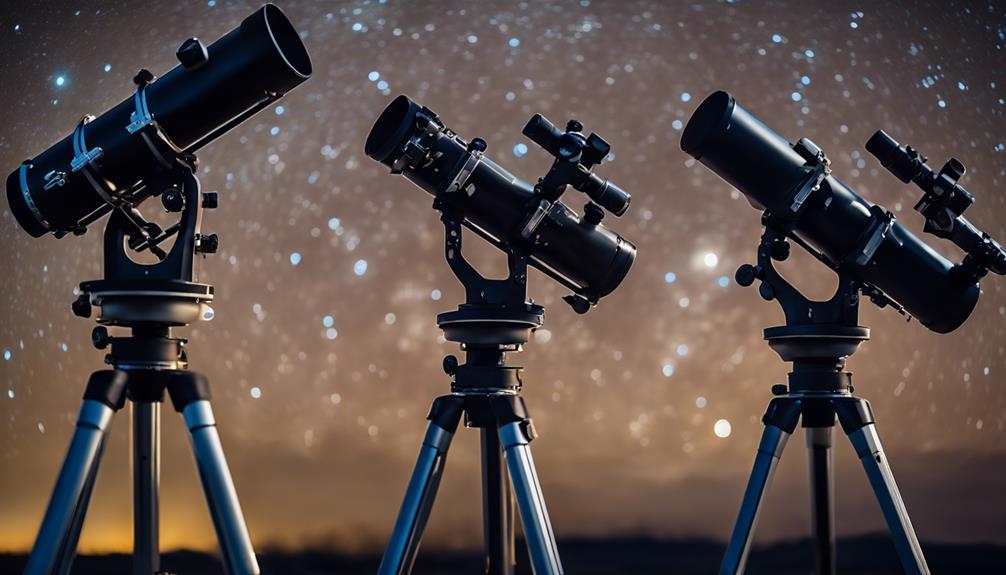
After exploring how magnification affects your viewing experience, it’s imperative to examine the stability and types of mounts, as these greatly enhance or impair your astronomical observations. Telescope mounts are the backbone of any telescope setup, offering the support and movement needed to navigate the celestial sphere.
Equatorial mounts, designed to align with Earth’s rotation, allow for precise tracking of celestial objects. This precision is vital for long exposures in astrophotography, where even the slightest movement can blur the image. The ability to follow the stars with minimal adjustment makes them a preferred choice for advanced astronomers seeking detailed observations.
On the other hand, Altazimuth mounts offer a more straightforward approach, with simple up-down and left-right movements. This user-friendly design is ideal for beginners and those interested in quick celestial scans, providing a solid foundation without the complexity of alignment.
Stability across all mount types can’t be overstressed. A stable mount minimizes vibrations, ensuring that high-magnification observations remain sharp and uninterrupted. Whether you’re gazing at the moon’s craters or capturing the rings of Saturn, the steadiness of your mount is as vital as the telescope’s optical quality.
Ease of Use and Setup
The ease of use and setup of modern telescopes, particularly those equipped with GoTo technology, greatly enhances your stargazing experience by automating the tracking and location of celestial objects. When you’re diving into the world of astronomy, the simplicity with which you can set up and use your equipment is key. Here’s a closer look at how certain features make telescopes not only advanced but also remarkably easy to set up and use:
- GoTo Technology: This feature automates sky tracking, allowing for easy location of celestial bodies. With GoTo, you don’t have to manually search the sky; the telescope does the work for you.
- Pre-aligned Setups: Some telescopes are designed with pre-aligned setups, reducing the time and effort required for assembly. This means you can start your stargazing session almost immediately after unboxing.
- Hand Controllers and Slewing Speeds: Hand controllers equipped with adjustable slewing speeds enable precise movements and efficient tracking of moving objects, adding to the user-friendly nature of modern telescopes.
- Wi-Fi Connectivity and Smartphone Apps: Built-in Wi-Fi and compatibility with smartphone apps offer a convenient way to control your telescope. This integration simplifies the alignment process and makes it easier to navigate the night sky.
Investment and Value
While exploring the ease of use and setup of modern telescopes enhances your stargazing experience, it’s equally important to contemplate the investment and value these advanced devices offer to budding astronomers. The Celestron NexStar Evolution 9.25, with its premium GoTo scope experience and high-definition universe viewing capabilities, carries a premium price. Its Schmidt-Cassegrain optical design is renowned for delivering exceptional image quality, making it a substantial investment for serious enthusiasts.
On the other hand, the Celestron NexStar 4SE, while also bearing the NexStar name, serves as a solid and sturdy choice at a different price point. Ideal for moon and planet observations, its suitability for astrophotography beginners coupled with a variety of accessories presents it as a value-packed option. Its motorized mount equipped with a rechargeable lithium-ion battery allows for precise movements and swift exploration of the night sky, emphasizing its value for those taking their first steps into astrophotography.
Investing in a telescope like the Celestron NexStar series means weighing the balance between initial cost and the long-term value it brings to your astronomical journey. Understanding the technical specifications and the added value of included accessories is important in determining which telescope presents the best investment for your specific interests and level of commitment.
Recommended Telescopes for Amateurs
Exploring the cosmos as a novice astronomer requires selecting a telescope that combines functionality, ease of use, and affordability, ensuring a rewarding stargazing journey from your very first glance through the eyepiece. For beginners, finding the right telescope is paramount, and here’s a carefully curated list to guide you:
- Celestron NexStar 5SE Telescope: This model is a favorite among amateurs for its 5-inch aperture, which strikes a balance between portability and the ability to gather enough light for observing planets and distant nebulae. Its GoTo technology simplifies sky navigation, making it easier for you to locate celestial objects.
- Astronomers Without Borders OneSky Reflector Telescope: Offering a budget-friendly option without compromising on quality, this telescope combines a portable design with excellent optical performance, suitable for both celestial and terrestrial viewing.
- Sky-Watcher Classic Dobsonian Telescope (8-inch): With its 8-inch aperture, this telescope excels in deep-sky viewing, capturing detailed images of galaxies and nebulae. The Dobsonian mount is noted for its stability and ease of use, ideal for beginners who are keen to explore deep-sky objects.
- Celestron StarSense Explorer LT 80AZ: This telescope integrates with a smartphone app to guide you through the night sky. The 80mm aperture is ideal for beginners, offering clear views of the moon, planets, and brighter deep-sky objects, with the added convenience of app-assisted navigation.
After Purchase: Care and Maintenance
Having selected your ideal telescope from the list of recommendations, it’s imperative to understand how proper care and maintenance can greatly extend its performance and durability. Regularly cleaning your lenses and mirrors is important for maintaining best performance. Dust, smudges, and scratches not only degrade the quality of your observations but can also cause permanent damage to these delicate components.
Storing your telescope in a dry, dust-free environment is equally important. Exposure to moisture can lead to the formation of mold on optical surfaces, while dust can scratch lenses and mirrors when they are cleaned. In addition, handling optical components with bare hands can leave oils and smudges, negatively impacting your viewing experience.
Regular checks and adjustments of alignment and focus are essential for clear and crisp celestial viewing. Even small misalignments can greatly diminish the quality of the images produced. Following the manufacturer’s instructions for maintenance will help you understand the specific needs of your telescope and extend its lifespan.
| Care Aspect | Why It’s Important |
|---|---|
| Clean lenses and mirrors | Prevents degradation of viewing quality |
| Store in dry, dust-free | Protects optical components |
| Avoid touching optics | Prevents smudges and scratches |
| Check alignment and focus | Ensures clear viewing of celestial objects |
| Follow manufacturer’s instructions | Prolongs telescope lifespan |
Optical Quality Considerations
When selecting your telescope, understanding the significance of aperture size is pivotal. It’s not just about magnification but about how much light your telescope can capture, directly influencing the brightness and resolution of the objects you’re observing.
High-quality lenses and mirrors play a critical role, especially those utilizing ED glass or equipped with advanced coatings. They help in minimizing chromatic aberration and maximizing image clarity. These optical components and their treatments are fundamental in ensuring that the views you get are as sharp and detailed as possible, elevating your astronomical experience.
Lens and Mirror Types
To understand the optical quality of telescopes, it’s important to explore the characteristics of lenses and mirrors employed in their design. When delving into this technical domain, you’ll encounter three primary telescope types: refractor, reflector, and catadioptric, each with distinct optical components that shape their performance and application.
- Refractor telescopes use lenses to gather and focus light, making them ideal for high-contrast viewing of the Moon and planets.
- Reflectors rely on mirrors to collect light, enabling larger apertures that excel in deep-sky observation of galaxies and nebulae.
- Catadioptric telescopes merge lenses and mirrors in a compact design, offering versatility for viewing a wide range of celestial objects.
- APO (apochromatic) refractors reduce false color, providing astrophotographers and visual observers with sharp, color-accurate images.
Aperture Size Importance
Aperture size greatly influences a telescope’s performance by determining the volume of light it can collect, directly impacting the clarity and detail of observed celestial phenomena. The larger the aperture, the more light your telescope can gather, enabling brighter and clearer images. This characteristic is paramount because a larger aperture facilitates better resolution, allowing you to discern finer details and subtle features in celestial objects.
Additionally, telescopes with a larger aperture excel in deep-sky observations, such as viewing galaxies, nebulae, and star clusters, by providing enhanced visibility of fainter objects. The capability to capture a significant amount of light not only enriches the overall viewing experience but also guarantees that you get the most out of your stargazing sessions, making aperture size a critical factor in optical quality considerations.
Coating and Clarity Impact
Beyond the size of its aperture, a telescope’s ability to deliver clear and detailed images importantly depends on the quality and application of optical coatings. When considering optical quality, the role of coatings can’t be overstated.
- Coatings enhance optical quality by reducing reflections and increasing light transmission, vital for observing faint celestial bodies.
- Anti-reflective coatings on lenses and mirrors greatly improve contrast and clarity, making celestial objects stand out against the night sky.
- High-quality coatings minimize light loss and enhance image sharpness, offering a better viewing experience by capturing finer details.
- Multiple coatings on telescope optics reduce glare and ghosting, improving overall image fidelity and ensuring that your observations are as true to life as possible.
Selecting a telescope with superior coating technologies like fully multi-coated optics guarantees maximum light transmission, essential for clear, detailed views of the night sky.
Price Considerations
When considering your first telescope purchase, it’s vital to assess the spectrum of options available within various price ranges.
Budget-friendly telescopes, typically under $300, offer a practical entry point, but it’s important to weigh their features against your specific observational goals.
Moving up, mid-range and high-end telescopes, priced from $300 to $700 and above respectively, present enhanced optics and advanced features, necessitating a careful analysis of their value against your budget and astronomical aspirations.
Budget-Friendly Options
Exploring the cosmos doesn’t have to break the bank, as several telescopes offer remarkable capabilities at an affordable price. When seeking budget-friendly options, consider these:
- Celestron FirstScope 3-inch Tabletop Dobsonian Telescope: Priced at just $49.98, this is an ideal entry-level telescope. Its simplicity and ease of use make it perfect for beginners.
- Sky-Watcher Virtuoso GTi 150P Tabletop GoTo Dobsonian: For $470.00, it offers a balance of affordability and functionality, with automated tracking features that enhance the stargazing experience.
- Celestron StarSense Explorer DX 130AZ Newtonian Reflector Telescope: At $479.95, it introduces advanced features without a hefty price tag, ideal for those ready to take a step further.
- Apertura AD8 Dobsonian 8-inch Telescope****: This option, priced at $649.95, represents a mid-range choice that doesn’t compromise on quality or performance.
Mid-Range Value Picks
For those looking to balance cost with advanced features, the Celestron NexStar 5SE Telescope stands out as a compelling mid-range option, offering a 5-inch aperture and sophisticated GoTo functionality.
| Telescope | Key Features |
|---|---|
| Celestron NexStar 5SE | 5-inch aperture, GoTo functionality |
| Astronomers Without Borders OneSky | Portable design, 130mm aperture |
| Sky-Watcher Classic Dobsonian | 8-inch aperture, stable mount for deep-sky viewing |
| Celestron StarSense Explorer LT 80AZ | 80mm aperture, smartphone compatibility |
| Orion StarSeeker IV 150mm | 150mm aperture, GoTo tracking |
In this category, you’ll find mid-range value picks that strike a balance between affordability and performance. Notable is the Sky-Watcher’s 8-inch aperture for those fascinated by deep-sky objects, and for tech enthusiasts, Celestron’s StarSense with smartphone compatibility offers an engaging experience.
High-End Investments
Moving beyond mid-range models, investing in a high-end telescope opens up a world of advanced features and unparalleled quality for serious stargazers. When you’re ready to take your celestial observations to the next level, here’s what you can expect with your investment:
- Price Range: High-end telescopes can range from $500 to several thousand dollars, reflecting their superior capabilities.
- GoTo Technology: These telescopes often include GoTo technology, enabling automated celestial tracking with precision.
- Optics Quality: Expect high-quality optics that provide crystal-clear images, enhancing your stargazing experience.
- Premium Mounts and Tracking: Larger apertures, premium mounts, and advanced tracking capabilities assure exceptional viewing experiences and reliability.
Investing in a high-end telescope guarantees you access to cutting-edge technology and long-term satisfaction in your astronomical pursuits.
Exploring the Night Sky
Exploring the vastness of the night sky, you’ll find the Celestron NexStar 4SE telescope an indispensable tool for its robust construction and adaptable functionality. Its precision-engineered optics and sturdy mount provide a stable platform for viewing a wide range of celestial objects in the night, from the rings of Saturn to distant galaxies. The integrated SkyAlign technology simplifies the alignment process, allowing you to quickly locate and track celestial bodies with ease.
The Celestron NexStar Evolution 9.25 takes your stargazing experience to another level. With its 9.25-inch aperture, you’re equipped to capture crisper, more detailed images of the cosmos. This model’s motorized mount, complemented by a rechargeable lithium-ion battery and built-in Wi-Fi, facilitates seamless control via the Celestron SkyPortal app. This feature is particularly beneficial for time-lapse photography or extended observation sessions, minimizing manual adjustments and enhancing your viewing experience.
For those ready to explore deeper into astronomy, the Celestron NexStar Evolution 9.25 offers a premium GoTo scope experience. Its high-definition viewing capabilities make it an ideal choice for experienced astronomers seeking to investigate the intricacies of the universe with unparalleled clarity.
Frequently Asked Questions
What Type of Telescope Do Professional Astronomers Use?
Professional astronomers use advanced telescopes, tackling light pollution challenges, mastering observational techniques, and following meticulous telescope maintenance tips. They rely on ground-based, radio, infrared, and X-ray telescopes to uncover the universe’s secrets.
What Is a Good Professional Telescope?
For a good professional telescope, you’re aiming for the stars optical quality, mount stability, and price range. It should offer crystal-clear views, rock-solid tracking, and fit your budget without breaking the bank.
Do Professional Astronomers Use Telescopes?
Yes, professional astronomers use telescopes extensively. They rely on routine telescope maintenance tips, engage in night sky photography, and often collaborate with amateur astronomer communities to enhance their research and understanding of the universe.
Which Telescope Is Best for Nebula?
To pierce the veil of night and disclose nebulae, you’ll need a telescope that masters nebula visibility challenges, withstands light pollution effects, and highlights aperture size importance, ensuring the cosmos’ whispers aren’t lost in silence.
Conclusion
To wrap up, picking the right telescope requires a balanced approach, blending technical prowess with value. Remember, ‘the best telescope is the one used most often.’
Focus on optical quality, aperture size, and user-friendliness to make certain your stargazing journey isn’t just a fleeting interest but a lifelong passion.
Careful consideration of mount stability, magnification, and maintenance will safeguard your investment, allowing you to unravel the mysteries of the night sky with precision and ease.