Best Telescopes for Star Gazing: 2024 Reviews & Guide

As you ponder the skies, the stars, and the vast universe, selecting the right telescope becomes essential to revealing the mysteries of the cosmos.
In 2023, the market offers a variety of telescopes, from the beginner-friendly Celestron NexStar 4SE to the advanced Celestron Advanced VX 8 EdgeHD, each tailored to fit different needs and budgets.
Whether you’re venturing into astronomy or looking to upgrade your stargazing experience, understanding the nuances of aperture, magnification, and portability is key.
But how do you decide which telescope is the perfect companion for your celestial explorations? Stay tuned as we navigate the stars together, finding the ideal telescope that not only meets your astronomical aspirations but also fits your lifestyle.
Key Takeaways
- Select a telescope with the right aperture and magnification for your observational goals, balancing brightness and clarity.
- Prioritize portability and travel-friendly features for convenient stargazing on the go.
- Consider weight, ease of assembly, and budget-friendly options without compromising on the viewing experience.
- Ensure the telescope offers durability and high optical quality for long-term, enjoyable celestial exploration.
Selecting the Right Aperture
When diving into the world of star gazing, selecting a telescope’s aperture size is a critical decision that hinges on your specific observational goals and the level of detail you’re aiming to see in celestial bodies. The aperture of a telescope isn’t just a number; it’s a gateway to the universe, determining its light-gathering ability, which is important for viewing faint celestial objects. Larger apertures, measuring 8 inches or more, open up brighter and clearer views of stars, galaxies, and nebulae, greatly enhancing your viewing experience. These telescopes excel in revealing the intricate details of celestial objects, thanks to their superior resolving power.
However, smaller apertures, around 4 inches, cater well to observers primarily interested in our solar system’s wonders, like the Moon and planets, alongside some brighter deep-sky objects. While offering less detail in faint objects, they provide a balance between performance and portability considerations, essential for those who value convenience.
Choosing the right aperture isn’t just about going big. It’s about aligning the telescope’s capabilities with your viewing targets, considering portability, and ultimately, satisfying the observer’s preferences. Whether you’re drawn to the faint whispers of distant galaxies or the dramatic landscapes of our neighboring planets, selecting the right aperture is your first step into a larger world.
Understanding Magnification Levels
You’ll find that magnification in telescopes is a key factor in how much larger celestial objects appear.
Understanding the ideal magnification for stars requires knowledge of the telescope’s focal length and the eyepiece used.
It’s important to remember, however, that higher magnification can compromise image brightness and clarity, affecting your stargazing experience.
Magnification Explained Simply
Delving into the domain of telescope magnification reveals that it’s not merely about how much larger objects appear, but involves a calculated ratio, specifically the division of the telescope’s focal length by the eyepiece’s focal length.
| Factor | Impact on Magnification |
|---|---|
| Focal Length | Directly determines magnification level |
| Eyepiece | Modifies the final magnification |
| Image Quality | Can deteriorate at high magnifications |
| Brightness | Decreases as magnification increases |
| Field of View | Narrows with higher magnification |
Ideal Magnification for Stars
To achieve perfect star gazing, it’s important to understand that the ideal magnification level depends on a telescope’s aperture and focal length.
- Magnification Levels: Typically, 25x to 50x magnification is sufficient for clear observations during star gazing.
- Aperture and Focal Length: These determine the best magnification, balancing image brightness and clarity.
- Detailed Observations: For binary stars or star clusters, higher magnifications around 100x may be necessary.
- Image Brightness: Higher magnification can reduce image brightness, so it’s vital to find a balance for a rewarding experience.
- Best Star Gazing: Understanding these aspects guarantees detailed observations and enhances your star gazing adventure.
Considering Portability for Stargazing
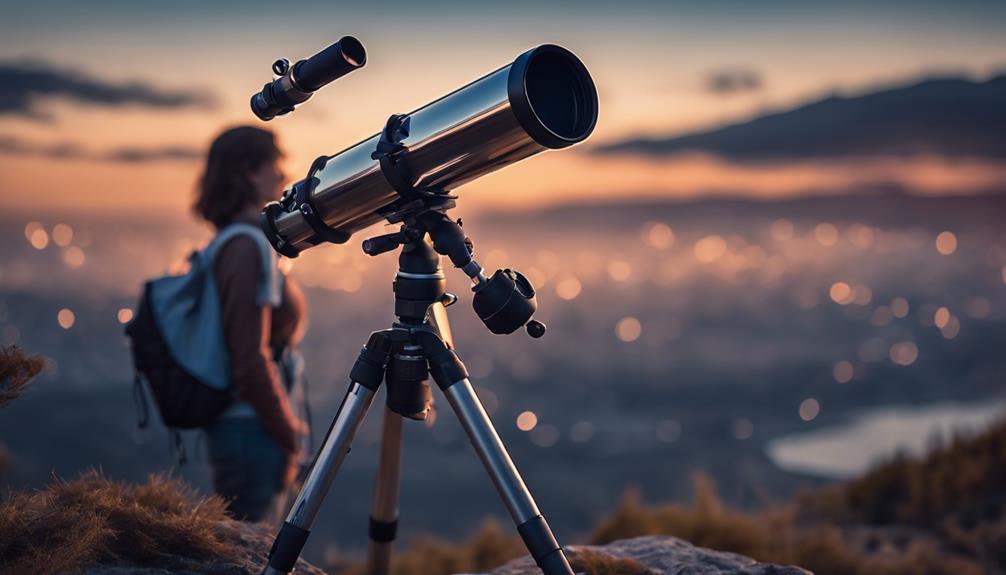
When you’re considering a telescope for stargazing, the benefits of compact designs can’t be overstated. These travel-friendly telescopes combine lightweight construction with rapid assembly features, streamlining your journey to remote observing sites.
Prioritizing weight and assembly time guarantees you’re ready to capture celestial wonders with minimal setup delay.
Compact Telescope Advantages
Compact telescopes, weighing just 5-10 lbs, offer the flexibility to easily carry your stargazing adventures anywhere, from remote campsites to cramped urban rooftops. Despite their small apertures (2-4 inches), these telescopes provide clear views of the moon, planets, and even some deep-sky objects. They’re perfect for stargazing on the go, combining portability with the ability to deliver satisfying stargazing experiences.
- Portability: Easily transportable for spontaneous stargazing adventures.
- Small Apertures: Offer surprisingly clear views despite their compact size.
- Tabletop Mounts: Simplify setup on varied surfaces.
- Lightweight Tripods: Enhance stability without adding bulk.
- Satisfying Stargazing: Capable of revealing the moon, planets, and some deep-sky wonders.
These features make compact telescopes an excellent choice for beginners and casual astronomers alike.
Travel-Friendly Features
Building on the advantages of compact telescopes, let’s explore the travel-friendly features that make some models exceptionally suited for stargazing wherever your journey takes you.
Portable telescopes are typically lightweight and compact, ensuring easy transportation. They often boast quick and simple assembly and disassembly mechanisms, streamlining your stargazing setup.
For enhanced mobility, many come equipped with carrying cases or backpacks, facilitating convenient storage and transport. Designed for on-the-go use, these telescopes are ideal companions for camping trips or remote stargazing adventures.
It’s essential to contemplate models with sturdy construction to withstand travel rigors and varying environmental conditions. This combination of portability, practicality, and durability makes certain telescopes stand out as travel-friendly options for avid stargazers.
Weight and Assembly Time
Considering the importance of portability for stargazing, the Celestron NexStar 4SE’s weight and assembly time emerge as critical factors in its suitability for both novice and seasoned astronomers. This telescope combines portability with quality optics, making it ideal for observing the moon and planets. Here are key points to take into account:
- Weight: At approximately 20 lbs (9.07kg), it’s relatively portable for backyard stargazing.
- Assembly: Easy and straightforward, allowing for quick setup.
- Portability: Strikes a balance between weight and performance for on-the-go use.
- Build: Despite its sturdy build, it’s designed for easy transport.
- Observation: Suitable for moon and planet observations, offering enjoyable stargazing experiences.
This blend of features ensures the Celestron NexStar 4SE is a top choice for those valuing both portability and quality in their stargazing adventures.
User-Friendly Features for Beginners
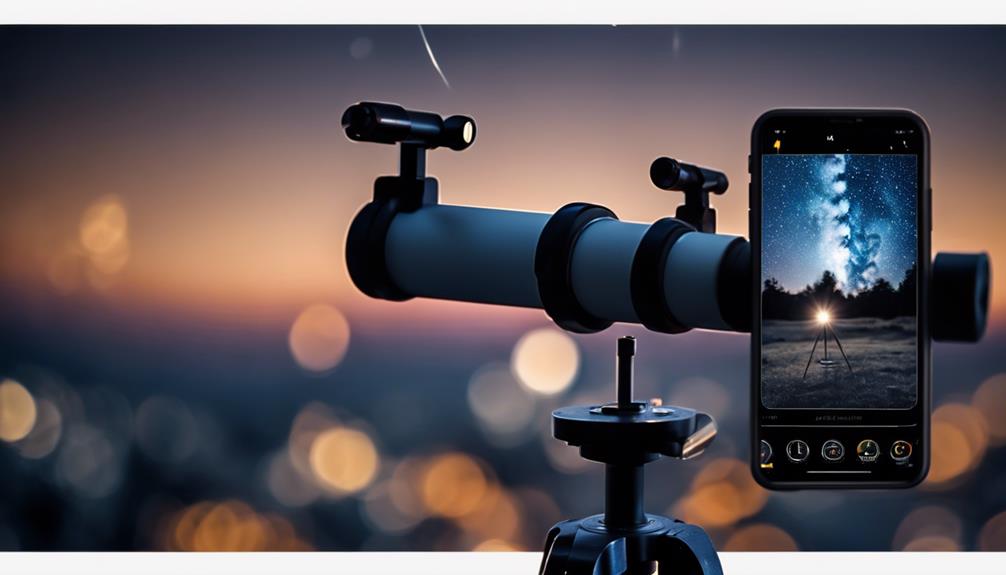
Diving into telescopes designed for beginners, you’ll find that they often boast easy setup processes that streamline your entry into star gazing. Brands like Celestron are at the forefront, offering models such as the NexStar series which combine user-friendly features with innovative technology. For beginners, these telescopes introduce intuitive sky navigation systems, including GoTo and StarSense, which greatly simplify the learning curve. By automating the process of locating celestial objects, they allow you to focus on the experience rather than the complexity of manual adjustments.
Additionally, smartphone compatibility emerges as a key feature, enabling you to control your telescope and access informative content seamlessly through your device. This integration enriches your star gazing sessions, making celestial exploration more accessible and enjoyable.
In addition, beginner telescopes often come with lower magnifications, which, contrary to what you might assume, are suitably designed for learning. This choice in magnification ensures that you’re not overwhelmed by the vastness of the night sky, providing a balanced field of view that’s ideal for starters. Portability, too, is a critical aspect, with many models featuring compact and lightweight designs. This ensures that your telescope can easily accompany you on various adventures, from backyard observations to remote dark-sky excursions.
Finding a Budget-Friendly Telescope
For those on a tight budget, finding a telescope that combines affordability with quality is absolutely achievable, with options ranging from $100 to $300. When you’re just starting out, focusing on features that offer the best value without compromising on the experience is crucial. Here’s how to get the most bang for your buck:
- Aim for at least a 70mm aperture to guarantee you get clear, bright views of celestial objects, even in budget-friendly telescopes.
- Refractor telescopes are known for their easy setup and low maintenance, making them a great choice at an affordable price point.
- Dobsonian telescopes offer good light-gathering capabilities, ideal for those who want to dive deeper into star gazing without breaking the bank.
- Look for bundled accessories, such as eyepieces and finderscopes, which can greatly enhance your viewing experience and save money in the long run.
- Remember, beginners benefit greatly from telescopes that don’t require extensive knowledge for setup and maintenance, ensuring a smooth and enjoyable entry into astronomy.
Assessing Durability for Long-Term Use
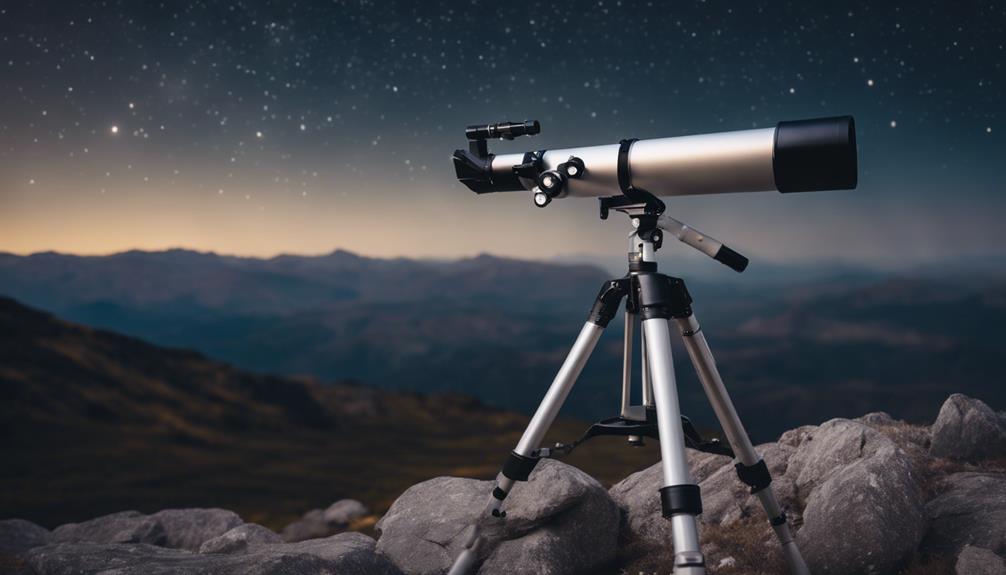
When evaluating a telescope’s long-term value, analyzing its durability is paramount, as robust construction and quality materials secure sustained performance and reliability. Telescope durability guarantees you’re making a wise investment, capable of withstanding the rigors of regular use without the need for frequent repairs or replacements.
Consider the table below which highlights key factors contributing to a telescope’s durability:
| Factor | Importance | Impact on Durability |
|---|---|---|
| Material Quality | High | High-quality materials resist wear and tear, extending the telescope’s life. |
| Construction Design | Critical | A well-designed telescope withstands harsh conditions and usage. |
| Protective Coatings | Essential | Coatings protect against environmental damage, maintaining clarity and function. |
| Weather-Resistant Features | Very Important | Sealed optics and robust mounts prevent damage from moisture and dust. |
Investing in a telescope with sturdy components and weather-resistant features not only enhances your star gazing experience but also assures your telescope remains a reliable companion for years. High-quality construction design and protective coatings are indispensable for a telescope’s longevity, offering peace of mind that your investment is safeguarded against the inevitable wear and tear of long-term use.
Evaluating Optical Quality and Performance
Evaluating a telescope’s optical quality and performance is important, as it directly impacts your ability to observe celestial bodies with clarity and precision. When you’re in the market for a telescope, understanding the technical aspects that contribute to a superior stargazing experience is essential. Here’s what to look for:
- Aperture size: The larger the aperture, the more light the telescope gathers, enhancing image brightness and detail.
- Focal length: This affects the telescope’s field of view and magnification power. Longer focal lengths offer higher magnification.
- Lens coatings: Multi-coated optics reduce glare and improve light transmission, resulting in clearer, more contrasted images.
- Mount type: A stable and appropriate mount type, whether altazimuth or equatorial, is essential for smooth tracking and ease of use.
- Performance features: Look for high-tech options like GoTo technology, motorized mounts, and computerized systems for precise tracking accuracy and alignment ease.
These key factors are critical in evaluating optical quality and performance. They ensure that you select a telescope capable of delivering breathtaking views of the universe, with minimal effort and maximum enjoyment.
Top Rated Telescopes for Star Gazing

Understanding the technical aspects that contribute to a superior stargazing experience prepares you to select from the top-rated telescopes designed for celestial observation. The Celestron NexStar 8SE stands out with its Schmidt-Cassegrain design and portability, making it an excellent choice for both beginners and experienced astronomers who prioritize mobility without sacrificing quality.
For those intrigued by technological advancements, the Unistellar eVscope 2 offers a smart, user-friendly experience with its automatic sky navigation and live image-stacking capabilities, enhancing your star gazing sessions.
If you’re seeking value without compromising on performance, the Sky-Watcher Skyliner-200P Classic, with its 8-inch aperture and Dobsonian mount, provides manual tracking and affordability, making it a favorite among budget-conscious enthusiasts. On the other hand, the Celestron Advanced VX 8 Edge HD caters to serious amateur astronomers with its lightweight design, equatorial mount for precise astrophotography, and compatibility with Celestron’s SkyPortal app.
Thus, for unparalleled deep-sky views, the Sky-Watcher Flextube 16-inch 400P Synscan is the pinnacle of advanced observation. Its large aperture and truss tube design, combined with dual-encoder technology, allow for manual slewing without losing alignment, offering seasoned astronomers a powerful tool for exploring the cosmos.
Frequently Asked Questions
Which Telescope Is Best for Stars?
Choosing the best telescope for stars depends on aperture sizes, mount types, and optical coatings. Consider Dobsonian models for manual tracking and telescopes with computerized controls and celestial tracking for exploring light pollution.
What Magnification Telescope Is Best for Stargazing?
For stargazing, you’ll want a telescope that balances magnification limits with aperture importance. It’s about light gathering, not just zooming in. Consider optical designs, mount types, and eyepiece selection for viewing star clusters vividly.
How Do I Choose a Stargazing Telescope?
To choose a stargazing telescope, consider aperture sizes for clarity, mount types for stability, and optical designs for your targets. Factor in light pollution, budget, portability, eyepiece options, accessory compatibility, maintenance, and user experience.
What Is the Best Telescope for Viewing Planets for Beginners?
For beginners viewing planets, don’t let budget concerns deter you. Opt for telescopes with larger apertures, considering mount types and eyepiece selection. They’ll mitigate beginner mistakes, even in areas with light pollution or during varying Moon phases.
Conclusion
In wrapping up, finding the perfect telescope is akin to unlocking the universe’s vast secrets, with each model offering a unique key. Whether you’re a novice aiming for the stars or a seasoned observer chasing celestial marvels, prioritize aperture, magnification, and portability.
Don’t skimp on durability and optical prowess; they’re your ticket to breathtaking vistas. Dive into our top picks for an astronomical journey that’s not just about gazing at stars—it’s about touching the very fabric of the cosmos.