Famous Astronomers and Their Iconic Telescopes
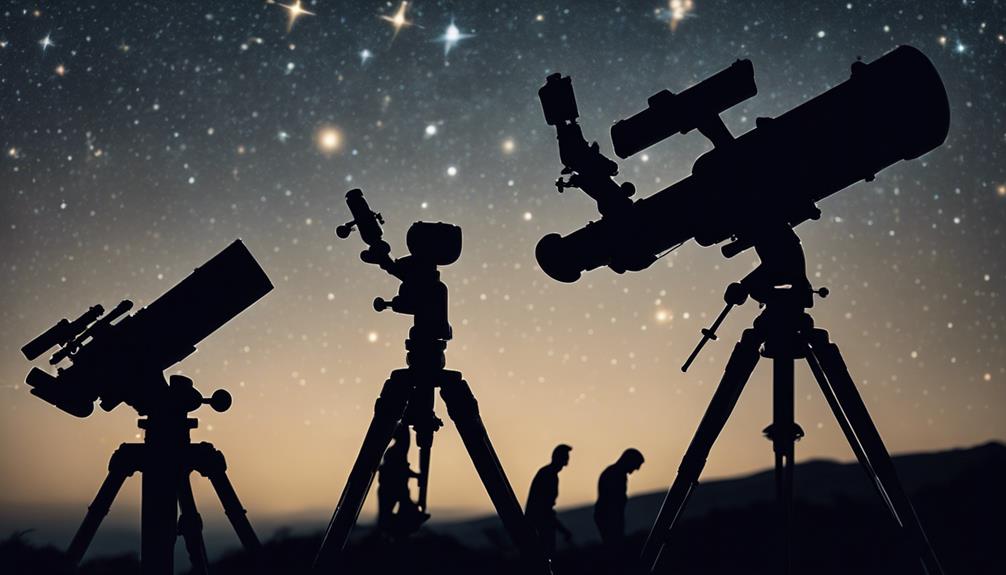
When stars aren’t just twinkling lights but the subjects of deep cosmic inquiry, you’re venturing into the domain of famous astronomers and their groundbreaking tools.
You’ve probably heard of Galileo Galilei’s early strides in observational astronomy or Isaac Newton’s innovative approach to telescope design, but that’s just scratching the surface. These pioneers didn’t just gaze at the heavens; they revolutionized our understanding of it with their iconic telescopes.
Imagine what secrets lie beyond the well-known tales of these celestial voyagers and their inventions. It’s an invitation to explore not just the stars but also the stories of those who brought them closer to us.
Key Takeaways
- Galileo Galilei’s refracting telescope unveiled the moons of Jupiter, challenging the geocentric model.
- Johannes Kepler’s observations led to the understanding of elliptical planetary orbits.
- Isaac Newton’s reflecting telescope design significantly improved image clarity and optical performance.
- William Herschel’s construction of the Forty-Foot Telescope enabled the discovery of Uranus, expanding our knowledge of the solar system.
Galileo’s Refracting Telescope
In 1609, Galileo Galilei revolutionized observational astronomy by crafting a refracting telescope that magnified objects up to 20 times, offering unprecedented clarity and detail in the study of celestial bodies.
This device not only embodied the ingenuity of its creator but also marked a pivotal moment in the history of science, enabling direct observations that would challenge and eventually reshape our understanding of the cosmos.
Galileo’s refracting telescope was instrumental in uncovering the intricate features of the Moon, revealing a landscape far more complex than the smooth, perfect sphere previously imagined. More notably, it allowed him to discover the moons of Jupiter, a groundbreaking observation that provided compelling evidence in support of the heliocentric theory.
By showing that not all celestial bodies revolved around the Earth, Galileo’s discoveries challenged the prevailing geocentric model and bolstered Copernicus’ heliocentric hypothesis.
These direct observations by Galileo weren’t merely incremental improvements in the study of the heavens but were, in fact, radical revelations that transformed observational astronomy. Through his telescope, Galileo Galilei laid the groundwork for the modern exploration of the cosmos, demonstrating the profound impact that technological advancements in observational tools can have on scientific discovery.

Kepler’s Astronomical Discoveries
Building on Galileo’s telescopic revelations, Johannes Kepler’s meticulous analysis of planetary motion further transformed our understanding of the universe by demonstrating that planets orbit in ellipses, not perfect circles.
Kepler’s groundbreaking work, encapsulating his discoveries into three laws, has become a cornerstone of celestial mechanics. His first law, stating that planets move in elliptical orbits with the sun at one focus, shattered the age-old belief in perfect circular orbits. This insight wasn’t just a minor adjustment but a major overhaul of the prevailing cosmological models.
Kepler’s second and third laws, detailing the equal areas at equal times and the harmonic relationship between the orbital period and the distance from the sun, respectively, provided a mathematical framework that quantified planetary motion with unprecedented precision. These laws, founded on empirical evidence, offered a predictive tool that was instrumental in the advancement of modern astronomy.
Furthermore, Kepler’s analysis of the Great Comet of 1577 underlined the importance of empirical observation in celestial mechanics, challenging traditional views and emphasizing the predictability of celestial phenomena. Through his work, Kepler not only laid the groundwork for future explorations of the universe but also championed the methodological shift towards evidence-based scientific inquiry in astronomy.
Newton’s Reflecting Telescope
You’ll find that Newton’s reflecting telescope marked a pivotal shift in astronomical equipment, addressing the issue of chromatic aberration with its innovative use of a spherical mirror.
This invention not only introduced the concept of spherical aberration into telescope design but also set the stage for the development of modern reflecting telescopes.
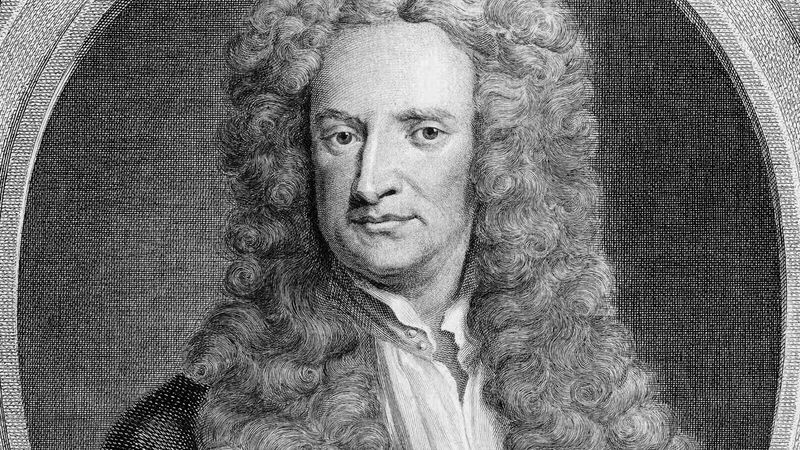
Newton’s Telescope Innovation
Isaac Newton revolutionized observational astronomy with the introduction of the reflecting telescope. This innovation addressed the issue of chromatic aberration by employing a curved mirror rather than a lens.
The reflecting telescope mitigated the distortion caused by different colors refracting at various angles through a lens and introduced a new challenge: spherical aberration.
However, Newton’s design notably enhanced optical performance by allowing for larger apertures, which facilitated clearer images. This leap forward formed the cornerstone of modern telescopes, dramatically advancing observational astronomy.
Subsequently, John Hadley refined Newton’s concept by implementing parabolic mirrors. This refinement further reduced spherical aberration and set a standard for excellence in telescope design that persists in the astronomical community to this day.
Impact on Astronomy
Newton’s introduction of the reflecting telescope marked a pivotal moment in astronomy, fundamentally transforming how we observe the cosmos by enhancing image quality and reducing optical distortions. By employing a spherical mirror, Newton’s design effectively eliminated chromatic aberration, a major advancement over previous telescopes.
However, this innovation introduced spherical aberration, a new challenge that would shape the future of telescope optics. The subsequent adoption of parabolic mirrors by John Hadley, building upon Newton’s groundwork, further refined reflecting telescopes, greatly improving image clarity.
Today, reflecting telescopes, rooted in Newton’s principles, remain indispensable in astronomical research. Their efficiency and precision, born from centuries of refinement, underscore the lasting impact of Newton’s work on the field, illustrating a legacy of innovation that continues to drive astronomical discovery.
Halley’s Comet Observations
You’ll find that Edmond Halley’s prediction of the comet’s return in 1758 marked a pivotal moment in astronomy, demonstrating the power of applying Newtonian physics to celestial phenomena.
This breakthrough was built upon historical comet appearances, tracing back centuries, which provided the empirical evidence necessary for Halley’s calculations.
Additionally, modern observational techniques have since enhanced our understanding of cometary behavior, leveraging advancements in technology to shed light on the mysteries of these celestial visitors.
Edmond Halley’s Prediction
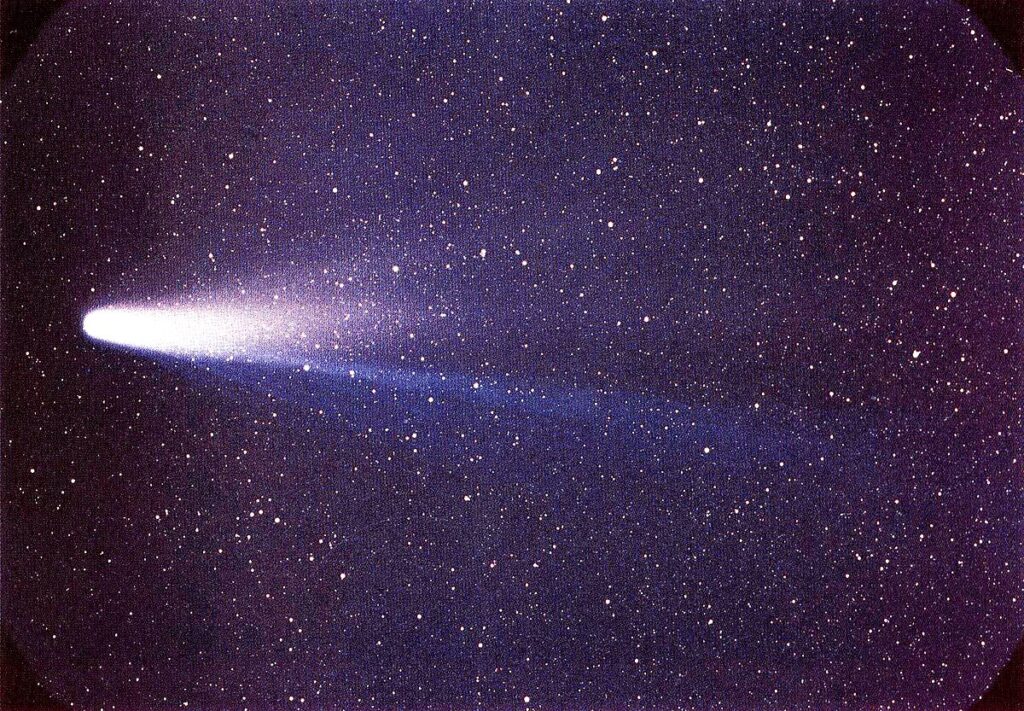
Through meticulous analysis of historical data dating back to 240 BC, Edmond Halley accurately predicted the 1758 return of Halley’s comet, a breakthrough that greatly advanced the understanding of celestial mechanics.
By recognizing the periodic nature of this comet, Halley’s work marked a pivotal moment in astronomy. His prediction underscored the comet’s 76-year return cycle, demonstrating an unprecedented grasp of celestial mechanics.
This insight into Halley’s Comet wasn’t just about one celestial body; it revolutionized how astronomers viewed all comets, establishing their orbits around the Sun as predictable phenomena. Halley’s methodology—combining historical observations with his analysis—laid the groundwork for modern studies of cometary orbits, proving that comets weren’t erratic wanderers but followed discernible paths.
This foundation remains a cornerstone in the ongoing exploration of our solar system.
Historical Comet Appearances
Building on Edmond Halley’s groundbreaking prediction, examining the historical appearances of Halley’s comet offers valuable insights into its impact on astronomy and human culture. Recognized for its roughly 76-year periodicity, Halley’s study revealed the comet’s predictable returns, tying it to historical sightings meticulously recorded in texts and artwork.
This celestial phenomenon, stemming from the distant Kuiper Belt, traverses an elliptical orbit, bringing it close to the Sun and Earth, making it a prominent feature in the night sky.
| Year Observed | Significance |
|---|---|
| Pre-1758 | Pre-prediction sightings validated Halley’s hypothesis. |
| 1758 | Marks the successful prediction by Edmond Halley. |
| 1986 | The latest visible return, with extensive scientific observation. |
These observations underscore the comet’s role in enriching our understanding of celestial mechanics and its cultural significance across centuries.
Modern Observational Techniques
Leveraging modern observational techniques, astronomers have greatly enhanced our understanding of Halley’s Comet.
They have shed light on its intricate orbit and composition with unprecedented detail. Instruments like the Hubble Space Telescope and the forthcoming Webb Space Telescope, grounded in the modern theory of light, offer deep insights not just into comets, but into the broader cosmos, including stellar evolution, black holes, and variable stars.
Radio telescopes complement these observations, enabling radio astronomy to probe the comet’s nucleus and outgassing behaviors, enriching scientific studies. Such thorough scientific investigations underscore the evolution from Halley’s initial observations, illustrating how far our capacity to decipher the universe’s mysteries has advanced.
This offers a clearer picture of celestial mechanics, the dynamic processes governing comets, and their interactions with the solar system.
William Herschel’s Forty-Foot
In 1789, William Herschel’s construction of the Forty-Foot telescope marked a monumental advancement in the field of astronomy, enabling unprecedented observations of deep-sky objects like nebulae and galaxies.
This formidable instrument, renowned for its revolutionary design and sheer size, stood as a proof of Herschel’s ingenuity and his unwavering pursuit of the cosmos’ secrets. With a focal length of 40 feet and a 48-inch-diameter primary mirror, the telescope was unlike anything that had come before.
You’ll find that Herschel’s Forty-Foot wasn’t just a marvel of engineering; it was a gateway to astronomical discoveries that would reshape our understanding of the universe. The telescope’s remarkable capabilities allowed Herschel to peer deeper into the night sky than ever before, revealing the intricate structures of nebulae and galaxies.
Also, it was with this very telescope that Herschel made one of his most groundbreaking discoveries: the planet Uranus. This singular achievement not only expanded our solar system but also cemented Herschel’s legacy in the annals of astronomy.
Herschel’s Forty-Foot telescope, thus, did more than just observe the heavens; it propelled the field of astronomy into a new era, disclosing the cosmos’ wonders and complexities to humanity’s inquisitive eyes.
Messier’s Celestial Catalog
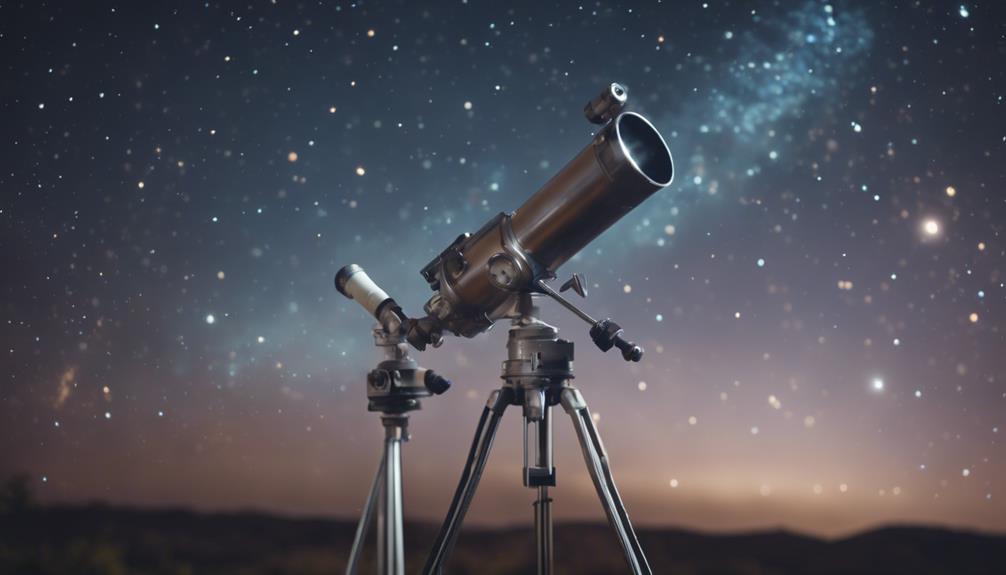
Charles Messier’s compilation of 103 celestial objects revolutionized the way astronomers distinguish between permanent and transient phenomena in the night sky. By diligently cataloging these objects, Messier provided a foundation that has greatly impacted both the fields of astronomy and astrophotography.
His work enables observers to systematically explore the cosmos, identifying galaxies, nebulae, and star clusters that are now famously known by their M numbers.
Consider the following to visualize the scope of Messier’s contribution:
- The Andromeda Galaxy (M31): A spiral galaxy that challenges the very scale of our cosmic neighborhood.
- The Orion Nebula (M42): A stellar nursery, teeming with the birth of new stars, is a tribute to the dynamic nature of our universe.
- The Crab Nebula (M1): The remnants of a supernova explosion, serving as a stark reminder of the celestial cycle of life and death.
Messier’s catalog has become an indispensable tool for both amateur astronomers and astrophotographers, guiding deep-sky observations and the quest to capture the beauty of these celestial objects. It’s a reflection of the enduring value of meticulous, scholarly work in unraveling the mysteries of the cosmos.
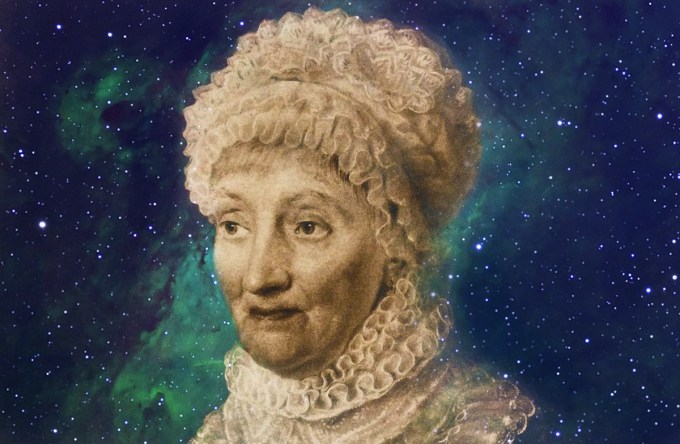
Caroline Herschel’s Sky Sweep
Caroline Herschel’s meticulous sky sweeps, employing a 27-inch telescope, propelled her to discover eight comets and catalog hundreds of nebulae, marking a pivotal shift in observational astronomy.
You’d appreciate her tenacity and precision, which not only illuminated the night sky’s mysteries but also paved the way for future astronomers.
Her collaboration with her brother, William Herschel, wasn’t just familial; it was a partnership that revolutionized the way humans comprehend the cosmos. Caroline’s role was instrumental, her contributions were marked by the receipt of the Gold Medal of the Royal Astronomical Society, an honor highlighting her significant impact.
Caroline Herschel wasn’t just an observer; she was a pioneer. As the first woman to receive a salary for scientific work, she broke barriers, setting a precedent for women in science.
| Aspect | Detail |
|---|---|
| Instrument | 27-inch telescope |
| Discoveries | 8 comets, hundreds of nebulae |
| Recognition | Gold Medal, Royal Astronomical Society |
| Contribution | Revolutionary methods in observational astronomy |
| Pioneering Role | First woman receiving a salary for science work |
Her legacy is a beacon for those who follow, embodying dedication, curiosity, and the relentless pursuit of knowledge.
Innovations in Telescope Design
While advancements in telescope technology have been pivotal in expanding our understanding of the cosmos, Isaac Newton’s revolutionary design marked the beginning of a new era in astronomical observation.
His innovative approach to telescope design addressed chromatic aberration through the use of a spherical mirror, laying the groundwork for the development of modern reflecting telescopes.
Important milestones in telescope design include the following:
- John Hadley’s Introduction of Parabolic Mirrors: This advancement notably reduced spherical aberration, enhancing the quality of the images produced by reflecting telescopes. Parabolic mirrors focus light more efficiently, providing clearer and more detailed views of celestial objects.
- Adaptive Optics in Extremely Large Telescopes (ELTs): The integration of adaptive optics technology into ELTs such as the Thirty Meter Telescope (TMT) and European Extremely Large Telescope (E-ELT) represents a leap forward in our ability to observe the universe. By compensating for atmospheric distortions, adaptive optics allow for sharper images and better resolution, even over vast distances.
- The Legacy of Arecibo Observatory: Despite its closure due to structural damage, Arecibo’s unique design and contributions continue to influence current telescope innovations, underscoring the importance of adaptability and resilience in astronomical research.
These developments underscore a continual quest for precision and clarity in our cosmic observations, driven by ingenuity and a relentless pursuit of knowledge.
Frequently Asked Questions
What Is the Most Famous Astronomical Telescope?
You’re likely thinking of the Hubble Telescope when it comes to famous astronomical tools. It’s revolutionized space exploration with deep space images and discoveries, paving the way for its successor, the James Webb Telescope.
Who Was the Astronomer That Made Telescopes Popular?
You’re asking about the person who made telescopes widely used. It was Galileo’s inventions, particularly his refracting telescope design in the 17th century, that revolutionized optics and astronomy, revealing Jupiter’s moons and lunar landscapes.
Who Is the Most Famous Astronomer?
In the grand tapestry of the cosmos, Galileo Galilei shines brightest, laying the groundwork for future titans like Edwin Hubble and his space telescope, which furthered our understanding through cosmic observations and dark matter exploration.
What Telescope Do Most Astronomers Use?
Astronomers don’t stick to one type; they use a mix, from ground-based optical innovations to space telescopes, adapting to their study’s needs, embracing telescope technology’s evolution for clearer celestial photography and effective dark sky initiatives.
Conclusion
To sum up, you’ve journeyed through the annals of astronomical exploration, witnessing the monumental strides made by pioneering astronomers and their iconic telescopes.
From Galileo’s refracting telescope to Herschel’s forty-foot leviathan, these instruments haven’t just peeked but leaped into the cosmos, revealing its mysteries.
Their relentless pursuit of knowledge hasn’t only pushed the envelope in telescope design but also notably broadened our cosmic perspective, ensuring that the stars aren’t the limit but the beginning.
