Essential Telescope Gear for Starry Night Magic
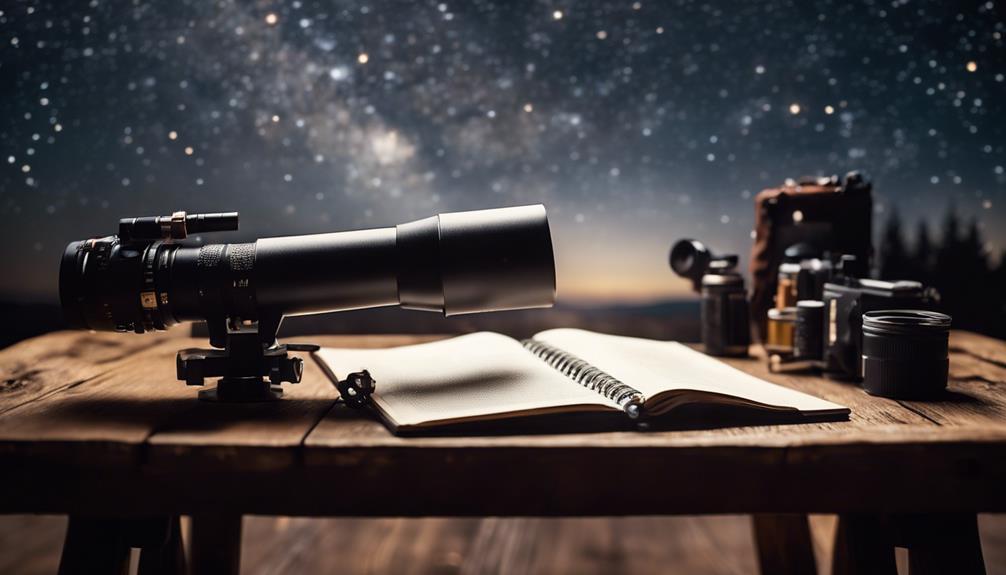
As you set out on a journey to seize the celestial ballet above, it’s vital to equip yourself with the right telescope gear. A sturdy tripod and a remote shutter release are your foundation for crisp, ethereal photos.
But there’s more to starry night magic than meets the eye. Have you considered the transformative power of a T-ring, or how a Moon filter might disclose the night in new hues?
Let’s explore the essentials that elevate your stargazing from mere observation to an immersive experience. What could these tools reveal about the universe’s secrets that you’ve been missing?
Key Takeaways
- Choosing the right mount, such as an equatorial or GoTo, enhances tracking accuracy for clear celestial views.
- High-quality, wide-field eyepieces with coatings improve viewing comfort and image clarity.
- Filters, including light pollution and specialized planetary, reveal finer details by enhancing contrast.
- Accessories like Barlow lenses and finder scopes optimize telescope performance for a magical stargazing experience.
Selecting the Right Mount
Choosing the right mount for your telescope is a critical decision that directly impacts the quality and ease of your celestial observations and astrophotography. When delving into the domain of telescope mounts, you’re faced with several options, each offering distinct advantages based on your specific needs and aspirations in the field of astronomy.
Equatorial mounts stand out for their precision in tracking celestial bodies, aligning perfectly with the Earth’s axis. This alignment is essential for astrophotography, where exact tracking over extended periods is required to capture detailed images without star trails. Conversely, Alt-azimuth mounts offer a straightforward setup, favored by beginners and those focusing solely on visual observation. Their simplicity, however, limits their effectiveness in long-exposure astrophotography.
For enthusiasts seeking convenience and efficiency, Computerized GoTo mounts are a game-changer. These motorized mounts not only automate the tracking process but also pinpoint celestial objects with remarkable accuracy, vastly reducing setup time and enhancing the overall observing experience. Additionally, the integration of motorized mounts provides steady, continuous tracking, essential for achieving clear, long-exposure images of the night sky.
Considering these aspects—stability, weight capacity, and compatibility with your telescope—is paramount when selecting the mount that will best suit your astrophotography setup and thus magical starry night observations.
The Importance of Quality Eyepieces
Understanding the types of eyepieces and their features is important in maximizing your viewing comfort and the quality of celestial observations.
You’ll find that eyepieces with a wide apparent field of view not only offer an immersive observing experience but also minimize optical aberrations, ensuring sharp, clear views of stars and planets.
Hence, selecting the right eyepiece greatly enhances your telescope’s performance, making every stargazing session more enjoyable and rewarding.
Eyepiece Types Explained
To fully appreciate the night sky’s wonders, understanding that the quality of eyepieces plays a pivotal role in defining the clarity, sharpness, and overall viewing experience offered by your telescope is important. When exploring eyepiece types, consider these aspects:
- Field of View: Wide-angle eyepieces offer an expansive view, making them ideal for observing large celestial objects, while Plossl eyepieces provide a more focused view for detailed observations.
- Magnification Power: The focal length of the eyepiece directly influences magnification, affecting how large and detailed celestial objects appear.
- Coatings: High-quality eyepieces feature special coatings that reduce glare and enhance contrast, improving the image quality.
Investing in high-quality eyepieces tailored to your viewing preferences can transform your stargazing experience, making celestial objects appear more vibrant and detailed.
Maximizing Viewing Comfort
Maximizing your viewing comfort through the selection of quality eyepieces is essential for enhancing the clarity and detail of celestial observations. Investing in eyepieces with premium optics not only elevates the magnification capabilities, allowing for intricate details of planets and deep-sky objects to come to life, but also integrates comfort features that greatly reduce eye strain during extended stargazing sessions.
| Feature | Benefit | Impact on Viewing |
|---|---|---|
| High Magnification | Detailed observations of celestial objects | Enhances clarity and detail |
| Adjustable Eye Relief | Reduces eye strain | Increases comfort during long sessions |
| Wide Field of View | Captures more of the night sky | Enhances the immersive experience |
| Multi-Coated Optics | Improves contrast and color rendition | Provides a vibrant and immersive viewing experience |
Eyepieces designed with ergonomic features and twist-up eyecups offer further customization for your comfort, transforming your celestial viewing into a truly magical experience.
Advantages of Using Filters
When you’re aiming to elevate your stargazing experience, integrating filters into your telescope setup can be transformative. By selectively blocking unwanted wavelengths, light pollution filters greatly sharpen the visibility of celestial bodies against the night sky, while specialized filters, such as those for nebulas or planets, enhance contrast to reveal finer details that would otherwise remain obscured.
Additionally, employing solar filters safeguards your eyes and equipment during solar observations by attenuating intense sunlight to manageable levels, ensuring both safe viewing and the capture of striking solar phenomena.
Enhancing Star Visibility
Utilizing filters greatly enhances star visibility by mitigating light pollution and boosting contrast, offering you clearer views of the cosmos. When you peer through your telescope, filters play a pivotal role in transforming your stargazing experience. Here’s how:
- Light Pollution Filters: These are specially designed to block out artificial light sources. By filtering out the wavelengths emitted by common streetlights and other urban lighting, these filters dramatically improve the visibility of celestial objects.
- Nebula Filters: Targeting faint nebulae, these filters work by isolating specific wavelengths of light. This selective filtering brings out the intricate details of nebulae that would otherwise be lost in the background glow.
- Color Filters: By emphasizing different wavelengths, color filters enhance the visibility of specific features on planets and stars. This can reveal details that aren’t visible without filtration, such as cloud bands on Jupiter or the polar ice caps on Mars.
Reducing Light Pollution
To further explore the benefits of filters, let’s examine how they greatly reduce light pollution, enhancing the contrast and detail of celestial observations. Light pollution filters, including CLS (City Light Suppression) and UHC (Ultra High Contrast), are pivotal in blocking unwanted artificial light. These filters notably improve the visibility of nebulae, galaxies, and star clusters by filtering out the pervasive glow of urban lighting.
Additionally, narrowband filters excel by isolating specific wavelengths, offering clearer views of emission nebulae and other deep-sky objects. On the other hand, broadband filters, like the LPS (Light Pollution Suppression), diminish overall light pollution, revealing fainter celestial bodies.
Utilizing light pollution filters is essential for anyone aiming to maximize their telescope’s capabilities in urban or light-polluted environments, providing a clearer window to the cosmos.
Improving Color Contrast
Filters greatly enhance the color contrast in celestial objects by selectively blocking certain wavelengths of light, allowing for more detailed and vibrant observations. Here’s why incorporating filters into your telescope setup can greatly improve your astronomical observations:
- Light Pollution Filters: These filters minimize unwanted artificial light, ensuring clearer views of stars and planets. You’ll find your observations less affected by urban light pollution, making even faint celestial objects more visible.
- Nebula Filters: By emphasizing specific emission lines, nebula filters boost the visibility and detail of nebulous objects. This enhancement allows for a more profound appreciation of these cosmic clouds’ structure and composition.
- Planetary Filters: These filters are essential for observing planetary surfaces and atmospheric features with improved contrast and detail. Planetary filters reveal subtleties in the planet’s appearance, contributing to a more immersive and enlightening viewing experience.
The Role of a Barlow Lens

A Barlow lens significantly enhances your telescope’s magnification capabilities, effectively doubling or tripling the observable details of distant celestial bodies. As an optical accessory, it’s engineered to increase the effective focal length of your telescope. This increase in focal length directly translates to higher magnification, allowing celestial objects to appear closer and with more intricate detail than observed through the eyepiece alone.
By inserting a Barlow lens between the telescope and the eyepiece, you seamlessly amplify the magnification power, typically by 2x or 3x. This range of magnification factors empowers you with versatile adjustments, catering to both wide-field views and detailed observations of planets or deep-sky objects. The adaptability offered by a Barlow lens makes it an indispensable tool in your astronomical toolkit.
Utilizing a Barlow lens to achieve higher magnification is a cost-effective strategy. Instead of purchasing multiple eyepieces with different focal lengths, you can use this single optical accessory to explore a broader spectrum of magnification options. This not only saves you money but also reduces the hassle of switching between multiple eyepieces during an observation session, making your stargazing experience both efficient and expansive.
Choosing a Finder Scope
Exploring the vast night sky, choosing the right finder scope becomes essential for astronomers aiming to precisely locate and observe celestial objects. Finder scopes serve as your navigational guide, offering a broader view to easily align your main telescope for detailed observation.
When selecting a finder scope, consider these three key factors:
- Type of Finder Scope: You’ll encounter optical, red dot, and reflex sights. Optical finders are basically mini telescopes, offering magnified views with crosshairs for precision aiming. Red dot finders, on the other hand, project a simple red dot onto a clear window without magnification, ideal for quickly pointing your telescope in the right direction. Reflex sights are similar to red dot finders but use a reticle for targeting.
- Field of View: Opt for a finder scope with a wide field of view. This feature is critical for efficiently scanning the sky and locating the celestial objects you wish to observe. A wider field of view facilitates easier alignment with your main telescope.
- Precision Aiming: Ensure the finder scope is equipped with crosshair reticles or a targeting system. This aids in the accurate alignment of celestial objects, enhancing your observational experience. Precision aiming is important for successfully locating and observing distant stars and deep-sky objects.
Choosing the right finder scope enhances your star-gazing sessions, making the exploration of the night sky a more enjoyable and fruitful endeavor.
Stability With the Right Tripod
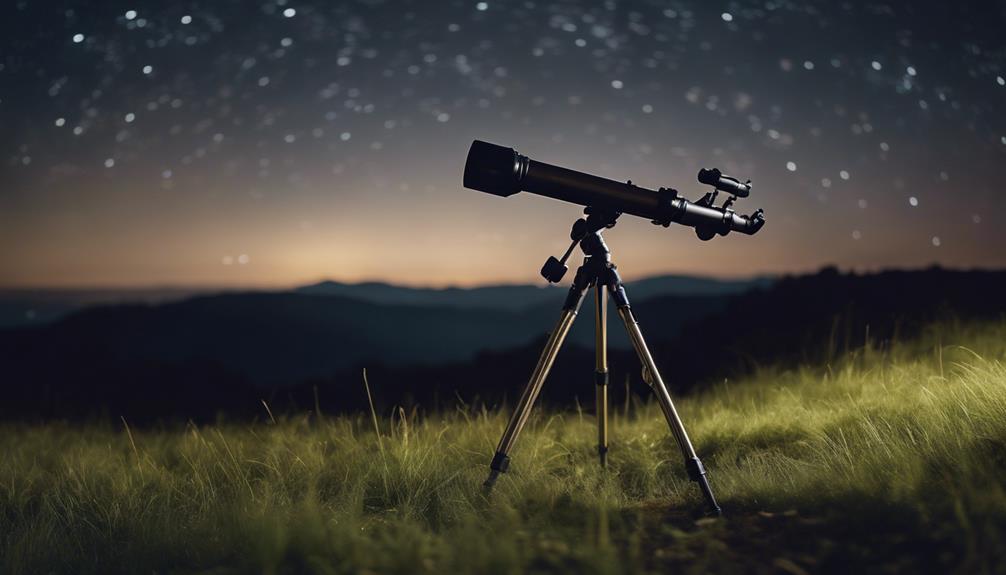
After selecting the perfect finder scope, it’s imperative to focus on the foundational support of your telescope: choosing a tripod that guarantees stability for unobstructed stargazing. A tripod’s sturdy construction isn’t just a benefit; it’s a necessity for maintaining the precision of your celestial observations. When it comes to telescopes, even the slightest vibration can blur the cosmos into obscurity. Thus, selecting a tripod with a robust frame is essential for ensuring that your stargazing sessions remain unaffected by ground vibrations.
Adjustability in a tripod is equally important. Look for models with adjustable legs and center columns that allow you to fine-tune the height and angle, ensuring comfortable and sustained viewing. This adaptability not only enhances your experience but also accommodates observers of various heights and viewing positions.
Moreover, the integration of vibration damping features within a tripod is paramount. Such technology minimizes the impact of inadvertent movements, preserving the clarity of your astronomical observations. Opting for a lightweight yet durable construction facilitates easy transport and setup, a significant advantage when chasing clear skies at different locations.
To conclude, compatibility with your telescope’s mounting system is non-negotiable. A mismatch can lead to instability or damage. Hence, ensure the tripod you choose is fully compatible, offering a secure and reliable foundation as you explore the night sky.
Enhancing Experience With an Accessory Kit
Delving into the domain of accessory kits can greatly enhance your stargazing experience, providing tools and components crafted to optimize your telescope’s performance. Investing in a quality kit introduces a range of benefits, essential for both novice and seasoned astronomers aiming to elevate their night sky observations.
Here’s a closer look at the essentials:
- Eyepieces and Barlow Lenses: These are pivotal for magnification. While eyepieces offer varied focal lengths for different scales of view, Barlow lenses, when paired with an eyepiece, can double or triple the magnification power. This versatility is vital for viewing celestial objects in detail.
- Filters: Including both color and moon filters, these tools enhance contrast and detail. Color filters isolate specific wavelengths of light, making planetary features stand out, whereas moon filters reduce glare and improve clarity for lunar observations.
- Adapters: Adapting your telescope for different uses, such as astrophotography, requires specific adapters. These enable the connection of cameras or smartphones, allowing you to capture and share the wonders of the universe.
Frequently Asked Questions
What Magnification Do You Need to See Stars?
To see stars, you’ll need basic magnification between 25x to 50x. Consider light pollution effects, dark sky locations, and the eyepiece selection guide. Mount importance is essential for clear views, enhancing your star magnification basics.
How Good of a Telescope Do You Need to See Saturn’s Rings?
To see Saturn’s rings, you’ll need a telescope with at least 60x magnification. Considering Saturn’s visibility, light pollution, telescope types, atmospheric conditions, and viewing locations can deeply impact your experience and the detail you’ll observe.
What Telescope Do You Need to See Stars?
To see stars, you’ll need a telescope with a stable mount for precision, a good selection of eyepieces for varied magnifications, and refractor benefits for clear images, even on a budget, under dark skies.
How Do You Connect a Telescope to Starry Night?
To connect your telescope to Starry Night, first check software compatibility. Use the correct mounting system and connection type. This guarantees precise celestial tracking and enhances night photography by aligning and controlling your telescope accurately.
Conclusion
In wrapping up, remember that 80% of stargazers notice significant improvements in their celestial observations when they upgrade their gear.
Investing in a robust tripod enhances stability, vital for clear night sky photography.
Quality eyepieces and filters can dramatically improve your viewing experience, while a Barlow lens doubles your eyepiece’s magnification power.
Don’t overlook the importance of a good finder scope for exploring the stars.
With the right accessory kit, you’re set to capture the magic of the starry night in all its glory.