Must-Have Gear for Stellar Backyard Stargazing

While the naked eye can reveal the beauty of a starlit sky, the right gear transforms your backyard into a personal observatory. You’ll need a quality telescope, perhaps a versatile Dobsonian for novices or a computerized model for the more ambitious stargazer, as your centerpiece.
Don’t overlook the importance of a sturdy mount, essential eyepieces for varied magnification, and a red flashlight to keep your night vision intact. But there’s more to ponder beyond the basics—tools and accessories that promise to elevate your experience.
Stick around to uncover these must-have items that could change the way you gaze at the heavens forever.
Key Takeaways
- Choose an equatorial or motorized mount for stable, precise tracking of celestial bodies.
- Invest in quality eyepieces and lenses to enhance image clarity and detail.
- Utilize filters and a Barlow lens to improve viewing conditions and magnify images.
- Prioritize comfort with observing chairs and portable gear for extended stargazing sessions.
Essential Mounts for Stability
For best stargazing, selecting the right mount is critical, as it provides the stability needed to prevent shaky views and guarantees precise tracking of celestial bodies across the night sky. When you’re diving into the cosmos from your backyard, the last thing you want is a jittery view that detracts from the awe-inspiring experience. Let’s get technical and pinpoint why the mount choice matters so much.
Equatorial mounts, with their ability to follow the Earth’s rotation, offer a seamless stargazing experience. They’re designed for prolonged observation, enabling you to track the celestial dance without manual adjustments continually. This precision is important for capturing detailed images or simply soaking in the view without interruption.
Altazimuth mounts, on the other hand, shine in their simplicity and flexibility. Their straightforward design allows for quick shifts in view, covering vertical and horizontal planes with ease. This makes them ideal for spontaneous stargazing sessions where speed and ease of use are key.
For those seeking the cutting edge, motorized mounts with automated tracking capabilities represent the pinnacle of convenience. They eliminate the need for constant manual adjustments, letting technology do the work. This ensures a steady, uninterrupted view, important for both amateur and seasoned astronomers alike.
Choosing the Right Eyepiece
When selecting an eyepiece, you must consider its focal length, as this directly influences magnification power. Shorter focal lengths yield higher magnifications, essential for detailed observations of distant celestial bodies.
Additionally, the quality of the lens within the eyepiece plays a pivotal role in the clarity and sharpness of the image you perceive, making it a critical factor in your stargazing experience.
Understanding the synergy between your telescope’s focal length and the eyepiece’s focal length guarantees you achieve the desired balance between magnification and field of view, optimizing your observational capabilities.
Eyepiece Focal Length
Understanding the focal length of an eyepiece is crucial as it directly influences both the magnification and field of view during your stargazing sessions, allowing you to tailor your observations to specific celestial objects with desired detail. Here’s a concise breakdown:
- Shorter Focal Lengths: These eyepieces, offering higher magnification, are perfect for zooming in on planets or the moon. However, they sacrifice field of view, making them less ideal for expansive celestial phenomena.
- Longer Focal Lengths: Opt for these to enjoy a broader field of view, essential for observing nebulae or galaxies. Although they provide lower magnification, the wider perspective enhances the observational experience.
- Versatility with 25mm: A focal length around 25mm strikes a balance, suitable for a wide range of celestial objects without compromising too much on detail or field of view.
Experimenting with various focal lengths can significantly enrich your stargazing, catering to both specific interests and general sky exploration.
Lens Quality Importance
While exploring different focal lengths offers a tailored viewing experience, the clarity and detail of your observations greatly depend on the quality of the eyepiece lens. Choosing the right eyepiece is critical, as its quality greatly impacts the magnification, field of view, and, importantly, the optical coatings that enhance your night vision.
High-quality eyepieces not only boost contrast and sharpness but also improve color rendition, important for distinguishing features on planets, stars, and deep-sky objects. Investing time in selecting eyepieces with advanced coatings and designs is essential for reducing aberrations and achieving sharper images.
Eyepieces with wider apparent field of view and multi-element designs offer immersive views, making every stargazing session more detailed and rewarding, ensuring your time under the stars is well spent.
Filters for Enhanced Quality

As you explore the domain of backyard stargazing, understanding the types of filters available is key to elevating your observational experience.
Light pollution filters, for instance, are essential for city dwellers, cutting through the haze of urban glow to reveal the faint whispers of distant galaxies and nebulae.
When selecting your first filter, it’s vital to contemplate the specific celestial objects you’re most keen on observing, as this choice greatly impacts the clarity and detail of your cosmic observations.
Types of Stargazing Filters
To enhance your stargazing experience, various filters such as Moon, nebula, and light pollution filters can greatly improve viewing quality by reducing glare, increasing contrast, and sharpening image clarity. These specialized filters are designed to optimize your observation of the night sky and its myriad celestial objects.
Here’s how they function:
- Moon Filters: These reduce the Moon’s intense brightness, making surface details more visible and less straining on your eyes.
- Nebula Filters: By blocking specific wavelengths of light, these filters enhance the visibility of nebulae against the night sky, dramatically increasing contrast and detail.
- Light Pollution Filters: These are crafted to cut through the glow of urban lighting, enhancing the visibility of celestial bodies even from light-polluted areas.
Benefits of Light Pollution Filters
Building on the variety of filters available for stargazing, light pollution filters offer distinct advantages by greatly mitigating the adverse effects of artificial lighting on celestial observations. Products like the Orion SkyGlow Astrophotography Filter greatly enhance the quality of your stargazing experience.
They’re engineered to reduce the impact of urban and suburban artificial light by selectively blocking specific wavelengths emitted by common streetlights. This technology improves contrast and visibility of celestial bodies, making fainter stars and deep-sky objects more discernible against the night sky.
Essentially, using a light pollution filter can transform your backyard into a more conducive space for astronomy, cutting down glare and substantially improving image clarity, ensuring a more rewarding stargazing experience under the night sky.
Choosing Your First Filter
Selecting your inaugural telescope filter, important for enhancing the quality of celestial observations, requires understanding the distinct types and their specific benefits under varying viewing conditions. Here’s a technical breakdown:
- Moon Filters: These reduce glare and enhance lunar surface details, making moon observation more comfortable. They’re essential for anyone focusing on lunar landscapes.
- Solar Filters: Protecting both your eyes and equipment, solar filters enable safe sun observation. They’re essential for studying solar phenomena without risking damage.
- Light Pollution Filters: Ideal for urban astronomers, these filters cut down city light pollution, improving contrast for deep-sky objects.
Choosing the right filter depends on your targets and conditions. Star charts and binoculars provide additional support, but the correct filter can significantly enhance your celestial experience.
Magnification With Barlow Lens
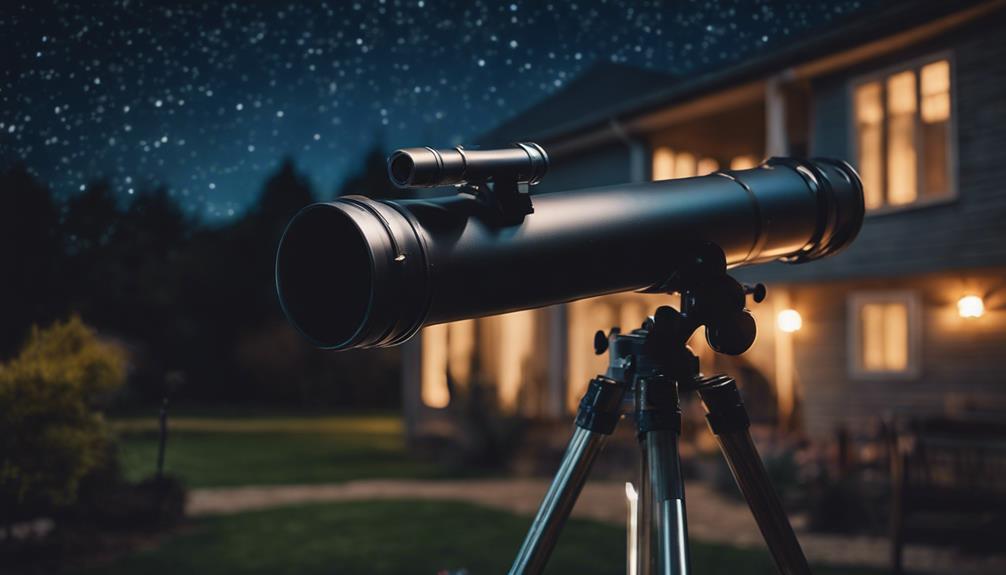
Employing a Barlow lens effectively doubles or triples your telescope’s magnification, offering a closer and more detailed examination of celestial wonders. This optical device, when paired with an eyepiece, boosts the magnification power, allowing for a closer view that can greatly enhance your stargazing experience. The beauty of a Barlow lens lies in its ability to magnify without necessitating the purchase of multiple, higher-powered eyepieces. This not only makes it a cost-effective solution but also adds to the versatility and performance of your telescope setup.
By inserting a Barlow lens between the telescope and the eyepiece, you’re able to achieve higher magnifications effortlessly. This setup is especially advantageous for observing the fine details on the moon’s surface, the rings of Saturn, or the bands of Jupiter. The increased magnification brings these celestial bodies into sharper focus, revealing intricacies that would otherwise remain unseen.
Adding a Barlow lens to your stargazing gear is a strategic move to maximize the potential of your telescope. It provides a more detailed view of various astronomical targets without the need for a complete overhaul of your existing equipment.
Navigational Aids: Finder Scope
Exploring the vast expanse of the night sky demands accuracy, and integrating a finderscope into your telescope setup can greatly enhance your ability to swiftly locate celestial objects. When it’s time to stargaze, especially during spectacular meteor showers, you don’t want to waste precious moments fumbling to find your target in the cosmos. A finderscope becomes indispensable in these moments, serving as your celestial guide.
To elevate your stargazing experience, consider these enhancements:
- Upgrade to a Red Dot Finder: Unlike traditional finderscopes, red dot finders project a small red dot onto a clear window without magnifying the image. This allows for quick alignment with celestial objects, improving your efficiency in locating stars, planets, and during meteor showers.
- Utilize Specialized Accessories: Accessories like the Telrad or StarPointer Pro offer advanced sighting capabilities, enabling you to pinpoint objects with greater precision. These tools are particularly useful for identifying specific stars or galaxies in cluttered regions of the sky.
- Invest in Quality: Whether your telescope came with a finderscope or you’re purchasing one separately, opting for quality is critical. A well-constructed finderscope can notably reduce the time spent searching the sky, making your stargazing sessions more fruitful and enjoyable.
Capturing the Cosmos: Cameras
After mastering celestial navigation with a finderscope, capturing the beauty of the night sky becomes your next endeavor, requiring the right camera to immortalize those moments. Selecting the appropriate camera is important for turning your stargazing sessions into visual masterpieces, making the best time to capture the cosmos even more rewarding and the cleanup a breeze post-processing.
| Camera Type | Best For |
|---|---|
| DSLR (e.g., Canon EOS Rebel T7i) | Versatile astrophotography, excelling in both wide-field and detailed celestial shots due to its superior image quality. |
| Dedicated Astrophotography (e.g., ZWO ASI224MC) | Capturing faint celestial objects with high sensitivity, ideal for deep-sky imaging. |
| Webcam (e.g., Celestron NexImage 10) | Planetary imaging, offering high frame rates essential for detailing planetary surfaces. |
| Mirrorless (e.g., Sony Alpha a7 III) | Capturing expansive night sky scenes with excellent low-light performance and dynamic range. |
In the world of astrophotography, understanding the technical capabilities of your camera is as important as knowing the celestial bodies you wish to capture. Whether you’re utilizing a DSLR, a dedicated astrophotography camera, a webcam for planetary imaging, or a mirrorless camera for its dynamic range, each has its niche, ensuring your efforts in capturing the night sky are not only successful but also make cleanup a breeze.
Frequently Asked Questions
What Equipment Do You Need to Stargaze?
To stargaze, you’ll need a star chart or smartphone apps for navigation, night vision aids like red LED flashlights, binoculars for detailed celestial views, and a comfortable chair for prolonged observation.
What Do You Need to Bring for Stargazing?
For stargazing, you’ll need a star chart or app, a red LED flashlight, binoculars or a telescope with mount, extra eyepieces, a moon filter, comfortable seating, and warm clothing for a perfect experience.
How Do You Stargaze in Your Backyard?
To stargaze in your backyard, mitigate light pollution by choosing a dark spot and using a red LED flashlight. Acknowledge seasonal sky changes to identify celestial bodies, ensuring a detailed and analytical observation experience.
What Is the Best Equipment to See Stars?
To see stars clearly, you’ll need equipment that reduces light pollution’s effect. Celestron’s telescopes or 25×70 binoculars paired with a sturdy tripod excel. Don’t forget star charts for exploring the night sky’s wonders.
Conclusion
To sum up, equipping yourself with the right stargazing gear elevates your backyard astronomy experience to a great extent.
It’s fascinating to note that even with a modest setup, you can observe over 2,000 stars compared to the naked eye’s 200 on a clear night.
This underscores the transformative power of proper equipment, from stable mounts to precision eyepieces and navigational aids.
Investing in quality gear not only enhances your viewing clarity and scope but also deepens your cosmic exploration, making every stargazing session a profound journey into the universe.