Telescope History: From Early Gazing to Modern Stargazing

Have you ever considered how the theory that a simple device could extend our gaze far beyond the reaches of the naked eye transformed the world?
The evolution from early telescopes in the 17th century to today’s technological wonders like the Hubble Space Telescope marks a fascinating journey of discovery and innovation.
As you trace back to the origins of Hans Lippershey and reflect on the revolutionary contributions by Galileo and Newton, you’ll find yourself on the cusp of understanding how these advancements not only reshaped our comprehension of the cosmos but also continued to challenge our boundaries.
Let’s explore how this quest for clarity in the night sky unfolds, revealing secrets of the universe that have captivated humanity for centuries.
Key Takeaways
- Telescopes evolved from ancient astronomy to space-based observatories like the Hubble Space Telescope.
- Technological advancements have transitioned telescopes from optical to radio and smart telescopes.
- Innovations in telescope design, such as reflecting mirrors, significantly enhanced cosmic observation.
- The development of telescopes has continually expanded humanity’s understanding of the universe.
The Dawn of Astronomy
Since ancient times, civilizations around the globe have harnessed astronomy, a cornerstone of early scientific endeavor, for critical applications such as timekeeping and navigation.
This fascination with the cosmos led to the development of astrometry, one of the oldest branches of astronomy. It became indispensable in ancient cultures, providing a framework for understanding celestial movements and their impact on terrestrial events.
Greek astronomers in Alexandria, particularly Aristarchus and Hipparchus, greatly advanced early astronomy. Their meticulous observations and mathematical calculations refined the understanding of celestial bodies’ positions and movements. This era marked a pivotal moment in the history of astronomy, laying the groundwork for future scientific inquiries.
Simultaneously, the Assyro-Babylonians meticulously monitored celestial phenomena, creating a foundational corpus of astronomical observations. Their detailed records of lunar and planetary movements were instrumental for subsequent civilizations.
During Europe’s Dark Ages, Islamic scholars continued this legacy, enhancing astronomical knowledge through the development of sophisticated astronomical instruments and detailed star catalogues.
Their contributions were crucial in preserving and expanding the astronomical knowledge accumulated by previous civilizations, ensuring its transmission to future generations. This rich tapestry of early astronomy showcases humanity’s enduring quest to understand the cosmos, driven by a blend of practical needs and sheer curiosity.
Birth of the Optical Telescope
In 1608, Hans Lippershey’s invention of the optical telescope marked a transformative moment in the annals of astronomical exploration, offering humanity its first tool to not only gaze but to thoroughly scrutinize the heavens.
This groundbreaking device utilized a novel combination of convex and concave lenses, a design that magnified distant objects and brought the celestial into closer view for the first time.
Galileo Galilei, swiftly recognizing the telescope’s potential, was among the pioneering astronomers to exploit this new technology. His observations made with an optical telescope he improved upon himself led to unprecedented discoveries. He revealed the rugged surface of the Moon, identified the major moons of Jupiter, and observed the phases of Venus, findings that challenged the prevailing geocentric models of the universe.
The telescope’s invention didn’t just open up new vistas for astronomers; it heralded the birth of new telescopes, each more sophisticated than the last. Kepler’s advancements in 1611 further refined optical telescope design, enhancing their capability to reveal the universe’s mysteries.
Through these observations made by early astronomers, the optical telescope became humanity’s gateway to understanding the cosmos, earning its place as one of the most significant inventions in the history of science.
Refraction and Reflection Evolution

Building on the foundational work of early optical telescopes, the evolution of refraction and reflection became pivotal in enhancing the clarity and quality of astronomical observations.
Initially, Hans Lippershey’s telescopes relied on alteration principles, utilizing lenses to magnify distant objects. However, these altered telescopes encountered a significant setback: chromatic aberration. This phenomenon, where light of different colors fails to converge at a single point, compromises image quality.
In a groundbreaking shift, Sir Isaac Newton introduced the reflecting telescope in 1668, replacing lenses with mirrors to bypass chromatic aberration. This innovative design marked a pivotal moment in telescope evolution, directing the trajectory towards reflecting telescopes for improved image fidelity.
The change from altering to reflecting telescopes didn’t just signify a change in components; it represented a profound advancement in telescope technology. Mirrors overcame the limitations of lenses, offering a clearer, more precise view of the cosmos.
This evolution in telescope design, from alteration to reflection, mirrors the broader narrative of scientific progress, demonstrating how challenges catalyze innovation, driving the quest for clearer skies and deeper insights into the universe.
Leap Into Space: Hubble
As you shift from the evolution of refraction and reflection telescopes, it’s essential to examine the Hubble Space Telescope’s groundbreaking design.
You’ll discover that its deployment into orbit marked a pivotal moment in astronomical observation, allowing scientists to study the cosmos with unprecedented clarity and depth.
The Hubble’s contributions, from measuring the universe’s expansion rate to capturing images of distant galaxies, epitomize the leap from terrestrial telescopes to exploring the vastness of space.
Hubble’s Revolutionary Design
Launched into the cosmos in 1990, the Hubble Space Telescope’s innovative design marked a quantum leap in our ability to observe the universe’s most elusive secrets.
Orbiting Earth at an impressive altitude of approximately 547 kilometers, its 2.4-meter diameter primary mirror captures high-resolution images across ultraviolet, visible, and near-infrared wavelengths.
This capability is augmented by a suite of instruments, including cameras, spectrographs, and fine guidance sensors, facilitating precise celestial observations. With over 1.4 million observations, Hubble has led to groundbreaking discoveries such as dark energy and exoplanets.
Its iconic images haven’t only transformed our understanding of the universe but have also ignited a global passion for scientific exploration, showcasing the telescope’s pivotal role in the ongoing journey to unravel the cosmos.
Discoveries Beyond Imagination
Frequently, the Hubble Space Telescope has transformed our understanding of the cosmos, revealing phenomena that once lay beyond the reach of human imagination.
Launched in 1990, Hubble initiated a new era in observational astronomy, capturing images of distant galaxies, nebulae, and stars with unprecedented detail unattainable from Earth-based telescopes.
This space-based marvel followed in the footsteps of pioneers like Galileo, who first peered at the moons of Jupiter, expanding our cosmic perspective. Hubble’s discoveries, from showcasing the ethereal beauty of the Pillars of Creation to uncovering the elusive dark energy accelerating the universe’s expansion, have profoundly enriched our knowledge.
These iconic findings underscore Hubble’s pivotal role in transcending previous astronomical limits, heralding an age where heavenly bodies are observed with astonishing clarity.
Radio Waves and Invisible Universe
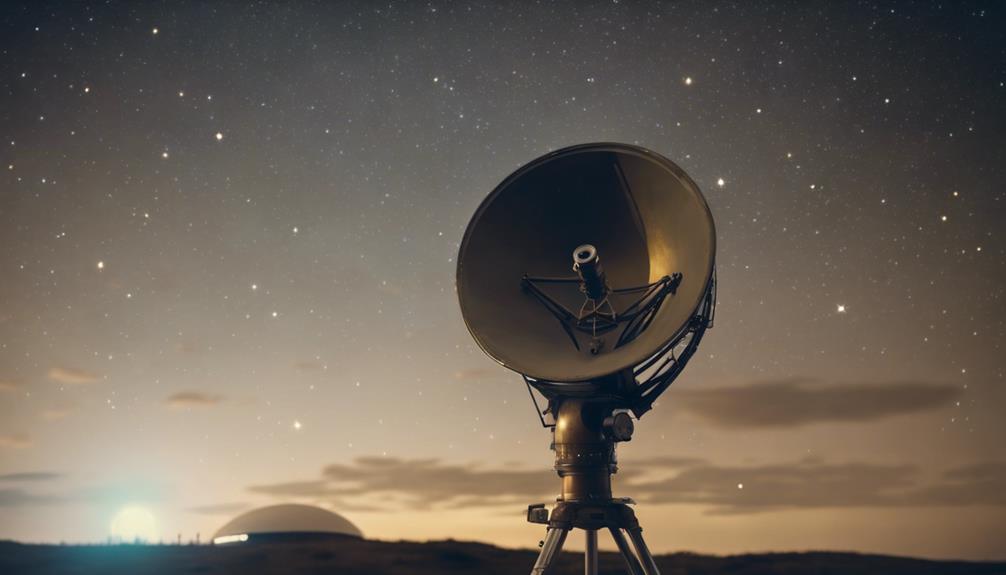
Moving from the visual splendor captured by optical telescopes, you now encounter the domain of radio astronomy, a field that has fundamentally altered our comprehension of the cosmos.
By harnessing radio waves, scientists have exposed the universe’s hidden facets, exploring enigmatic phenomena such as pulsars and quasars, and peering into the cosmic microwave background radiation.
This shift to the invisible spectrum hasn’t only expanded our universe’s perceptual boundaries but has also been instrumental in mapping distant galaxies, offering a profound understanding of celestial mechanics and the universe’s vast, unseen components.
Radio Astronomy Origins
In the 1930s, Grote Reber’s groundbreaking work in detecting radio waves from celestial bodies marked the inception of radio astronomy, exposing an invisible universe that traditional optical telescopes could not perceive.
This discovery allowed for the study of celestial objects beyond the reach of optical observations, such as pulsars, quasars, and distant galaxies. Additionally, radio telescopes played a pivotal role in identifying the cosmic microwave background radiation, offering profound insights into the universe’s mysteries.
| Advancement | Impact | Revealed Mysteries |
|---|---|---|
| Radio Telescopes | Exceeded optical limits | Distant Galaxies |
| Cosmic Microwave Background Radiation | Confirmed Big Bang | Universe’s Origin |
| Pulsars/Quasars Detection | Expanded cosmic understanding | Extreme Physics |
| Continuous Development | Complements optical observations | New Cosmic Insights |
Radio astronomy has greatly expanded our comprehension of the universe, revealing its complexities and the mysteries it holds.
Exploring Cosmic Phenomena
Delving into the domain of radio telescopes allows us to uncover the invisible universe, revealing cosmic phenomena through the radio waves emitted by celestial objects.
These telescopes afforded astronomers a revolutionary tool for the observation of distant objects, enabling new discoveries that reshaped our understanding of the cosmos.
By capturing radio signals from space, radio telescopes provide a distinct vantage point on the universe, offering astronomical insights into pulsars, quasars, and the enigmatic cosmic microwave background radiation.
This technology has been instrumental in mapping the large-scale structure of the universe, identifying distant stars and galaxies far beyond the reach of optical telescopes.
The advancements in radio telescope technology have thus expanded our knowledge, exploring cosmic phenomena and uncovering the mysteries of the invisible universe.
Technological Advancements in Design
Reflecting on the journey of telescope design, it’s clear that technological advancements have played a pivotal role in enhancing the precision and efficiency of these instruments for celestial observation.
Isaac Newton’s introduction of reflecting telescopes addressed the limitations seen in earlier models by eliminating many optical aberrations. This innovation laid the groundwork for subsequent improvements in mirror technology, progressively refining the performance and precision of these telescopes.
In addition, the advent of radio telescopes, such as the one developed by Grote Reber in the 1930s, marked a significant leap forward. By detecting radio waves from celestial objects, they expanded the observational capabilities beyond the visible spectrum.
This period also saw the inception of electronically assisted telescopes. These instruments, evolving from rudimentary beginnings in the 1960s to the sophisticated smart telescopes of the 21st century, integrate optical elements with advanced software algorithms, facilitating more efficient exploration of the cosmos.
Furthermore, the evolution of telescope technology has introduced electronic imaging systems, enabling astronomers to capture detailed celestial images. The late 20th century brought forth computer-controlled telescopes, further streamlining observations. Today, smart telescopes, leveraging electronic aids, offer unparalleled precision and ease of use, epitomizing the zenith of telescope design.
Frequently Asked Questions
How Has the Telescope Changed Over Time?
Telescopes have evolved extensively, from basic refracting breakthroughs to reflecting innovation using advanced optical materials. This technological evolution includes digital imaging, adaptive optics in space telescopes, countering light pollution, and enhancing amateur astronomy.
What Is the Early History of Telescopes?
You’re exploring early telescopes’ tales, where Dutch spyglasses and Galilean innovations marked milestones. Lens grinding led to optical breakthroughs; refracting designs and mirror advancements unfolded. Invention controversies colored their technological ancestry, sparking celestial discoveries and scientific debates.
What Was the Problem With Early Telescopes?
Early telescopes had issues like chromatic aberration, limited magnification, and optical distortions, leading to poor resolution. Their cumbersome designs, fragile lenses, narrow field, and alignment challenges made observing celestial objects difficult, worsened by light pollution.
How Did Ancient Astronomers Observe the Sky and Stars Before the Telescope Invented?
Before telescopes, you’d rely on naked eye astronomy, using star maps and celestial events. Observational techniques, sky mythology, and constellation naming guided you. You’d track planetary motions and solstice observations through astronomical alignments.
Conclusion
In your journey from the rudimentary lenses of the 17th century to the sophisticated mirrors of the Hubble, you’ve traversed the vast expanse of telescope evolution.
You’ve witnessed the transformation from mere celestial observation to unraveling the universe’s cryptic narratives.
This odyssey, merging ancient curiosity with cutting-edge technology, underscores a profound truth: as our tools sharpen, so too does our glimpse into the cosmos.
On this continuum, each innovation isn’t just a step but a leap towards understanding the infinite.