Top 7 Telescope Tech Upgrades Through History
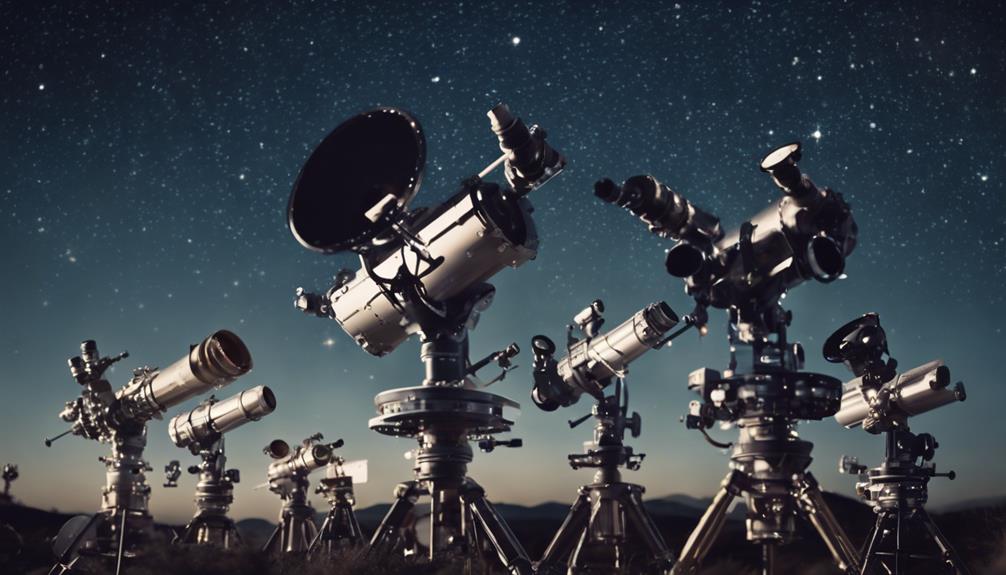
From Galileo’s simple yet revolutionary telescope to the sophisticated James Webb Space Telescope, the journey of astronomical tools is a tale of humble beginnings and cosmic ambitions. You’ve seen the stars, but have you ever wondered how immensely our view of them has changed?
Each technological leap, from the inception of optical glass lenses to the digital revolution brought by CCD imaging, has peeled back another layer of the universe’s vast mysteries. Let’s start on a journey through the top 7 telescope tech upgrades in history, and discover together how these innovations have not only enhanced our view of the cosmos but also reshaped our understanding of it.
Key Takeaways
- Introduction of optical glass lenses revolutionized clarity in astronomical observations.
- Reflecting telescopes, introduced by Newton, significantly reduced chromatic aberration.
- Adaptive optics and CCD imaging greatly enhanced image quality and efficiency.
- Space telescopes like Hubble and James Webb expanded our cosmic understanding.
Inception of Optical Glass Lenses
The advent of optical glass lenses in the early 17th century revolutionized telescope technology, enabling astronomers to observe celestial bodies with unprecedented clarity and detail.
Pioneers like Hans Lippershey and Jacob Metius were instrumental in integrating these lenses into early telescopes around 1608. This innovation not only marked a significant advancement in telescope design but also laid the foundation for the future of astronomical observations.
Optical glass lenses brought about a paradigm shift by allowing for the magnification and clearer viewing of distant celestial objects. This was a critical development because, prior to the 17th century, the study of the heavens was limited by the human eye’s capability and rudimentary observational tools. With the introduction of these lenses, astronomers could now explore deeper into the cosmos, uncovering details that were once beyond reach.
The significance of optical glass lenses in telescope construction can’t be overstated. They’re at the heart of the instrument’s ability to capture light and magnify images, a principle that remains central to both historical and contemporary telescope technology.
These lenses have continuously enhanced the clarity and precision of astronomical observations, driving forward our understanding of the universe.
The Reflector Telescope Breakthrough
Building upon the foundation laid by early optical glass lenses, Sir Isaac Newton introduced the reflecting telescope in 1668, fundamentally altering the course of telescope technology by using mirrors to address chromatic aberration.
Newton’s innovation wasn’t just a minor tweak; it was a seismic shift that solved the color distortion issues plaguing refracting telescopes. This leap forward meant astronomers could now enjoy clearer, more precise observations, marking a pivotal moment in the history of observational astronomy.
- Newton’s design utilized a curved mirror to reflect and focus light, sidestepping the limitations that had hindered earlier telescope models.
- The introduction of mirrors into telescope technology was a game-changer, reducing chromatic aberration and enhancing image clarity.
- By resolving the issue of color distortion, Newton’s reflecting telescope laid the groundwork for the development of larger, more powerful astronomical instruments.
- This breakthrough in telescope technology has fueled countless discoveries in the domain of observational astronomy, expanding our understanding of the cosmos.
- Newton’s reflecting telescope represents a monumental achievement, paving the way for further innovations and advancements in optical instruments, forever changing how we explore the universe.
Refractor Telescopes and Quest for Clarity

Despite their early challenges with chromatic aberration, refractor telescopes have undergone substantial enhancements, especially through Chester Moore Hall’s lens design improvements, to achieve greater clarity and precision in astronomical observations.
Galileo Galilei’s initial use of refractor telescopes marked a pivotal moment in history, leveraging lenses to magnify celestial bodies. Yet, the vexing issue of chromatic aberration, where different colors did not converge at a single focus point due to the lens’s material properties, marred the clarity of observations.
Chester Moore Hall’s innovations in lens design greatly mitigated chromatic aberration. By carefully selecting materials and refining the curvature of lenses, Hall’s approach allowed for a more precise convergence of light rays, drastically improving image quality. This advancement laid the groundwork for future enhancements in refractor telescope technology.
| Advancement | Impact |
|---|---|
| Galileo’s Refractor | Initiated telescopic astronomy |
| Chromatic Aberration | Hindered clarity in early telescopes |
| Hall’s Lens Design | Reduced chromatic aberration |
| Precision Lenses | Enhanced clarity and detail |
| Yerkes Observatory | Showcased large refractor potential |
These milestones highlight the journey of refractor telescopes from their rudimentary beginnings to instruments capable of capturing the cosmos with unparalleled clarity. The Yerkes Observatory, in particular, stands as a proof of the zenith of refractor technology, housing one of the largest and most advanced refracting telescopes by 1897.
Adaptive Optics and War Against Blurriness
Moving beyond lens improvements, adaptive optics emerged as a groundbreaking solution to combat atmospheric blurriness, further sharpening our gaze into the cosmos. Developed initially for military use in the 1950s, this technology has revolutionized the way we observe the universe from our vantage point on Earth.
By employing deformable mirrors that adjust in real-time to counteract the distortion caused by atmospheric turbulence, adaptive optics have effectively declared war on the blurriness that plagued earlier observations.
Here are a few reasons why adaptive optics stir both excitement and emotion:
- They bring distant galaxies within our reach, making the cosmos feel a bit more like home.
- The technology peels back the veil of Earth’s atmosphere, revealing the universe in unprecedented clarity.
- Every adjustment of a deformable mirror is a triumph over the chaos of atmospheric turbulence.
- The enhanced telescope image resolution invites us to dream bigger, pushing the boundaries of what’s possible.
- Adaptive optics symbolize human ingenuity’s ability to overcome natural obstacles for the sake of discovery.
Radio Astronomy: Beyond Visible Light

You’ve seen how adaptive optics revolutionized our view of the universe by combating blurriness in telescopic images.
Now, let’s turn your attention to radio astronomy, which allows us to perceive the cosmos through radio waves, far beyond the reach of visible light.
This field began with Karl Jansky’s groundbreaking discovery in the 1930s and has since evolved with significant technological advancements, enabling us to study cosmic phenomena like quasars and pulsars in unprecedented detail.
Origins of Radio Astronomy
Delving into the origins of radio astronomy reveals a transformative era beginning in the early 1930s, when Karl Jansky constructed the first radio telescope, ushering in a new way to observe the cosmos beyond the limitations of visible light.
Grote Reber’s 1937 parabolic dish telescope dramatically advanced radio astronomy, enabling more precise detection of cosmic radio waves.
Bernard Lovell’s 1957 Jodrell Bank telescope expanded our capacity to probe deep into celestial phenomena.
Radio telescopes have disclosed mysteries of meteors, quasars, and pulsars, enriching our knowledge of the universe.
The shift from static interference studies to dynamic celestial observation has revolutionized our cosmic understanding.
These advancements mark pivotal moments in disclosing the universe’s secrets, transforming our grasp of the vast unknown.
Technological Advancements
As radio astronomy extends our gaze beyond the visible light spectrum, it leverages advanced technologies to uncover the universe’s most elusive phenomena.
Unlike the Hubble Space Telescope, which captures breathtaking visible light images, large telescopes designed for radio astronomy detect radio waves emitted by celestial objects.
These technological advancements have enabled astronomers to explore the universe in unprecedented detail. By utilizing vast parabolic mirrors, radio telescopes collect and focus radio emissions from space, offering crucial insights into cosmic phenomena such as pulsars, quasars, and the cosmic microwave background radiation.
This shift to radio wavelengths complements traditional optical telescopes, providing a thorough view of the universe’s diverse and dynamic nature and marking a significant milestone in the evolution of astronomical tools.
The Era of Space Telescopes
Embarking on a journey into the era of space telescopes reveals how these sophisticated instruments, like the Hubble and the soon-to-launch James Webb Space Telescope, have transformed our understanding of the cosmos with unmatched precision and depth.
- Hubble: Launched in 1990, it orbits Earth every 97 minutes, capturing images like the iconic Pillars of Creation. Its initial mirror flaw, corrected in 1993, didn’t hinder its contribution to over 15,000 scientific papers, making groundbreaking discoveries.
- James Webb Space Telescope: Set to launch in December 2021, it’s designed to study galaxies, stars, and planets using advanced infrared technology. This allows for deeper cosmic observations, from the early Universe to the present day.
Space telescopes, including Hubble and James Webb, aim to observe cosmic phenomena with exceptional clarity. They’ve greatly enhanced our understanding of the cosmos through:
- Advanced infrared technology, allowing for observations not possible with ground-based telescopes.
- The study of cosmic phenomena from the early universe to present, offering a detailed view of cosmic evolution.
- Contributions to over 15,000 scientific papers, demonstrating their impact on scientific advancements.
This era of space telescopes marks a pivotal moment in astronomy, offering insights into the universe with outstanding depth and precision.
CCD Imaging: Digital Revolution in Astronomy
From traditional photographic plates, CCD (Charge-Coupled Device) imaging has revolutionized astronomy by introducing digital sensors that capture celestial phenomena with unprecedented sensitivity and efficiency.
You’re now witnessing a digital revolution that’s transformed the way astronomical images are captured and analyzed. Unlike the older methods, CCD technology allows for the gathering of light with much higher efficiency, making it possible to detect fainter objects in the cosmos with remarkable clarity.
The advent of CCDs meant that astronomers could process data faster, turning observations into actionable insights in astrophysics with much greater speed. This digital leap has not only enhanced the quality of images but also the breadth of discoveries across various fields of astrophysics.
Here’s a quick glance at how CCD imaging stands out:
| Aspect | CCD Imaging Advantage |
|---|---|
| Sensitivity | Allows detection of faint celestial objects with high precision. |
| Efficiency | Captures and processes astronomical data rapidly. |
| Image Quality | Produces detailed images with precise color representation. |
| Contribution to Science | Advances research and discoveries in astrophysics. |
CCD cameras have become indispensable in astronomy, enabling you to explore the universe in ways that were unimaginable with photographic plates. This digital revolution has truly opened new frontiers in our understanding of the cosmos.
Frequently Asked Questions
What Is the Most Technologically Advanced Telescope?
You’re asking about the most advanced telescope, and it’s the James Webb Space Telescope. It incorporates mirror coatings, adaptive optics, charge coupled devices, laser guide stars, interferometry techniques, and spectroscopy enhancements.
How Has the Telescope Improved Over Time?
Telescopes have leaped from Galileo’s simple tube to cosmic time machines. You’ve seen mirror coatings evolve, adaptive optics sharpen views, digital imaging captures the universe, solar telescopes probe our star, and interferometry exposes radio astronomy’s secrets.
What Historical Figure Improved the Telescope?
You’re exploring who enhanced the telescope. Figures like Newton, with his Newtonian reflector inception, revolutionized it. They increased aperture sizes, introduced adaptive optics, innovated mounting systems, evolved eyepieces, and enabled discoveries like the Galilean Moons.
What Are 5 Discoveries of the Hubble Space Telescope?
You’ve learned Hubble’s key findings: it mapped the cosmic distance scale, revealed dark energy’s role in the universe, captured black hole images, explored exoplanet atmospheres, and located stellar birthplaces, advancing our cosmic understanding notably.
Conclusion
In wrapping up, you’ve journeyed through the telescope tech odyssey, from the genesis of optical glass lenses to the digital cosmos captured by CCD imaging.
Reflectors and refractors revolutionized clarity, while adaptive optics combatted atmospheric blur.
Radio astronomy catapulted us beyond visible light, and space telescopes like Hubble and James Webb have boldly taken us where no one has gone before.
This evolution underscores a relentless pursuit of the cosmos, marking each upgrade as a leap towards unraveling the universe’s mysteries.