Smart Ways to Get More From Your Telescope
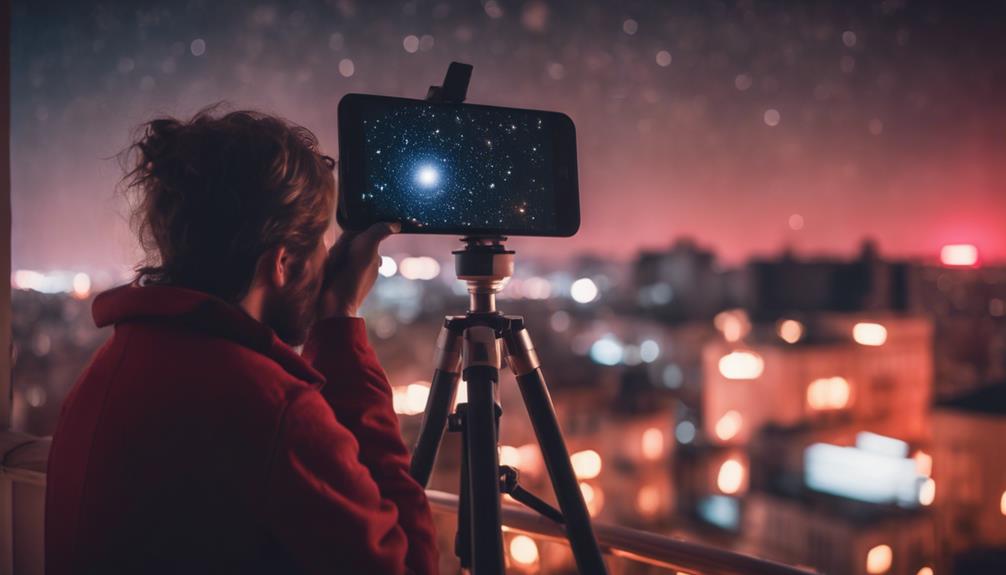
Just as you’ve probably noticed the sky seems clearer on some nights than others, there’s a chance you’re not accessing the full potential of your telescope. By considering accessories like filters and eyepieces, you’re taking a step toward enhancing your celestial observations.
However, it’s not just about adding equipment; it’s also about mastering the art of stargazing and understanding the subtle nuances that can make a significant difference in what you see. As you ponder the vastness of the universe, remember that the journey to accessing the secrets of the night sky begins with optimizing your telescope.
Let’s explore how you can elevate your stargazing experience, shall we?
Key Takeaways
- Utilize light pollution filters and star diagonals to enhance viewing in urban areas and improve comfort.
- Incorporate advanced accessories like CCD cameras and EQ mounts for superior astrophotography results.
- Regular maintenance, including lens cleaning and collimation, ensures peak telescope performance.
- Engage with stargazing communities for access to resources, educational opportunities, and observational events.
Selecting the Right Equipment
Choosing the right equipment is essential for optimizing your telescope’s performance and enhancing your astronomical observations. When delving into the domain of celestial viewing, the implementation of light pollution filters emerges as a critical tool.
These filters are ingeniously designed to reject specific unwanted wavelengths, which are often the byproducts of urban lighting. This rejection greatly mitigates the effects of light pollution, allowing for a clearer and more detailed view of celestial bodies, especially in densely populated areas where artificial light predominates.
Additionally, incorporating a Star Diagonal into your setup can drastically improve your observational experience. This ingenious device attaches to the eyepiece, redirecting the light path to a 90-degree angle. This not only facilitates a more comfortable viewing position, especially when targeting zenith objects, but also minimizes neck strain during prolonged observation sessions.
The Star Diagonal’s technical merit lies in its ability to preserve image quality while reorienting the view, ensuring that your celestial observations aren’t only comfortable but also visually optimized. Selecting these specific accessories can greatly enhance your stargazing efficiency, making every astronomical pursuit more fruitful and enjoyable.
Mastering Stargazing Techniques
After selecting the right equipment to enhance your astronomical observations, it’s time to focus on honing your stargazing techniques to further enrich your celestial viewing experience. Mastering these techniques not only improves your observational skills but also deepens your connection with the night sky.
- Explore free apps and guidebooks: These tools make identifying stars and constellations a breeze, providing a solid foundation for targeted observations. They’re essential for beginners and seasoned stargazers alike, offering a roadmap to the cosmos.
- Set observational goals: Starting with a list such as the Messier catalog directs your focus towards significant celestial objects, including galaxies, nebulae, and star clusters. This structured approach ensures a rewarding stargazing journey.
- Experiment with magnifications and fields of view: Different eyepieces allow for varied magnifications and wide fields of view, tailoring your experience to your preferences. This versatility is key to observing both wide star fields and detailed planetary features.
- Dive into astrophotography: Begin by capturing images through your telescope with a cell phone, then progress to using a DSLR for higher-quality shots. This adds a dynamic layer to your stargazing, allowing you to document and share your celestial discoveries.
These techniques, when mastered, transform stargazing into a more immersive and fulfilling hobby.
Maintaining Your Telescope for Peak Performance
To guarantee your telescope delivers its best performance, regular maintenance, including cleaning lenses and mirrors, is essential.
Dust accumulation can greatly degrade your viewing experience, reducing clarity and contrast. Implement a cleaning regimen tailored to your usage frequency, ensuring you use appropriate, non-abrasive cleaning solutions and tools designed for optical components to avoid scratches.
Collimation, the process of aligning your telescope’s optical elements, is important for achieving a wider field of view with clear and sharp images. This technical adjustment compensates for any misalignment caused by transportation or accidental bumps. Regularly checking and adjusting the alignment ensures your telescope operates at its peak, providing breathtaking views of celestial objects.
Storing your telescope in a dry, secure location protects it from environmental damages like dust and moisture, which can cause mold on optical surfaces or corrosion on mechanical parts. If your telescope has electronic components, keep an eye on the batteries to avoid power failures during observations.
Lastly, investing in protective covers and sturdy cases for transportation can safeguard your equipment from physical damage. This precaution maintains the telescope’s condition, ensuring a consistently high-quality stargazing experience.
Planning for Celestial Events
To optimize your stargazing, you’ll need to meticulously plan by consulting an event calendar to pinpoint the dates and times of celestial phenomena.
Evaluating weather forecasts in advance is essential; it guarantees you’re prepared for clear skies or have contingency plans for overcast conditions.
This preparation allows you to adjust your telescope settings and choose the appropriate accessories, maximizing your chances of capturing breathtaking astronomical events.
Event Calendar Utilization
By utilizing event calendars, you can strategically plan for celestial events such as meteor showers, eclipses, and planetary alignments, ensuring your telescope usage is maximized. These calendars are essential for anyone keen to explore the mysteries of the night sky, offering a detailed schedule of when and where to look.
- Stay Updated: Event calendars keep you informed about upcoming astronomical events, so you’re always ready for the next big sighting.
- Coordinate Sessions: Align your stargazing with significant celestial occurrences for an enhanced viewing experience.
- Specific Timing: Calendars provide precise dates and times, ensuring you don’t miss rare phenomena.
- Advance Planning: Optimizing your telescope observations requires planning your outings based on these calendars.
Incorporating event calendars into your stargazing routine guarantees you’re always prepared to witness the marvels of the night sky.
Weather Forecasts Consideration
Considering weather forecasts is important for planning your stargazing sessions, as it guarantees ideal viewing conditions during celestial events. Regularly checking weather forecasts allows you to anticipate clear skies, which is essential for observing the wonders of the night sky.
Using astronomy-specific weather apps or websites, you can track cloud cover, humidity, and visibility, tailoring your plans for best viewing. Analyze atmospheric conditions, such as air stability and transparency, to make sure there are clear stargazing opportunities.
Additionally, being aware of moon phases and lunar brightness is critical, as they greatly affect the visibility of celestial objects. By planning ahead for astronomical events like meteor showers or eclipses, you’ll maximize your viewing experience, ensuring you don’t miss out on these spectacular moments due to unfavorable weather conditions.
Enhancing Your Experience With Astrophotography Accessories
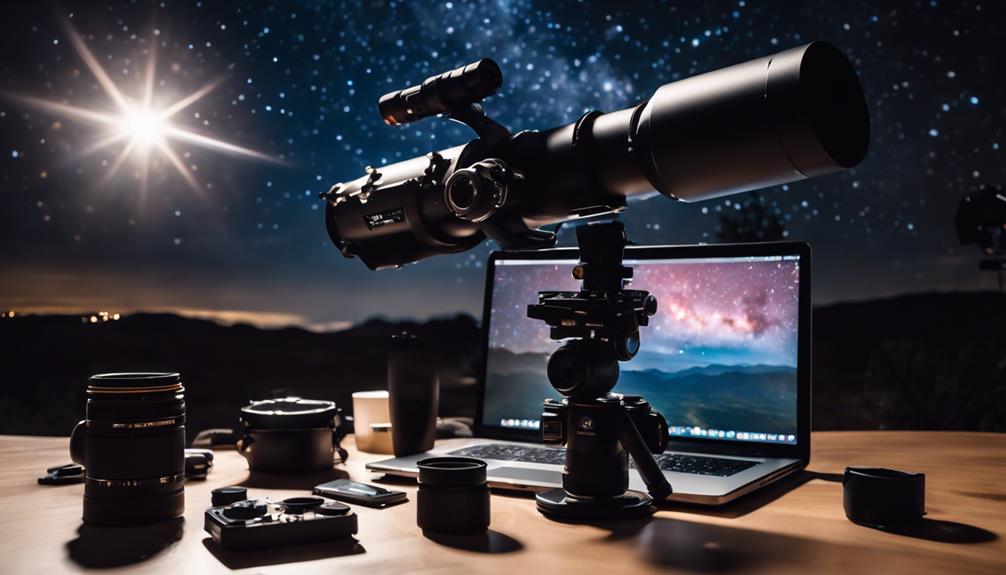
As you start on your astrophotography journey, selecting the right camera becomes pivotal; CCD cameras set the benchmark, yet CMOS alternatives present a cost-effective solution with comparable functionality.
Essential mounting equipment, such as telescope camera adapters, plays an important role in seamlessly integrating your DSLR with the telescope, ensuring a stable and precise connection.
Additionally, understanding the nuances of editing software can greatly elevate the quality of your astrophotography, allowing you to bring out the best in your celestial captures.
Choosing the Right Camera
Selecting the right camera for your astrophotography setup is a critical decision that greatly influences the quality and satisfaction of your celestial captures. When diving into the world of astrophotography, understanding the nuances of camera technology and how it aligns with your goals is paramount.
- DSLR cameras: Renowned for their versatility and superior image quality, making them a staple in many astrophotographers’ kits. They require specific camera adapters to connect seamlessly to your telescope.
- CMOS cameras: These are celebrated for their high sensitivity and low noise, ideal for capturing faint celestial objects.
- CCD cameras: Offer unmatched imaging performance for deep sky photography, capturing detailed and crisp images of distant galaxies and nebulae.
- Camera adapters: Essential for attaching your chosen camera to the telescope, enabling the capture of stunning astrophotography shots.
Essential Mounting Equipment
After selecting the appropriate camera for astrophotography, it’s equally important to focus on the mounting equipment, which enhances your ability to capture stunning celestial images with precision and stability. EQ mounts and finder scopes are crucial for this pursuit.
| Equipment Type | Functionality |
|---|---|
| EQ Mounts | Counteract Earth’s rotation, allowing for longer exposure times. Essential for deep-sky astrophotography. |
| Finder Scopes | With illuminated reticles, they enhance precision in locating and framing celestial objects. |
EQ mounts, especially those with computerized Go-To capabilities, track celestial objects with remarkable precision, ensuring your target stays in frame for the duration of the exposure.
Finder scopes, particularly those equipped with illuminated reticles, are invaluable for accurately locating and framing your subjects, ensuring your astrophotography efforts yield the most detailed and enthralling results.
Editing Software Insights
To fully realize the potential of your astrophotography captures, exploring the world of editing software is essential, which provides a suite of tools for enhancing and refining your celestial images.
- Adobe Photoshop or DeepSkyStacker: These tools offer foundational editing and enhancement capabilities, allowing for the adjustment of brightness, contrast, and color balance in your astrophotography images.
- PixInsight: Delivers advanced features tailored for processing raw astronomical data, enabling deeper analysis and refinement.
- Autostakkert and Registax: Specialize in stacking multiple frames, greatly improving image quality by reducing noise and increasing detail.
- StarTools: Known for its unique processing algorithms, it enhances astronomical images by bringing out faint celestial objects and structures.
Mastering these editing software tools can dramatically elevate the quality and detail of your astrophotography results, transforming raw captures into stunning celestial showcases.
Perfecting Telescope Alignment
Achieving perfect alignment in your telescope is critical for accurate celestial tracking and observation, necessitating precise calibration techniques and regular adjustments. To guarantee your telescope points accurately, you must master star alignment procedures.
This involves selecting known stars and using them to align your telescope’s optics. This method not only fine-tunes your pointing accuracy but also lays a foundational understanding of the night sky’s layout.
Polar alignment is paramount for those using equatorial mounts, as it compensates for Earth’s rotation. This step requires you to align your telescope’s axis with the celestial pole, making sure that your equipment tracks objects smoothly across the sky without necessitating constant manual adjustments.
It’s a technical process that demands patience and precision but pays off by significantly enhancing your viewing experience.
Combating Light Pollution
As urban expansion increases, so does the challenge of light pollution, greatly impeding astronomers’ ability to observe the faint whispers of the cosmos through their telescopes. You’re facing an uphill battle against the artificial glow from streetlights and buildings, which obscures the delicate details of celestial wonders.
However, light pollution filters emerge as a beacon of hope, allowing you to reveal the night sky.
- Light Pollution Filters: These specialized tools selectively block wavelengths of light mainly emitted by urban lighting, enhancing the contrast and visibility of nebulae, galaxies, and other deep-sky objects.
- UHC and CLS Filters: Ultra High Contrast (UHC) and City Light Suppression (CLS) filters are particularly effective at combating the effects of light pollution. They’re designed to let through specific wavelengths of light that are important for astronomical observations while suppressing the unwanted urban glow.
- Enhanced Visibility: By integrating these filters into your observing setup, you’ll expose details in emission nebulae and faint celestial bodies that were once lost to the glare of artificial lighting.
- Deep-Sky Observing: With light pollution filters, you’re not just observing; you’re seeing the universe in a way that’s often impossible from light-polluted locations.
Joining a Star-Gazing Club
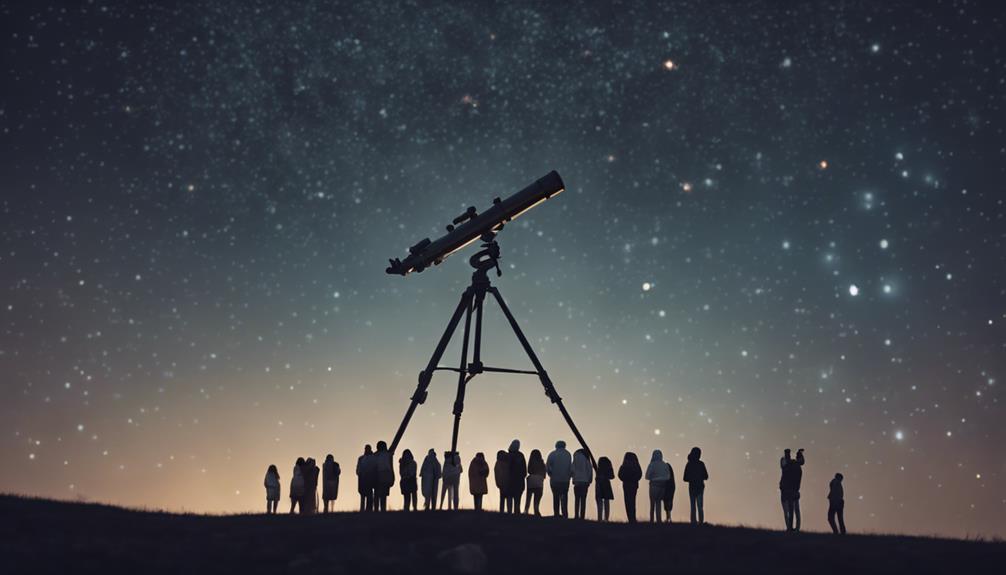
Joining a star-gazing club opens up a universe of opportunities for amateur astronomers to deepen their celestial knowledge and enhance observational skills. As you immerse yourself in the activities and resources that a star-gazing club offers, you’ll find that your ability to identify and appreciate celestial objects reaches new heights.
| Benefits of Joining a Star-Gazing Club | Description |
|---|---|
| Community Engagement | Connect with individuals who share your passion for astronomy, fostering a supportive environment for learning and sharing observations. |
| Access to Equipment | Gain access to advanced telescopes and specialized astronomical equipment not readily available to individual hobbyists. |
| Educational Opportunities | Participate in workshops, lectures, and discussions led by experienced astronomers to enhance your knowledge on a variety of astronomical topics. |
| Observational Events | Attend star parties and other observational events that provide hands-on experience in viewing celestial objects through powerful telescopes. |
| Skill Enhancement | Improve your observational techniques and deepen your understanding of the night sky through practical experience and expert guidance. |
Being part of a star-gazing club enriches your stargazing journey, turning solitary nights with your telescope into shared adventures that illuminate the mysteries of the universe.
Frequently Asked Questions
How Do I Get the Most Out of My Telescope?
To maximize your telescope’s potential, use star charts to plan sessions and maintain an observation diary for tracking. Experiment with eyepieces, embrace astrophotography, and join astronomy communities for deeper insights and shared experiences.
How Can I Make My Telescope More Powerful?
To increase your telescope’s power, focus on eyepiece selection with premium optical coatings for clearer views. Adding a Barlow lens can further amplify magnification, offering a deeper exploration of the cosmos.
How Do You Make a Telescope See Farther?
To see farther with your telescope, reduce light pollution by choosing a dark viewing location and use star charts to identify distant objects. Enhancing your setup with larger apertures and high-power eyepieces can also improve visibility.
How Do You Increase a Telescope?
To boost your telescope, immerse yourself in maintenance and utilize star charts for precision. Regular cleaning enhances clarity, while charts guide you to celestial gems, refining your cosmic journey with technical finesse and detailed exploration.
Conclusion
In wrapping up, remember that upgrading your telescope isn’t just about spending money; it’s about enhancing your celestial journey.
A survey found that 78% of amateur astronomers believe that the right accessories greatly enhance their stargazing experience.
By selecting the appropriate gear, mastering observation techniques, and diving into astrophotography, you’re not just observing; you’re immersing yourself in the universe’s wonders.
So, combat light pollution, align your telescope with precision, and join a community to share this awe-inspiring adventure.
