Guide to Telescope Mount Types: What You Should Know

Just as you’ve started pondering the night sky’s mysteries, it’s important to understand that not all telescope mounts are created equal.
You’re stepping into a world where precision meets passion, and the right mount can have a major impact on your stargazing experience. This guide breaks down the essentials, from simple alt-azimuth mounts to complex equatorial systems, and even touches on specialized options like the Centre-balanced Equatorial Mount.
Each has its pros and cons, tailored to different observational needs and expertise levels. Stick around to uncover which mount might elevate your celestial explorations, shaping your journey among the stars.
Key Takeaways
- Altazimuth mounts are beginner-friendly, ideal for quick observations and terrestrial viewing, but not suited for long-exposure astrophotography.
- Equatorial mounts are essential for astrophotography, requiring polar alignment to track celestial objects accurately over long exposures.
- Dobsonian mounts offer stability and simplicity, making them cost-effective for amateur astronomers interested in deep-sky viewing.
- Motorized and GoTo mounts provide automated tracking of celestial objects, enhancing the experience of both visual observation and astrophotography.
Altazimuth Mounts: Simple and Versatile
Altazimuth mounts, characterized by their two-axis design—altitude and azimuth—offer you a straightforward and efficient way to navigate the night sky. Their simplicity and efficiency make alt-azimuth mounts a popular choice for amateur astronomers and enthusiasts alike.
With movements along two axes, you can easily follow objects as they move across the sky. This design is particularly advantageous when paired with Dobsonian telescopes, which are known for their large apertures and ease of use.
Dobsonian telescopes, combined with alt-azimuth mounts, allow for quick and effortless scanning of celestial bodies, making them ideal for both beginners and seasoned astronomers. The setup’s simplicity enables a focus on observing rather than on complicated mount adjustments. Additionally, alt-azimuth mounts are well-suited for terrestrial observing and scanning the sky at lower powers, where the need for precise tracking is less critical.
For those seeking more accuracy and convenience, some alt-azimuth mounts come equipped with computer-driven systems. These advanced mounts can automatically track celestial objects with a high degree of precision, compensating for the Earth’s rotation. This feature enhances the observing experience, allowing you to spend more time marveling at the wonders of the universe and less time adjusting your equipment.
Equatorial Mounts: Tracking the Stars
For astronomers aiming to track celestial objects with unparalleled precision, equatorial mounts stand out as the ideal solution, aligning seamlessly with Earth’s rotational axis.
These mounts, pivotal for astrophotography, compensate for Earth’s rotation, making sure that your celestial target remains in the eyepiece without tedious manual adjustments.
Equatorial mounts rely on precise pointing, utilizing right ascension and declination coordinates. This system mirrors the celestial sphere’s coordinate system, allowing for targeted, smooth tracking of objects across the night sky. The key to their functionality is polar alignment; without it, tracking accuracy diminishes to a great extent.
| Feature | Importance | Benefit |
|---|---|---|
| Right Ascension Axis | Tracks Earth’s rotation | Enables smooth, continuous tracking |
| Polar Alignment | Aligns with Earth’s axis | Makes sure precise pointing and tracking |
| Declination Adjustment | Compensates for celestial object’s movement north or south of the celestial equator | Allows for targeted observation and astrophotography |
Equatorial mounts facilitate polar-aligned movement, which is a necessity for long-exposure astrophotography. This feature eliminates the need for frequent manual adjustments, providing a stable platform for capturing the night sky’s wonders.
The combination of precise pointing and smooth tracking makes equatorial mounts indispensable for serious astronomers and astrophotographers alike.
Motorized Tracking Systems: Precision and Ease
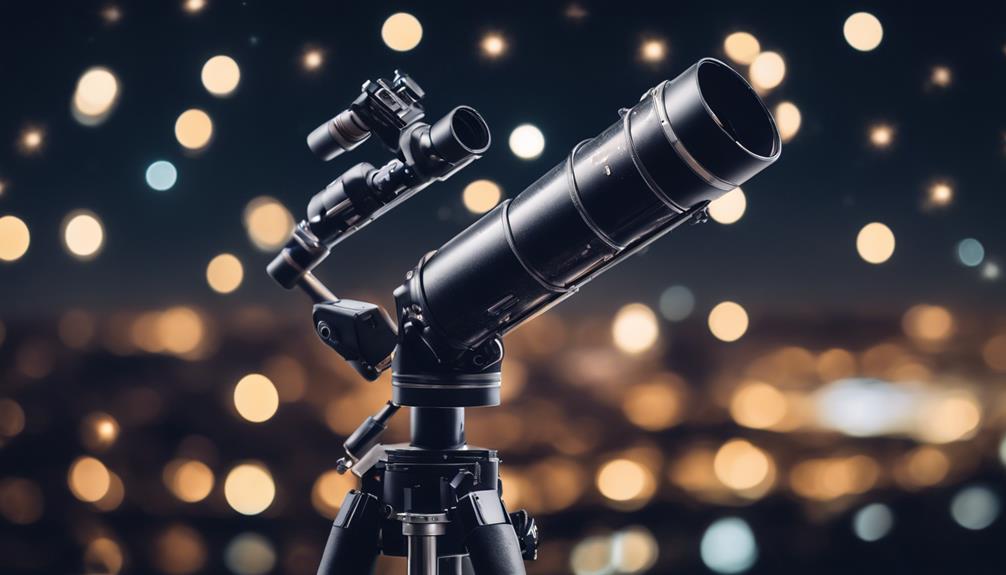
Integrating motorized tracking systems into telescope mounts revolutionizes your stargazing experience by automating the pursuit of celestial bodies with unmatched accuracy. These systems, powered by precision motors, are at the heart of modern telescopes, offering both newcomers and seasoned astronomers a seamless observation journey.
When you explore the technicalities, several aspects stand out:
- Precision Motors: The core of motorized tracking systems, these motors guarantee that your telescope can follow the apparent motion of celestial objects with incredible precision. This is crucial for both visual observation and astrophotography, especially when capturing images of distant galaxies or nebulae.
- Compensation for Earth’s Rotation: One of the most challenging aspects of astronomy is compensating for Earth’s rotation. Motorized tracking systems do this effortlessly, maintaining your target in the field of view for extended periods. This capability is essential for long-exposure astrophotography, allowing you to capture the faintest details of celestial objects.
- Automated Tracking: With the integration of computerized systems, motorized tracking becomes automated, allowing for precision targeting and tracking of celestial bodies. Whether you’re manually selecting your target or using a computerized database, the system’s accuracy ensures that your telescope aligns perfectly, offering an unmatched stargazing experience.
Dobsonian Mounts: Popular and User-Friendly
While motorized tracking systems offer precision in celestial tracking, Dobsonian mounts bring a different advantage to the table: their simplicity and user-friendliness make them a favorite among amateur astronomers seeking effective stargazing experiences.
Designed by John Dobson in 1956, these mounts are ground-mounted, ensuring stability for large reflecting telescopes. What sets Dobsonian mounts apart is their combination of simplicity, affordability, and the ability to support long observing sessions without compromising on quality.
| Feature | Benefit | Ideal For |
|---|---|---|
| Large apertures | Enhanced celestial observations | Deep sky viewing |
| Ground-mounted | Stability and ease of use | Amateur astronomers |
| Simplicity | Straightforward operation | Beginners and enthusiasts |
Dobsonian mounts cater to a wide range of apertures, from 6 to over 20 inches, making them versatile for various observational needs. Their design is particularly user-friendly, allowing even beginners to navigate the skies with ease.
The affordability of Dobsonian mounts, combined with their effectiveness for observing celestial objects, makes them a top choice for those who value both quality and ease of use during long observing sessions.
Specialty Mounts: Fork and German Equatorial

Exploring the world of specialty mounts, we’ll investigate the intricacies of Fork and German Equatorial mounts, each offering unique advantages for serious astrophotography and observational astronomy. Understanding these mounts is essential for anyone looking to elevate their astronomical pursuits.
- German Equatorial Mount: This mount is a favorite among enthusiasts using Newtonian Reflectors and Refractor telescopes due to its exceptional stability during observations. Its design necessitates a large counterweight to balance the telescope, making it ideal for longer periods of astrophotography. The precision and stability provided are unparalleled, especially when tracking celestial objects across the sky.
- Fork Mount: Known for its convenience and precise computer-controlled equatorial drive, the Fork Mount is mainly used with Catadioptric telescopes and shorter optical tubes. Its fully automatic operation makes it a staple in modern research telescopes, offering an enjoyable observing experience without the hassle of manual adjustments.
- Commonalities and Differences: Both mounts are indispensable for astrophotography, yet they cater to different needs. The German Equatorial Mount emphasizes stability and precision for extended observations, requiring a counterweight for balance. In contrast, the Fork Mount emphasizes convenience and is often equipped with advanced, computer-controlled equatorial drives for effortless tracking and observation.
Frequently Asked Questions
How Do I Choose a Telescope Mount?
To choose a telescope mount, consider mount stability, weight capacity, and tracking capabilities for your visual or astrophotography needs. Factor in portability, budget, GoTo functionality, setup complexity, maintenance, and environmental factors for an informed decision.
What Are the Different Types of Telescope Mounts?
In your stargazing journey, telescope mounts are your compass and anchor. They vary in mount durability, tracking accuracy, and offer options from motorized to manual controls. Consider portability, weight capacity, and tripod compatibility for your celestial voyage.
Which Telescope Mount Should I Buy?
You should consider your budget, portability concerns, and if you’re focusing on astrophotography, prioritize tracking capabilities. Check weight capacity, compatibility, and opt for motorized options with durable testing and manageable setup time for convenience.
What Is the Difference Between EQ and AZ Mount?
EQ mounts offer superior tracking precision and stability, requiring polar alignment and a counterweight system. AZ mounts excel in portability and ease of setup, without needing polar alignment, but may lack in declination adjustment and vibration reduction.
Conclusion
In wrapping up, remember that choosing the right telescope mount is as important as aiming for the stars.
Whether you’re drawn to the simplicity of Altazimuth mounts, the precision of Equatorial setups, or the user-friendliness of Dobsonian mounts, each has its niche.
Motorized systems offer unmatched ease, while specialty mounts, like Fork and German Equatorial, cater to specific needs.
As the adage goes, ‘the right tool for the right job’—in stargazing, your mount is that indispensable tool.
Analyze your requirements closely to make sure your celestial journey is both rewarding and enlightening.
