How Telescopes Evolved: A Journey Through History

From Galileo's rudimentary spyglass to the advanced James Webb Space Telescope, you've witnessed a monumental leap in our cosmic window's clarity and reach.
You might marvel at how a simple device used to observe distant ships has morphed into a tool that reveals the universe's deepest secrets.
This transformation didn't happen overnight; it's a tale of human curiosity, ingenuity, and relentless pursuit of understanding.
As you explore this journey, you'll discover the incredible milestones and the brilliant minds behind them.
Let's set off on this voyage together, and you'll see how each innovation brought us closer to the stars, leaving you wondering what marvels the next leap in technology will disclose.
Key Takeaways
- Optical technology, beginning with basic lenses, revolutionized our exploration and understanding of the cosmos.
- Refracting telescopes, introduced in the early 1600s, utilized visible light to uncover space mysteries.
- Reflecting telescopes, developed by Sir Isaac Newton, improved celestial observations by reducing chromatic aberration.
- Modern telescopes employ adaptive optics and advanced detectors, enhancing clarity and detail in astronomical data collection.
Inception of Optical Technology
The inception of optical technology in 1608, through the pioneering patents of Hans Lippershey and Jacob Metius, marked a pivotal moment in the evolution of telescopes, fundamentally altering humanity's exploration of the cosmos.
These early telescopes, crafted with rudimentary lenses, were designed to magnify distant objects, a breakthrough that laid the foundation for future optical advancements.
The invention of the telescope by Lippershey and Metius didn't just introduce a new tool; it revolutionized the way we perceive and understand the universe.
The Era of Refracting Telescopes
Building on the foundational optical technology of the early 1600s, refracting telescopes emerged as the inaugural instruments allowing astronomers to closely study celestial bodies. These telescopes, utilizing lenses to gather and focus light, represented a pivotal advancement in the observation of the cosmos. You'll find that Galileo Galilei's early endeavors with refracting telescopes set a precedent, pushing the boundaries of what was known about the universe. His work laid down the principles that would guide future generations in exploring the heavens.
Refracting telescopes were indeed the first of their kind, harnessing visible light to disclose the mysteries of space. This era was defined by trial and error, as pioneers like Galileo and Thomas Harriot navigated the limitations and possibilities of their optical instruments. Their efforts marked the beginning of a profound journey into the cosmos, with the refracting telescope serving as the primary tool for astronomical research.
Remarkably, the Royal Observatory at Greenwich stands as a confirmation to the historic role of refracting telescopes in expanding our understanding of the universe. These instruments, through their evolution, have paved the way for modern organizations like the European Space Agency to explore objects in space with unprecedented clarity and depth.
The Advent of Reflecting Telescopes
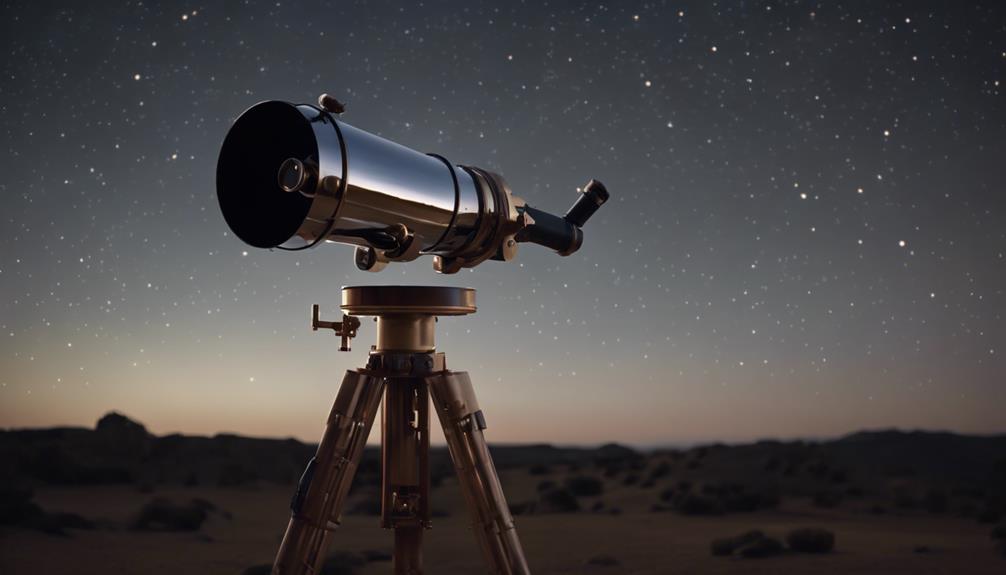
Revolutionizing the field, Sir Isaac Newton's introduction of the reflecting telescope in 1668 marked a pivotal shift in astronomical observation, employing mirrors to circumvent the issue of chromatic aberration that plagued earlier refracting models. This leap forward meant that you, the observer, could now gaze upon celestial objects with unprecedented clarity. Unlike their refracting counterparts, reflecting telescopes utilized a simpler optical system, relying on mirrors to focus light. This not only reduced chromatic aberration but also allowed for larger mirrors, vastly improving the telescope's capability to gather light from distant objects.
Reflecting telescopes have since undergone significant advancements, leading to the construction of colossal instruments that have pushed the boundaries of modern astronomy. These innovations have enabled the observation of fainter, more distant celestial objects, contributing to groundbreaking discoveries that have expanded our understanding of the universe.
| Feature | Reflecting Telescope Advantages | Impact on Astronomy |
|---|---|---|
| Optics | Reduced chromatic aberration | Sharper images |
| Design | Simpler optical systems | Easier construction and maintenance |
| Capability | Larger mirrors possible | Observes fainter, more distant objects |
| Innovation | Paved the way for advancements | Enabled groundbreaking discoveries |
| Role | Essential in modern astronomy | Expanded understanding of the universe |
Radio Telescopes and the New Age of Astronomy
As Karl Jansky engineered the first radio telescope in the early 1930s, he ushered in a new era of astronomical discovery, enabling scientists to observe the universe through the lens of cosmic radio waves. You're now at the forefront of a revolution where the unseen becomes visible, thanks to the ingenuity of pioneers like Jansky.
- Grote Reber's creation of the first parabolic dish radio telescope in 1937 was a monumental shift, transforming radio astronomy from a curiosity into a critical field of study.
- Bernard Lovell's construction at Jodrell Bank in 1957 further propelled astronomical observations to new heights, allowing for detailed studies of meteors, quasars, and pulsars.
This metamorphosis was marked by a progression from combating static interference to harnessing radio waves for exploring celestial phenomena.
- Radio telescopes have become indispensable for delving into the mysteries of the universe, from tracking asteroids to uncovering the secrets of distant galaxies.
- The shift from merely intercepting cosmic radio waves to actively mapping the cosmos reflects a significant expansion in our understanding of the universe.
You're witnessing how radio telescopes have reshaped our astronomical capabilities, providing a unique window into the universe's most enigmatic corners.
Technological Advancements in Modern Telescopes
Modern telescopes, leveraging adaptive optics and advanced detectors like CCDs, have greatly sharpened our gaze into the cosmos. You're witnessing a significant leap in how these instruments combat atmospheric distortions, a pervasive challenge that has long blurred our view of the universe. Adaptive optics ingeniously fine-tune telescopic lenses on-the-fly, correcting these distortions in real-time to achieve unprecedented image clarity. This isn't just about seeing the stars more clearly; it's about peeling back the layers of the universe with more precision than ever before.
Furthermore, the integration of charge-coupled devices (CCDs) and infrared sensors into telescope systems has revolutionized the collection and analysis of celestial data. These detectors are incredibly sensitive, capable of capturing faint light from distant galaxies and translating it into high-quality images and invaluable scientific data. This technology, combined with sunshields and segmented mirrors, not only protects the instruments from the harsh solar radiation but also contributes to the precise control and alignment of telescope components through active optics systems.
The advent of remote operation has further transformed modern astronomy. You can now control telescopes and manage data collection from anywhere in the world, a feat that brings the cosmos closer to us than ever. This blend of technology—adaptive optics, CCDs, infrared sensors, sunshields, segmented mirrors, and active optics systems—composes the backbone of modern telescopic achievements, enabling astronomers to explore the universe with an accuracy and depth previously unimaginable.
Frequently Asked Questions
How Have Telescopes Evolved Over Time?
You've seen telescopes evolve from simple lenses to complex systems with reflecting models, optical enhancements, and aperture advancements. Adaptive optics, radio astronomy, space telescopes, and infrared discoveries have revolutionized your understanding, alongside digital imaging and spectroscopy developments.
What Was the Impact of the Telescope on World History?
The telescope's impact on world history includes navigational advancements, maritime exploration, and a scientific revolution. It reshaped cultural perspectives, sparked religious controversies, fueled educational reform, had political implications, inspired artists, drove technological innovation, and enhanced global interconnectedness.
How Have Telescopes Changed the World?
Telescopes have reshaped our world by democratizing astronomy, enabling space exploration, and allowing cosmic distances to be measured. They've provided insights into star formation, discovered exoplanets, and offered clues about dark matter and black holes.
What Is the Brief History of Telescope?
Telescopes, humanity's eyes to the cosmos, started with Hans Lippershey's spyglass origins in 1608. Galileo's discoveries, through both refracting and reflecting types, pushed lens grinding and optical improvements, sparking invention controversy and celestial mapping.
Conclusion
Ironically, as you've journeyed from the rudimentary lenses of Galileo's time to the sophisticated mirrors of the James Webb Space Telescope, you've not just been looking outwards, but also inwards.
Every technological leap in telescope design, every shift from refracting to reflecting, and the change to radio and beyond, hasn't just expanded your view of the cosmos; it's magnified your understanding of human ingenuity.
In seeking the vast, unknowable universe, you've inadvertently crafted a detailed map of your own intellectual evolution.


