How to Master Your Telescope for Amazing Space Views
Exploring the mysteries of the cosmos with your telescope is like setting sail on a grand voyage across the sea of stars; it requires the right vessel, a keen understanding of the skies, and a map to guide you.
By choosing a telescope that aligns with your observational goals, you're launching towards celestial wonders. Scouting locations with the darkest skies, understanding the rhythms of celestial events, and mastering your telescope's setup and focusing techniques are the compass and sextant guiding your journey.
However, like any seasoned explorer, you'll need to maintain your equipment with care to guarantee your voyage continues night after night. As you stand on the brink of discovery, remember, the universe's vastness is matched only by the potential for awe-inspiring experiences that lie in mastering these skills.
Key Takeaways
- Selecting a telescope that aligns with your astronomical goals is crucial for optimal celestial observations.
- A dark, tranquil location minimizes light pollution, enhancing the clarity and detail of stargazing experiences.
- Mastering telescope focusing techniques and using accessories like Barlow lenses significantly improve the visibility of celestial objects.
- Regular maintenance and proper setup of your telescope ensure its longevity and the quality of your observations.
Choosing the Right Telescope
Selecting the ideal telescope is critical to revealing the wonders of the cosmos tailored to your specific interests. The type of celestial bodies you're keen to observe dictates the kind of telescope that'll best suit your needs. If you're fascinated by the intricate details of planets, reflector telescopes with their superior deep-sky viewing capabilities mightn't be your first pick. However, for those captivated by nebulae and galaxies far beyond, the powerful light-gathering ability of a reflector's large aperture is unmatched.
Speaking of aperture, it's the heart of your telescope's performance. A larger aperture captures more light, bringing distant, faint objects into clearer view. But remember, with great power comes great size; a telescope with a hefty aperture might challenge your portability needs.
The mount is another cornerstone of your stargazing experience. A Dobsonian mount, for instance, offers a stable and straightforward platform, perfect for beginners and those who appreciate simplicity in tracking the night sky's wonders. Combined with an appropriate focal length, which determines how wide or narrow your field of view is, the right mount can make or break your celestial journey. So, choose wisely to make sure your stargazing is as smooth and enjoyable as possible.
Scouting Observation Locations
Finding the perfect spot for stargazing involves steering away from the blinding lights of urban areas to embrace the tranquility and darkness of more remote locations. Scouting locations with minimal artificial light is important for an ideal stargazing experience. Utilize light pollution maps and apps to pinpoint areas where the stars shine brightest. These tools offer detailed insights into light pollution levels across different regions, helping you select the perfect spot.
Rural areas, national parks, and dark sky reserves emerge as prime choices for their minimal light pollution and clearer night skies. Such locations provide an unspoiled backdrop for celestial wonders, enhancing your viewing experience. When scouting locations, aim for spots with unobstructed views of the horizon. Being distant from urban centers not only minimizes light pollution but also increases the likelihood of spotting celestial objects with greater clarity and detail.
Tracking Celestial Events
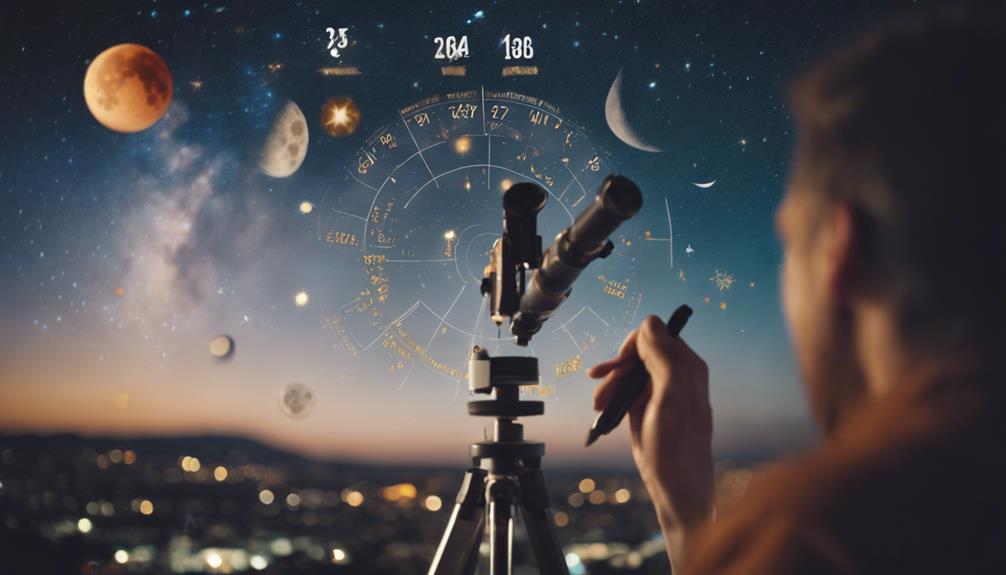
To confirm you don't miss out on the marvels of the cosmos, it's important to track celestial events such as meteor showers and planetary alignments with precision. By staying informed, you'll guarantee that your stargazing sessions are as rewarding as possible. Here's how you can stay ahead:
- Utilize astronomy apps or websites to pinpoint dates and times for celestial events like meteor showers and eclipses. These digital tools provide real-time updates and notifications to keep you informed.
- Join local astronomy clubs or forums. These communities are valuable resources for information on upcoming celestial events and offer the chance to participate in group observations.
- Consult with local observatories or planetariums. These institutions often schedule special viewing nights for significant celestial events and provide expert guidance.
- Create a personal observing calendar. Mark down significant celestial events throughout the year to plan your observing sessions in advance.
- Employ star charts and celestial event guides to prepare for observations. Understanding how to read these aids will enhance your ability to locate and enjoy celestial phenomena.
Telescope Setup Essentials

Before you can capture the cosmos through your telescope, you'll need to master a few setup essentials. Selecting an ideal location is your first step, ensuring you're aligning with celestial objects without interference.
Then, adjusting the optical components of your telescope will sharpen your views, bringing the universe into crisp focus.
Selecting Ideal Location
Selecting the perfect spot away from the bustling city lights is crucial for revealing breathtaking views of the cosmos through your telescope. Minimizing light pollution enhances the clarity of celestial objects, making your stargazing experience truly unforgettable. The right location, combined with your telescope's focal length, can transform a casual glance into a deep-sky exploration.
To elevate your stargazing sessions, consider these essentials:
- Seek areas with minimal light pollution for a pristine dark sky.
- Find spots with clear, unobstructed views.
- Choose locations with stable ground, considering elevation and terrain.
- Check the weather forecast for clear skies.
- Ensure the site is safe and easily accessible.
Aligning With Celestial Objects
Having identified an ideal location with minimal light pollution, it's time to focus on accurately aligning your telescope with celestial objects to expose the wonders of the night sky.
Proper alignment is critical for visual observing, ensuring your telescope's focal length and finder scope are directed precisely at your desired target. Whether you're using star alignment, GPS alignment, or manual procedures, accurate alignment enhances the clarity and detail of celestial wonders.
Adjusting Optical Components
To access the full potential of your telescope and marvel at the universe's splendor, start by accurately aligning its optical components, such as mirrors or lenses, for pristine light management. This step is essential for maximizing your telescope's focal length and making sure you get the clearest views of celestial wonders.
- Align mirrors or lenses to optimize light reflection or refraction.
- Regularly inspect optical surfaces for dust or debris, cleaning as necessary.
- Utilize a collimation tool for precise alignment of reflector telescope mirrors.
- Make sure the eyepiece is securely attached and correctly focused for sharp, clear views.
- Maintain your telescope's optical components to prevent dirt buildup and preserve the best performance.
Focusing Techniques Unveiled
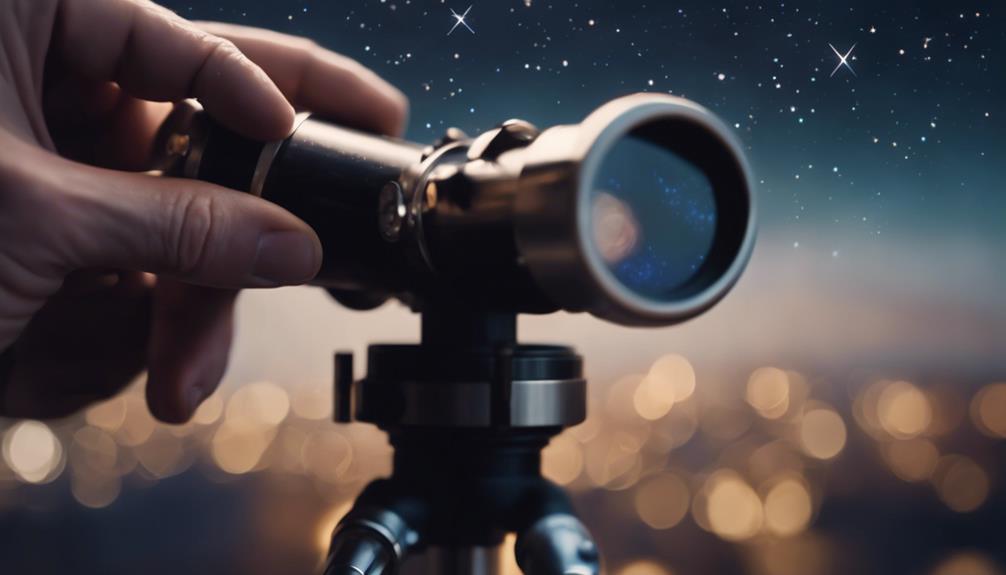
To release the full potential of your telescope, begin by mastering the focus knobs; this is your first step toward capturing the universe's stunning details. Achieving sharp star images will transform your stargazing into an extraordinary experience, requiring patience and practice.
Additionally, incorporating Barlow lenses effectively can elevate your viewing sessions, offering magnified and crisp celestial visuals.
Adjusting Focus Knobs
Mastering the art of adjusting your telescope's focus knobs is essential for capturing breathtaking views of the cosmos with unparalleled clarity and detail. These knobs fine-tune your view, making the difference between a blurry blob and a sharp celestial spectacle. Here's how to get it right:
- Begin with the coarse focus knob for broad adjustments, getting you close to your focal point.
- Switch to the fine focus knob for precise tuning, refining your view of the night sky.
Remember, the focus knobs adjust the position of your telescope's primary mirror or lenses.
Practice focusing techniques during the day on a distant object to improve your skills.
Always approach focusing with patience; small adjustments can have a big impact on image clarity.
Achieving Sharp Star Images
After honing your skills with the focus knobs, you'll want to explore techniques for achieving sharp star images, a key step for any astrophotographer or avid stargazer.
| Technique | Benefit | Best For |
|---|---|---|
| Bahtinov Mask | Creates precise diffraction patterns | Refractor telescopes |
| Focus and Defocus | Achieves the best sharpness | High focal length views |
| Motorized Focuser | Hands-free, precise adjustments | Long observation sessions |
| Temperature Adjustments | Maintains sharpness despite temperature changes | All-night stargazing |
| Cleaning Optics | Ensures clear views of celestial objects | Maintaining image quality |
Using Barlow Lenses Effectively
Diving into the world of Barlow lenses, you'll uncover the potential to magnify celestial wonders, transforming your stargazing experience. These optical gems increase your telescope's focal length, boosting magnification for breathtaking celestial observations.
Here's how to harness their power:
- Choose the right magnification factor: Pick between 2x, 3x, and more, depending on your target and existing eyepiece.
- Insert correctly: Place the Barlow lens into the focuser before the eyepiece to enhance magnification seamlessly.
- Pair with compatible eyepieces: Optimize image quality by matching the Barlow lens with suitable eyepieces.
- Focus on distant objects: Aim for clearer views of far-off celestial bodies.
- Experiment for best results: Try different combinations to discover the perfect setup for your astronomical adventures.
Mastering Barlow lenses can greatly enhance the quality of your celestial observations.
Stargazing Session Tips

To elevate your stargazing experience, start by adapting your eyes to the darkness, making sure you can fully appreciate the night sky's wonders. This important step enhances your night vision, allowing you to spot celestial objects with greater clarity. For seamless navigation through the stars, rely on star charts. However, to maintain your adapted night vision, use a red flashlight when consulting these charts. The red light minimizes disruption to your night vision, keeping your eyes primed for stargazing.
Before venturing out, always check the weather to make sure clear skies await. Nothing dampens a stargazing session like unexpected cloud cover. Once you've confirmed favorable conditions, prepare for comfort during your observation. A cozy chair or blanket can make extended periods of sky watching more enjoyable, preventing any unnecessary discomfort from distracting you from the celestial show.
Moreover, embrace technology to enhance your experience. A star-finder app on your smartphone can be an invaluable tool, guiding you to celestial wonders with ease. These apps often feature augmented reality, overlaying constellations and celestial bodies over the night sky as seen through your phone's camera, making it easier than ever to explore the heavens above.
Telescope Maintenance 101
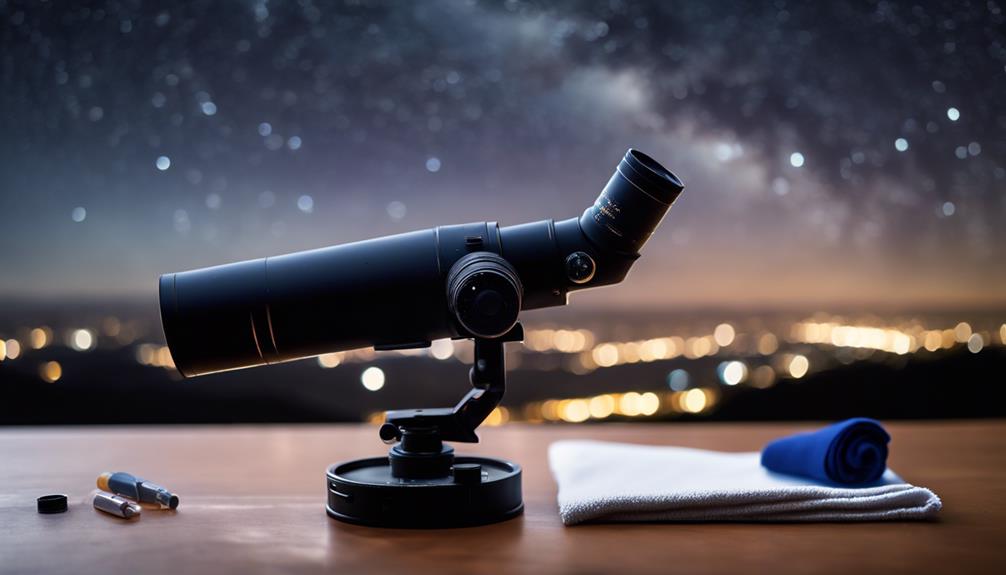
Ensuring your telescope remains in top condition is essential for capturing those breathtaking views of the cosmos. Regular telescope maintenance is vital, not only to extend the life of your equipment but also to guarantee the clarity and quality of your celestial observations.
Here's how to keep your telescope performing at its best:
- Regular Cleaning: Use a soft brush or compressed air to gently remove dust and debris from the lenses and mirrors. This prevents scratches and maintains the clarity of your images.
- Proper Storage: Always store your telescope in a protective case or cover to shield it from dust and potential damage. This simple step can significantly increase its longevity.
- Collimation Checks: Periodically check and adjust your telescope's collimation. Proper alignment is key to achieving sharp, focused images of celestial bodies.
- Avoid Extremes: Keep your telescope away from extreme temperatures and moisture. A dry, stable environment is ideal for storage and will help prevent damage.
- Follow Manufacturer Guidelines: Adhere to the maintenance and servicing advice provided by your telescope's manufacturer. This includes lubricating moving parts and inspecting for wear or damage.
Enhancing Longevity Practices
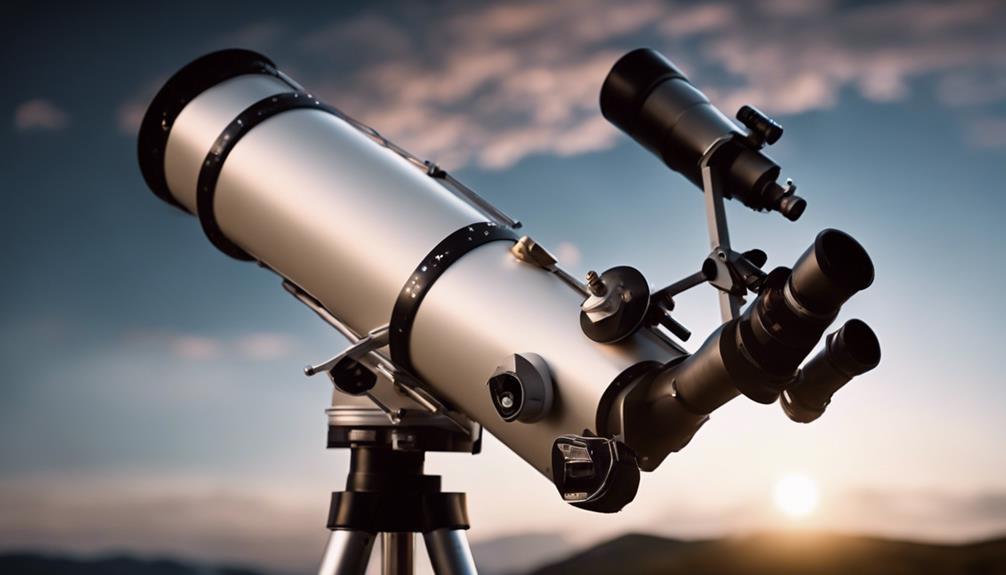
By regularly implementing these enhanced longevity practices, you'll greatly extend the operational life of your telescope, ensuring years of spectacular cosmic exploration. Keeping the lenses and mirrors clean is essential; dust buildup can greatly degrade optical quality over time. Make it a habit to gently clean these components, following the manufacturer's instructions to avoid any accidental damage.
Storing your telescope in a dry and cool environment is another important step. Moisture is the enemy of precision instruments, leading to moisture damage that can impair functionality or even cause irreparable harm. Similarly, avoiding exposure to extreme temperatures and direct sunlight will protect your telescope's delicate components from potential damage, ensuring it remains in peak condition for your next stargazing session.
Furthermore, don't overlook the importance of regularly checking and tightening any loose screws or fittings. This simple maintenance task preserves the telescope's stability and prevents mechanical issues that can accumulate over time. Finally, adhering to the manufacturer's maintenance guidelines, especially for tasks like collimation adjustments, will keep your telescope in best working condition, ready for whenever the skies call you to explore the universe anew.
Frequently Asked Questions
What Is the Correct Technique to View Through a Telescope?
To view through a telescope, align your eye properly, adjust the viewing angle and light management, and select the right eyepiece. It'll enhance clarity and detail, making your stargazing sessions truly spectacular.
What Makes a Great Telescope?
A great telescope, your window to the cosmos, hinges on aperture importance for clarity, mount stability for precision, optical quality for detail, and eyepiece variety for versatility. You'll reveal the universe's secrets with these keys.
What Is One Way to Achieve a Better Seeing With Telescopes?
To achieve better seeing with telescopes, allow a cooling period to match external temperatures. Minimize vibrations and choose locations with stable atmospheric conditions, away from light pollution, for clearer, more detailed celestial observations.
How Do You Use a Telescope Step by Step?
First, set up your telescope and adjust its focus. Use star charts and night mode on devices to find celestial bodies. Regularly clean the lens and consider accessory upgrades for enhanced viewing. Happy stargazing!
Conclusion
In mastering your telescope, you're unlocking the universe. Choose wisely, seek dark skies, chart the stars, set up with precision, focus with finesse, and embrace the night with curiosity.
Every session enhances your skills, every adjustment deepens your connection to the cosmos. Care for your telescope as your gateway to the stars, ensuring its journey—and yours—spans the ages.
Embrace this celestial voyage with passion, and the universe will unveil its wonders, one starry night at a time.
