Major Milestones in the Evolution of Telescopes

When the first spyglass was invented, little did they know it would evolve into humanity’s ultimate prying tool, allowing us to pry into the heavens’ deepest secrets.
You’ve probably marveled at the beauty of the night sky, but have you considered the journey of the tools that enable these observations? From Hans Lippershey’s accidental invention to the celestial revelations afforded by the Hubble Space Telescope, each milestone in telescope technology has peeled back a layer of the cosmic onion.
As we stand on the brink of the James Webb Space Telescope era, one must wonder: What mysteries await us next? Your curiosity might just be the key to revealing the next chapter in this unfolding saga of discovery.
Key Takeaways
- The invention of the spyglass laid the groundwork for modern telescopic advancements.
- Reflecting telescopes and achromatic lens development significantly reduced optical distortions and chromatic aberration.
- Radio astronomy expanded our observational capabilities beyond visible light, uncovering new celestial phenomena.
- The launch of the Hubble Space Telescope revolutionized our view of the universe through high-resolution, multi-wavelength imaging.
Inception of the Spyglass
The spyglass, the Netherlands’ early 17th-century innovation, marked a pivotal advancement in optical technology by utilizing a series of lenses to enhance the observation of distant objects.
This breakthrough allowed for a significant magnification of views that were previously unreachable to the naked eye, establishing a cornerstone in the development of optical instruments.
The design of the spyglass, centered around its capacity to magnify, was instrumental in various fields, particularly in military applications, navigation, and the early stages of astronomical observations.
Refraction and Reflection
Building on the foundations laid by the spyglass’s lens-based magnification, innovators like Sir Isaac Newton introduced reflecting telescopes, employing mirrors to enhance image clarity and address optical shortcomings inherent in their refractive counterparts.
Early telescopes, as explained by Johannes Kepler, relied on the refraction of light through convex lenses to magnify distant objects. However, this method introduced chromatic aberration, a type of optical distortion where different colors focus at different points, leading to blurred images.
Newton’s leap to reflection over refraction marked a pivotal shift. Reflecting telescopes, by design, use mirrors instead of lenses to gather and focus light.
This fundamental change eliminated chromatic aberration, as mirrors reflect all colors of light at the same points, unlike lenses, which refract them differently. The switch from refraction to reflection in telescope design not only improved image quality but also notably reduced optical distortions.
Newton’s introduction of the reflecting telescope showcased a profound understanding of light’s properties and its interaction with mirrors, setting a new standard in the observational capabilities of telescopes and paving the way for future advancements in astronomical observation and research.
The Achromatic Breakthrough
Despite the advancements brought forth by reflecting telescopes, it wasn’t until the early 18th century that the achromatic breakthrough revolutionized telescope design by greatly mitigating chromatic aberration through the development of specialized lenses.
This innovation involved combining different types of glass to create achromatic lenses that notably reduced color distortion, a persistent issue in telescope images. As a result, the clarity and quality of astronomical observations experienced a notable improvement.
The introduction of achromatic lenses marked a pivotal moment in the evolution of telescopes. These lenses allowed for more precise and accurate observations, free from the blurring effects associated with chromatic aberration. This technological leap paved the way for the construction of larger and more powerful telescopes, such as the William Herschel Telescope at the Roque de Los Muchachos Observatory, one of the largest telescopes dedicated to exploring the cosmos.
Today, the legacy of the achromatic breakthrough continues to influence the field of astronomy. The James Webb Space Telescope, the largest telescope ever built, incorporates advanced optical technologies that trace their roots back to the early development of achromatic lenses, showcasing the enduring impact of this innovation on the quest to unravel the mysteries of the universe.
The Rise of Radio Astronomy
In the 1930s, Karl Jansky’s groundbreaking discovery of radio waves emanating from the Milky Way heralded the advent of radio astronomy, a field that would profoundly expand our understanding of the universe through the detection of celestial objects emitting radio frequencies.
Unlike traditional optical telescopes housed at sites like the Palomar Observatory, Yerkes Observatory, and de Los Muchachos Observatory, radio telescopes explore the invisible world of radio waves, offering a complementary perspective on the cosmos.
- Radio telescopes, such as the 300-foot Green Bank Telescope in West Virginia, stand as some of the largest instruments dedicated to deep sky observations, capturing radio emissions far beyond the reach of optical telescopes.
- These instruments have revealed the mysteries of celestial objects, exposing pulsars, quasars, and the intricate structure of galaxies.
- Pioneer radio astronomers like Grote Reber and Jocelyn Bell Burnell utilized these telescopes to discover phenomena invisible to the naked eye, including the elusive cosmic microwave background radiation, a faint echo of the universe’s birth.
- The synergy between radio and optical astronomy has catalyzed a revolution in our understanding of the universe, allowing astronomers to piece together a more detailed picture of its vast, intricate structure.
The Hubble Era
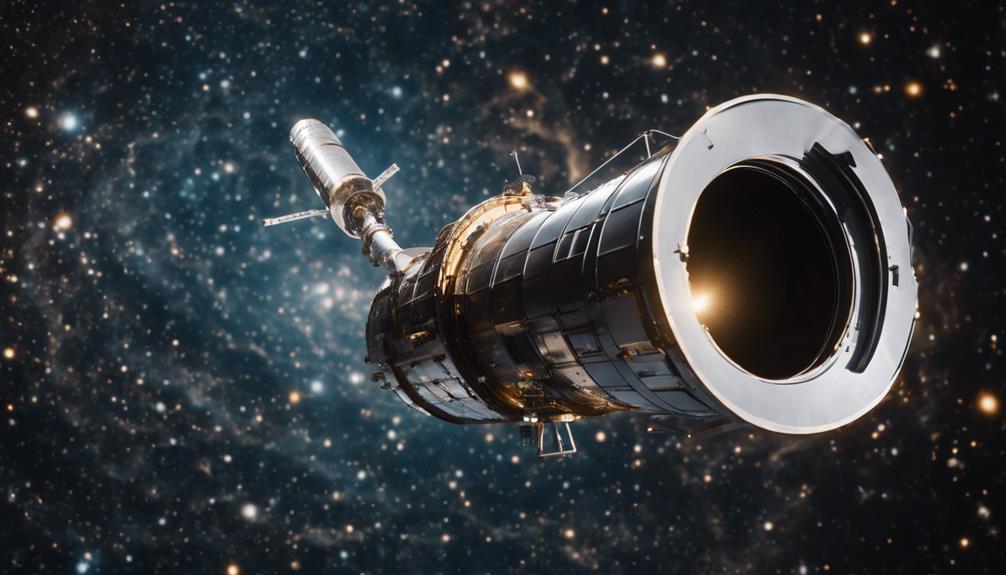
Moving beyond the groundbreaking discoveries of radio astronomy, the launch of the Hubble Space Telescope in 1990 marked a significant leap forward in our quest to unravel the mysteries of the universe. This marvel of technology, orbiting Earth, has been instrumental in pushing the boundaries of our cosmic knowledge.
Equipped with a 2.4-meter diameter mirror, the Hubble Space Telescope excels in high-resolution imaging across visible, ultraviolet, and near-infrared wavelengths. This capability has allowed it to capture unprecedented views of distant galaxies, providing insights into the structure and evolution of the universe far beyond what was previously possible.
Through its lens, you’ve witnessed the intricate details of celestial phenomena, from the birth of stars in nebulae to the destructive beauty of supernovae. Hubble’s observations have been pivotal in studying black holes, revealing their properties and influence on surrounding matter. Additionally, its detailed images have enhanced our understanding of the expansion of the universe, adding valuable data to support the Big Bang theory.
The Hubble Era represents a monumental phase in astronomy, transforming our comprehension of the universe with every image and discovery. Its contributions continue to be a cornerstone in the field, shaping future explorations into the cosmos.
Frequently Asked Questions
What Are the Important Milestones in the Development of the Telescope?
You’ve asked about key advancements in telescope technology. These include Galileo’s invention, Newton’s reflector, the rise of radio astronomy, space telescopes like Hubble and James Webb, adaptive optics, the Very Large Telescope, and exoplanet discoveries.
What Is the Historical Development of Telescopes?
You’re setting out on a journey through time, seeing how telescopes evolved from Galileo’s discoveries to today’s marvels. Refracting telescopes gave way to reflecting models, enhanced by adaptive optics, optical coatings, and digital imaging, alongside interferometry advancements in radio astronomy and space telescopes.
How Have Telescopes Evolved?
Telescopes have evolved with optical coatings, mirror technology, and adaptive optics, improving clarity. Space observatories and radio telescopes have expanded our view, while digital imaging and interferometry advances have sharpened images. Quantum telescopes and solar viewing are emerging fields.
What Events Led to the Telescope?
You’re standing on the shoulders of giants, where optical discoveries, lens grinding, and ancient stargazing meet. Philosophical theories, light refraction, glass making, and the need for visual aids and navigational tools fueled your scientific curiosity.
Conclusion
In your journey through the cosmos, you’ve witnessed the telescope’s transformative evolution from a mere spyglass to the celestial giants of today.
‘Seeing is believing,’ and with each technological leap—from refractive to reflective, from explore lenses to the expansive reach of radio astronomy—you’ve explored deeper into the universe’s mysteries.
The Hubble Era epitomizes this quest for clarity, merging precision engineering with the insatiable human desire to investigate.
As we stand on the shoulders of giants, our gaze extends ever outward, driven by relentless curiosity and the sophisticated tools we’ve crafted in our quest to unravel the cosmos.
