Mastering Deep Space Photography With Your Telescope
Venturing into the realm of deep space photography with your telescope is like setting sail into an ocean of stars, nebulae, and galaxies, each waiting to reveal their secrets. You’ll need more than just a sturdy ship; understanding the right equipment, from equatorial mounts to guiding software, is essential for exploring these celestial currents.
But it’s not just about the gear. Mastering the art of capturing the cosmos involves a symphony of techniques, from the delicate dance of focusing to the artistry of post-processing. As you stand on the brink of this vast, uncharted territory, consider what wonders await the patient and the prepared.
Let’s explore how you can transform your stargazing into breathtaking galaxie portraits, one shutter click at a time.
Key Takeaways
- Select the right telescope and accessories to enhance deep-space image quality.
- Use proper focusing techniques and celestial tracking for sharp images.
- Employ image stacking and color correction to reveal stunning celestial details.
- Share and showcase your astrophotography work for recognition and feedback.
Selecting the Right Telescope
Choosing the right telescope is important because it directly impacts the quality and type of deep-space images you’ll capture. If you’re venturing into deep-sky astrophotography, there’s a wide array of telescopes to ponder, each with its unique advantages.
For starters, a refractor telescope, especially an apochromatic refractor, is your go-to for sharp, high-quality images. They’re designed to minimize chromatic aberration, a common issue that can affect the clarity of your deep-sky shots.
If you’re mindful of your budget, reflectors offer a cost-effective alternative. They provide larger apertures for less, making them ideal for beginners keen on exploring deep-sky objects without breaking the bank.
However, if space and portability are your primary concerns, catadioptric telescopes strike a perfect balance. They combine lenses and mirrors into a compact design while offering a long focal length, suitable for capturing the wonders of the night sky.
Preparing Your Equipment
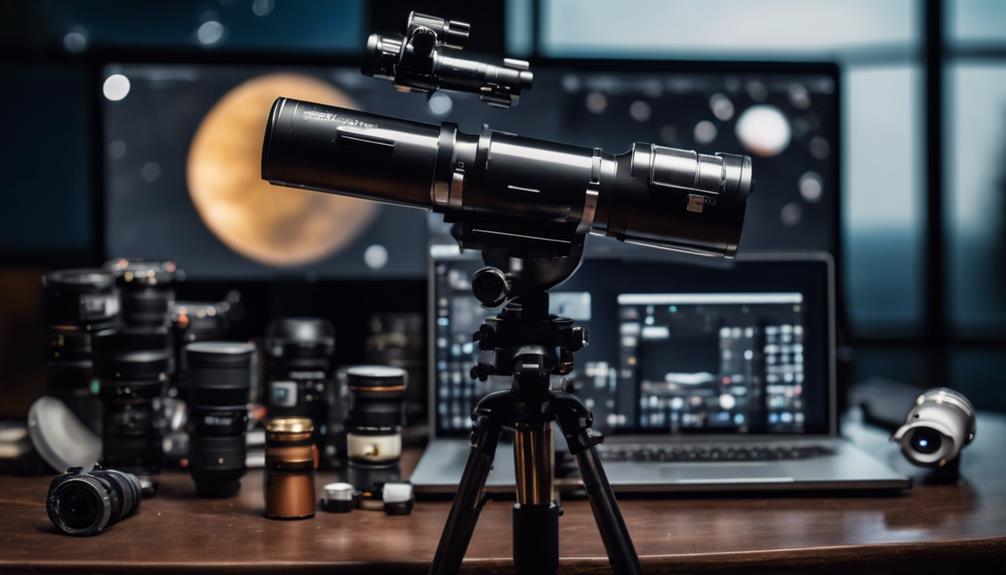
Before you embark on your deep-space photography journey, it’s critical to ensure your equipment is well-prepared and fully compatible with your telescope. One of the first steps is ensuring your camera can seamlessly connect to your telescope. This often necessitates specific adapters, such as t-rings and t-adapters, which bridge the gap between your camera and the eyepiece holder of your telescope.
For those who are serious about capturing the cosmos, consider investing in dedicated astronomy cameras. These are designed for direct mounting to your telescope, offering ease of use and peak performance.
To track celestial objects with precision, German equatorial mounts (GEM mounts) are the preferred choice. They provide stable and accurate mounting, vital for long-exposure astrophotography where even the slightest movement can blur your images.
Don’t overlook the accessories that can enhance your deep-sky imaging experience. Guide scopes help with precise tracking, field flatteners correct field curvature for edge-to-edge sharpness, and dew heaters prevent condensation on your optics during cool nights. Each of these accessories plays a pivotal role in preparing your equipment for a successful deep-space photography session.
Understanding Celestial Movements
As you venture into deep space photography, grasping the basics of celestial movements becomes essential.
You’ll find that tracking celestial bodies and understanding planetary motion are foundational skills for capturing the night sky’s wonders.
These dynamics not only enrich your photography but also deepen your connection with the cosmos.
Tracking Celestial Bodies
To effectively capture the dynamic beauty of the cosmos, grasp how celestial bodies, influenced by Earth’s rotation, glide across the sky from east to west. Understanding diurnal motion is key to tracking these celestial wonders. Here’s how:
- Use an equatorial mount to compensate for Earth’s rotation, aligning it with the celestial pole.
- Achieve precise tracking through proper polar alignment, a vital step for astrophotography.
- Capture long-exposure images without star trails by accurately following the movement of stars and galaxies.
- Revel in the intricate details of deep space objects, brought to life through your mastery of tracking.
Planetary Motion Basics
After mastering the art of tracking celestial bodies across the night sky, it’s time to explore the forces governing their movements, starting with the basics of planetary motion. Your telescope isn’t just a tool; it’s your gateway to understanding the dance of the planets.
Planetary motion, driven by the gravitational pull of the sun and other celestial bodies, unfolds in elliptical orbits.
These varied paths cause planets to speed up or slow down, creating enthralling scenes for astrophotography tracking. Witnessing retrograde motion, where planets seem to reverse course, becomes a highlight.
Grasping Kepler’s laws reveals the secrets behind orbital shapes, areas swept, and orbital periods. This knowledge isn’t just academic; it’s essential for predicting celestial movements, ensuring your astrophotography captures the universe in motion with precision.
Mastering Focusing Techniques
Mastering focusing techniques is essential for capturing the intricate details of distant galaxies and nebulae with your telescope. To make sure you’re getting the most detailed images of celestial objects, consider these steps:
- Use a Bahtinov Mask: This tool creates a diffraction pattern when placed in front of the telescope lens. The pattern adjusts as you focus, pinpointing the moment your target is in perfect focus. It’s invaluable for achieving sharpness in your deep space photography.
- Implement Electronic Focusing Systems: Motorized focusers or software-controlled focus adjustments can fine-tune your focus with precision. They’re especially useful for making slight adjustments without introducing vibration or movement to the setup.
- Apply the Focus and Reframe Technique: After achieving focus, you might need to adjust your composition. This technique allows you to maintain focus while repositioning, ensuring your celestial subjects remain sharp.
- Monitor Through Live-View Mode: Whether using DSLR cameras or dedicated astronomy cameras, live-view mode enables you to make real-time focus adjustments. It’s important for adapting to temperature changes that might affect focus stability during long imaging sessions.
Navigating Image Capture
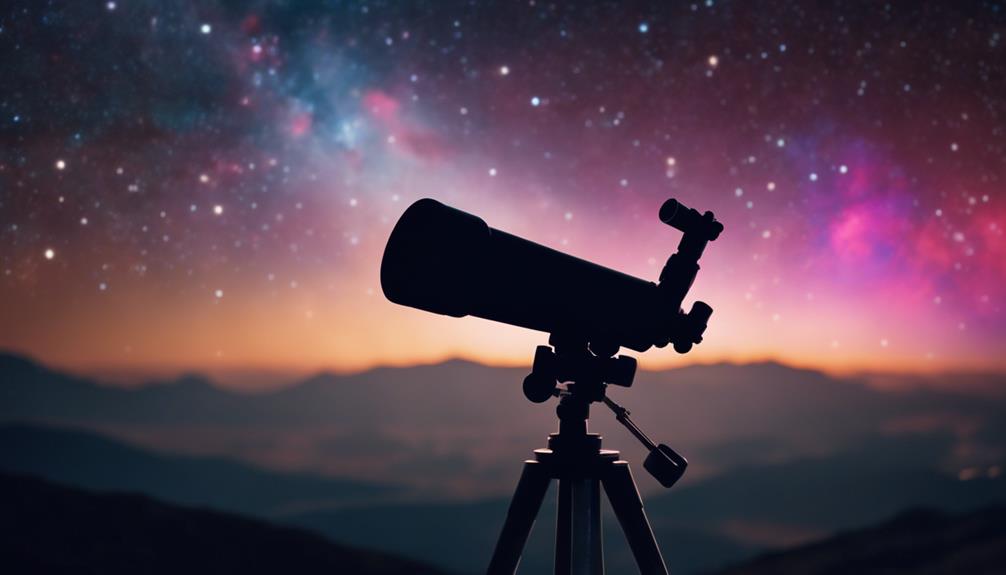
Having honed your focusing skills, you’re now ready to tackle the intricacies of capturing breathtaking images of the cosmos through long-exposure photography and other advanced techniques. With your DSLR camera mounted on the telescope, delve into the domain of deep sky objects, where distant galaxies and nebulae await your lens.
Long exposure is your best friend here, allowing you to gather enough light to reveal the details of these celestial wonders. Yet, capturing such faint objects isn’t without its challenges. Your telescope’s tracking accuracy becomes important, and this is where autoguiding systems come into play. They fine-tune your telescope’s movements, ensuring sharp, well-defined images.
Experimentation is key in deep space photography. Don’t shy away from playing with different ISO levels and exposure times to find the sweet spot for your setup.
Remember, a higher ISO might increase sensitivity but can also introduce noise.
To further enhance your images, consider stacking multiple exposures. This technique significantly boosts the signal-to-noise ratio, making those dim details pop. While you’re capturing the night sky, think of each image captured as a piece of a larger puzzle. It’s in the stacking and subsequent post-processing that this puzzle comes together, revealing the full majesty of the cosmos.
Post-Processing Techniques
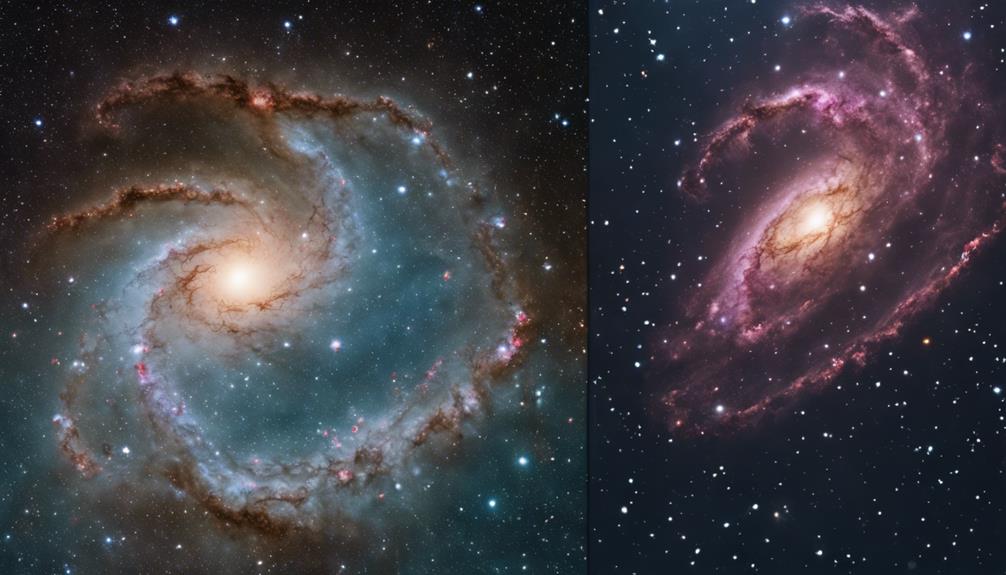
Once you’ve captured the cosmos through your telescope, it’s time to bring those images to life with post-processing techniques.
Mastering image stacking essentials and color correction tips can transform your shots from raw captures to awe-inspiring deep-space photographs.
Let’s explore how to elevate your astrophotography with these essential steps, ensuring your final images are as breathtaking as the night sky itself.
Image Stacking Essentials
To reveal the full potential of your deep space photographs, familiarizing yourself with image stacking is essential, as it greatly reduces noise and enhances image quality. Here’s how you can master it:
- Capture multiple frames of the same celestial object. This redundancy is key in deep-sky astrophotography to improve the signal-to-noise ratio.
- Use advanced software like Deep Sky Stacker or PixInsight. These tools are designed for aligning and combining your images efficiently.
- Align and register each frame to make sure they match up perfectly. This step is important for clarity in the final image.
- Combine the frames to create a composite image. This process enhances detail and reduces noise, improving the overall image quality.
Delve into image stacking to bring out the unseen beauty of the cosmos with unparalleled clarity.
Color Correction Tips
After mastering image stacking, you’ll find that color correction is your next essential step in bringing the true vibrancy of the cosmos to life in your photographs.
Utilizing post-processing software like Photoshop or PixInsight, you can fine-tune the color balance of your deep-space images. By balancing RGB channels, you’re not only correcting color casts but also enhancing the natural colors of galaxies, nebulae, and stars.
Techniques such as histogram adjustments and selective color editing play a pivotal role in refining the color accuracy of your celestial captures. Proper color correction guarantees the astronomical objects’ true colors shine through in your final images, faithfully reproducing the breathtaking beauty of the universe.
Sharing Your Photographs
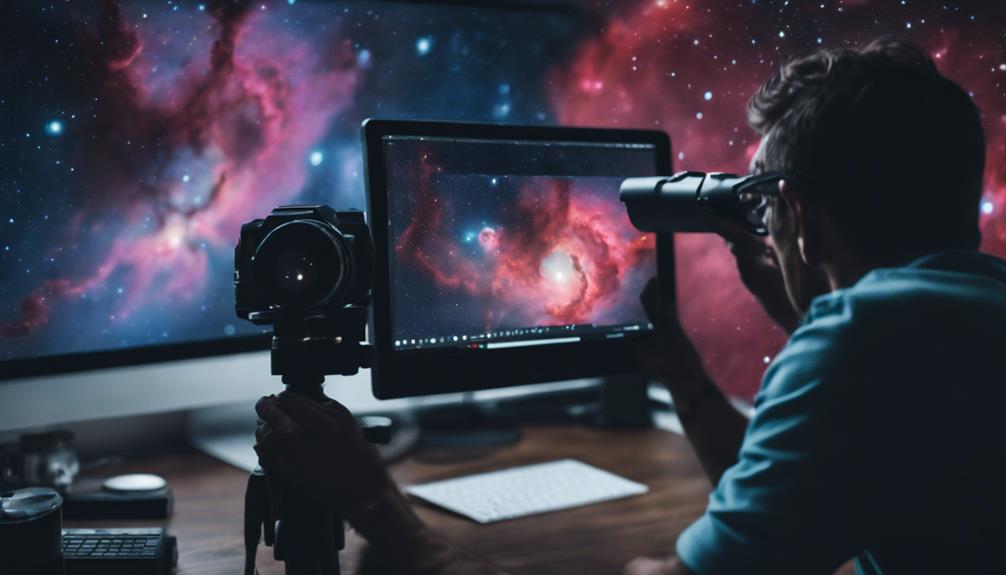
Sharing your deep space photographs not only inspires others but also connects you with a passionate community of astrophotography enthusiasts. Whether you’ve captured the Orion Nebula with a DSLR or mirrorless camera or the intricate details of the Andromeda Galaxy, your deep space photography can awe and educate.
Here’s how to share your universe:
- Social Media Platforms: Platforms like Instagram are perfect for showcasing your deep sky astrophotography. Tagging your images with specific astrophotography hashtags can help you connect with a community of like-minded individuals.
- Astrophotography Forums: Dedicated forums offer a space to share tips, receive feedback, and discuss deep space photography techniques with peers.
- Astrophotography Contests and Exhibitions: Participating in contests or exhibitions not only showcases your work but also provides recognition and the opportunity to see how your work stacks up against others.
- Online Portfolio: Creating a personal website or online portfolio is an excellent way to attract a wider audience. It serves as a hub for all your deep space images and can be a gateway to potential showcasing opportunities at astrophotography workshops or other events.
Preserving Deep Space Images
Once you’ve captured the cosmos through your lens, it’s equally important to understand how to preserve those deep space images for the future. Ensuring your celestial captures stand the test of time involves a few critical steps, leveraging both hardware and software to reduce noise, enhance details, and bring out the true colors of the universe.
Here’s a snapshot of how to preserve your deep space images:
| Process | Purpose |
|---|---|
| Calibration Frames | Reduces noise and corrects imperfections using darks, flats, and biases |
| Post-Processing | Enhances and refines images with PixInsight or Deep Sky Stacker |
| Color Correction | It brings out true colors of celestial objects |
| Stacking Exposures | Increases signal-to-noise ratio to reveal finer details |
| Narrowband Filters | Highlights specific wavelengths for stunning contrast |
Using calibration frames like darks, flats, and bias frames is essential. They help you reduce noise and correct imperfections. Post-processing software, such as PixInsight or Deep Sky Stacker, lets you refine your deep space images, enhancing their quality significantly.
Techniques like color correction, stacking exposures, and utilizing narrowband filters can elevate your photographs, making the cosmos not just visible but vibrantly alive in your deep space images.
Exploring Celestial Targets
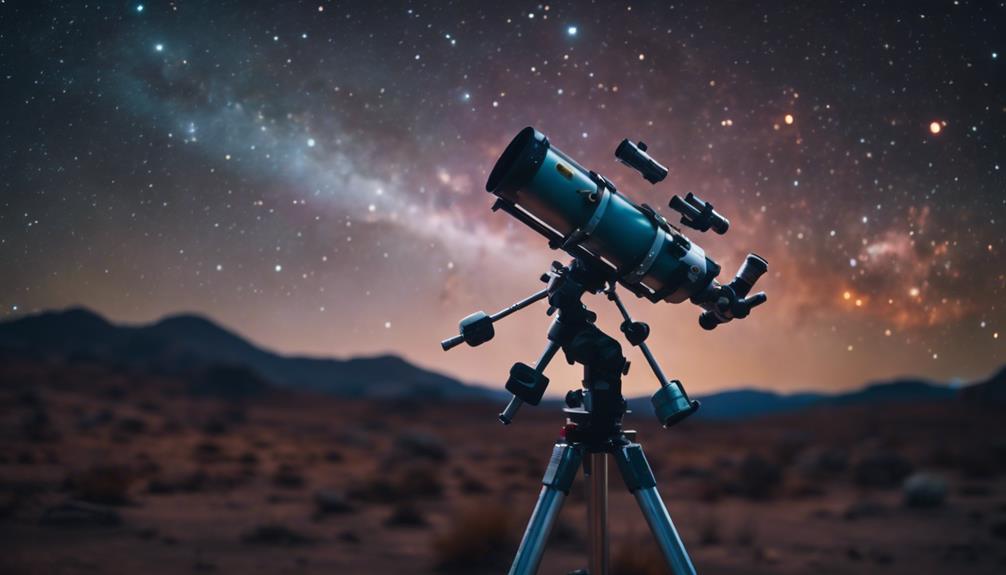
Exploring celestial targets, you’ll often find yourself mesmerized by the vivid tapestry of nebulae, galaxies, and star clusters that adorn the night sky. Each of these celestial bodies offers a unique challenge and reward in deep-sky photography.
With the right astrophotography setups, including a telescope with an appropriate focal length, a dedicated astronomy camera, and the patience for long exposure times, you can capture breathtaking images of the cosmos.
Here are four celestial targets that should be on every astrophotographer’s list:
- The Orion Nebula: A nursery of new stars, its glowing gas and dust create a spectacle of color.
- The Andromeda Galaxy: Our closest galactic neighbor offers a grand view of spiral arms and star-filled regions.
- The Pleiades (Seven Sisters): This star cluster is a jewel in the night, showcasing young, hot stars enveloped in a nebulous blue glow.
- The North America Nebula: Mimicking the continent’s outline, this emission nebula reveals the intricate dance of gas and dust illuminated by starlight.
Each target, from the Orion Nebula’s swirling clouds to the Andromeda Galaxy’s vast spiral, presents unique opportunities for deep sky photography. Adjusting focal lengths and mastering long exposures with your astrophotography setup will reveal the celestial beauty these targets hold.
Frequently Asked Questions
Can You See Deep Space With a Telescope?
Yes, you can see deep space with a telescope, especially from dark sky locations. Light pollution effects are minimized, allowing clearer views. Using suitable mounts, longer exposure times, and appropriate aperture sizes enhances your experience.
What Is the Best Telescope for Deep-Sky Photography?
Choosing the best telescope for deep-sky photography isn’t just about reaching for the stars; it’s about matching your budget with the right aperture size, ensuring sensor compatibility, and considering factors like light pollution and tracking systems.
How Do You Take Pictures of Space With a Telescope?
To capture space through your telescope, adjust your camera settings and stabilize the mount. Reduce light pollution, experiment with exposure times, and use filters. Master image stacking, dark and calibration frames, and post-processing techniques for clarity.
What Lens to Use for Deep Space Photography?
Aren’t you curious about the best lens for capturing the universe’s wonders? Opt for one with a long focal length, wide aperture, and coated lenses. Prime or zoom, make sure it’s weather-sealed with minimal chromatic aberration.
Conclusion
With your telescope aimed at the heavens, you’ve begun on a thrilling journey to capture the cosmos.
Remember, about 95% of the universe is still unexplored, making each photo you take a potential gateway to undiscovered wonders.
By honing your skills in focusing, mastering celestial movements, and refining post-processing techniques, you’re not just preserving images; you’re immortalizing the mysteries of deep space.
Share your findings, inspire others, and keep gazing upward—the universe awaits your lens.
