Mastering Telescope Skills for Stargazing Wonders
As you stand under the vast tapestry of the night sky, you might find yourself on the threshold of an infinite cosmic journey. Mastering the art of telescope use is akin to holding a key to unearthing the universe’s most profound secrets.
From selecting the right telescope to aligning its optics and tracing celestial bodies, each step brings you closer to the wonders that dot our night sky. Yet, as you commence on this quest, you’ll discover that exploring the cosmos requires more than just technical skills.
Stay engaged, for true mastery lies in blending knowledge with the sheer joy of discovery, a domain where patience and persistence illuminate the path to celestial marvels.
Key Takeaways
- Select the right telescope type based on the desired celestial objects for observation.
- Ensure proper setup and alignment for clear, sharp images of the night sky.
- Utilize stellar maps and understand Earth’s rotation for accurate celestial tracking.
- Choose dark, elevated spots away from light pollution for optimal stargazing experiences.
Selecting the Right Telescope
Choosing the right telescope is important for transforming your stargazing from mere observation to an immersive cosmic journey. The night sky, with its vast array of celestial objects, demands careful consideration of telescope type to reveal its mysteries.
Reflecting telescopes, known for their proficiency in capturing faint light from distant deep-sky objects, are ideal for those fascinated by nebulae and galaxies. Their design favors the observation of such elusive sights by minimizing optical aberrations.
On the other hand, refracting telescopes excel at delivering crisp images of planets and the moon, making them perfect for enthusiasts keen to explore the solar system’s finer details. Their simple lens-based system is renowned for producing high-contrast views of celestial bodies against the dark void.
For a more versatile approach, catadioptric telescopes blend the best of both worlds, catering to a wide range of stargazing interests. Their hybrid design enhances the viewing experience across the spectrum of celestial phenomena.
When selecting a telescope, it’s also important to take aperture size, focal length, and mount stability into account. These factors greatly influence your ability to discern fine details and track objects as they journey across the sky, ensuring your stargazing is as rewarding as possible.
Setting Up Your Tripod Correctly
Ensuring your tripod is set up on solid ground is important to eliminating vibrations that can disrupt your observation of the cosmos.
When positioning your tripod, the first step is to find stable ground. This prevents the tripod from wobbling or shifting during use, which couldn’t only ruin your stargazing experience but also risk damaging your telescope.
Once you’ve found a suitable spot, it’s time to adjust the tripod’s legs. This step is critical for creating a balanced and level platform for your telescope. Uneven legs can lead to instability, making it difficult to focus on celestial objects. By carefully extending or retracting each leg and ensuring they’re all securely locked in place, you’ll achieve the stability needed for precise observations.
Next, securely attach your telescope to the tripod using the designated mounting bracket or adapter. This connection should be tight to prevent any movement of the telescope during observation.
To wrap up, don’t overlook the importance of adjusting the tripod’s height. Align the telescope’s eyepiece to a comfortable viewing height to avoid neck strain during long stargazing sessions. Remember, keeping all tripod connections tight is crucial to maintaining stability and ensuring a safe and enjoyable experience as you explore the wonders of the night sky.
Aligning Your Telescope Optics

After setting up your tripod correctly, the next step in mastering stargazing involves aligning your telescope optics for the sharpest views of the night sky. Proper alignment is vital, as misaligned optics can lead to distorted or blurry images, greatly diminishing your viewing experience.
The process entails adjusting your telescope’s mirrors or lenses to make sure they’re perfectly oriented, a procedure that varies slightly depending on whether you’re using a reflecting or refracting telescope.
To truly grasp the essence of aligning your telescope’s optics, consider these key insights:
- Alignment is the foundational step to achieving clear, sharp images of celestial objects.
- Collimation is essential for reflecting telescopes, ensuring mirrors are aligned to direct light precisely.
- Focusing is paramount for refracting telescopes, adjusting lenses to fine-tune image clarity.
- Regular checks and adjustments to your telescope’s alignment can greatly enhance your stargazing experience.
Understanding and applying techniques like collimation for reflectors and focusing for refractors are essential for effective alignment. By regularly checking and fine-tuning your telescope optics, you’ll guarantee top performance and greatly enrich your enjoyment of exploring the cosmos.
Mastering Celestial Tracking Techniques
To master celestial tracking techniques, you’ll need to grasp the basics of sky movement, ensuring your stargazing sessions are both accurate and rewarding.
Utilizing stellar maps effectively can greatly enhance your ability to pinpoint celestial bodies, while the choice of the right equipment is vital for seamless tracking and observation.
These foundational steps are integral to developing proficient telescope skills for exploring the night sky’s wonders.
Understanding Sky Movement Basics
Grasping the basics of sky movement is important for mastering celestial tracking techniques and understanding how the Earth’s rotation influences the nightly dance of stars across the sky. The sky’s objects, including stars, follow a predictable path over time, which is key to revealing the secrets of the night.
- The apparent motion of stars is a direct result of Earth’s rotation, making them shift across the sky hourly.
- Stars rise about 4 minutes earlier each day, gradually changing their positions in the sky.
- Star trail images provide a visual representation of this apparent motion.
- Polaris, the North Star, serves as a fixed point, helping to trace the movements of other celestial bodies.
Understanding these movements enhances your ability to navigate the night sky, making stargazing more rewarding.
Utilizing Stellar Maps Effectively
Having understood the basics of sky movement, you’ll now find that mastering celestial tracking techniques becomes notably easier with the use of stellar maps. Stellar maps, or star charts, are invaluable tools that provide detailed information on the locations of celestial objects in the night sky.
Learning to read these maps is essential for identifying specific stars, constellations, and even deep-sky objects like nebulae. By pinpointing where various constellations are visible and recognizing patterns in the sky, you can navigate accurately and locate objects of interest with precision.
Utilizing stellar maps effectively not only enhances your stargazing experience but also assures your celestial tracking efforts are both efficient and rewarding. Mastering this skill is a significant step towards achieving expertise in stargazing wonders.
Choosing the Right Equipment
Selecting the right equipment is crucial for mastering celestial tracking techniques, as it directly influences your ability to observe and track celestial objects with precision. When the night beckons you to explore the stars and constellations, having a telescope with the right features becomes indispensable.
Your journey into celestial observation requires a keen understanding of the equipment that can enhance your field of view, even with smaller telescopes.
- Understand the difference between altazimuth and equatorial mounts for precise celestial tracking.
- Consider motorized mounts with tracking capabilities for smooth and accurate tracking of celestial objects.
- Learn about setting circles and digital setting circles to aid in locating specific celestial targets.
- Explore the benefits of computerized GoTo telescopes for automated celestial tracking and object location.
Mastering these aspects will significantly enhance your stargazing experience, offering you a gateway to the wonders of the universe.
Maintaining Your Telescope
To confirm your telescope remains a reliable window to the cosmos, it’s important to adopt a meticulous maintenance routine.
The foundation of telescope maintenance encompasses a few key practices: clean lenses regularly, store properly, and check alignment. These steps guarantee your stargazing experiences are not just breathtaking but accurate too.
Here’s a quick guide to help you maintain your telescope effectively:
| Practice | Purpose | How Often |
|---|---|---|
| Clean lenses | Prevent dust buildup | As needed |
| Store in cool, dry place | Avoid moisture damage | After every use |
| Check alignment | Ensure accuracy in observations | Periodically |
| Use protective covers | Prevent debris or insects entering the system | After every use |
| Follow manufacturer guidelines | Prolong lifespan and functionality | As recommended |
Employing protective covers for your telescope’s aperture and eyepiece is also important. It shields the delicate optical system from external harm.
Additionally, adhering to the manufacturer’s maintenance and calibration guidelines cannot be overstated. It’s not just about keeping your telescope in prime condition; it’s about ensuring each stargazing session is as profound as the last.
Assessing Weather and Atmospheric Variables
While maintaining your telescope guarantees it’s in top condition, evaluating weather and atmospheric variables is key to maximizing your stargazing experience. Grasping the impact of these elements can greatly enhance your telescope skills and the quality of your stargazing sessions.
Weather conditions such as cloud cover, humidity, and temperature directly affect the clarity of the night sky. Likewise, atmospheric variables, including air turbulence and light pollution, play vital roles in determining the best viewing conditions.
To ensure the most rewarding stargazing experiences, consider these important points:
- Understanding the influence of weather conditions on visibility helps in planning sessions when the sky is most transparent.
- Monitoring atmospheric variables is essential for identifying nights with minimal light pollution and air turbulence, ensuring sharper images.
- Utilizing weather forecasting tools allows for anticipation of clear skies and favorable atmospheric conditions, making every stargazing opportunity count.
- Adapting to real-time weather updates can greatly improve observational experiences, allowing for quick adjustments to maintain the quality of your stargazing sessions.
Choosing Optimal Observation Spots
Selecting a top observation spot requires you to ponder light pollution levels and natural terrain advantages.
You’ll need to leverage light pollution maps to identify locations where the night sky shines brightest, ensuring a high-quality stargazing experience.
Additionally, seeking out areas that naturally shield you from ambient light can greatly enhance your ability to observe celestial wonders with clarity.
Light Pollution Levels
Understanding the impact of light pollution levels is essential when choosing the best observation spots for stargazing. The Bortle scale, which categorizes light pollution from Class 1 (darkest skies) to Class 9 (bright urban skies), serves as a critical guide for astronomers.
Darker skies, indicative of low light pollution levels, greatly enhance the visibility of celestial objects, offering a more immersive stargazing experience.
Here’s why paying attention to light pollution levels matters:
- Dark skies reveal more stars, planets, and deep-sky objects.
- Lower light pollution levels improve the quality of astronomical observations and astrophotography.
- Light pollution maps and apps assist in finding prime spots.
- Observing away from urban lights greatly enriches stargazing experiences.
Choose your observation spots wisely to reveal the full splendor of the night sky.
Natural Terrain Advantages
Beyond considering light pollution levels, it’s also important to examine the natural terrain when choosing your next stargazing location. Elevated spots, such as hills or mountains, greatly enhance visibility.
Here, you’re above much of the light pollution and atmospheric interference, making it easier to spot bright stars or celestial events visible from your location.
Coastal areas or open fields expand your horizon, essential for observing objects near it. For beginners in astronomy, these spots can greatly improve your experience, aided by stargazing apps that guide you through the constellations. Urban areas, conversely, should be avoided due to excessive light pollution.
National parks or remote locations offer pristine conditions, transforming your stargazing into a truly mesmerizing experience.
Understanding Telescope Types
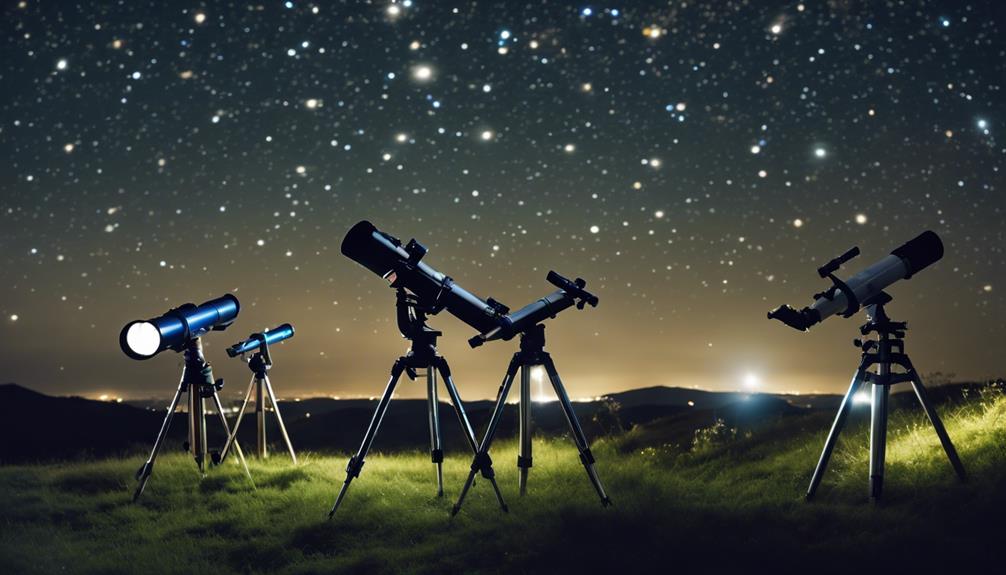
To explore into the world of stargazing, it’s important you’re familiar with the three primary telescope types: refracting, reflecting, and catadioptric, each offering distinct advantages for observing the cosmos. Understanding these differences is essential for choosing the right telescope to enhance your astronomy skills and stargazing experiences.
- Refracting telescopes use lenses to gather and focus light, making them excellent for observing planets and the moon. Their design minimizes optical distortions, providing clear, high-contrast images.
- Reflecting telescopes, leveraging mirrors, excel in deep-sky viewing. They’re ideal for amateur astronomers excited to explore galaxies, nebulae, and star clusters beyond our solar system.
- Catadioptric telescopes combine lenses and mirrors, offering a versatile option. They’re compact, portable, and capable of delivering detailed views of a wide range of celestial objects, from planets to the International Space Station visible from space.
Choosing the right telescope depends on what celestial objects you’re most interested in observing. Each type caters to different aspects of the night sky, enhancing your experience as an amateur astronomer.
This knowledge enables you to make an informed decision, ensuring you get the most out of your stargazing adventures.
Adapting to Atmospheric Conditions
Adapting to atmospheric conditions, such as air temperature and humidity, is important for enhancing your stargazing experience and obtaining clearer, more precise observations. These factors directly impact the clarity and quality of what you can see through your telescope.
For instance, high humidity levels can result in a hazier sky, reducing visibility of celestial objects. Similarly, air temperature differences create atmospheric turbulence, which can distort the images you’re trying to capture.
Understanding how light pollution affects your ability to view the night sky is another critical aspect. Urban areas with high levels of artificial light make it challenging to observe faint stars and galaxies. By choosing locations away from city lights, you’ll greatly improve your stargazing quality.
In addition, familiarizing yourself with the concept of light scattering is essential. This phenomenon occurs when particles in the atmosphere scatter light, affecting the brightness and visibility of stars and planets. It’s particularly pronounced near the horizon and in areas with significant air pollution.
Frequently Asked Questions
How Can I Get Better at Using a Telescope?
To improve your telescope use, start with alignment during daylight and experiment with eyepiece selection. Follow maintenance tips closely and keep an observational logbook. Gradually, you’ll enhance your skills and enjoy more celestial sights.
How Do You Learn Star Gazing?
To discover the secrets of the cosmos, start by mastering night navigation and understanding celestial events. Use star charts and keep an observation journal to track your progress. This precise approach will elevate your stargazing.
What Telescope Is Used for Stargazing?
For stargazing, you’ll use refracting, reflecting, or catadioptric telescopes. It’s important to understand aperture importance, choose the right mount types, and select suitable eyepieces. Regular telescope maintenance guarantees the best celestial views and experiences.
What Makes for Good Stargazing?
For good stargazing, you’ll need dark skies to reduce light pollution, clear weather conditions, and awareness of the moon’s phase to minimize brightness. Utilizing stargazing apps helps identify celestial objects, enhancing your experience.
Conclusion
In conclusion, embarking on the journey to master telescope skills is akin to unlocking a celestial treasure chest; it’s both challenging and rewarding.
By selecting the right telescope, setting up your gear correctly, and honing your celestial tracking techniques, you’ll navigate the night sky with precision.
Remember, maintaining your equipment and adapting to atmospheric whims are key.
With patience and a keen eye on weather and ideal spots, the universe’s wonders will unfold before you, making every stargazing session a voyage of discovery.
