Mastering Your Telescope: Tips for Stellar Astronomy
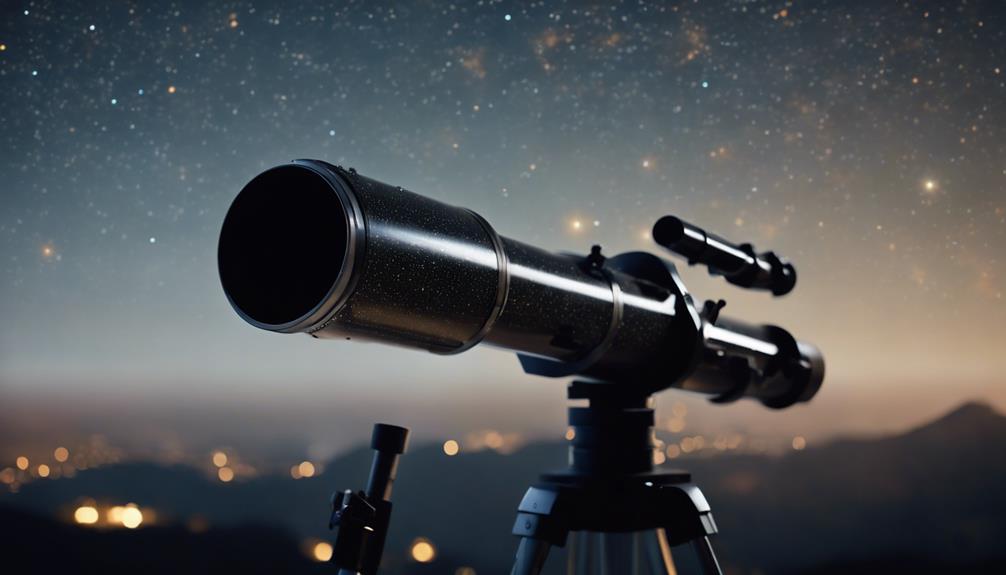
Imagine the universe as a vast ocean, and your telescope is the ship that navigates these celestial waters. To steer your ship right, understanding the nuances of aperture size, magnification, focal length, and resolution is paramount.
You'll need to choose the right mount for stability and select eyepieces that enhance your journey. Don't forget the importance of regular maintenance to guarantee your vessel remains seaworthy.
As you stand on the brink of discovery, remember, mastering these elements is not just about seeing the stars but revealing the secrets they hold. The path to celestial mastery awaits, are you ready to set sail?
Key Takeaways
- Larger apertures improve light-gathering, enhancing image brightness and detail for observing faint celestial objects.
- Balancing magnification with aperture size is crucial to avoid image distortion and maintain clarity in observations.
- The right focal length combines magnification power and field of view, impacting the telescope's overall usability and observation quality.
- Choosing an appropriate mount type enhances stability and precision, significantly improving the tracking and viewing experience of celestial objects.
Deciphering Aperture Size
Understanding the role of aperture size in telescopes is important, as it greatly influences the quality and clarity of the images you'll observe. The aperture, often measured in millimeters or inches, serves as the telescope's eye, determining its light-gathering ability. Basically, the larger the aperture, the more light it can collect. This enhanced light-gathering capacity is vital for viewing faint objects in the night sky, allowing you to discern finer details and enjoy brighter images.
When selecting a telescope for astronomy, considering the aperture size is vital. A larger aperture not only improves image brightness but also greatly boosts the telescope's resolving power. This means you'll be able to see celestial bodies with greater sharpness, revealing intricate features that would remain invisible with smaller apertures. However, the choice of aperture size isn't just about going for the biggest available; it's about balancing your astronomical interests with practical considerations like portability and cost.
Magnification Essentials
After exploring how aperture size impacts your telescope's ability to gather light, let's now focus on how magnification plays a fundamental role in bringing celestial objects into closer view. Understanding that magnification is determined by the combination of your telescope's focal length and the eyepiece's focal length is essential. This understanding allows you to tailor your viewing experience to achieve detailed observations of the night sky.
- Matching Magnification to Observing Conditions: Ensuring the magnification level is suited to both the target object's size and the current observing conditions maximizes your viewing potential.
- Using a Barlow Lens: Incorporating a Barlow lens into your setup can effectively double or triple your eyepiece's magnification, offering versatile viewing options without sacrificing image quality.
- Impact on Brightness and Field of View: Higher magnification can reduce both the brightness and the field of view, making it essential to find a balance for the best viewing experience.
- Resolution and Magnification: Understanding the relationship between these two factors is key in selecting the right combination to capture detailed and clear celestial images.
- Aperture's Role: Remember, the aperture size also affects the resolution and brightness of the image, making it a critical factor in conjunction with magnification for stellar astronomy.
Focal Length Explained
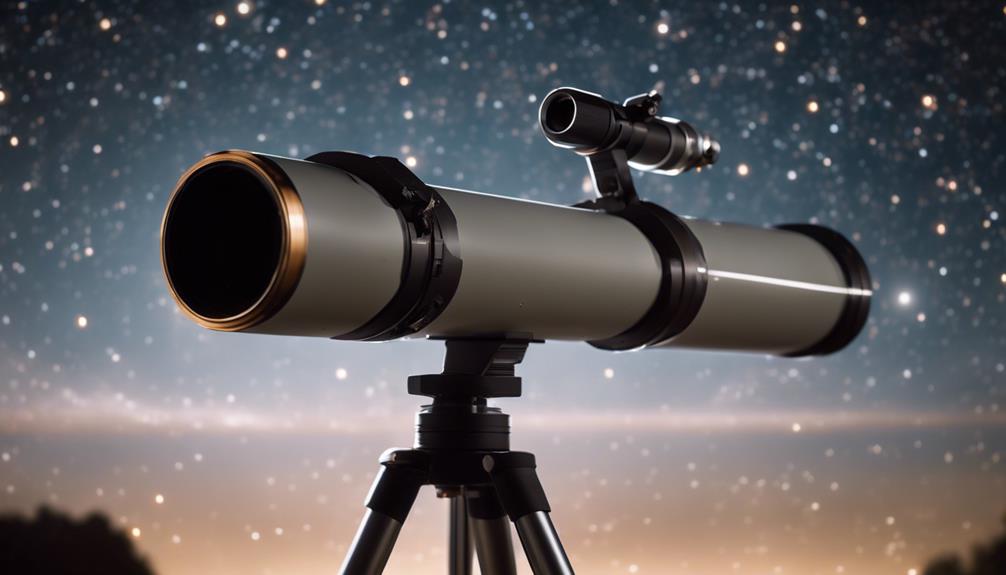
Diving deeper into the core aspects of telescope functionality, acknowledging that focal length, the distance where light rays converge to form a sharp image, fundamentally shapes your viewing experience by dictating magnification levels and field of view. Focal length, measured from the primary lens or mirror to where light converges, is a critical factor in telescope design and performance. It directly influences how much of the night sky you can see at once and how detailed celestial objects will appear.
Longer focal lengths lead to higher magnification, allowing you to zoom in on distant galaxies and nebulae, albeit with a narrower field of view. This means you'll see less of the sky but in greater detail. Conversely, shorter focal lengths provide a wider field of view, perfect for sweeping views of the Milky Way or large star clusters, though at lower magnification.
Understanding this balance is important when selecting the right telescope for your astronomical pursuits. Whether you're peering into the depths of space or scanning the heavens for broad cosmic landscapes, grasping the interplay between focal length, magnification, and field of view will guide you in choosing a telescope that meets your stargazing objectives.
Understanding Resolution
As you explore the cosmos through your telescope, understanding resolution is pivotal for discerning the intricate details of celestial objects. Factors such as aperture size, optical quality, and atmospheric conditions greatly impact your telescope's ability to separate fine features.
We'll discuss strategies for enhancing stellar resolution, ensuring you capture the clearest views of planets, stars, and beyond.
Resolution Explained Simply
To fully grasp the concept, it's important to understand that a telescope's resolution is its ability to distinguish between closely spaced celestial objects, revealing finer details that enhance your viewing experience.
- Higher resolution translates to clearer and sharper views, allowing you to see the intricate patterns on Jupiter's surface or the distinct rings of Saturn.
- Larger apertures greatly boost this capability, making distant galaxies and nebulae stand out with breathtaking clarity.
- The optical quality of your telescope directly influences resolution, with superior lenses and mirrors providing a notable advantage.
- Celestial objects once blurred or indistinguishable become vivid, allowing for deeper exploration and appreciation.
- Understanding resolution is key to selecting a telescope that meets your astronomical ambitions, ensuring every stargazing session is as rewarding as possible.
Factors Affecting Resolution
Having grasped the basic concept of resolution, let's examine the factors that greatly impact this critical aspect of your telescope's performance.
Primarily, aperture size is pivotal; larger apertures capture more light, affording higher resolution and consequently, more detailed views of celestial objects.
However, the optical quality of your telescope can't be overlooked. Superior optics produce sharper images, enhancing your viewing experience by minimizing aberrations that can blur details.
Additionally, atmospheric conditions play a significant role. Turbulence in the Earth's atmosphere can distort light, reducing the resolution attainable on any given night.
These factors underscore the importance of considering both hardware quality and environmental variables when choosing a telescope, ensuring you select a model capable of meeting your expectations for observing the cosmos in stunning detail.
Enhancing Stellar Resolution
Understanding the nuances of enhancing stellar resolution is pivotal if you're aiming to reveal the full potential of your telescope and explore deeper into the cosmos's intricacies. Resolution is your telescope's ability to distinguish fine details in celestial objects, and here's how you can enhance it:
- Increase Aperture Size: Larger apertures provide higher resolution by capturing more light and minimizing diffraction effects.
- Reduce Diffraction Effects: Optimize your telescope setup to limit these effects, enhancing clarity.
- Seek Celestial Objects with High Contrast: High contrast helps in distinguishing intricate details.
- Utilize Best Eyepieces: Select eyepieces that complement your telescope's aperture for improved resolution.
- Regular Maintenance: Keep your telescope in top condition to preserve its resolving power.
Enhancing resolution opens up a universe of intricate details and celestial bodies, elevating your astronomical experience.
Choosing the Right Mount
Choosing the right mount for your telescope hinges on understanding mount stability essentials and mastering precision alignment techniques. You'll need a mount that not only maintains a stable platform for observation but also aligns accurately with celestial objects to make certain crisp, clear views.
Analyzing the differences in mount types reveals that stability and precision are paramount for enhancing your stargazing experience.
Mount Stability Essentials
To guarantee top stability and precision in your telescope viewing experiences, it's essential to choose the right mount customized to your observational requirements and expertise level. Mount stability essentials include:
- Equatorial mounts, ideal for tracking celestial objects by aligning with the Earth's rotational axis, ensuring precise movements.
- Alt-azimuth mounts, offering intuitive control with vertical and horizontal movement, suitable for quick scanning of the night sky.
- Dobsonian mounts, celebrated for their robust stability and user-friendliness, perfect for beginners.
- Go To mounts, providing automated celestial objects tracking with high precision, though they require a bit more setup effort.
The choice of mount greatly impacts stability and precision, affecting your ability to track celestial objects smoothly and accurately during your telescope viewing sessions.
Precision Alignment Techniques
After exploring the importance of mount stability for your telescope, let's focus on how precision alignment techniques can enhance your astronomical observations by selecting the appropriate mount.
Equatorial mounts, aligning with Earth's axis, enable precise tracking of celestial objects through polar alignment, essential for observing stars' movements.
Alt-azimuth mounts, offering intuitive vertical (altitude) and horizontal (azimuth) adjustments, are excellent for beginners seeking simplicity.
Whether you're performing polar alignment with equatorial mounts or making altitude and azimuth adjustments for alt-azimuth types, mastering these alignment techniques is important. They ensure smooth, accurate tracking of celestial bodies, enriching your stargazing experience.
Eyepiece Selection Tips
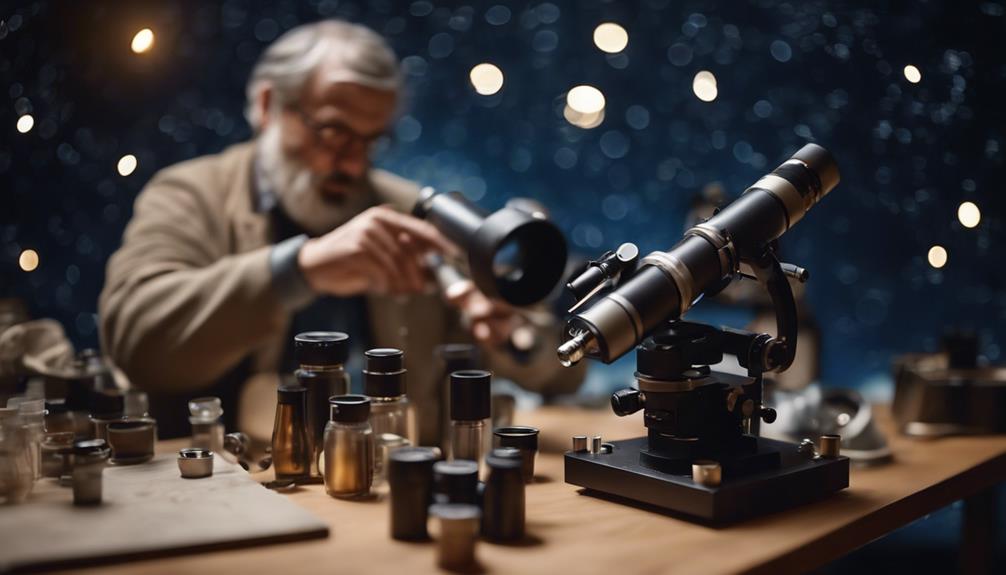
When selecting eyepieces for your telescope, it's important to think about their focal lengths, as these dictate the magnification power and field of view you'll experience while observing celestial phenomena. The right eyepiece can transform your viewing experience, offering a window to the cosmos with unparalleled clarity and detail.
Consider the following when choosing your eyepiece:
- Focal Lengths: Shorter focal lengths provide higher magnification, ideal for planetary viewing. Longer focal lengths offer wider fields of view, perfect for nebulae and galaxies.
- Eye Relief: Make sure there's sufficient eye relief for comfortable viewing, especially if you wear glasses.
- Barlow Lens Compatibility: A Barlow lens can double or triple the magnification of your eyepiece, adding versatility without sacrificing quality.
- Multi-Coated Optics: Opt for eyepieces with multi-coated optics to enhance contrast and clarity, making celestial objects stand out against the night sky.
- Field of View: A wider field of view allows you to observe larger areas of the sky, enriching your exploration of star clusters and the Milky Way.
Selecting the right eyepiece involves balancing magnification, field of view, eye relief, and optical quality to match your observational goals and guarantee a rewarding viewing experience.
Frequently Asked Questions
What Are the 4 Main Types of Telescopes?
You're exploring the universe with four main telescope types: refractors with their sharp images, reflecting designs for cost-effectiveness, versatile catadioptric systems, and Dobsonian simplicity, each evolving with optical innovations for enhanced astrophotography and portable options.
How Can You Get a Clear Image of a High Magnification in a Telescope?
To get a clear high-magnification image, you'll need best focusing, a steady mount, and high-quality optics. Minimize light pollution, make sure atmospheric conditions are favorable, and use image stabilization and precision alignment. Don't forget about contrast enhancement.
How Much More Light Will a 16 Inch Telescope Collect Than a 4 Inch Telescope?
A 16-inch telescope collects 16 times more light than a 4-inch, thanks to its diameter advantage. This light gathering boosts brightness, enhancing star visibility and detail in deep sky objects for a superior observation impact.
What Can You See With 100x Magnification Telescope?
With a 100x magnification telescope, you'll see lunar craters, Jupiter's moons, Saturn's rings, and Venus' phases. You can also discern Mars' ice caps, binary stars, nebula details, galaxy cores, asteroid shapes, and comet tails.
Conclusion
In the cosmos of stargazing, your telescope is your vessel, exploring the celestial seas. Ensuring it's well-equipped with the right aperture, magnification, and focal length acts as your compass, guiding you to clearer, more detailed stellar vistas.
Choosing the perfect mount and eyepiece is akin to setting your sails correctly, catching the best cosmic winds. Regular maintenance is the anchor that keeps your journey smooth.
Master these elements, and the universe's treasures will unfold before you, with each star telling its story in vivid clarity.


