Maximizing Viewing: Is Your Telescope Underperforming?
Have you ever wondered if the stories about telescopes not living up to their potential are true? You’re not alone in pondering this question.
Many amateur astronomers overlook simple steps that can greatly enhance their viewing experience. From the important alignment of your telescope to selecting the right eyepiece, there’s a myriad of factors that can make or break your stargazing sessions.
If you’ve ever felt that the stars and planets you observe aren’t as clear or as detailed as they should be, stick around. We’re about to explore common pitfalls and solutions that could transform your astronomical journey.
Key Takeaways
- Regular cleaning and maintenance ensure peak telescope performance and safeguard optical quality.
- Proper alignment and calibration are crucial for accurate tracking and sharp imaging.
- Atmospheric conditions significantly affect viewing quality; optimal times and locations enhance observation.
- Accessory upgrades, like eyepieces and filters, can dramatically improve magnification, sharpness, and contrast.
Assessing Performance
To accurately evaluate your telescope’s performance, you’ll need to focus on obtaining clear, sharp images through meticulous evaluation of its collimation and the use of proper magnification. A well-collimated telescope, where the optical elements are perfectly aligned, is critical for achieving the best image quality.
However, the best performance isn’t just about alignment; it’s also about understanding and utilizing the right magnification for your observations.
Magnification is directly related to the focal length of your telescope and the eyepiece in use. The focal length, a measure of how strongly the optical system converges or diverges light, plays a pivotal role in determining the telescope’s resolving power. Essentially, a longer focal length can provide higher magnification, but this comes with limitations. High magnification can make image brightness and sharpness suffer if your telescope’s aperture and collimation aren’t up to par.
Therefore, when evaluating your telescope’s performance, you must consider the interplay between focal length, magnification, and collimation. Each factor influences the others, and finding the right balance is key.
By focusing on these technical aspects, you’re taking a significant step towards realizing the full potential of your telescope, ensuring that your celestial observations are as detailed and clear as possible.
Aligning Your Telescope
Aligning your telescope, a critical step for precise celestial guidance, involves meticulous adjustment of its components to guarantee accurate pointing and tracking of objects in the night sky.
Proper alignment is not just about making sure that your telescope points where you want it to; it’s about maximizing the efficiency of your stargazing sessions. By aligning the finder scope during the day on a distant object, you’re setting the stage for easier, more accurate night-time observations.
| Step | Component | Benefit |
|---|---|---|
| 1 | Finder Scope | Ensures initial pointing accuracy |
| 2 | Optical Tube | Aligns viewing with the focal length |
| 3 | Mount | Maintains tracking consistency |
Accurate alignment, particularly considering the focal length of your telescope, is essential for effective celestial guidance. The focal length determines how wide or narrow your field of view is, impacting your ability to locate and track objects in the vast night sky.
Regularly checking the alignment of your telescope’s components, especially before each use, ensures that you’re not missing out on the cosmic show due to misalignment. Remember, accurate finder scope alignment not only enhances your sky observation experience by reducing frustration but also improves your efficiency in traversing the stars.
Effective Cleaning Techniques
To ensure your telescope maintains peak performance, selecting proper cleaning supplies is critical.
A step-by-step cleaning process is essential. Start with a soft, lint-free cloth for gentle dust removal and progress to using specialized solutions for more stubborn stains. This approach protects the delicate optics.
Integrating these maintenance and care tips into your routine is crucial. It preserves the clarity and quality of celestial observations.
Selecting Proper Cleaning Supplies
Selecting the right cleaning supplies is essential for maintaining your telescope’s peak performance and safeguarding its intricate optical surfaces. Your telescope’s focal length doesn’t just influence the magnification—it also determines how susceptible your optics are to dust and debris. Hence, choosing tools that are gentle yet effective is key.
| Tool | Use Case | Note |
|---|---|---|
| Soft Brush | Removing dust without touching optics | It prevents scratching, ideal for initial cleaning. |
| Canned Air | Blowing away particles | Use short bursts to avoid moisture buildup. |
| Microfiber Cloth | Wiping away smudges | Pair with a mild cleaning solution for the best results. |
Step-by-Step Cleaning Process
Before diving into the cleaning process, make sure you have all the necessary tools laid out, as precision and care are paramount to maintaining your telescope’s peak performance. Begin by using a soft brush or compressed air to gently remove any dust and debris from the optical surfaces.
This initial step is vital; even minute particles can have a substantial impact on your telescope’s focal length and clarity. For eyepieces and lenses, carefully wipe them with a clean microfiber cloth, moving in a circular motion to avoid scratching. It’s imperative to avoid harsh chemicals or abrasive materials that can damage the delicate coatings.
Regular adherence to this step-by-step cleaning process will prevent buildup, ensuring your telescope delivers an excellent viewing experience consistently.
Maintenance and Care Tips
Having outlined the initial steps for cleaning your telescope, we’ll now focus on advanced maintenance and care techniques to make sure your equipment remains in prime condition.
Start by using a soft brush or compressed air to gently remove any dust from the optical surfaces, ensuring you don’t disturb the focal length alignment. For more stubborn dirt, apply a lens cleaning solution or isopropyl alcohol with minimal pressure to avoid scratching. Remember, touching the optical surfaces can leave smudges or scratches, compromising your viewing experience.
Additionally, clean eyepieces and accessories separately to maintain their performance. Regularly adopting these maintenance practices not only guarantees prime viewing quality but also significantly prolongs the lifespan of your telescope, safeguarding your investment in astronomical exploration.
Atmospheric Impact
You’ve likely noticed that atmospheric conditions notably impact your telescopic views, with turbulence and distortion often marring image quality.
By strategically planning your observation sessions, you can mitigate these effects, leveraging astronomy software to pinpoint times when the atmosphere is least turbulent.
Additionally, observing celestial bodies when they’re at a higher altitude in the sky can dramatically enhance visibility, minimizing the atmospheric interference that can degrade your viewing experience.
Turbulence Effects on Clarity
When observing celestial bodies, turbulent atmospheric conditions can greatly distort images and reduce clarity, impacting the level of detail visible through your telescope. This turbulence, a fluctuating mix of air temperatures and currents, directly affects planetary visibility and detail resolution.
Noticeably, the extent of image distortion varies with your telescope’s focal length; longer focal lengths magnify not only the celestial object but also the turbulence effects. To combat this, utilizing astronomy software can help predict and mitigate turbulence’s impact on image quality.
Understanding and managing atmospheric turbulence is important for optimizing your telescope’s performance, as planetary viewing quality fluctuates with atmospheric conditions. By closely monitoring these conditions, you can significantly enhance the clarity and detail of your astronomical observations.
Humidity and Light Transmission
Beyond managing atmospheric turbulence, it’s also imperative to contemplate how high humidity levels impact light transmission, greatly affecting your telescope’s viewing capabilities. High humidity causes light to scatter and distort, greatly impacting the clarity and sharpness of celestial observations.
This scattering effect is particularly detrimental to telescopes with larger focal lengths, as the distortion becomes more pronounced over longer distances.
Best viewing conditions with low humidity levels minimize atmospheric interference, enhancing your telescope’s performance and allowing for clearer, more detailed views of celestial objects.
| Factor | Impact on Viewing |
|---|---|
| High Humidity | Reduces Clarity |
| Light Scattering | Distorts Images |
| Best Conditions | Low Humidity Levels |
| Focal Length | Increases Distortion |
Understanding the relationship between humidity and light transmission is essential for maximizing your telescope’s potential and achieving the best possible observations.
Altitude’s Viewing Advantage
Understanding the impact of altitude on your viewing experience is crucial, as the best observations typically occur when planets are directly overhead, minimizing atmospheric interference. The turbulent atmosphere at low altitudes can greatly degrade the quality of your images. This atmospheric turbulence scatters light and distorts the image captured within your telescope’s field of view.
By utilizing astronomy software to pinpoint the best viewing times when celestial bodies are at their highest altitude, you’ll mitigate much of this distortion. Planetary visibility fluctuates with altitude, directly influencing the clarity and detail observable.
Starting your observation with a low magnification and incrementally increasing it allows you to adapt to atmospheric conditions, gradually improving the field of view and overall image quality despite the atmospheric challenges.
Accessory Upgrades
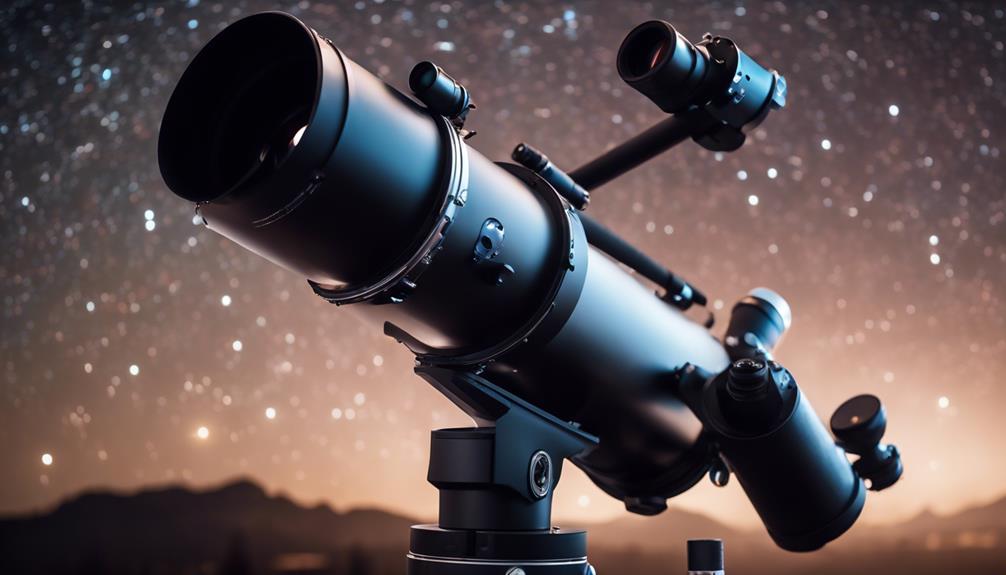
Diving into accessory upgrades can dramatically enhance your telescope’s performance, offering improved magnification, clarity, and the ability to reveal astonishing details of celestial bodies. The right accessories can transform your stargazing experience, making it more engaging and rewarding.
But it’s important to understand how each accessory impacts your telescope’s capabilities, especially regarding focal length.
- Eyepiece Upgrades: The focal length of your telescope’s eyepiece plays a pivotal role in determining magnification. Upgrading to higher quality eyepieces can greatly improve the clarity and sharpness of the images you observe, allowing for deeper exploration of the cosmos.
- Color Filters: By enhancing contrast, color filters make it easier to distinguish subtle details on planets like Jupiter and Saturn. They can bring out features such as cloud bands and ice caps, adding depth to your observations.
- Red Dot/Telrad Finders: Aiding in the swift location of celestial objects, these finders streamline the process of aligning your telescope, ensuring you spend less time searching and more time observing.
- Solar Filters: Essential for safely observing the sun, solar filters protect your eyes from harmful rays while allowing you to witness solar phenomena in stunning detail.
Magnification Selection
Selecting the right magnification level for your telescope is crucial to balancing image quality against detail.
You’ll find that a magnification of around 100x is optimal for planetary observation, revealing features on Jupiter, but remember, exceeding your telescope’s maximum power limit, generally 2x the aperture in millimeters, can degrade resolution.
Carefully choosing your eyepieces and adjusting magnification in response to atmospheric conditions ensures the clearest, most detailed views.
Choosing Right Magnification Levels
Choosing the right magnification level for your telescope involves experimenting with various settings and understanding how atmospheric conditions impact your viewing experience. The pivotal length of your telescope is essential in this process. Here’s how you can maximize your viewing:
- Calculate Magnification: Divide the telescope’s pivotal length by the eyepiece’s pivotal length. This gives you the power of magnification, helping you choose the right eyepiece.
- Use a Barlow Lens: This accessory can double or triple your magnification, offering flexibility without needing to switch eyepieces.
- Be Mindful of Maximum Power: Adhere to the rule of 2x the aperture in millimeters to avoid image degradation.
- Gradual Increases: Especially when observing planets, incrementally increase magnification to uncover more details while maintaining image clarity.
Magnification Vs. Image Quality
Having explored how to determine the right magnification levels, it’s important to understand that balancing magnification with image quality is key to maximizing your telescope’s capabilities.
Avoiding excessive magnification guarantees you maintain clarity and detail in your observations. The connection between magnification and the telescope’s focal length is essential; a higher focal length allows for greater magnification but can compromise image quality if pushed too far.
Experimentation under various atmospheric conditions can help you find the sweet spot where detail and sharpness intersect, typically around 100x for planets.
Gradually increasing magnification while considering the telescope’s aperture and the prevalent atmospheric conditions allows you to fine-tune your viewing experience, striking a delicate balance between magnifying distant celestial objects and preserving the integrity of their images.
Optimal Eyepiece Selection
To maximize your telescope’s viewing potential, it’s crucial to carefully consider the type and specifications of eyepieces you employ, as these directly influence the magnification and overall quality of celestial observations. The focal length of an eyepiece determines its magnification power.
- Best Magnification for Planets: Around 100x is ideal for observing detailed features on planets without introducing excessive blur.
- Observing Jupiter’s Moons: Low powers are sufficient, highlighting the advantage of starting with less magnification.
- Balancing Detail and Clarity: Gradually increase magnification to find the sweet spot where details are clear without sacrificing image quality.
- Limitations: High magnifications are often constrained by atmospheric conditions and the telescope’s aperture, necessitating experimentation with different eyepieces and Barlow lenses to adapt to these variables.
Observation Planning
Effective observation planning is important for maximizing the clarity and detail of celestial objects through your telescope.
A key element in this process involves understanding the impact of focal length on your viewing experience. Specifically, the focal length of your telescope dictates the magnification and field of view, which are vital for both identifying and appreciating celestial bodies.
To enhance your observation sessions, it’s vital to take into account planetary visibility, which is greatly influenced by altitude and atmospheric conditions. Astronomy software can be invaluable in determining the best viewing times, taking into account these and other variables. Starting your observations with low magnification allows you to locate objects more easily, gradually increasing magnification to examine details.
Furthermore, it’s advisable to avoid viewing planets when they’re low in the sky. Objects near the horizon are more susceptible to atmospheric distortion, leading to less clear images. The turbulent atmosphere acts as a dynamic lens, distorting light and affecting the quality of your observation experience.
By planning your sessions with these factors in mind, you’ll greatly enhance the performance of your telescope and your overall satisfaction with the celestial sights you capture.
Routine Maintenance
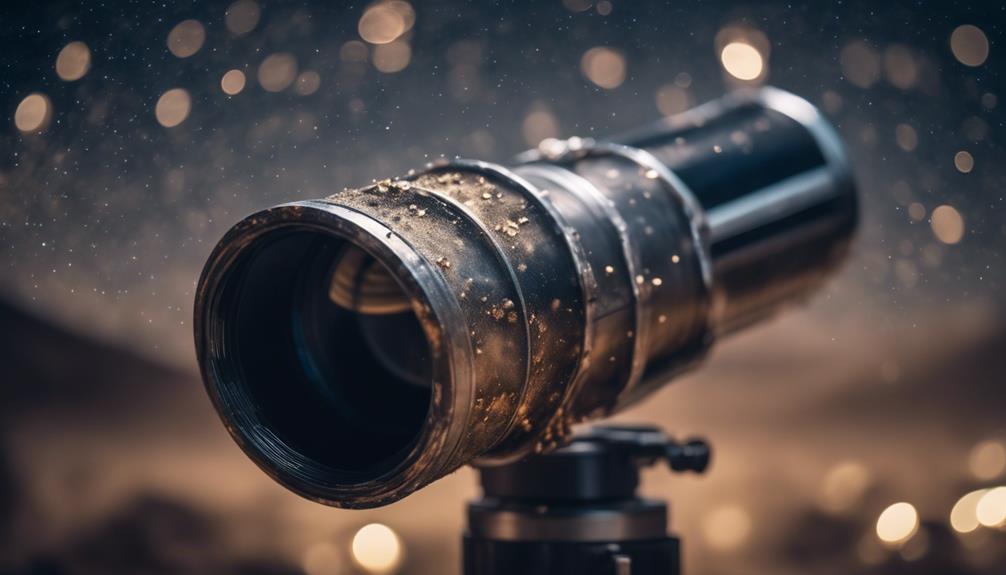
Maintaining your telescope’s peak performance necessitates regular, meticulous care of its optics and mechanical components. To make sure that you’re getting the most accurate and clear observations, certain steps are essential.
These not only preserve the condition of your telescope but also greatly influence its capability to deliver precise views of celestial objects, directly impacting the effective utilization of its focal length.
Here’s a concise guide to essential maintenance routines:
- Clean Optics and Lenses Regularly: Dust, fingerprints, and other contaminants can greatly degrade image clarity. It’s important to gently clean the telescope’s lenses and mirrors using the correct tools and techniques, ensuring no scratches or damage that could affect the focal length’s efficiency.
- Adjust Collimation: Proper alignment of the telescope’s optics is important for best performance. Misalignment can blur images and reduce the effectiveness of the telescope’s focal length, making celestial objects appear less sharp.
- Store Appropriately: Protect your telescope from moisture and dust by storing it in a dry, dust-free environment. This precaution prevents potential damage that could misalign components or necessitate costly repairs.
- Replace or Repair Accessories: Worn-out or damaged accessories, such as eyepieces, can limit your telescope’s performance. Regularly assess and replace these components to maintain or enhance viewing quality, making sure they’re compatible with the telescope’s focal length for optimal observation experiences.
Enhancing Clarity
After addressing the foundational aspects of routine maintenance, we now focus on specific strategies to enhance the clarity of your telescope’s observations.
Enhancing clarity is not just about cleaning and adjustments; it involves a thorough approach that considers everything from the telescope’s location to its alignment and the atmospheric conditions.
| Strategy | Benefit | Consideration |
|---|---|---|
| Proper Collimation | Sharper images, better star resolution | Requires patience and precision |
| Aligning the Finder Scope | Easier location of celestial objects | Critical for effective targeting |
| Acclimatizing to Outdoor Temp | Reduced thermal currents, clearer images | Allow time for temperature adjustment |
| Choosing Observing Location | Minimized light pollution, improved clarity | Seek out dark skies |
To further these efforts, it’s vital to use ideal magnification levels. This is where understanding the focal length of your telescope becomes critical. Different atmospheric conditions demand adjustments in magnification to maintain sharpness in your observations.
By selecting magnifications that complement both the focal length of your telescope and the current viewing conditions, you’ll enhance the clarity of the images you capture.
Remember, achieving the perfect balance between these factors is key to maximizing the performance and viewing experience of your telescope.
Calibration Insights
Why is it that regular calibration, particularly collimation, plays a pivotal role in the optimization of your telescope’s performance? The answer lies in the precision alignment of your telescope’s optical elements, which is essential for reaching its full potential. The process of collimation, especially critical for reflecting telescopes like Newtonians, guarantees that each optical component works in harmony to produce the sharpest, clearest images possible.
When you explore the technicalities of collimation, you’re basically adjusting the telescope’s mirrors or lenses to make sure they’re perfectly aligned along the optical axis. This alignment is important for several reasons:
- Maximized Light Gathering: Proper collimation harnesses the full capability of the telescope’s aperture, guaranteeing that all incoming light is focused precisely at the desired focal point.
- Enhanced Image Sharpness: Misaligned optics scatter light, leading to blurred or distorted images. Collimation brings everything into sharp focus.
- Optimal Use of Focal Length: Accurate alignment allows you to exploit the telescope’s focal length to its fullest, providing a wider, clearer field of view.
- Consistent Viewing Quality: Regular maintenance prevents the gradual degradation of image quality, ensuring consistent, high-quality observations.
Carefully and precisely adjusting your telescope’s collimation is a technical but rewarding process, greatly enhancing your viewing experience by leveraging the best performance of your optical system.
Frequently Asked Questions
What Is the Rule of Thumb for Telescope Magnification?
You should aim for 50-60x magnification per inch of aperture, as exceeding these magnification limits can degrade your image quality. Calculating magnification by dividing your telescope’s focal length by the eyepiece’s enhances clarity.
How Can I Improve My Telescope Resolution?
To boost your telescope’s resolution, consider upgrading the mirror coating—a move that can enhance light reflectivity by up to 25%. Proper collimation and high-quality eyepieces also play important roles in achieving sharper images.
How Do You Fix a Poor Focus on a Telescope?
To fix poor focus on your telescope, first check its collimation and alignment. Then, meticulously adjust the focus knob for best sharpness. Using a Bahtinov mask can help achieve precise focus on celestial objects.
What Is a Reasonable Magnification for a Very Good Telescope?
Like peering through nature’s keyhole, a very good telescope’s magnification shines when you’ve nailed the aperture importance. Typically, aim for 50x to 60x per inch of aperture, balancing clarity with power for top-notch observation.
Conclusion
To summarize, optimizing your telescope’s performance is like fine-tuning a musical instrument; it requires precision, attention to detail, and patience.
By assiduously aligning, diligently cleaning, and strategically upgrading accessories, you’ll reveal celestial wonders with unparalleled clarity.
Remember, the atmosphere’s fickleness and your equipment’s upkeep are pivotal in this quest.
With meticulous observation planning and routine maintenance, your stargazing experiences won’t only meet but exceed expectations, transforming the night sky into an endlessly unfolding cosmos of discovery.
