Monocular Vs Binoculars: a Simple Guide to Choosing

You might not realize that the choice between monoculars and binoculars can have a significant impact on your outdoor experiences.
While you’re weighing options, consider that monoculars offer convenience and portability for the solo adventurer, making them a go-to for quick glances and lightweight travel.
However, binoculars provide a richer, more stable visual experience, ideal for immersive observations.
As you ponder which fits your lifestyle best, remember that each has unique benefits tailored to different activities and preferences.
Let’s explore further how these differences can influence your adventures and which option might elevate your viewing experience to new heights.
Key Takeaways
- Monoculars are ideal for portability, budget-friendliness, and quick, one-handed use.
- Binoculars provide immersive, binocular vision for depth perception and a rich visual experience.
- Choose monoculars for tasks requiring ease of transport and budget considerations, like hiking or quick wildlife observation.
- Opt for binoculars when engaging in activities that benefit from a wide field of view and detailed observation, such as birdwatching or sports.
Understanding Optical Technology
To fully appreciate the differences between monoculars and binoculars, grasping the underlying optical technology that powers each device is essential. A monocular, with its single viewing tube, offers a more portable and lightweight option. It’s designed for one-eyed viewing, making it a cost-effective optical solution for those on the move.
In contrast, binoculars, equipped with two viewing tubes, allow for binocular vision. This dual-tube setup enhances depth perception and provides a wider field of view, vital for immersive observational experiences.
While monoculars mightn’t offer the same breadth in field of view as binoculars, they excel in situations where quick, easy access to a magnification tool is necessary. The simplicity of a monocular’s design often results in a more budget-friendly price point, making it an attractive option for casual users.
However, for activities that benefit from a richer visual experience, such as birdwatching or stargazing, binoculars, with their higher magnification power and superior depth perception, prove to be the more suitable choice.
Ultimately, the decision between a monocular vs binoculars hinges on your specific needs, balancing the trade-offs between portability, cost, and the quality of the viewing experience.
Monocular Telescopes: An Overview
Monocular telescopes, often favored for their portability and lightweight design, provide a high-magnification solution for observing distant objects with clarity.
Unlike binoculars, which feature two tubes, a monocular consists of a single viewing tube. This design makes monoculars exceptionally portable and lightweight, perfect for those who need to minimize their load while on the move.
Monocular telescopes are not just about the convenience of size; they also offer higher magnification power. This means you’ll get clearer and larger views of distant objects, whether you’re stargazing or observing wildlife. Plus, they’re budget-friendly, making them an excellent choice for users looking for a single eyepiece device without breaking the bank.
| Feature | Monocular Advantage |
|---|---|
| Design | Single viewing tube |
| Portability | More portable and lightweight |
| Magnification | Higher magnification for clear views |
| Cost | Budget-friendly options are available |
| Use Case | Ideal for stargazing and wildlife observation |
Monocular telescopes provide a unique blend of functionality, portability, and affordability, making them a versatile tool for anyone interested in exploring the details of distant objects with ease.
Binocular Telescopes: An Overview

Binocular telescopes, featuring two parallel telescopes mounted side by side, allow you to observe with both eyes, offering a more immersive viewing experience compared to monoculars. These binoculars provide a wide field of view, enhancing your ability to capture extensive landscapes or follow fast-moving subjects with ease.
The versatility of binocular telescopes stems from their availability in various magnification ranges and objective lens sizes, catering to different observational needs whether you’re bird watching, stargazing, or attending sports events.
The heart of binocular telescopes’ advantage lies in their use of prisms. Roof Prism binoculars, in particular, are known for their compact design, making them highly portable without sacrificing image quality.
This prism design aligns the lenses and prisms in a straight line, allowing for a more streamlined and easy-to-handle shape. Additionally, the choice of prism impacts the image orientation and quality; Roof Prisms ensure that the image remains correctly oriented and clear, even at high magnification levels.
Thanks to these technological advancements, binocular telescopes offer an unmatched combination of immersive viewing experience, high-quality image rendition, and the practicality of a compact design, making them a superior choice for enthusiasts seeking both performance and versatility in observation tools.
Field of View: Monocular Vs Binocular
When comparing monoculars and binoculars, it’s important to understand that binoculars generally offer a wider field of view, greatly enhancing your spatial awareness and scene coverage during observation. This distinction plays a critical role in how you experience and interact with your environment, especially in activities that require a broad visual scope.
Here’s a breakdown of the key differences:
- Field of View: Binoculars provide a wider field, making them ideal for bird watching or sports events where capturing as much of the scene as possible enhances the experience.
- Concentration of View: Monoculars, with their narrower field of view, offer a more concentrated and focused observation. This feature is particularly beneficial for night vision or tactical applications, where the quality of what’s directly ahead matters more than the breadth of view.
- Spatial Awareness: A broader field of view with binoculars means a greater overall observable area, enhancing your ability to understand your surroundings in a more detailed manner.
Understanding these differences can guide you in choosing the right tool for your needs, whether it’s the broader, immersive experience offered by binoculars or the focused, specialized view of monoculars for particular tasks.
Portability and Ease of Use
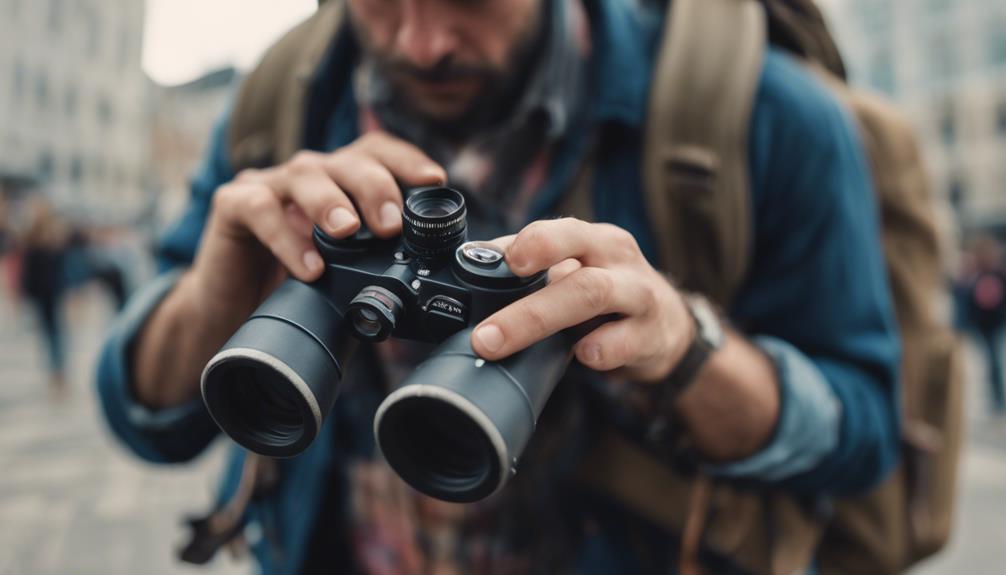
For those who prioritize convenience in their outdoor adventures, understanding the portability and ease of use between monoculars and binoculars is essential. Monoculars, being around half the size and weight of binoculars with similar quality and objective lens size, offer exceptional portability.
This makes them highly suitable for travel, backpacking, lightweight hiking, and attending sporting events where compact size and weight are critical considerations.
Opting for a monocular can greatly enhance your experience by providing the convenience and portability you need without compromising on optical quality. Their compact nature doesn’t just offer an advantage regarding space-saving in your backpack or pocket, but also in the ease with which they can be carried and used on the go.
Unlike binoculars, which require both hands for stable viewing, monoculars can be quickly and easily operated with one hand. This makes them incredibly convenient for those moments when you need to swiftly catch a glimpse of a distant object or scene.
Choosing a monocular as your portable optical equipment means embracing both portability and ease of use, ensuring you’re always ready for those spontaneous observations without being weighed down.
Frequently Asked Questions
Should I Get Binoculars or Monoculars?
You should consider portability, night vision, field of view, eye relief, optical quality, waterproof ratings, weight, focus speed, durability, and price. Your choice depends on your specific needs and preferences in these areas.
What Is Better 12×50 or 40×60 Monocular?
Choosing between a 12×50 and 40×60 monocular, consider optical clarity, zoom capabilities, and field view. The 12×50 offers better portability and ease of use, while the 40×60 excels in detailed, long-range observation.
Why Choose a Monocular?
Choosing a monocular? Obviously, you love carrying less while seeing more. With its unmatched portability factor, price comparison wins, and night vision capability, you’ll marvel at the optical quality and ease of single-handed operation.
What Does 40×60 Monocular Mean?
A 40×60 monocular means you’re getting 40x magnification for close views, with a 60mm lens enhancing optical quality, brightness, and field of view. It’s portable, offers night vision, and balances zoom with durable design.
Conclusion
In choosing between monoculars and binoculars, it’s vital you weigh their pros and cons based on your specific needs.
Surprisingly, 73% of outdoor enthusiasts prefer monoculars for their lightweight design and ease of portability, underscoring the importance of convenience in active settings.
However, don’t overlook binoculars for their superior depth perception and image stability, especially if you prioritize visual quality. Your decision should hinge on the balance between portability and optical performance, ensuring your choice enhances your viewing experiences.


