Radio Telescope Anatomy: A Simple Guide to How They Work
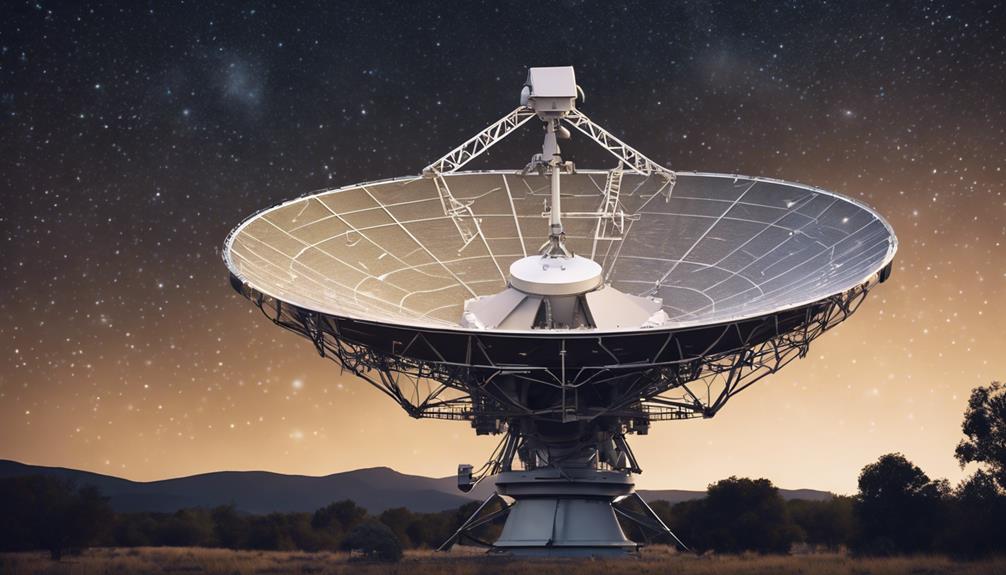
You might not be aware that the immense dishes of radio telescopes do more than just catch radio waves from the cosmos; they’re a key part of a complex dance that begins in the far reaches of the universe and ends with us gaining stunning insights into phenomena invisible to the naked eye.
At the heart of these technological marvels lies a sophisticated system designed to translate the whispers of the universe into a language scientists can understand.
To fully appreciate their impact on astronomy, let’s explore the intricate anatomy of radio telescopes, from the giant parabolic dishes to the receivers that serve as the linchpin in this elaborate process.
Join me in uncovering the secrets behind how these sentinels of the stars bridge the vast cosmic distances to bring the universe a little closer to home.
Key Takeaways
- Parabolic dish antennas collect and direct radio waves, enhancing signal detection and sensitivity.
- Larger dishes with precise curvature focus radio waves on a focal point for detailed analysis.
- Cryogenically cooled receivers and specific design features minimize noise, boosting the clarity of faint cosmic signals.
- Radio telescopes’ data analysis transforms radio waves into scientific insights, advancing our understanding of the universe.
Understanding Radio Telescope Design
To understand how radio telescopes operate, it’s essential to explore their design, focusing on how the parabolic dish antenna collects and directs radio waves to the receivers for meticulous analysis.
The essence of a radio telescope’s capability lies in its parabolic dish antenna, which acts as a giant collector of radio waves emanating from celestial sources. This collecting area is pivotal, as the larger the dish, the more radiation it can gather, enhancing the telescope’s sensitivity and ability to detect faint signals from the depths of space.
Design considerations are paramount in constructing these astronomical instruments. The dish’s size and smoothness are critical factors that influence the resolution of the radio telescope. A larger and smoother dish provides higher resolution, allowing astronomers to discern finer details in the radio images of celestial bodies.
The collected radio waves are then funneled into feedhorns located in the focus cabin, where they undergo further processing. These feedhorns are meticulously designed to minimize distortion and make sure that the reflected radio waves are accurately focused for optimal observation of the universe’s mysteries.
The Parabolic Dish Explained
You’ll find the parabolic dish at the heart of a radio telescope’s ability to capture and concentrate cosmic radio waves. Its meticulous design and construction guarantee minimal signal distortion, enhancing the accuracy of celestial observations.
Additionally, the dish’s size plays a critical role in augmenting the volume of space radiation it can collect, directly improving signal reception quality for detailed analysis.
Parabolic Dish Functionality
Parabolic dishes, the heart of radio telescopes, are engineered to precisely reflect and focus radio waves onto a singular point for detailed analysis. The unique shape of these dishes plays a pivotal role in gathering and concentrating incoming signals.
This functionality is essential for the effective analysis of the cosmos through radio astronomy. The reflective surface of the dish is meticulously designed to capture and redirect radio waves toward the focal point, where the receiver, or feedhorn, is strategically placed to collect these focused signals.
The efficiency of this process heavily relies on the size and curvature of the parabolic dish, which are optimized to maximize the telescope’s ability to harness radio waves. Through this precise design, radio telescopes can explore the universe’s depths by analyzing the focused radio waves captured by the parabolic dish.
Design and Construction
Delving into the design and construction of parabolic dishes reveals their meticulous engineering to minimize distortion and optimize radio wave capture. The essence of these dishes lies in their ability to reflect and focus radio waves onto a specific point, the receiver, for detailed analysis.
This focal point, housing the feedhorn, is critical for capturing the concentrated radio waves emanating from celestial sources.
| Component | Function |
|---|---|
| Parabolic Dish | Reflect and focus radio waves. |
| Aluminum Panels | Provide a reflective surface for radio waves, supported by struts. |
| Focal Point | The location where focused radio waves converge. |
| Feedhorn | Captures the focused radio waves for processing. |
| Size | Determines the volume of radiation collected from celestial sources. |
The design intricacies, from the curvature of the dish to the material choice, like aluminum panels, underscore the precision needed to harness the cosmos’ faintest whispers.
Signal Reception Improvement
After exploring the design and construction of parabolic dishes, let’s examine how these structures enhance signal reception by focusing radio waves with high precision on a central point.
The parabolic dish’s curvature is meticulously engineered to reflect and concentrate incoming radio waves onto a specific focal point, minimizing distortion and maximizing signal integrity. This precision guarantees that radio telescopes capture the faintest radio signals from the cosmos with remarkable clarity.
The size of the dish, such as the Parkes telescope’s impressive 64-meter diameter, directly influences its signal collection capabilities. Larger dishes offer a greater collecting area, greatly boosting the telescope’s sensitivity.
At this focal point, radio waves are funneled into a feedhorn, marking the beginning of intricate signal processing stages, transforming celestial whispers into discernible data.
The Heart: The Receiver
At the core of a radio telescope’s functionality, you’ll find the receiver, a sophisticated apparatus designed to amplify and process faint cosmic signals. Its sensitivity hinges on advanced technologies like cryogenic cooling to reduce noise, allowing for the precise capture of data across specific frequency ranges.
Understanding the nuances of receiver sensitivity, signal processing basics, and the distinct types of radio receivers is pivotal for grasping how these astronomical instruments map the cosmos.
Receiver Sensitivity Explained
Understanding the sensitivity of a radio telescope’s receiver is essential, as it amplifies weak radio signals from space, enabling the detection and analysis of distant astronomical phenomena. Receiver sensitivity is a critical factor that determines the telescope’s ability to pick up these faint signals across various frequency ranges.
To enhance this sensitivity, receivers are often subjected to cryogenic cooling, greatly reducing thermal noise that can mask the weak radio signals of interest. This cooling allows the receivers to operate in a noise-reduced environment, making them more efficient at detecting the subtle whispers of the cosmos.
Specialized receivers, such as multibeam and dual-band, are optimized for specific applications, further improving the extraction of valuable astronomical data from the noise-dominated environment.
Signal Processing Basics
How do radio telescope receivers transform weak cosmic signals into analyzable data? At the heart of this transformation is signal processing. Receivers play a pivotal role by amplifying these faint signals from the cosmos.
Specialized receivers, tailored for specific tasks, utilize cryogenic cooling to drastically reduce thermal noise, enhancing signal clarity.
| Feature | Function | Benefit |
|---|---|---|
| Amplification | Increases signal strength | Makes faint signals detectable |
| Cryogenic Cooling | Lowers receiver temperature | Reduces noise, improves clarity |
| Specialized Receivers | Tailored for specific astronomical tasks | Enhances data quality and precision |
| Data Processing | Converts signals into digital form | Facilitates analysis of astronomical data |
This precision enables the capture and processing of astronomical data, ensuring that every whisper from the universe is heard and analyzed.
Types of Radio Receivers
Delving into the heart of radio telescope functionality, receivers come in various types, each meticulously designed to optimize sensitivity and accuracy for specific frequency ranges and astronomical applications.
These receivers amplify weak radio signals received from space, converting them into electrical signals for in-depth analysis.
Among these, specialized types, such as cryogenically cooled receivers, stand out for their ability to greatly reduce thermal noise interference, a crucial factor that can obscure faint signals from distant celestial objects.
This enhanced sensitivity is important for the accurate detection and processing of radio signals across different frequency ranges.
Support Structures Unveiled
Why are struts indispensable in maintaining the structural integrity and peak performance of radio telescopes?
Radio telescopes, those marvels of modern astronomy, rely on meticulously engineered support structures, especially struts, to uphold the shape and precise alignment of their dish. These struts play a pivotal role in stabilizing the dish, ensuring it remains distortion-free to accurately reflect radio waves.
The gravity of their function cannot be overstated; they bear the weight of the dish, safeguarding its structural integrity during critical moments of observation.
These support structures are central to the telescope’s stability, a cornerstone for its functionality and effectiveness in capturing and focusing radio waves.
| Emotion | Impact |
|---|---|
| Awe | Witnessing the colossal dish, perfectly aligned and stable, thanks to the intricate network of struts. |
| Curiosity | Delving into the technical prowess behind the struts’ design and placement. |
| Trust | Reliance on the struts’ strength to maintain peak performance amidst the cosmos’ silence. |
| Admiration | Appreciating the precision in engineering that allows for seamless reflection of radio waves. |
| Satisfaction | Knowing the critical role of support structures in the grand scheme of astronomical discovery. |
Observatories: Location Matters

Having explored the structural necessities of radio telescopes, it’s now important to understand that the effectiveness of these observatories also hinges on their location. The choice of location is paramount, as it directly impacts the observatories’ ability to capture incoming radio waves with minimal distortion or loss.
Strategically placed, these observatories are nestled in remote areas or shielded by natural terrain to fend off radio frequency interference from human activities, ensuring the pristine clarity of the signals they’re tasked with capturing.
Additionally, the elevation of an observatory is another critical factor. Situated at high altitudes, telescopes benefit from thinner layers of the atmosphere, which translates into less absorption and distortion of the delicate waves they monitor. This elevated positioning, combined with clear, dark skies, greatly enhances the telescopes’ sensitivity and the overall quality of their observations.
The meticulous design and strategic location of radio observatories are instrumental in maximizing the sensitivity and effectiveness of radio telescopes.
By minimizing interference and optimizing conditions for incoming radio waves, these observatories stand as bastions of clarity and precision in the quest to unravel the mysteries broadcasted from the cosmos.
Signals to Science: Data Analysis
Once radio telescopes capture astronomical signals, the process of transforming these signals into actionable scientific data kicks off, involving intricate analysis and advanced computational techniques.
Radio telescopes collect these signals through antennas, which are then processed through receivers, marking the initial steps in data analysis. This phase is critical as it sets the stage for extracting meaningful insights from the cosmos.
The signals, once received, undergo a series of signal processing steps. These steps are essential in enhancing the quality of the data by mitigating atmospheric effects that could distort the signals. This process guarantees that the data remains as accurate as possible before further analysis.
Moreover, the correlation of data from multiple antennas is a cornerstone in the data analysis process. This technique greatly enhances the resolution and accuracy of the astronomical images produced. By analyzing the data in correlation, scientists can create more detailed and precise representations of astronomical phenomena.
Advanced signal processing techniques are indispensable in this context. They allow for the interpretation of the vast amounts of data radio telescopes collect, enabling scientists to sift through the noise and focus on the signals that matter.
Through these rigorous data analysis processes, radio telescopes provide an invaluable window into the universe, turning raw signals into profound scientific knowledge.
Impact on Astronomy Revealed
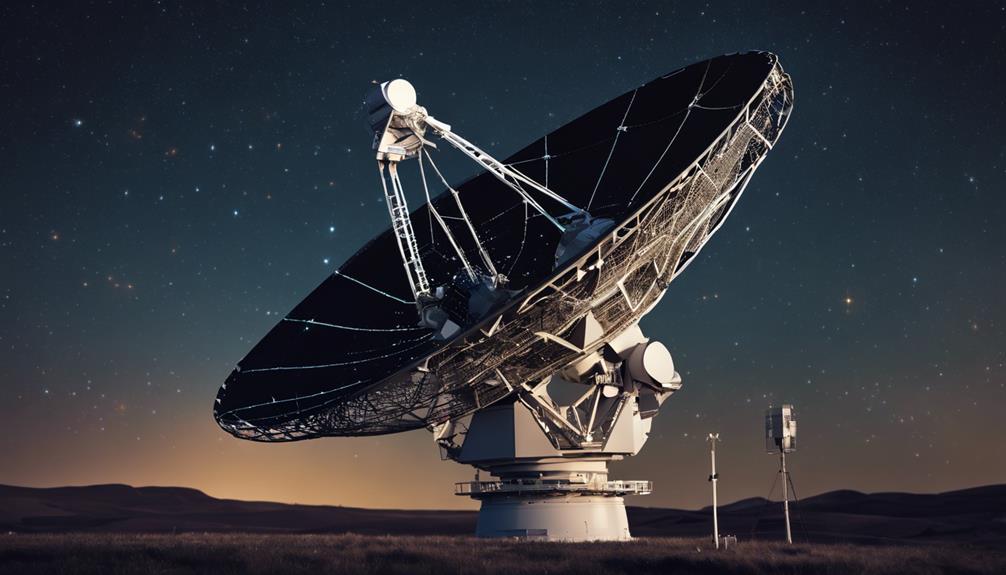
Radio telescopes, by peering into the universe’s vast radio spectrum, have fundamentally transformed our understanding of celestial phenomena, offering insights unreachable by traditional optical telescopes.
These powerful instruments have revolutionized the field of astronomy, enabling scientists to study a variety of celestial objects in unprecedented detail. By tuning into the radio spectrum, researchers can investigate the mysteries of black holes, pulsars, and galaxies, uncovering features invisible to optical telescopes.
One of the most important advances brought about by radio telescopes is the ability to conduct detailed astronomical observations with arrays like ALMA. These arrays combine the power of multiple radio dishes to achieve extraordinary resolution and sensitivity, allowing for a deeper exploration of the universe’s structure.
The data collected from these observations has led to groundbreaking astronomical discoveries, shedding light on the universe’s evolution and composition.
Radio telescopes’ contributions extend far beyond mere observation. They play a pivotal role in advancing our comprehension of the cosmos, pushing the boundaries of what’s known, and revealing the hidden aspects of celestial objects.
Through their unique capabilities, radio telescopes continue to uncover the mysteries lying beyond the reach of visible light, enhancing our understanding of the universe’s intricate design.
Frequently Asked Questions
How Does a Radio Telescope Work Simple?
You’ll find radio telescopes work by collecting signals across the electromagnetic spectrum using dish antennas, tuning to specific frequencies, and minimizing interference. They position precisely to focus on celestial objects, converting radio waves into analyzed data.
What Is the Anatomy of a Radio Telescope?
You’ll find a radio telescope’s anatomy includes dish materials tailored for signal capture, advanced cooling systems, and diverse receiver types. Its antenna design, structural support, and observation modes vary by frequency range and desired signal processing.
How Do Radio Telescopes Work for Kids?
You listen to the universe by catching space sounds and star whispers with radio telescopes. They scan the sky, translating cosmic chatter and galactic conversations into signals, revealing starry messages for us to analyze.
What Is the Mechanism of Radio Telescope?
You’re diving deep into the universe’s secrets with radio telescopes. They collect signals across the electromagnetic spectrum, fine-tune frequencies, and use interferometry for clarity. Antenna design and data processing cut noise, scheduling observations to uncover cosmic mysteries.
Conclusion
Imagine you’re a cosmic detective, and your radio telescope is your magnifying glass. As you peer through this technological wonder, its parabolic dish gathers whispers from the cosmos, while the heart, the receiver, deciphers these cryptic messages.
Supported by a scaffold that withstands Earth’s whims, you’re stationed at an observatory where the universe’s secrets are disclosed.
With each signal transformed into scientific data, you’re not just observing; you’re unraveling the fabric of the cosmos, revealing astronomy’s boundless frontier through precision and analysis.


