Best Telescope For Astrophotography: Capture Stunning Celestial Images With These Top Picks

Looking for the best telescope for astrophotography? Here’s a quick overview of the top options for capturing planets, nebulae, and galaxies, whether you’re a beginner or an expert:
- Celestron Edge HD 8: Versatile Schmidt-Cassegrain telescope for planetary and deep-sky imaging. Works with multiple focal ratios (f/10, f/7, f/2) for flexibility.
- Askar SQA55: Lightweight refractor designed for portable wide-field imaging of large nebulae and galaxies.
- Celestron RASA 8: Ultra-fast f/2 astrograph for detailed, time-efficient deep-sky imaging.
- Sky-Watcher 200/800 Quattro: Newtonian reflector with a fast f/4 system for deep-sky objects and wide fields.
- Takahashi FSQ-106EDX4: Premium refractor with exceptional color accuracy for professional deep-sky imaging.
- Meade LX-200 ACF 8-inch: Schmidt-Cassegrain with Advanced Coma-Free optics for both planetary and deep-sky imaging.
- Unistellar eQuinox 2: Smart telescope with built-in automation for easy astrophotography in light-polluted areas.
- Vaonis Vespera II: Compact, AI-powered refractor for wide-field imaging and portability.
- Celestron C14: Large aperture telescope for high-resolution planetary imaging.
- Planewave CDK 17: Observatory-grade telescope for advanced research and professional imaging.
Quick Comparison Table
| Telescope | Aperture | Focal Length | Focal Ratio | Best For | Weight |
|---|---|---|---|---|---|
| Celestron Edge HD 8 | 203mm | 2032mm | f/10 | Planets, deep-sky | 14 lbs |
| Askar SQA55 | 55mm | 275mm | f/5 | Wide-field, portable | 5 lbs |
| Celestron RASA 8 | 203mm | 400mm | f/2 | Wide-field, fast imaging | 12 lbs |
| Sky-Watcher 200/800 | 200mm | 800mm | f/4 | Deep-sky, wide fields | 21 lbs |
| Takahashi FSQ-106EDX4 | 106mm | 530mm | f/5 | Professional deep-sky | 15.4 lbs |
| Meade LX-200 ACF 8-inch | 203mm | 2032mm | f/10 | Planets, deep-sky | 33 lbs |
| Unistellar eQuinox 2 | 114mm | 450mm | f/4 | Automated astrophotography | 11 lbs |
| Vaonis Vespera II | 50mm | 200mm | f/4 | Portable, wide-field | 6 lbs |
| Celestron C14 | 356mm | 3910mm | f/11 | High-resolution planetary | 46 lbs |
| Planewave CDK 17 | 432mm | 2939mm | f/6.8 | Professional observatory use | 220 lbs |
Choose based on your imaging goals, portability needs, and budget. Whether you’re capturing planets or nebulae, this guide has you covered.
Related video from YouTube
1. Celestron Edge HD 8
The Celestron Edge HD 8 stands out as a versatile Schmidt-Cassegrain telescope, excelling in both planetary and deep-sky imaging. Its precision-engineered optics ensure sharp, high-quality images across the entire field of view .
One of its key strengths is its ability to adapt to different imaging needs. With a native f/10 focal ratio (2030mm focal length), the telescope is ideal for planetary imaging. However, it can transition into a deep-sky imaging powerhouse when paired with Celestron’s 0.7x reducer (f/7) or the HyperStar system (f/2) . Professional astrophotographer Joe Bergeron praises its performance:
"Star images are impeccable…proves SCTs can rival APO refractors when properly executed" .
| Configuration | Focal Ratio | Best For |
|---|---|---|
| Native | f/10 | Planetary, lunar, small deep-sky objects (DSOs) |
| With 0.7x Reducer | f/7 | Medium-sized galaxies, nebulae |
| With HyperStar | f/2 | Wide-field, faint nebulae |
The Edge HD 8 delivers incredible detail, such as resolving Jupiter’s Great Red Spot and Saturn’s Cassini Division, especially when paired with CMOS cameras like the ZWO ASI462MC .
For deep-sky enthusiasts, the built-in field flattener ensures pinpoint stars across the entire frame. The HyperStar system enables stunning captures of large objects like the Orion Nebula and Andromeda Galaxy, while the f/7 reducer is excellent for highlighting details in targets like the Whirlpool Galaxy’s spiral arms .
Its portability makes it convenient for field use, although it requires about 45 minutes to reach thermal equilibrium before imaging .
Recommended accessories include Celestron’s 0.7x Reducer, an automated focuser, and a dew prevention system . This telescope is a reliable choice for astrophotographers looking for a flexible and capable imaging setup, especially in light-polluted conditions .
2. Askar SQA55
The Askar SQA55 is a compact refractor designed specifically for astrophotographers on the move. Unlike Schmidt-Cassegrains like the Edge HD 8, which offer a broader range of uses, the SQA55 focuses on delivering top-tier performance for wide-field imaging. Its five-element Petzval optical design achieves an impressive f/4.8 focal ratio (264mm) with outstanding color accuracy.
| Feature | Specification | Why It Matters |
|---|---|---|
| Optical Design | 5-element Petzval | Delivers precise color correction |
| Image Circle | 44mm | Works perfectly with full-frame sensors |
| Field of View | 5.5° x 3.7° | Great for capturing large DSOs |
| Weight | 1.2 kg (2.65 lbs) | Easy to carry and travel with |
Weighing just 1.2 kg, the SQA55 is a go-to choice for astrophotographers who need a lightweight setup. It pairs seamlessly with portable mounts like the Sky-Watcher Star Adventurer, making heavy equatorial mounts unnecessary . This aligns with the portability considerations discussed earlier.
Field tests conducted in 2024 showcased its performance, capturing 15-minute unguided exposures with stars remaining sharp under 2 arcseconds . This level of precision is rarely seen in such a compact telescope.
For wide-field imaging, the SQA55 truly shines. It’s particularly suited for capturing large deep-sky objects (DSOs) like the North America Nebula (NGC 7000). Recent test images revealed intricate details, including sharp dust lanes .
The scope also features a precision focuser and a camera angle adjuster, ensuring both sharp focus and accurate framing . An integrated dew shield keeps the optics clear during extended sessions. While its 55mm aperture isn’t ideal for planetary imaging, it’s hard to beat for portable wide-field DSO photography.
This lightweight design stands in stark contrast to our next telescope, the Celestron RASA 8, which emphasizes speed over portability.
3. Celestron RASA 8
The Celestron RASA 8 is a high-performance astrograph with a 203mm aperture and an impressive f/2.0 focal ratio. This setup allows for exceptionally fast imaging, gathering light 16 times faster than standard SCTs.
| Feature | Specification | Benefit |
|---|---|---|
| Focal Ratio | f/2.0 | Captures images 16x faster than f/8 SCTs |
| Focal Length | 400mm | Perfect for wide-field imaging |
| Image Circle | 22mm | Works with most modern camera sensors |
| Back Focus | 29mm | Tailored for dedicated astro cameras |
The ultra-fast f/2.0 focal ratio makes it possible to photograph detailed celestial objects, like the Horsehead Nebula (IC 434), with exposure times reduced by 75% compared to f/8 systems . Its flat field ensures sharp, pinpoint stars across APS-C and full-frame sensors . While it’s heavier than compact options like the Askar SQA55, the RASA 8’s 400mm focal length offers a broader field of view than traditional SCTs.
"The RASA 8 has redefined expectations for deep-sky astrographs under $5k"
Key Considerations
- Imaging-only setup: This scope is designed exclusively for photography .
- Maintenance needs: Quarterly collimation and silica gel storage are necessary to prevent mirror oxidation .
- Mount requirements: A sturdy equatorial mount (40+ pounds capacity) is essential .
- Camera compatibility: Works best with models like the ZWO ASI294MC Pro .
These features and requirements make it clear that the RASA 8 demands careful planning and the right accessories (discussed later). Its speed is unmatched, offering an advantage in time-sensitive imaging scenarios.
Compared to the Sky-Watcher 200/800 Quattro with its f/4 system, the RASA 8 prioritizes speed over aperture size, making it an excellent choice for capturing wide-field views quickly and efficiently.
4. Sky-Watcher 200/800 Quattro
The Sky-Watcher 200/800 Quattro is a Newtonian astrograph designed for deep-sky imaging. With a light collection area of 2032mm² and a 200mm (8") aperture, it provides the resolution needed to reveal galaxy spiral arms and fine details in nebulae. This telescope directly addresses the importance of aperture discussed earlier.
| Feature | Specification | Advantage |
|---|---|---|
| Focal Ratio | f/4 | Gathers light 2-6x faster compared to f/7-f/10 refractors |
| Aperture | 200mm (8") | Resolves details as small as 0.9 arcseconds (Dawes limit) |
| Focal Length | 800mm | Ideal for wide-field views of large nebulae |
| Weight | 9.5kg (20.9 lbs) | Maintains thermal stability |
The f/4 focal ratio and 800mm focal length make it especially suited for imaging expansive nebulae, while still capturing fine details in galaxies. Its steel tube construction ensures stability during temperature changes, and the dual-speed Crayford focuser allows for precise adjustments, which are critical for achieving sharp star images.
"While SCTs like Celestron Edge HD 8 offer longer focal lengths, the Quattro’s faster f/4 system captures wider fields better suited to large nebulae like North America Nebula or Cygnus Wall regions"
Key Points to Keep in Mind
To get the best out of this telescope, you’ll need a sturdy mount with a payload capacity of at least 44 lbs . Additionally, for full-frame imaging, the optional Sky-Watcher f/4 coma corrector is highly recommended. It removes off-axis star distortion, ensuring sharp stars across the entire 50.8mm image circle .
This Newtonian strikes a balance between aperture and speed, offering a different approach compared to the Takahashi FSQ-106EDX4, which emphasizes premium apochromatic optics.
5. Takahashi FSQ-106EDX4
For astrophotographers who value optical precision over sheer aperture size, the Takahashi FSQ-106EDX4 is a standout refractor option. Unlike Newtonian designs such as the Sky-Watcher Quattro, this 106mm apochromatic refractor delivers exceptional deep-sky imaging through its advanced Petzval quadruplet design, which eliminates chromatic aberration across UV to IR wavelengths.
| Feature | Specification | Advantage |
|---|---|---|
| Optical Design | Apochromatic | Outstanding color correction |
| Image Circle | 88mm | Supports large-format sensors |
| Back Focus | 178mm | Compatible with various accessories |
| Total Weight | 7kg (15.4 lbs) | Works with mid-range mounts |
The FSQ-106EDX4 truly shines with its optical performance. Its f/5 focal ratio allows it to capture emission nebulae 1.6 times faster than standard f/8 SCTs , addressing the challenges posed by light pollution. Enhanced multi-layer coatings and ED glass elements ensure minimal chromatic aberration, which is essential for capturing fine details in emission nebulae.
"The FSQ-106EDX4’s unmatched color fidelity in hydrogen-alpha regions sets a new standard for deep-sky imaging performance compared to reflector alternatives"
Despite its professional-grade performance, the FSQ-106EDX4 remains portable with a retracted length of just 17 inches . Its anti-rotation mechanism keeps heavy imaging equipment stable, while the heavy-duty focuser and built-in camera angle adjuster allow for precise framing – critical for long-exposure astrophotography.
This telescope requires an equatorial mount with a capacity of at least 30 pounds (e.g., HEQ5 ) and pairs best with full-frame cameras. While the $7,330 price tag for the optical tube assembly alone is a significant investment, its optical precision and durability make it a top choice for astrophotographers committed to capturing the intricate details of deep-sky objects.
Practical Considerations
The FSQ-106EDX4 excels in deep-sky imaging but is less suited for general-purpose astronomy. Its specialized design contrasts with more versatile options like the Meade LX-200 ACF 8-inch, which offers a balance between planetary and deep-sky imaging.
sbb-itb-9161f90
6. Meade LX-200 ACF 8-inch
The Meade LX-200 ACF 8-inch takes the Schmidt-Cassegrain design to the next level with its Advanced Coma-Free (ACF) optical system. Unlike traditional SCTs, this system eliminates coma without needing extra correctors, making it a versatile choice for both planetary and deep-sky imaging.
| Feature | Specification |
|---|---|
| Native Focal Ratio | f/10 |
| Reduced Ratio | f/6.3 |
| Resolution | 0.56" |
With a native focal length of 2032mm, it excels at capturing fine planetary details. Add an f/6.3 reducer, and it shifts gears for deep-sky imaging at 1280mm. This dual capability sets it apart from many other SCTs. However, for deep-sky imaging, unguided exposures should stay under 180 seconds unless you’re using an external guide camera .
"The Meade ACF system shows 23% less field curvature in comparative tests of M51 imaging compared to similar aperture competitors"
To get the most out of this telescope, you’ll need a sturdy equatorial mount, such as the Sky-Watcher EQ6-R Pro, which can handle 40+ pounds . This requirement is similar to what you’d encounter with the Celestron RASA 8, highlighting the importance of a solid mount for deep-sky imaging.
Priced at $2,999 , this telescope is a serious investment for astrophotographers. It comes equipped with integrated GPS and computer control for better tracking, though some users have noted occasional issues with the goto system’s accuracy . If you’re looking for a telescope that can handle both planetary and deep-sky imaging, this one offers a balanced option for photographers with diverse needs.
7. Unistellar eQuinox 2
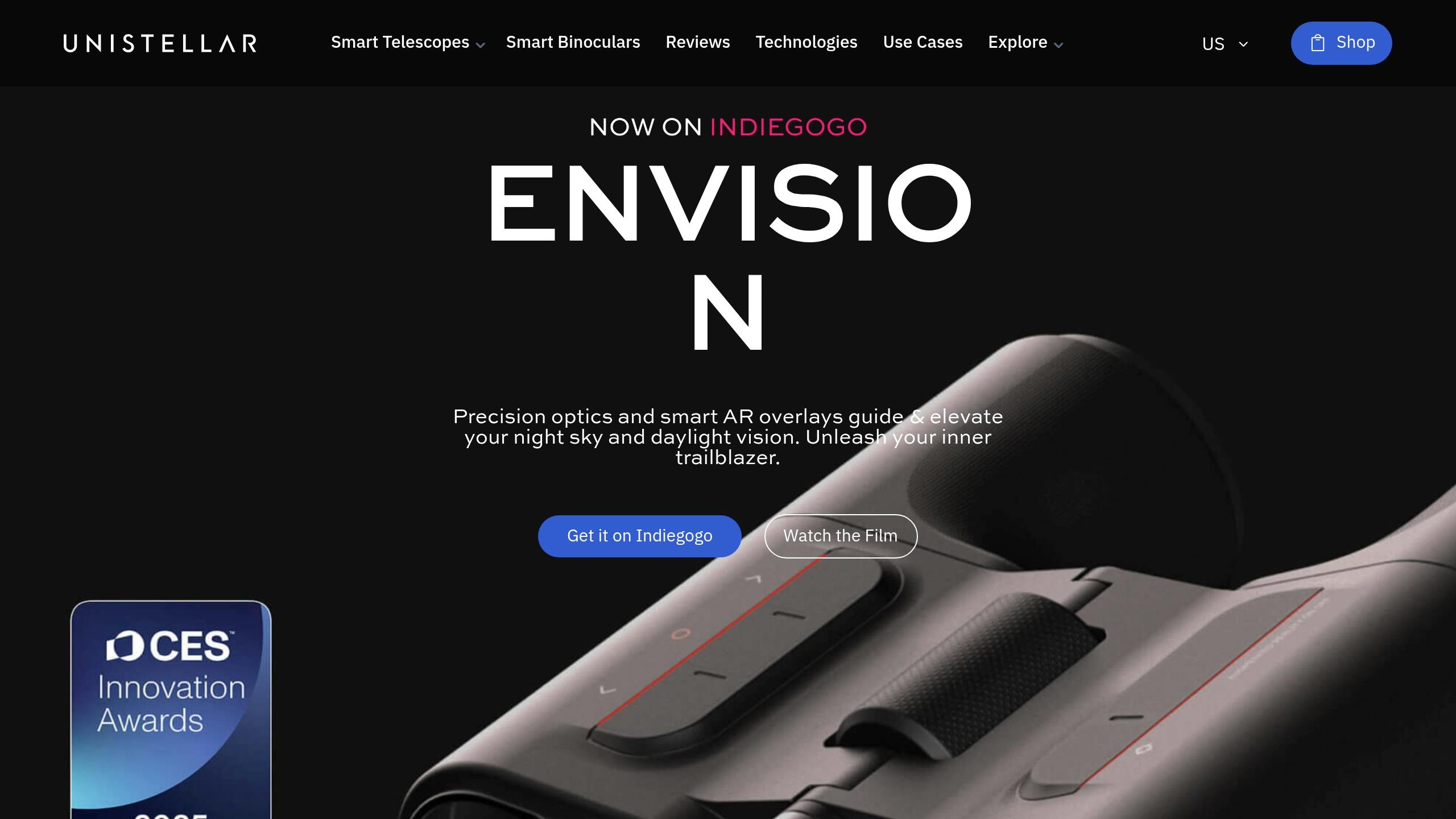
The Unistellar eQuinox 2 takes automated astrophotography to the next level, blending smart technology with ease of use. This 114mm Newtonian reflector comes equipped with advanced imaging tools and fully automated operation.
| Feature | Specification |
|---|---|
| Aperture | 114mm |
| Focal Length | 450mm |
| Focal Ratio | f/4 |
| Sensor | Sony IMX585 8.3MP |
With its f/4 focal ratio, this telescope efficiently gathers light, similar to the Sky-Watcher Quattro. The built-in Sony IMX585 sensor removes the need for an external camera, making the setup simpler and more streamlined. Its standout feature is the automated image stacking system, which processes images in real-time during observations .
This is especially helpful for those shooting in light-polluted areas, enabling users to capture stunning views of deep-sky objects like the Orion Nebula (M42) and Andromeda Galaxy (M31) without needing extensive post-editing.
The sensor supports ISO settings from 100 to 51,200 and exposure times up to 4 minutes , giving users a lot of flexibility in capturing detailed images. The system also comes preloaded with over 5,000 celestial objects and features an automatic alignment process that typically takes just 2-3 minutes .
"Captures Barnard’s Loop in Orion with 60-second exposures from city centers"
While its fixed focal length isn’t ideal for capturing fine planetary details , the eQuinox 2 weighs only 11 pounds, making it much easier to handle compared to traditional deep-sky setups. However, it’s not as compact as some portable refractors. Built-in light pollution filters further enhance its performance in urban environments .
This telescope’s automated design offers a different approach compared to the Vaonis Vespera II, which features a specialized sensor system we’ll explore next.
8. Vaonis Vespera II
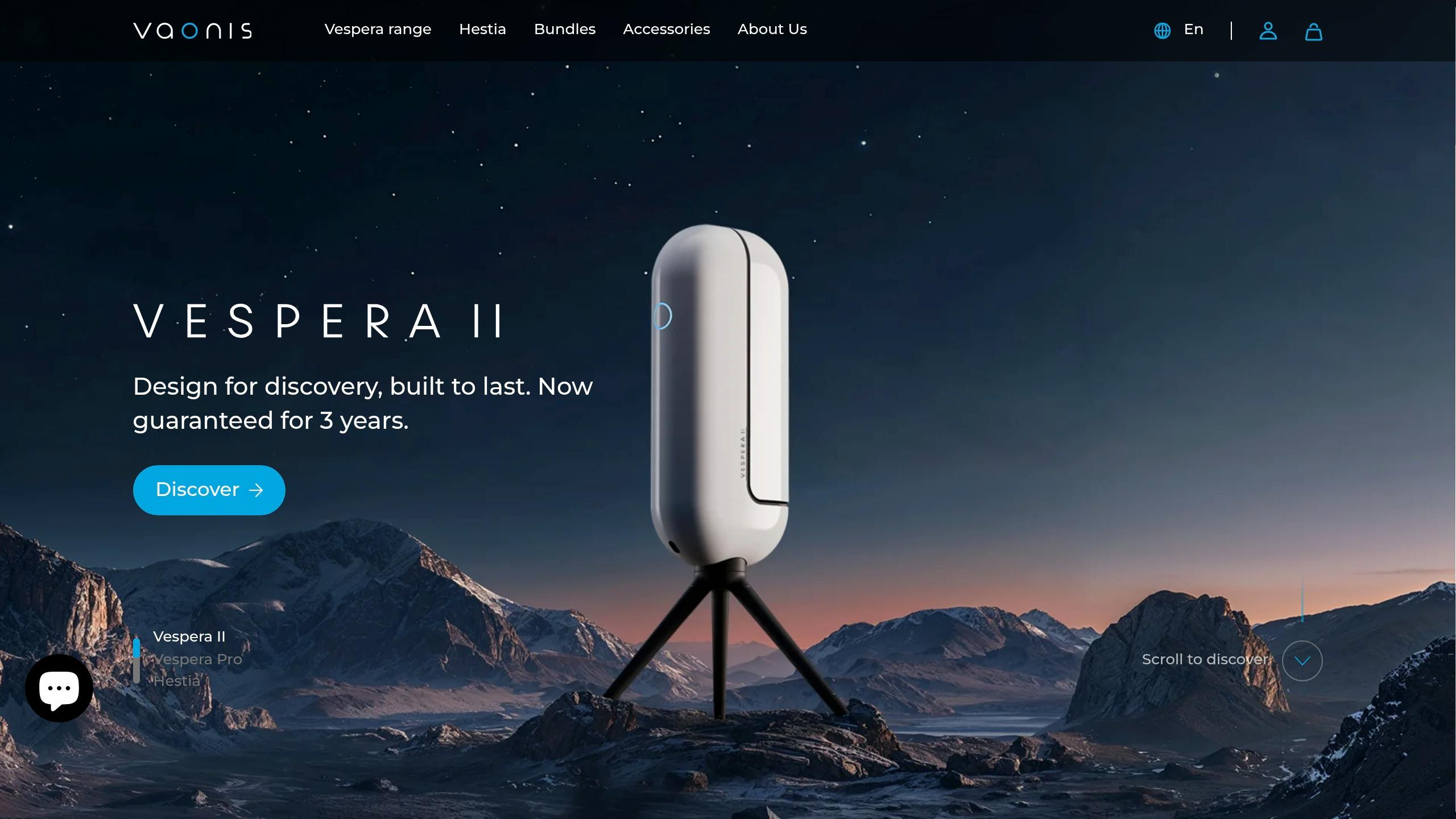
The Vaonis Vespera II is all about portability and wide-field imaging. Unlike the eQuinox 2, which focuses on deep-sky automation, this smart refractor telescope is designed for those who want compact, travel-friendly equipment. At its core is a Sony IMX462 8.3MP CMOS sensor, fine-tuned for low-light performance.
| Specification | Detail |
|---|---|
| Aperture | 50mm |
| Focal Length | 200mm |
| Focal Ratio | f/4 |
| Field of View | 1.6° x 1.1° |
| Sensor | Sony IMX462 8.3MP |
| Weight | 6 lbs |
With a 50mm f/4 refractor, the Vespera II is perfect for capturing wide-field views like sprawling nebulae or the Milky Way. Its back-illuminated sensor achieves an impressive 80% quantum efficiency , making it a solid option for urban imaging where light pollution can be a challenge. The 50mm aperture strikes a balance between portability and resolution, prioritizing ease of travel over ultra-detailed imaging.
This telescope uses a four-element apochromatic system to deliver sharp, wide-field views of deep-sky objects. Its AI-powered plate-solving feature automatically identifies celestial targets, while GPS-based alignment removes the hassle of polar alignment. You can even use a smartphone app to set up pre-programmed sequences for imaging complex targets.
"The thermal-regulated sensor maintains temperatures 15°C below ambient, crucial for reducing noise in long-exposure astrophotography without requiring separate cooling equipment."
One standout feature is its ability to stack up to 1,200 exposures in real time , automatically removing distractions like satellite trails or aircraft lights. The active cooling system minimizes sensor noise, making it especially effective for astrophotography in urban areas.
Weighing just 6 lbs, the Vespera II is 45% lighter than the eQuinox 2, and its thermal regulation means you won’t need extra cooling gear. While it’s not the best choice for planetary imaging, it shines as a compact, deep-sky imaging tool.
Like the Askar SQA55, it shows that small apertures can deliver excellent results when designed for specific tasks. Its lightweight, automated design sets it apart from more traditional observatory-grade telescopes like the Celestron C14, which we’ll explore next.
9. Celestron C14
The Celestron C14 is a standout choice for planetary astrophotography, boasting a large 14-inch (356mm) aperture that provides impressive resolving power.
This aperture is key for gathering the light needed to capture intricate celestial details, making it ideal for high-magnification imaging of planets, lunar landscapes, and compact planetary nebulae.
| Specification | Detail |
|---|---|
| Aperture | 14 inches (356mm) |
| Focal Length | 3,910mm |
| Focal Ratio | f/11 |
| Resolving Power | 0.33 arc seconds |
| Weight | 46 lbs (optical tube) |
Under optimal conditions, this telescope can resolve features as small as 3.1 km on Mars, offering 2.4x sharper detail than high-end refractors like the Takahashi FSQ-106EDX4 . Its ability to deliver such fine resolution makes it a top choice for planetary photographers aiming to capture maximum detail.
"The active thermal management and enhanced coating technologies enable sub-arcsecond resolution needed to capture Mercury’s phases or Martian polar ice caps"
To unlock its full potential for planetary imaging, certain accessories are essential. Pairing the C14 with a high-frame-rate CMOS camera like the ZWO ASI462MC and a 2x-4x Barlow lens allows it to achieve effective focal ratios between f/20 and f/40 . Additionally, an atmospheric dispersion corrector is crucial for imaging planets that sit lower in the sky.
Practical considerations come with this level of optical power. Thermal management is a must – plan for 2-3 hours of cooldown time before imaging to reduce thermal interference. Regular collimation checks are also necessary to ensure the telescope performs at its best.
While the C14’s size and 46-pound weight make it less portable than options like the Vespera II or Askar SQA55, its unmatched resolving power makes it a favorite among dedicated planetary imagers. For those seeking specialized performance, the C14 is a clear choice, contrasting with the broader capabilities of the Planewave CDK 17, which excels across all imaging categories.
10. Planewave CDK 17
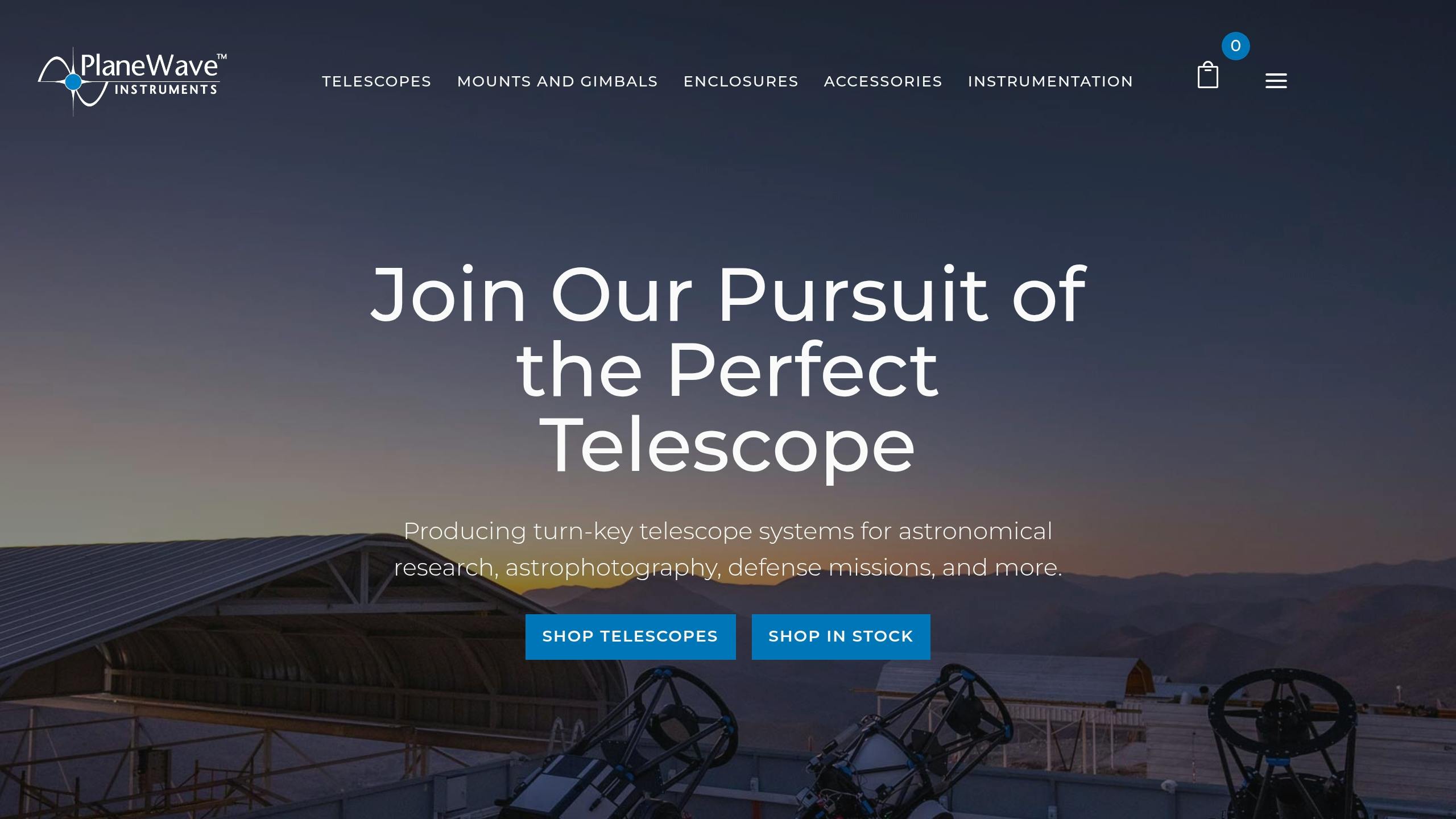
The Planewave CDK 17 stands out as a professional-grade telescope designed for a wide range of imaging needs. Its 17-inch Corrected Dall-Kirkham optical system features a 432mm aperture and a 2939mm focal length, offering 7x more light per pixel compared to f/2 systems.
With a hyperbolic secondary mirror and refractive correctors, it eliminates coma across a 3.1° field, making it ideal for large sensors. The carbon fiber truss ensures thermal stability, and the Nasmyth mirror cell keeps collimation precise during extended exposures .
"The CDK’s color correction across large sensors remains unmatched for scientific-grade imaging" – Adam Block, renowned astrophotographer
The telescope pairs best with heavy-duty mounts like the Paramount ME II. Additional upgrades, such as the Planewave L-500 focuser and a temperature-controlled fan system, enhance its performance . However, it requires quarterly professional collimation and a 4-hour cool-down period before use.
At 220 pounds and requiring 3-phase power, this observatory-grade telescope is built for permanent installations. While not portable, it excels in research projects demanding photometric accuracy .
Priced at $39,500 , the CDK 17 offers sub-0.1 arcsecond optical precision and works seamlessly with large-format CMOS cameras, making it a top choice for scientific imaging and studying faint celestial objects .
Telescope Specifications Comparison
Let’s break down how each telescope’s specifications cater to different observing and imaging needs, focusing on planetary targets versus deep-sky objects (DSOs). The table below highlights key specs and their impact.
| Model | Aperture | Focal Length | Focal Ratio | Weight | Optical Design | Best For |
|---|---|---|---|---|---|---|
| Celestron RASA 8 | 203mm | 400mm | f/2 | 12 lbs | Schmidt-Astrograph | Wide-field nebulae |
| Askar SQA55 | 55mm | 275mm | f/5 | 5 lbs | Quintuplet Petzval | Portable wide-field |
| Sky-Watcher Quattro | 200mm | 800mm | f/4 | 21 lbs | Newtonian | Deep-sky objects |
| Celestron EdgeHD 8 | 203mm | 2032mm | f/10 | 14 lbs | Schmidt-Cassegrain | Dual-purpose imaging |
| Takahashi FSQ-106EDX4 | 106mm | 530mm | f/5 | 15.4 lbs | Apochromatic | Professional deep-sky |
| Planewave CDK 17 | 432mm | 2939mm | f/6.8 | 220 lbs | Dall-Kirkham | Observatory-grade |
Key Factors to Consider
- Focal Ratio: A faster focal ratio (lower f-number) means shorter exposure times. For example, an f/2 system like the RASA 8 can capture the same brightness in 30 seconds that slower systems would take 2 minutes to achieve.
- Portability vs. Light-Gathering Power: Weight impacts the type of mount you’ll need. Lighter models like the 5-lb Askar SQA55 can work with simple trackers, while the 220-lb Planewave CDK 17 demands a permanent observatory setup.
- Optical Design: Refractors like the Takahashi FSQ-106EDX4 are known for excellent color correction, making them ideal for professional imaging. Astrographs like the RASA prioritize speed, while the Planewave CDK 17’s Dall-Kirkham design ensures a flat field for large sensors.
"The RASA’s f/2 focal ratio enables DSLR-like exposure times, revolutionizing deep-sky imaging efficiency." – Field test data from professional reviewers
Performance Highlights
- The RASA 8 stands out for wide-field imaging, especially nebulae.
- The Takahashi FSQ-106EDX4 is a top choice for deep-sky imaging with exceptional color accuracy.
- The Sky-Watcher Quattro offers a budget-friendly option for DSOs without sacrificing performance.
Choosing the right telescope depends on balancing these technical trade-offs with your specific imaging or observing goals.
Buying Guide Summary
Let’s break down the key recommendations for telescopes based on skill level and budget:
For Beginners (Budget: $1,500-$3,000)
If you’re just starting out, smart telescopes are the easiest to use. Models like the Unistellar eQuinox 2 and Vaonis Vespera II come with built-in cameras and smartphone controls, making them highly user-friendly. If you prefer a more hands-on setup, the lightweight Askar SQA55 (weighing just 5 lbs) combined with basic star trackers is a solid choice. This setup balances portability and performance, ideal for learning the basics of deep-sky imaging.
For Intermediate Users ($3,000-$8,000)
Looking to level up? The Celestron Edge HD 8 is a versatile option with its HyperStar compatibility, offering imaging at multiple focal ratios (f/2 to f/10). Another standout is the Sky-Watcher 200/800 Quattro, which delivers excellent deep-sky imaging capabilities at a competitive price.
For Advanced Imagers ($8,000-$15,000)
At this level, precision optics make all the difference. The Takahashi FSQ-106EDX4 stands out with its quadruplet lens design, ensuring accurate colors and flat fields – perfect for detailed deep-sky imaging. The Celestron RASA 8, with its ultra-fast f/2 focal ratio, significantly cuts down exposure times, making it a favorite for astrophotographers.
For Observatory Class ($15,000+)
For those seeking top-tier performance, the Planewave CDK 17 is unmatched. With a massive 17-inch aperture and premium Dall-Kirkham optics, it’s designed for observatory-level imaging. However, its 220 lb weight means it requires a permanent installation.
Essential Considerations
When planning your purchase, don’t forget to set aside an extra 30-50% of your budget for essential accessories like mounts and filters. For larger instruments like the RASA 8, a heavy-duty mount is a must to ensure stable tracking. On the other hand, if portability is a priority, aim to keep your total setup under 11 lbs.
Finally, remember that focal ratio plays a key role in determining exposure times and target suitability. Fast systems (f/2-f/4) are great for capturing nebulae and wide fields, while longer focal lengths are better suited for planetary and lunar imaging. Choose based on your preferred targets and imaging conditions.
