How Telescopes Changed History’s Course

While the night sky once held mysteries, telescopes have brought the universe to our doorstep, revealing not just stars, but gateways to understanding. You’ve likely heard of Galileo’s confrontations with the Church or how celestial navigation reshaped ocean voyages, but that’s merely the beginning.
From sparking the Scientific Revolution to playing a significant role in space exploration, these instruments have propelled humanity forward, intertwining with cultural evolutions and technological leaps. As you glance through history’s lens, consider how telescopes have not only mapped the cosmos but also expanded our collective horizons.
What lies beyond, however, hinges on their future as educational catalysts, promising discoveries that await just beneath the surface of our knowledge.
Key Takeaways
- Telescopes revolutionized our understanding of the cosmos, challenging geocentric views and laying the groundwork for modern astronomy.
- By enabling precise celestial navigation, telescopes were instrumental in advancing maritime exploration during the Age of Exploration.
- The technological evolution of telescopes, from Galileo’s initial designs to the James Webb Space Telescope, has continuously expanded our observational capabilities.
- Telescopes have transcended their scientific origins to influence modern culture and education, inspiring future generations and facilitating public engagement with astronomy.
Galileo’s Revelations and the Church
While Galileo’s telescopic observations revolutionized our understanding of the cosmos, they also ignited a contentious debate with the Catholic Church over the heliocentric model, challenging centuries-old geocentric beliefs.
Galileo’s use of the telescope exposed celestial phenomena that contradicted the Church-supported geocentric views, positioning the Earth not at the center of the universe but as a planet orbiting the Sun. This assertion clashed with the Church’s interpretation of scripture and traditional beliefs, marking a pivotal moment in the scientific revolution.
The Church initially perceived Galileo’s discoveries as a direct challenge to its authority, leading to a conflict that symbolized the broader struggle between burgeoning scientific inquiry and religious doctrine.
Despite the Church’s condemnation and the subsequent trial that resulted in Galileo’s house arrest, his work laid the groundwork for modern astronomy and science. His steadfast commitment to empirical evidence and observational science, even in the face of immense opposition, underscores the transformative impact of the telescope on both the scientific community and societal views at large.
Galileo’s revelations catalyzed a shift in how humanity perceives its place in the cosmos, marking a significant milestone in the journey towards embracing a scientifically informed understanding of the universe.
Navigating the Oceans: Telescope’s Role
Beyond its confrontation with ecclesiastical doctrines, the telescope’s influence extended to the vastness of the oceans, revolutionizing how sailors charted their course through the stars. The tool’s precision in celestial navigation enabled mariners to navigate the open seas with newfound accuracy.
By observing celestial bodies, sailors could accurately determine their position at sea, greatly improving the safety and efficiency of maritime exploration.
| Celestial Body Observed | Impact on Navigation |
|---|---|
| Sun | Determined latitude |
| Moon | Assisted in longitude calculation |
| Stars | Aided in pinpointing location at night |
| Planets | Provided reference points for navigation |
| Comets | Historical records for oceanic expeditions |
This advancement in technology paved the way for the Age of Exploration, allowing for the discovery of new lands and the establishment of trade routes across the globe. The reliability and accuracy of telescopes in observing celestial bodies greatly enhanced the effectiveness of oceanic expeditions.
As a result, maritime maps and charts became more precise, ensuring safer voyages. The telescope’s role in maritime exploration underscored its pivotal contribution to expanding the world’s geographical knowledge and fostering global connections.
The Enlightenment and the Telescope

As you explore the impact of telescopes during the Enlightenment, you’ll find they were pivotal in expanding human knowledge and sparking scientific curiosity.
These instruments allowed Enlightenment thinkers like Galileo to challenge traditional beliefs by providing empirical evidence of celestial phenomena.
Consequently, telescopes became indispensable tools for astronomers, facilitating a monumental shift towards a heliocentric view of the cosmos and fostering a new era of empirical observation and rational thinking.
Expanding Human Knowledge
Frequently, the Enlightenment era’s leap in scientific exploration and intellectual curiosity coincided with the telescope’s revolutionary ability to broaden our understanding of the cosmos. This period marked significant advancements in how humanity perceived the universe, largely thanks to figures like Galileo Galilei.
His use of the telescope to make unprecedented astronomical discoveries challenged the existing dogmas and propelled the scientific enlightenment forward. The instrument became not just a tool for observing celestial phenomena but a symbol of the era’s commitment to evidence-based reasoning and the pursuit of empirical knowledge.
Telescopes allowed philosophers and scientists to substantiate their theories with observable facts, thereby laying the groundwork for modern scientific thought and inquiry. Through these developments, the Enlightenment solidified the telescope’s role in expanding human knowledge and reshaping our conception of the universe.
Sparking Scientific Curiosity
Building on the foundation laid during the Enlightenment, telescopes not only expanded our celestial horizons but also ignited a wave of scientific curiosity that challenged and transformed traditional views of the cosmos.
This curiosity led to significant advancements in astronomy, driven by the likes of Galileo Galilei, who used telescopes to gather empirical evidence supporting heliocentric models.
Here’s how telescopes fueled the Enlightenment’s scientific revolution:
- Galileo’s Discoveries: His telescopic observations challenged the geocentric model, promoting a universe centered around the Sun.
- Empirical Evidence: Telescopes provided direct, observable proof, shifting reliance away from theoretical speculation to experimental methods.
- Advancements in Astronomy: Enabled by telescopic technology, leading to more accurate models of the universe.
- Scientific Curiosity: The telescope became a symbol of the pursuit of knowledge, inspiring future generations of scientists and thinkers.
Mapping the Cosmos: Astronomical Advancements
Telescopes have revolutionized our ability to map the cosmos, enabling significant astronomical advancements through precise observations of celestial bodies. Galileo’s revelations marked the dawn of a new era, where celestial navigation became a linchpin in understanding our place in the universe.
This heralded the Scientific Revolution, laying the groundwork for modern cosmological theories. By exploring celestial bodies with unprecedented detail, astronomers have uncovered layers of cosmic mystery, illuminating the path for future explorations.
| Advancement | Impact | Key Discovery |
|---|---|---|
| Galileo’s Observations | Birth of Modern Astronomy | Moons of Jupiter |
| Telescope Technology | Expanded Universe Understanding | Galaxies, Exoplanets |
| Modern Cosmological Theories | Framework for Universe’s Structure | Black Holes |
These developments underscore telescopes’ pivotal role in expanding our knowledge. The journey from Galileo’s telescope to today’s advanced observatories illustrates a continuous quest for understanding the cosmos.
As you explore deeper into the fabric of the universe, remember that it’s the amalgamation of these advancements that forms the cornerstone of our cosmic exploration, laying bare the mysteries of the vast expanse above us.
The Space Race and Beyond: Telescopes’ Legacy

You’ve observed how telescopes, from their pivotal role in the Space Race to the deployment of the Hubble Space Telescope, have immensely advanced our comprehension of the cosmos.
This technological evolution hasn’t only facilitated groundbreaking discoveries but also propelled deep space observations to unparalleled depths.
As we explore Hubble’s contributions, the progression in telescope technology, and the impact on our understanding of distant galaxies, you’ll appreciate their enduring legacy in pushing the frontiers of space exploration.
Hubble’s Groundbreaking Discoveries
Since its launch in 1990, the Hubble Space Telescope has revolutionized our understanding of the cosmos, making over 1.4 million observations that have fundamentally altered astrophysics and cosmology.
- Determining the Universe’s Expansion Rate: Hubble’s measurements have been pivotal in calculating the universe’s expansion rate, enhancing our grasp of the cosmos’s age and future.
- Capturing Distant Galaxies: It has provided unprecedented views of distant galaxies, offering insights into the structure and evolution of the universe.
- Identifying Dark Energy: The telescope played a pivotal role in recognizing dark energy, a mysterious force accelerating the universe’s expansion.
- Exploring the Early Universe: Through its observations, Hubble has shed light on the early universe, challenging and refining our cosmological models.
Deep Space Observations
By enabling deep space observations of galaxies, nebulae, and celestial phenomena, instruments like the Hubble Space Telescope have dramatically expanded our understanding of the universe’s formation, evolution, and the complex dynamics governing its vast expanses.
These telescopes have not only revealed the mysteries surrounding the birth and death of stars but also led to the discovery of exoplanets, hinting at the possibility of life beyond Earth.
Through meticulous observations, astronomers have identified black holes and pulsars, further demystifying the universe’s enigmatic nature.
| Discovery | Impact |
|---|---|
| Exoplanets | Expanded our understanding of planetary systems beyond our solar system. |
| Black Holes | Revealed the gravitational powerhouses shaping galaxies. |
| Nebulae | Provided insights into the stellar nurseries where stars are born. |
| Galaxies | Deepened our knowledge of the universe’s structure and history. |
These astronomical discoveries underscore the indispensable role telescopes play in our quest to comprehend the cosmos’s vastness and complexity.
Telescope Technology Evolution
The evolution of telescope technology, especially during the Space Race and subsequent years, has profoundly shaped our exploration and understanding of the cosmos, marking a pivotal shift in observational astronomy.
Galileo Galilei’s invention of the telescope laid the foundation, but it’s the new technologies that have expanded its magnifying power and versatility as a scientific instrument.
Space telescopes like the Hubble revolutionized astronomy with high-resolution images beyond Earth’s atmosphere.
Observation of distant galaxies and cosmic phenomena became possible, revealing the universe’s secrets with unprecedented clarity.
The James Webb Space Telescope promises to further our understanding by observing the universe’s earliest galaxies.
Multi-wavelength observations have disclosed hidden aspects of the universe, showcasing the telescope’s evolution from Galileo’s simple device to today’s sophisticated exploratory tools.
Telescopes in Modern Culture: A Broader View
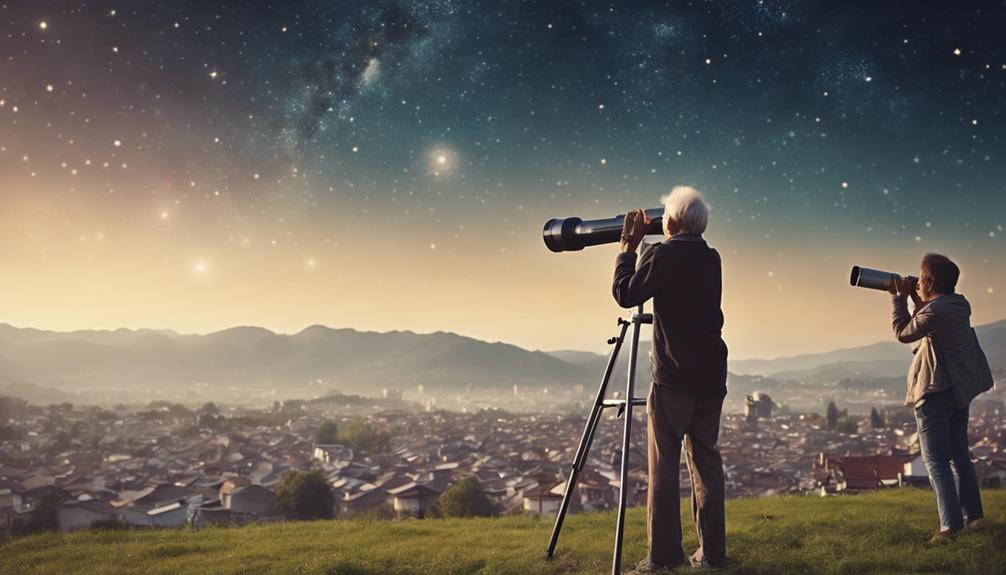
Telescopes haven’t only revolutionized our understanding of the cosmos but have also woven themselves into the fabric of modern culture, appearing in various forms of media and inspiring generations.
In popular culture, telescopes have been central to movies like ‘Contact’ and ‘Gravity’, as well as TV shows such as ‘Cosmos’ and ‘The Big Bang Theory’, reflecting society’s fascination with the universe and the tools we use to explore it. Modern telescopes, including the Hubble Space Telescope, have provided humanity with breathtaking images of distant galaxies and nebulae, fueling a cultural impact that extends into art, literature, and philosophy.
This influence is rooted in the way these images shift our perspective, offering a glimpse into the vastness of the universe and challenging our understanding of our place within it.
Thus, telescopes play a pivotal role in citizen science projects, empowering enthusiasts to contribute to astronomical research. Through analyzing data and even making discoveries, individuals can partake in the scientific process.
Virtual telescope programs and apps further democratize access to the cosmos, enabling people to explore celestial wonders from their homes. These initiatives highlight the telescope’s role as not just a scientific instrument but a cultural bridge, connecting the public to the universe in an interactive and educational manner.
The Future of Discovery: Educational Catalysts
Building on the cultural significance of telescopes in modern society, let’s explore how these instruments act as educational catalysts, shaping the future of discovery in classrooms and beyond.
As educational tools, telescopes offer unparalleled opportunities for engaging students in scientific exploration. They transform abstract concepts into tangible experiences, making the cosmos accessible and inspiring the next generation of scientists, astronomers, and engineers.
Here are four pivotal ways telescopes serve as educational catalysts:
- Promoting Interactive Learning: Virtual telescope tours and online resources allow students to immerse into the cosmos, fostering a hands-on approach to astronomy that encourages curiosity and critical thinking.
- Enhancing Practical Learning: Through the use of telescopes and astronomy kits in educational settings, students can directly observe celestial objects, applying theoretical knowledge in practical scenarios to grasp complex scientific concepts more effectively.
- Inspiring Future Scientists: By showcasing the wonders of the universe, telescopes in schools, museums, and observatories spark interest in scientific careers, encouraging students to pursue paths in science, technology, engineering, and mathematics (STEM).
- Facilitating Scientific Exploration: Educational programs, like NASA’s Hubble Space Telescope Outreach, connect students with cutting-edge astronomical discoveries, bridging the gap between academic learning and real-world scientific advancements.
Technological Advancements in Telescope Design

Over centuries, technological innovation has greatly advanced telescope design, enhancing our ability to probe the universe’s mysteries with greater clarity and precision.
Starting from Galileo Galilei’s basic design, telescopes have transformed into sophisticated instruments. These modern marvels, equipped with adaptive optics and digital cameras, have diversified into reflecting, refracting, radio, space, and infrared types to meet specific astronomical needs.
Key advancements such as interferometry and the incorporation of artificial intelligence for data analysis have revolutionized resolution and data processing capabilities. This evolution has been pivotal in confirming the heliocentric model, uncovering galaxies, discovering exoplanets, and delving into the enigmatic territories of black holes.
Today’s cutting-edge telescopes aren’t just tools for observation but are also platforms for groundbreaking discoveries. They aim for higher resolutions, search for extraterrestrial life, study the early universe’s nuances, and ignite scientific curiosity across communities.
Each leap in technology not only underscores the importance of continuous innovation but also reinforces the telescope’s legacy as a cornerstone of astronomical discovery and understanding.
Frequently Asked Questions
How Did the Telescope Change History?
Telescopes reshaped history by expanding maritime empires, influencing visual art, altering warfare strategy, challenging religious beliefs, and catalyzing economic shifts. You’ve seen the world anew, realizing the universe’s vastness and humanity’s place within it.
How Did the Telescope Impact Culture?
Telescopes’ve reshaped culture, sparking artistic inspiration, fueling philosophical debates, prompting mythology reevaluation, altering religious interpretations, and evolving entertainment. You’re witnessing a transformation in how humanity perceives its place in the cosmos, thanks to these pivotal instruments.
How Has the Telescope Helped Scientific Knowledge and Understanding in More Recent Times?
You’ve seen telescopes expose mysteries of dark energy, discover exoplanets, understand cosmic structures, observe gravitational waves, and image black holes, greatly expanding our scientific knowledge and understanding of the universe in recent times.
What Impact Did the Telescope Have in the Renaissance?
In the Renaissance, you’d have seen the telescope drive artistic inspiration, enrich Renaissance portraiture, stir philosophical debates, weave through literary references, and fuel economic growth, profoundly shaping your world’s intellectual and cultural landscapes.
Conclusion
To sum up, telescopes haven’t only revolutionized our understanding of the cosmos but have also profoundly shaped human culture and scientific thought. From Galileo’s confrontation with the Church to the ongoing quest to map the universe, telescopes have been pivotal.
The Hubble Space Telescope has observed over 40,000 celestial objects since its launch, a proof of their enduring legacy as tools of discovery.
As technological advancements continue to refine their capabilities, telescopes remain indispensable educational catalysts, ushering in new eras of exploration and enlightenment.
