The Great Dark Matter Hunt: Will 2025 Finally Solve the Universe’s Biggest Mystery?

Scientists are on the verge of cracking one of physics’ most perplexing puzzles. With the Vera C. Rubin Observatory coming online this year and breakthrough axion research showing promising results, 2025 could be the year we finally unmask the invisible force that makes up 85% of our universe’s mass.
The Hunt Intensifies
- The $473 million Vera C. Rubin Observatory in Chile is ready to map dark matter with unprecedented precision
- Revolutionary axion detection experiments using crystal structures are yielding exciting results
- AI-powered simulations are processing petabytes of cosmic data to track dark matter’s footprint
Why 2025 Is Different
For decades, dark matter has been physics’ most notorious ghost – we can see its gravitational effects but can’t directly detect it. But 2025 brings together three game-changing developments:
1. The Observatory Revolution
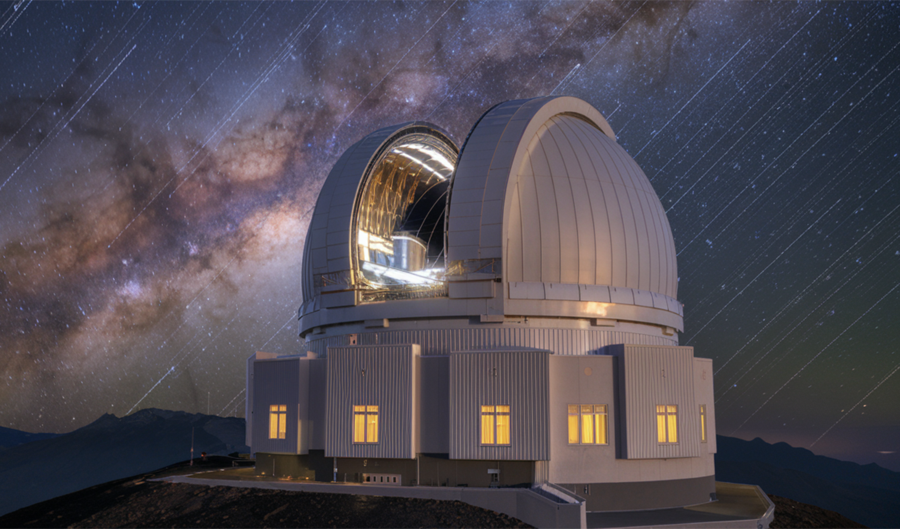
The Vera C. Rubin Observatory will capture the entire visible southern sky every few nights, creating the most detailed map of the universe ever attempted. Its 8.4-meter telescope and world’s largest digital camera will track how dark matter warps spacetime and bends light from distant galaxies.
2. The Axion Breakthrough
“We’re closer than ever to proving axions exist,” says Professor Maia Vergniory, whose team recently demonstrated how specialized crystal structures can mimic these theoretical dark matter particles. This groundbreaking approach could finally give us a way to detect dark matter directly.
3. AI-Powered Analysis
Modern supercomputers and AI are processing vast amounts of astronomical data, identifying patterns that human researchers might miss. This computational power is essential for:
- Analyzing gravitational lensing effects
- Mapping the cosmic web of dark matter
- Simulating galaxy formation and evolution
The Stakes Have Never Been Higher
The implications of solving the dark matter mystery go far beyond astronomy:
“Understanding dark matter could revolutionize our grasp of fundamental physics and potentially unlock new forms of energy and technology,” explains Dr. Alexandra Amon of the Dark Energy Survey.
A Universe at a Crossroads
Recent discoveries have revealed that dark matter dominated galaxy formation even 13 billion years ago, challenging our understanding of cosmic evolution. The Vera C. Rubin Observatory’s observations could either:
- Confirm our current theories about dark matter
- Force us to completely rethink our model of the universe
Looking Ahead
While 2025 may not give us all the answers, it represents our best chance yet at understanding this cosmic mystery. The convergence of next-generation technology, computational power, and theoretical breakthroughs has created perfect conditions for a potential discovery.
Whether through the detection of axions, unprecedented mapping of the cosmic web, or unexpected observations that challenge our current theories, 2025 promises to be a pivotal year in our quest to understand the invisible force that shapes our universe.
As we stand on the brink of potentially revolutionary discoveries, one thing is certain: our view of the cosmos will never be the same after this year.
