Top 5 Tips to Master Your Telescope for Star Gazing

As the stars above beckon, mastering your telescope becomes the bridge between mere curiosity and the profound exploration of the cosmos.
You’ve likely pondered the vastness above, but familiarizing yourself with the right type of telescope—be it a reflector, refractor, or the mighty Dobsonian—sets the stage for a journey through the stars.
By assembling it correctly, calibrating for accuracy, and maintaining its condition, you guarantee a clear window to the universe. And let’s not forget the magic of the right accessories to enhance your experience.
As you stand on the threshold of opening celestial secrets, remember, the journey is as vast as the sky itself, with each tip a stepping stone to the wonders above. Why stop when the universe is calling?
Key Takeaways
- Choose a telescope type that matches your experience and observing interests.
- Follow assembly instructions carefully and ensure proper calibration for best viewing results.
- Maintain your telescope by cleaning and storing it properly to extend its longevity.
- Enhance your stargazing with appropriate accessories and advanced techniques for a better observing experience.
Selecting the Right Telescope
When selecting the ideal telescope, it’s important to assess your experience level, making sure it aligns with your stargazing skills and knowledge.
Delving into the types of telescopes, such as refractor, reflector, and Dobsonian, is vital for making an informed decision. Refractor telescopes offer sharp and high-contrast images, making them excellent for observing planets and the moon. However, their optics, which rely on lenses, can be costly for larger apertures.
Reflectors, utilizing mirrors instead of lenses, provide a cost-effective solution for those interested in deep-sky objects.
Their design allows for larger apertures at a lower cost, but they require regular maintenance, including collimation, to make sure the mirrors are aligned correctly. Dobsonian telescopes, a subtype of reflectors, are known for their simplicity, ease of use, and large aperture sizes. They offer superb light-gathering capabilities, ideal for viewing faint deep-sky objects.
In selecting the right telescope, consider not just the type but also the quality of the optics and the stability of the mount. High-quality optics ensure clear, crisp images, while a stable mount is essential for tracking celestial objects smoothly and accurately. These considerations are pivotal in enhancing your stargazing experience, allowing for detailed observation and exploration of the cosmos.
Assembling Your Telescope Correctly
After selecting the right telescope that matches your stargazing needs, the next step involves assembling it correctly to guarantee peak performance during your celestial observations.
Following the manufacturer’s instructions meticulously is essential. These guidelines are designed to ensure that every component functions as intended, providing you with an excellent stargazing experience.
To assemble your telescope correctly:
- Follow the manufacturer’s instructions step by step to avoid any mistakes that could impair your telescope’s functionality.
- Confirm all components are securely attached, checking for any loose screws or parts that could compromise the stability or alignment of your telescope.
- Align the finder scope with the main telescope. This critical step aids in efficiently locating celestial objects in the night sky.
- Confirm that the mount is level and stable. A level mount is essential to prevent any vibrations or movements that could blur your view during observation.
- Confirm alignment of the main telescope and finder scope. This ensures that when you locate an object in your finder scope, it will appear in the main telescope’s field of view, ready for detailed observation.
Calibrating Your Telescope for Accuracy

To guarantee exact and accurate viewing, it’s essential that you properly collimate your telescope, aligning its optical components using tools like a laser or Cheshire eyepiece.
Collimation is critical, as it ensures that the light paths through your telescope’s optics are precisely aligned, directly impacting the clarity and sharpness of the images you observe. Without accurate collimation, even the most expensive telescopes can deliver subpar performance.
Equally important is the calibration of your finderscope. It must be accurately aligned with your telescope’s main optics to facilitate the quick location of celestial objects. This step is often overlooked, but it’s vital for efficient stargazing. Ensuring that your finderscope’s field of view matches that of your telescope will save you time and frustration.
Last but not least, don’t underestimate the importance of properly balancing your telescope on its mount. A well-balanced setup enhances stability, which is vital for tracking celestial objects smoothly and accurately. Inadequate balancing can lead to tracking errors and diminished observation quality.
Remember, stability is a cornerstone of accuracy in astronomy. Regularly checking and adjusting the balance, along with collimation and finderscope calibration, will maintain the best performance of your telescope, ensuring rewarding viewing experiences every time.
Maintaining Your Telescope for Longevity
After calibrating and balancing your telescope for accurate performance, it’s equally important to focus on its maintenance to guarantee its longevity and continued precision. As you aim to capture the beauty of the night sky, observing stars and constellations, maintaining your telescope becomes pivotal.
Proper care ensures that each celestial observation is as breathtaking as the last.
Consider the following maintenance tips to preserve your telescope’s functionality:
- Regularly clean the telescope lenses and mirrors with a gentle air blower or soft brush to prevent dust buildup, which can blur your view of the sky.
- Store your telescope in a dry, temperature-stable environment to prevent moisture damage and optical misalignment, ensuring that your views of the night sky remain sharp and clear.
- Check and adjust the telescope’s collimation regularly. Proper alignment of all optical components is vital for capturing optimal images of stars and constellations.
- Lubricate moving parts, such as focusers and mounts according to the manufacturer’s recommendations. This maintains smooth operation, allowing for seamless tracking and adjustments.
- Handle your telescope with care to avoid sudden movements or impacts that could misalign the optics or damage delicate components, ensuring the longevity of your window to the stars.
Enhancing the Experience With Accessories
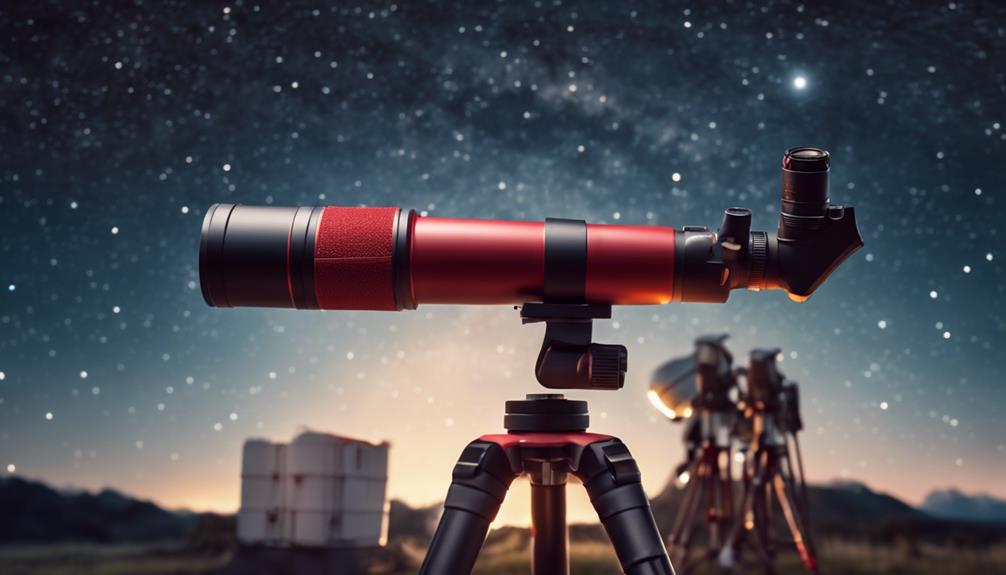
Selecting the right accessories, such as Barlow lenses and solar filters, can greatly enhance your telescope’s viewing capabilities and safeguard your eyes during solar observations. While Barlow lenses double or triple your magnification, it’s important to use them judiciously to avoid compromising image quality.
For solar viewing, solar filters are indispensable to protect your eyes from harmful rays. Alternatively, projection methods onto a white card offer a safer way to observe the sun without direct viewing.
Opting for lower magnifications guarantees a more stable and clear view, especially if your mount is prone to shaking.
It’s a common misconception that higher magnification yields better views. In reality, the best viewing experiences are often found at these lower magnifications, which also allow for wider fields of view, essential for exploring the night sky with star charts.
| Accessory | Purpose | Consideration |
|---|---|---|
| Barlow Lenses | Increase magnification | May impact image quality if overused |
| Solar Filters | Safe solar observation | Mandatory for eye safety |
| Projection Methods | Alternative solar viewing | Safer, uses white card/screen |
| Lower Magnifications | Stable, clear viewing | Recommended for shaky mounts, wider field of view |
| Star Charts | Guide through night sky | Enhance use of lower magnifications |
Incorporating these accessories thoughtfully into your stargazing routine can greatly enhance your observational experience.
Frequently Asked Questions
How Do I Get the Most Out of Stargazing?
To get the most out of stargazing, choose dark locations, consider Moon phases, and monitor weather conditions. Use stargazing apps, allow your eyes to adapt to the night, and maintain your equipment regularly.
How Do You Focus a Telescope Perfectly?
To focus your telescope perfectly, start with proper eyepiece selection and ensure mirror alignment. Use correct magnification, minimize light pollution, and avoid vibration. A consistent maintenance routine is essential for best performance and sharp focus.
How Can I See Better Through My Telescope?
To see better through your telescope, think of it as tuning a musical instrument. Choose eyepieces wisely, limit light pollution, understand magnification limits, maintain your telescope, and pick your viewing location considering atmospheric conditions.
How Do You Aim a Telescope at a Star?
To aim your telescope at a star, first consult star charts and guarantee proper mount and polar alignment. Use a finder scope, referencing celestial coordinates. Adjust carefully, preserving night vision for peak stargazing accuracy.
Conclusion
Ironically, mastering your telescope isn’t just about having the most advanced gear or the highest magnification.
It’s about the nuanced dance of correctly assembling its intricate parts, precisely calibrating its delicate systems, and diligently maintaining its complex mechanisms.
The real magic, however, lies in the simple addition of a few well-chosen accessories that elevate your star-gazing experience from ordinary to extraordinary. So, while you delve into the technical depths, don’t forget—it’s the small, thoughtful enhancements that truly open up the cosmos.
